The fastest way to ruin the dream of owning your time is to turn every evening into another shift.
The job remains.
Then comes the second job after it.
You spend Saturday building something nobody has asked for, giving your clearest remaining hours to a project that depends on you completely.
But if it needs every available hour, cannot operate without you and has never met a paying customer, you may not be building an asset.
You may be building another obligation.
That does not mean you should quit your job.
A good job can provide meaning, competence, relationships, credibility and a place to be useful.1 It can also provide the runway from which you build something of your own.
Research on hybrid entrepreneurship supports a more intelligent path than the dramatic leap celebrated online: begin while remaining employed, learn, then assume greater risk only when the evidence justifies it.2 People who entered full-time self-employment through this hybrid path had higher rates of survival than those who entered directly from paid employment.3
An asset is not passive income
There is no serious form of ownership that requires nothing from you.
A book must be written and marketed. Property requires capital, diligence and maintenance. Software needs development, support and improvement. A firm needs systems, people and judgment.
The honest distinction is not active versus passive.
It is whether every new unit of value permanently requires another equivalent unit of your time.
An asset may require enormous effort at the beginning. It may still require maintenance later. But it creates the possibility that value can continue, repeat or compound after the original hour has passed.
That possibility changes the architecture of a life.
Creation is not validation
Consider a composite example.
An experienced professional spends a year building a sophisticated digital tool around a problem they understand well. The product works. Industry peers praise it. Hundreds of people visit the page, join the waitlist and ask when it will become available.
Then the professional offers a paid pilot.
Almost nobody commits.
A year of effort has produced knowledge, software and attention. It has not yet produced a functioning commercial asset.
The market is asking a different question.
Have they connected a recognised problem to a result people want, a mechanism they trust and an offer they will pay for?
Not yet. Not reliably.
This does not make the work worthless. It means we must distinguish between what has been created and what it currently does. Knowledge, intellectual property, attention and reputation can enable an asset. None becomes a functioning commercial asset merely because it took effort to build.
The work must enter a system of service and exchange. That is what this plan is designed to create.
Step 1: Decide what freedom is for
Freedom is not the highest good merely because it removes constraint.
A person can become free enough to do nothing worthy.
Before deciding what to build, decide what the asset is meant to protect or make possible.
Is it greater presence for your children, time with your spouse, care for ageing parents, work that reflects your conscience, or more space for health, creativity, service, faith or thought?
The answer determines which sacrifices are intelligent and which defeat the purpose. Then give the desired life a financial and temporal shape.
Write:
Five years from now, I want my owned assets to produce ______ per year while requiring no more than ______ hours per week, so that I can ______.
The number will differ for every person. Calculate what your actual life requires.
Include housing, family responsibilities, health, taxes, saving, desired experiences and the continuing costs of the asset. Then state how much time you are willing for it to require once mature.
Without a number, you are working toward a feeling.
Without a purpose, the number has no natural end.
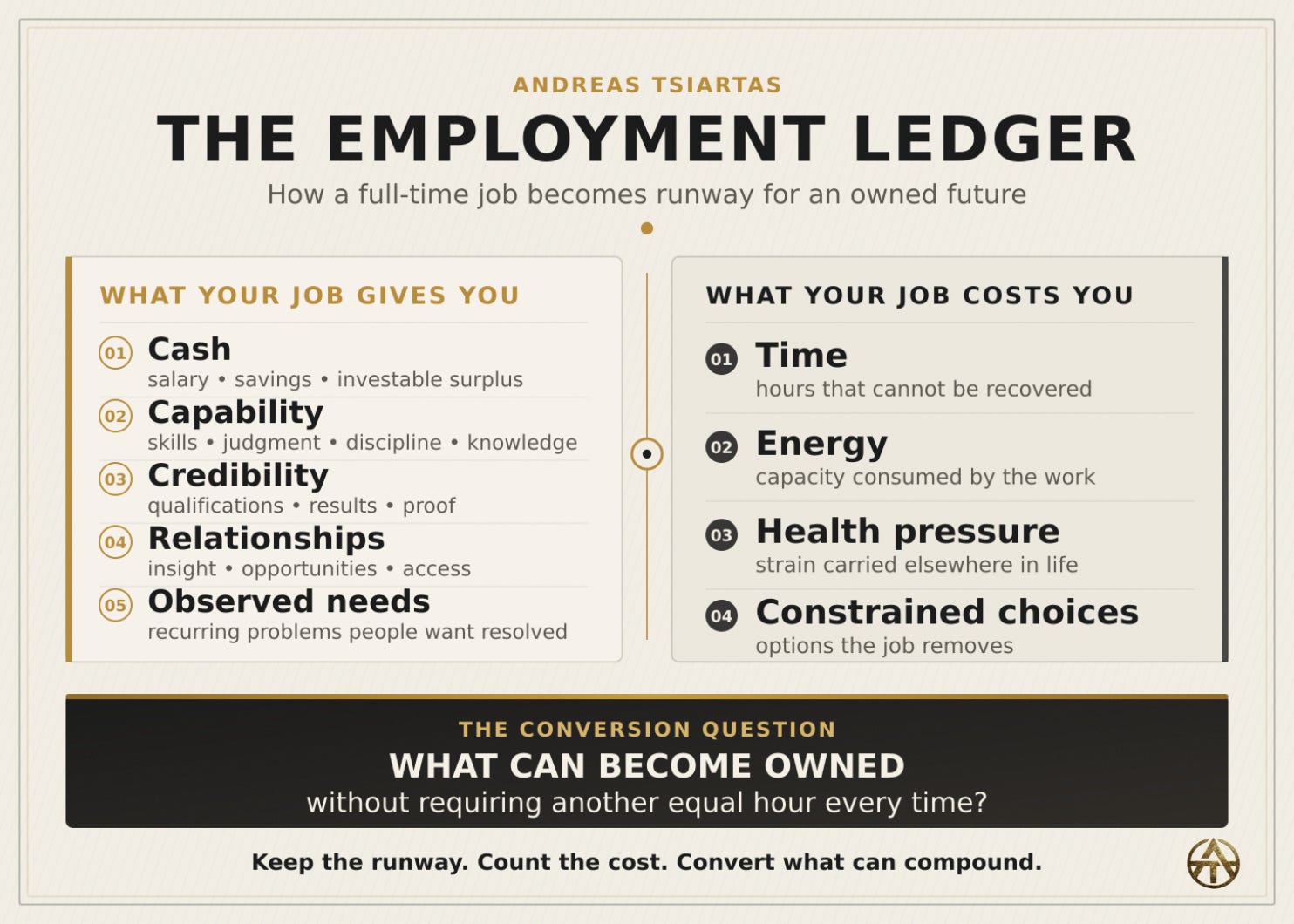
Step 2: Complete the Employment Ledger
Your job is not only paying you money. It may also be giving you the materials from which an owned future can be built.
List what it currently gives you in five columns:
Cash: salary, bonus, savings capacity and investable surplus.
Capability: skills, judgment, discipline and knowledge that remain yours.
Credibility: qualifications, results and proof that make other people trust your competence.
Relationships: people who deepen your understanding, enlarge your opportunities or reveal important problems.
Observed needs: recurring frustrations, delays, risks or unmet desires that people already want resolved.
Now add a sixth column:
Cost: time, energy, health pressure, constrained choices and what your work repeatedly takes from the rest of life.
Do not romanticise either side.
If you see only the cost, you may throw away valuable runway.
If you see only the salary, you may never notice what the runway was supposed to help you build.