

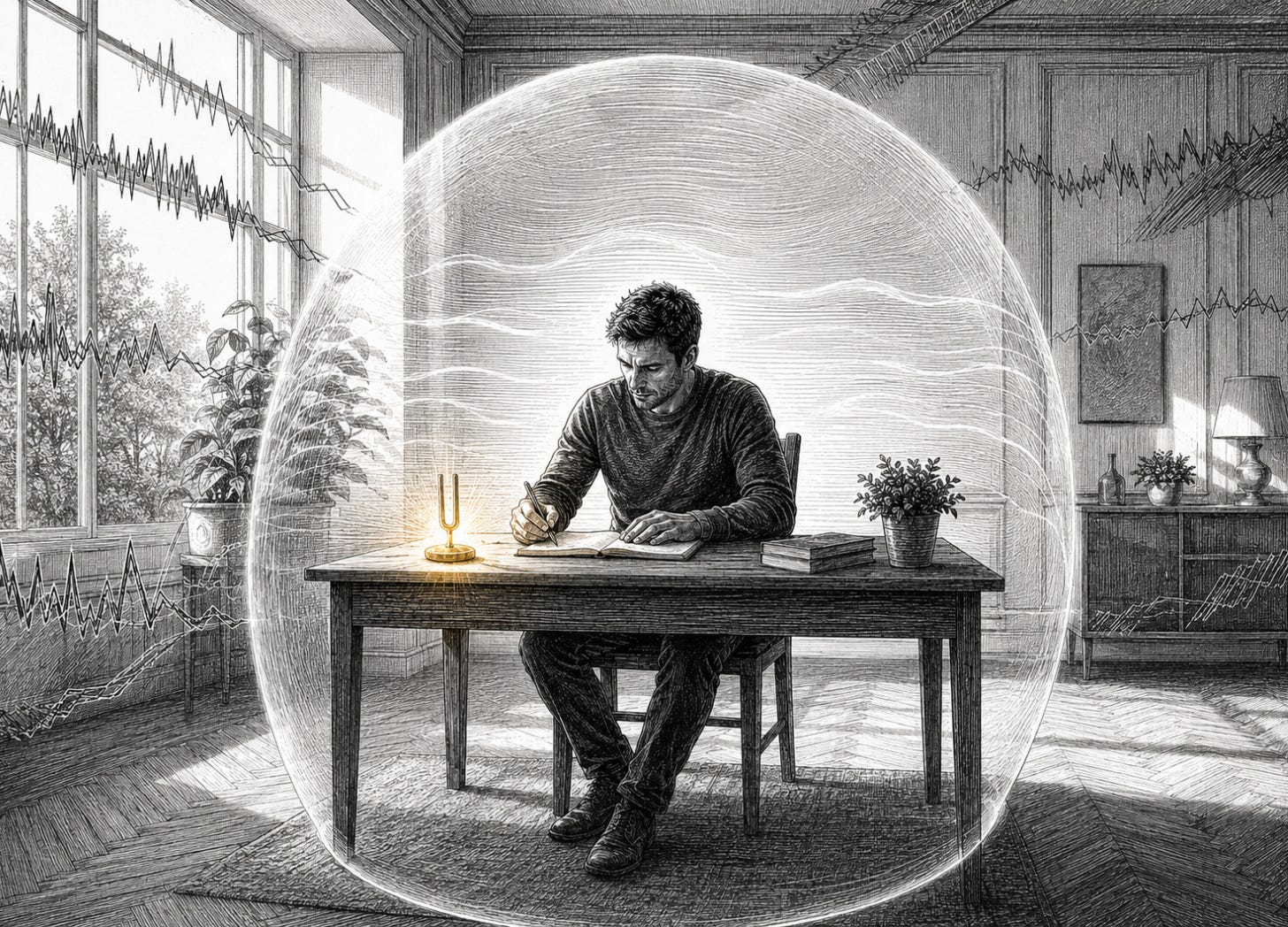
A room can make you smaller.
Not dramatically.
Not all at once.
Not in a way most people would notice.
But you notice it.
You sit down to write and the room keeps pulling at the edge of you.
The phone is there.
The tabs are there.
The wrong object is in view.
The light is flat.
The air feels stale.
A sound keeps asking to be interpreted.
A half-finished task sits beside the work like a silent accusation.
Nothing terrible is happening.
And still the mind does not fully arrive.
That is the subject of this essay.
The previous piece argued that movement changes the conditions of thought. It showed that the organism often needs a state transition before serious work becomes enterable. That was the last major gate of Act II: the body crossing into a better condition before the mind asks for depth.
Now the series moves outward.
Because even a better-prepared organism does not enter a vacuum.
It enters a field.
By the end of this essay, you will understand why the room is not just a container for thought, why environment belongs inside a serious theory of flow and peak mental states, why visual order, sound, light, air, tools, friction, and place meaning all matter, and why the next frontier of deep work is not only managing the mind, but engineering the field the mind has to enter.
The room is not decoration.
The room is part of the threshold.
Where this series is going
This essay begins Act III of The Hidden Architecture of Flow: Field, Support, and Distortions.
Act I dealt with entry: threshold, body, vigilance, boredom, and curiosity.
Act II dealt with consent, significance, stability, and movement.
Now Act III moves beyond the isolated individual into the field around him: environment, relationships, group flow, state support, salience, and the difference between clean elevation and distorted intensity.
Already live: the threshold essays, body-state essays, vigilance essays, curiosity essays, work-design essays, meaning essays, stability essays, and movement essays.
Coming next: Build a Room That Makes Absorption Easier, the subscriber protocol for light, sound, scent, order, and friction.
New public essays publish on Thursdays. Subscriber protocols follow on Mondays.
Thought does not happen in a neutral room
A lot of people still speak as if thinking happens inside the skull and the room merely hosts it.
That picture is too thin.
The mind is not a sealed chamber floating above the world. It is embodied, situated, and constantly shaped by what the organism perceives, reaches for, avoids, remembers, and anticipates. Grounded cognition rejects the idea that thought is independent of perception, action, bodily state, and situated experience. Ecological psychology also reminds us that environments are not passive scenes. They offer affordances, invitations for action, perception, movement, and use.1
There is an even stronger philosophical version of this argument. Clark and Chalmers famously argued that some external structures can become part of the cognitive process when they are reliably coupled to the person’s thinking.2 You do not need to accept the strongest version of that thesis to see the practical truth.
The notebook changes thought.
The desk changes thought.
The phone changes thought.
The visible pile changes thought.
The room you repeatedly use for deep work starts to become part of how the system knows what kind of state is being requested.
So when I say the room is part of the mind, I do not mean the walls think.
I mean the room participates.
It cues.
It burdens.
It invites.
It threatens.
It distracts.
It steadies.
It tells the nervous system what kind of place this is.
And the nervous system listens.
Flow has a place problem
Flow research has often centered the task: challenge, skill, goals, feedback, concentration, and intrinsic reward. That remains essential. But a newer scoping review on environments and flow makes the broader point explicit: flow is entangled with physical environments, including natural environments, built environments, place-based meanings, and the qualities of the setting itself.3
That matters because most flow advice still sounds strangely placeless.
It tells you to focus.
It tells you to set goals.
It tells you to remove distractions.
It tells you to match challenge to skill.
Fine.
But where?
In what room?
Under what light?
Beside which objects?
With what sound?
With what air?
With what history attached to that place?
With what tools laid out?
With what interruptions silently expected?
The task does not arrive alone.
It arrives with a sensory field.
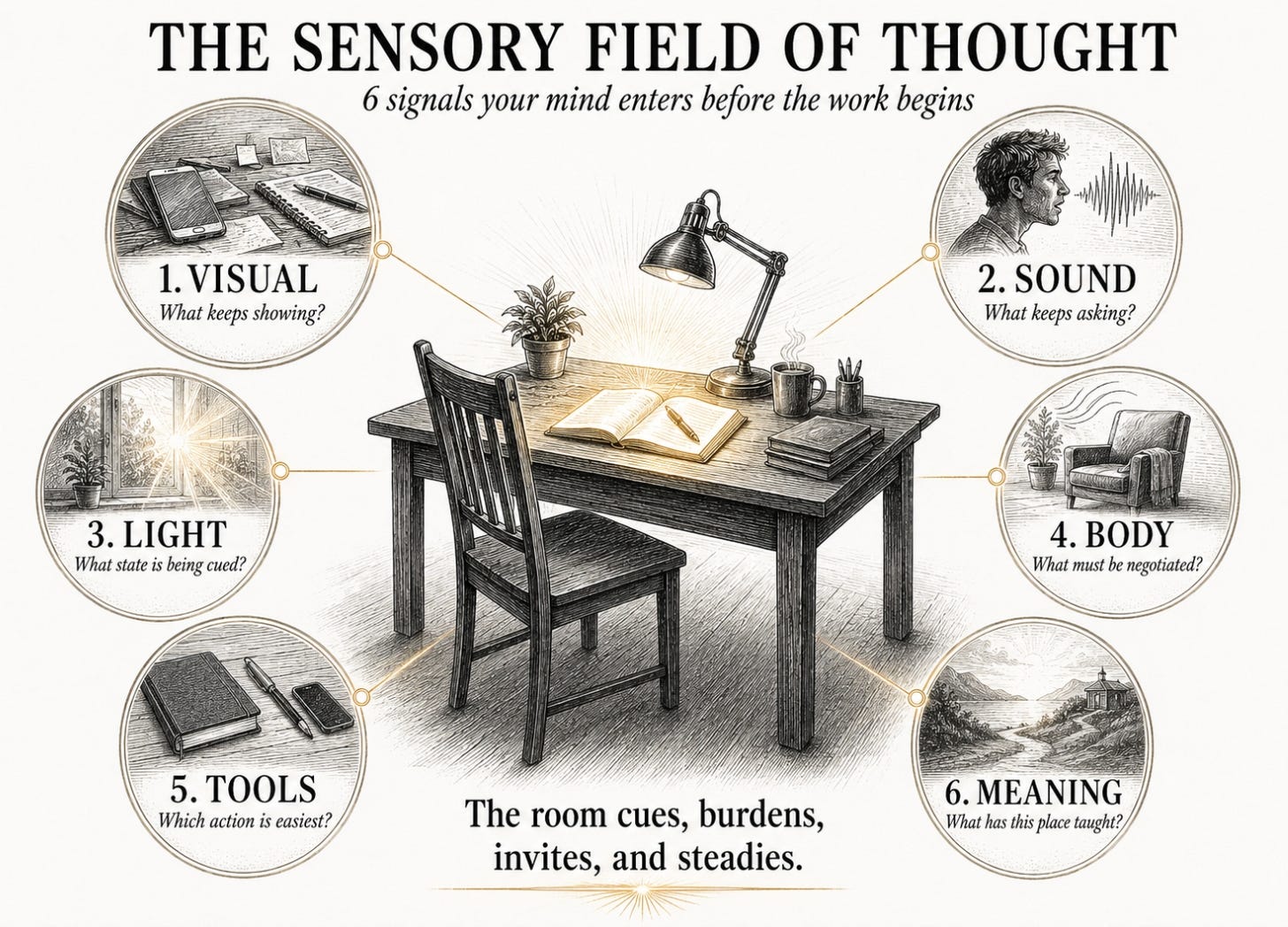
And that field changes whether the system feels invited, guarded, scattered, deadened, or ready.
This is why “just focus” is not enough.
Sometimes focus is not being lost inside the mind.
It is being spent by the room.
Some rooms make you guard
This is the first environmental law.
A bad room does not always distract loudly.
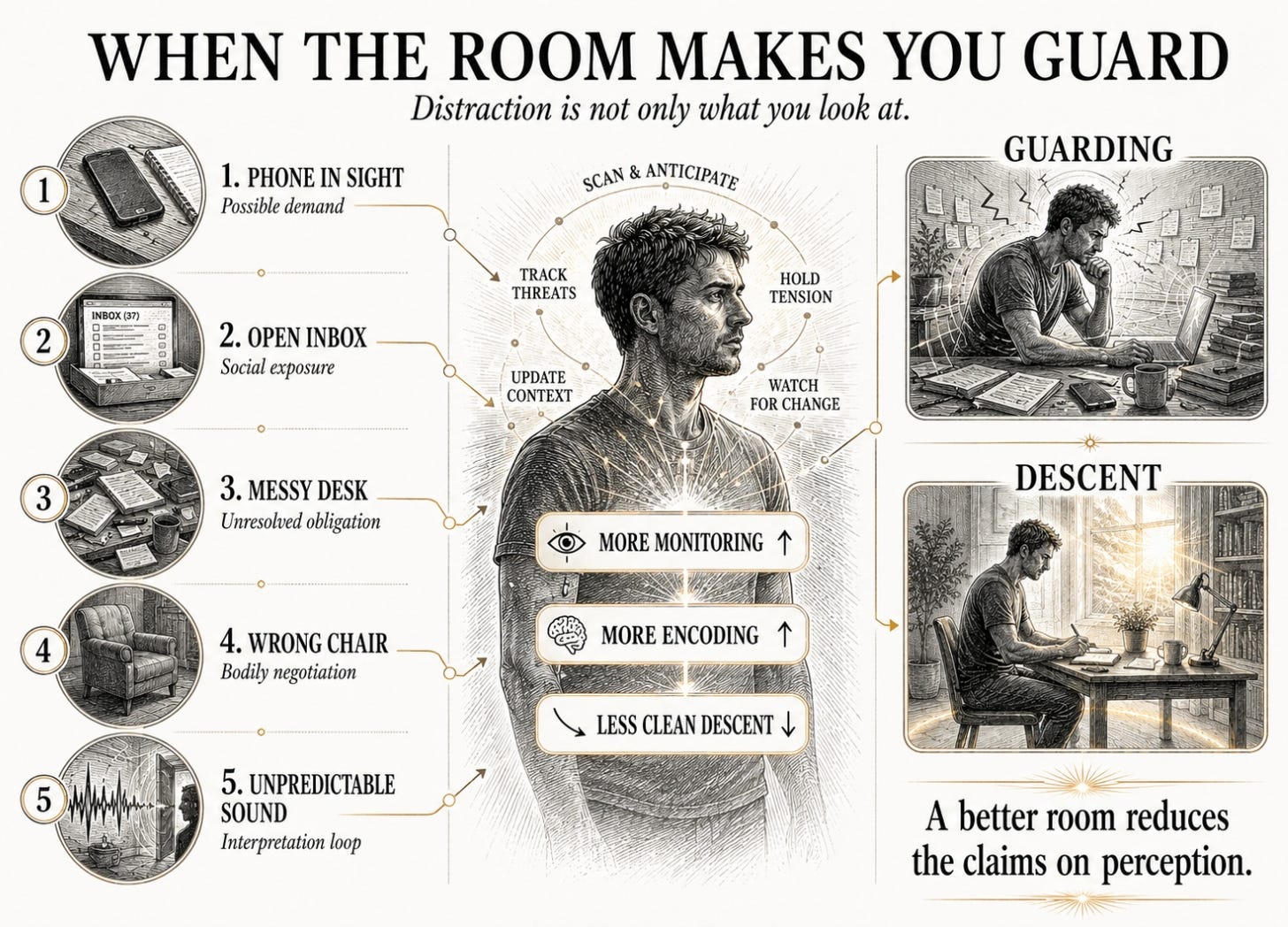
Sometimes it makes you guard quietly.
The phone in sight is not only a temptation.
It is a possible demand.
The open inbox is not only information.
It is social exposure.
The messy desk is not only visual clutter.
It is unresolved obligation made visible.
The wrong chair is not only discomfort.
It is low-grade bodily negotiation.
The unpredictable sound is not only noise.
It is a question the nervous system keeps trying to answer.
This connects directly to the vigilance essay.
A guarded system and a descending system are doing different jobs. A room that keeps asking the system to monitor will make absorption harder, even if the person is disciplined and the task matters. Research on visual distraction shows that even focal distractions during natural behaviour can have cascading effects, including slower behaviour, increased encoding demands, slower visual search, and reduced reliance on working memory.4
That sentence matters.
The cost of a distracting object is not only that you look at it.
It changes the way the system has to work.
And if the room is full of small claims on perception, the mind may never quite stop patrolling.
Visual order is not aesthetic vanity
A serious room does not need to be beautiful in a magazine sense.
It needs to be honest about the work it is asking for.
There is a difference between beauty and functional order.
A desk can be visually pleasing and still useless for depth.
A room can be plain and still powerful.
A tool path can be ugly and still clean.
A wall can be bare and still oppressive.
A shelf can be full and still coherent.
The question is not:
Does this room look good?
The question is:
What does this room make easier?
Environmental psychology and indoor environmental quality research have shown that visual factors, lighting, acoustics, air quality, thermal conditions, and spatial features can influence cognitive functioning, work performance, comfort, and attention-related outcomes.5 The point is not that every object on your desk determines your destiny. The point is that the sensory field has consequences.
The visual field should tell the mind what the block is for.
If the room is asking for ten different kinds of attention, do not be surprised when the mind struggles to offer one.
Sound can either hold the field or fracture it
Sound is not background for many minds.
It is an active participant.
Speech fragments are especially costly because they carry meaning. The system cannot always treat them as meaningless noise. It tries to parse them. It asks whether the sound matters. It checks whether it belongs to you. It interprets, predicts, and sometimes prepares to respond.
That is not neutral.
Open-plan office noise has been shown to affect cognition, emotion, physiology, and restoration, and background sound can influence working memory and task performance depending on level, type, and task demand.6
This does not mean silence is always best.
Some tasks benefit from stable sound.
Some people think well with low, predictable audio.
Some writing opens under music.
Some study needs quiet.
Some strategic work needs a sound field that does not carry language.
The deeper rule is this:
The sound must stop asking to be solved.
If the sound keeps making the nervous system interpret, monitor, or anticipate, it is not ambience.
It is work.
Light is part of the field
Light is often treated as décor.
Wrong category.
Light shapes alertness, circadian timing, perception, mood, and the felt quality of a room. Real-world light exposure research now suggests that higher daytime light exposure and less fragmented light patterns are associated with better performance across visual search, psychomotor vigilance, and working memory tasks, though the evidence should still be read with appropriate caution because much of this work is correlational.7
That is enough to matter.
Flat light can make work feel dead.
Harsh light can make the system brace.
Dim light can make the mind slide toward sleep or drift.
Morning daylight can make the world feel more enterable.
A lamp can create a boundary.
A window can become a regulator.
The point is not to worship light.
The point is to stop pretending it is decorative.
A room’s light tells the body what time, what mood, and what kind of readiness may be available.
The mind does not ignore that message.
Air, temperature, and comfort are not trivial
Some rooms make thinking feel heavier before you know why.
The air feels stale.
The temperature is slightly wrong.
The body keeps adjusting.
The posture keeps shifting.
The background discomfort never becomes dramatic, but it keeps taking small payments.
That matters because cognitive work depends on available resources. Indoor environmental quality research links air quality, thermal comfort, acoustic conditions, lighting, and other indoor variables to cognitive functioning, learning, work performance, and comfort.8
Again, precision matters.
A slightly warm room does not ruin genius.
A slightly imperfect chair does not destroy flow.
A less-than-ideal office does not mean deep work is impossible.
But repeated bodily negotiation changes the cost of entry.
If the body keeps having to solve the room, the mind receives less cleanly from it.
The room carries memory
Not all environmental influence is sensory.
Some of it is historical.
A room remembers through association.
Not literally.
But the nervous system does.
If a room is where you scroll, collapse, argue, panic, eat badly, work vaguely, sleep poorly, and half-answer messages, that room has a history. When you sit down there, the system does not enter a blank space. It enters a learned field.
Place attachment research shows that human bonds with places involve affective, cognitive, behavioural, personal, and social dimensions. Places are not merely coordinates. They can carry meanings, memories, identity, security, belonging, and threat.9
This is why some places feel easier to work in than others.
A library changes some people immediately.
A chapel changes some people immediately.
A gym changes some people immediately.
A studio changes some people immediately.
A familiar chair by a window can change the whole nervous system’s expectation.
The place has become a cue.
Not because the place has magic.
Because repeated meaning, action, and state have been tied together there.
Nature is not just scenery
Nature belongs in this essay, but it must be handled carefully.
There is a shallow version of this claim: go outside, nature is good.
True, but insufficient.
The deeper point is that certain environments restore attention differently from environments that constantly demand directed control. Attention Restoration Theory argues that directed attention can fatigue, and that natural environments are often rich in qualities that support recovery from that fatigue.10 A 2025 meta-analysis on nature exposure and attention restoration found that many studies associate nature exposure with improved cognitive performance compared with non-natural exposure, while also emphasizing that effect sizes and results vary by duration and outcome.11
So the correct claim is not that every plant creates flow.
The correct claim is more disciplined:
some environments reduce the burden of attention, while others increase it.
That distinction matters for the whole season.
A room that constantly asks for control, filtering, interpretation, and defense makes depth expensive.
A room that offers enough order, steadiness, and living contact can make depth less costly.
That is why the environment is not a side note.
It is one of the ways attention is either taxed or returned to itself.
Tools are part of the room’s intelligence
A room does not only shape you through atmosphere.
It shapes you through action paths.
Where is the notebook?
Where is the first source?
Where is the draft?
Where is the phone?
Where is the timer?
Where is the book?
Where is the instrument?
Where is the object that tells the system, “this is what we do here”?
This is where Gibson’s idea of affordances becomes practical. Objects and environments offer possibilities for action. A chair affords sitting. A pen affords writing. A phone affords checking. An open inbox affords response. A visible guitar affords playing. A closed notebook affords nothing until opened. The environment is full of invitations, and the body perceives many of them before conscious deliberation has finished.12
That means the room is always making suggestions.
Some are helpful.
Some are expensive.
Some are irrelevant.
Some are dangerous for the state you are trying to build.
A serious workspace does not merely contain tools.
It arranges invitations.
The tool you need should be easier to reach than the tool that steals you.
That is not a hack.
That is architecture.
The modern room is too many rooms at once
This is where modern life becomes especially hostile to depth.
The bedroom is also the office.
The office is also the meeting room.
The desk is also the entertainment centre.
The phone is also the library, casino, post office, theatre, argument chamber, market, and social court.
The laptop is both the tool of creation and the opening through which the whole world can enter.
No wonder the mind struggles to know what state is being requested.
The room is sending mixed orders.
Work.
Scroll.
Answer.
Compare.
Consume.
Create.
Buy.
React.
Perform.
Rest.
All from the same place.
This is one reason the threshold work from the first essay matters so much. A threshold is partly a way of telling the organism: this is no longer the field of everything. This is the field of one thing.
The environment must support that declaration.
If the room keeps contradicting the ritual, the ritual has to fight the room.
A room can invite surrender
This is the positive side.
A good room does not force flow.
No room can do that.
But a good room can make surrender less costly.
It can reduce needless choices.
It can quiet irrelevant signals.
It can stabilize sensory input.
It can make the first action obvious.
It can make the body feel held enough to stop guarding.
It can carry meaning from previous work.
It can make the right tool appear before the wrong impulse arrives.
That is why the strongest claim in this essay is not simply:
Environment matters.
Everyone says that eventually.
The stronger claim is:
The room is one of the co-authors of the state.
Not the author of the work.
Not the owner of your discipline.
Not the source of your standards.
But a co-author of the state from which thought begins.
And if that state matters, the room matters.
Why this belongs here in the series
The sequence matters.
We could not start with the room.
If the body is under-slept, the room alone will not save the block.
If the system is vigilant, aesthetic order alone will not create depth.
If the task is dead, a beautiful desk will not generate pull.
If the work feels coercive, a lamp will not create consent.
If the task lacks meaning, a view from the window will not give it weight.
If the mind is noisy, the room may help, but it cannot do the whole work.
If the organism has not crossed the state boundary, environment will not replace movement.
That is why this is Pair 9.
The series has moved through the person’s internal gates first.
Now we enter the field.
The environment is not the first answer to every depth problem.
But once the internal gates have been named, the room becomes impossible to ignore.
Because the room is where all the gates meet.
Body.
Vigilance.
Curiosity.
Consent.
Meaning.
Stability.
Movement.
Each one is affected by the field.
That is why Act III begins here.
The rep for today
Do not redesign your whole workspace today.
Read the room.
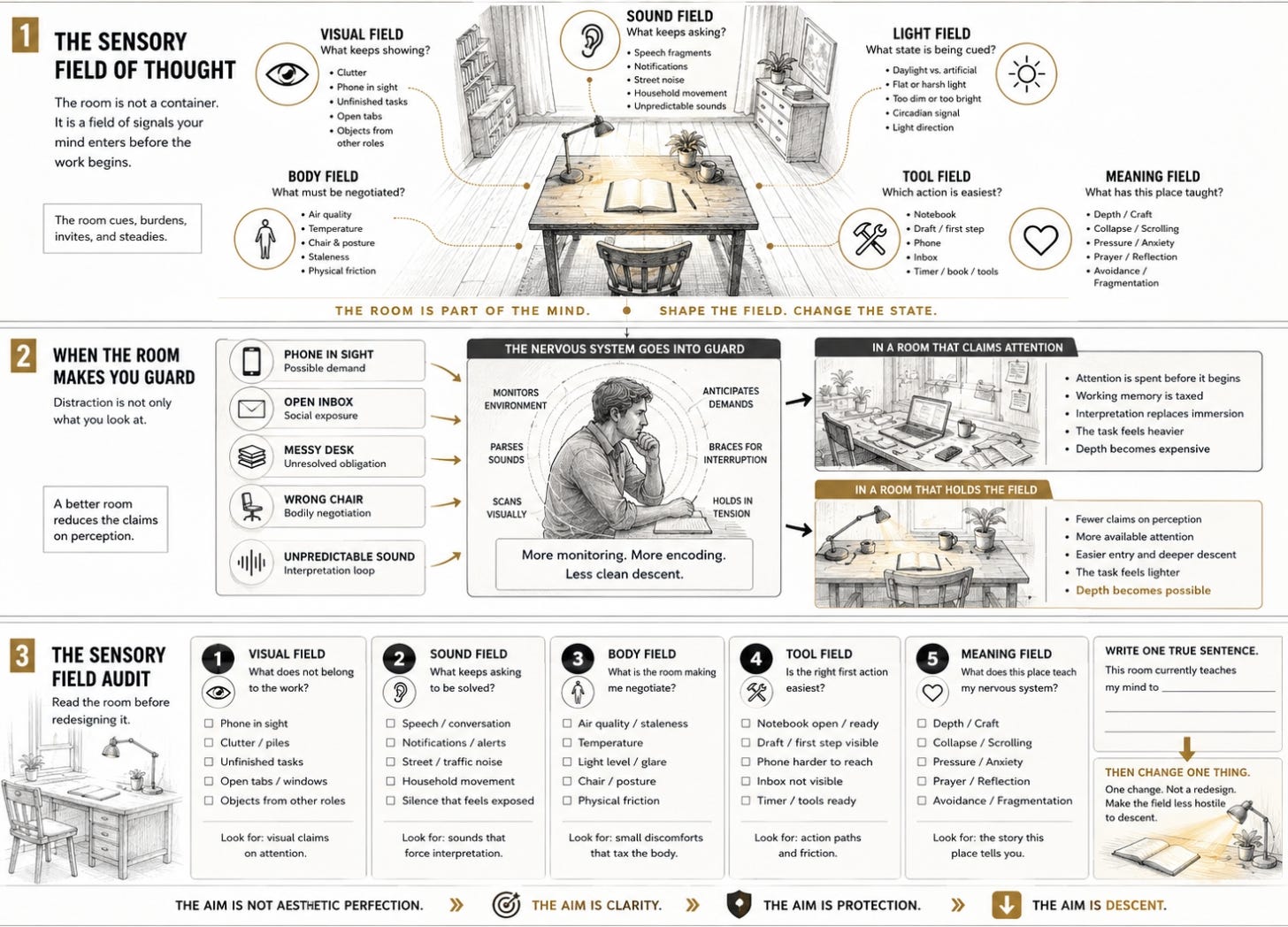
The Sensory Field Audit
Choose one place where you regularly ask for deep work.
Then answer five lines.
1. Visual field
What does the room keep showing me that does not belong to the work?
Phone?
Clutter?
Unfinished tasks?
Open tabs?
Objects from another role of life?
2. Sound field
What sound makes me interpret, monitor, brace, or wait?
Speech?
Notifications?
Street noise?
Household movement?
Silence that feels too exposed?
3. Body field
What is the room making my body solve?
Light?
Air?
Temperature?
Chair?
Posture?
Staleness?
Physical friction?
4. Tool field
Is the first right action easier than the first wrong action?
Is the notebook open?
Is the draft ready?
Is the phone easier to reach than the work?
5. Meaning field
What does this place currently mean to my nervous system?
Depth?
Collapse?
Scrolling?
Pressure?
Prayer?
Craft?
Avoidance?
Fragmentation?
Then write one sentence:
This room currently teaches my mind to ________.
Do not make it elegant.
Make it true.
Then change one thing only.
One.
Maybe it is:
phone outside the room
one screen only
lamp on before writing
notebook open before sitting
no inbox visible
chair moved toward light
one work object placed where the phone usually sits
a different room for deep work
a fixed sound field
a cleared visual line in front of the eyes
One change.
The aim is not aesthetic perfection.
The aim is to make the field less hostile to descent.
The standard to keep
Do not ask the mind to go deep in a field that keeps pulling it apart.
That is the standard.
The room is not everything.
But it is not nothing.
It is not decoration.
It is not merely background.
It is not a neutral box where the real work happens elsewhere.
The room participates.
It can make the system guard.
It can make the task feel dead.
It can scatter perception.
It can carry old associations.
It can invite the wrong action.
It can make the first move harder than it has to be.
Or it can do the opposite.
It can narrow the field.
Quiet the perimeter.
Support the body.
Clarify the first act.
Protect the threshold.
Remind the system what kind of person enters here and what kind of work is done.
That is why the room is part of the mind.
Not because the room thinks for you.
Because thought is never as placeless as we pretend.13
The Thursday essays clarify the architecture.
The Monday manuals turn it into practice: environmental audits, visual subtraction, soundscape design, light and temperature decisions, scent anchors, tool layout, and field-tested protocols built to be used under pressure, not merely admired in theory.
Next Monday’s subscriber edition is Build a Room That Makes Absorption Easier: The Environment Protocol for light, sound, scent, order, and friction.
Gibson, J.J. (1979) The Ecological Approach to Visual Perception. Boston, MA: Houghton Mifflin; Barsalou, L.W. (2008) ‘Grounded cognition’, Annual Review of Psychology, 59, pp. 617–645. doi: 10.1146/annurev.psych.59.103006.093639.
Clark, A. and Chalmers, D.J. (1998) ‘The extended mind’, Analysis, 58(1), pp. 7–19. doi: 10.1093/analys/58.1.7.
Abuhamdeh, S. (2020) ‘Investigating the “flow” experience: key conceptual and operational issues’, Frontiers in Psychology, 11, Article 158. doi: 10.3389/fpsyg.2020.00158; Peifer, C., Wolters, G., Harmat, L., Heutte, J., Tan, J., Freire, T., Tavares, D., Fonte, C., Andersen, F.O., van den Hout, J., Šimleša, M., Pola, L., Ceja, L. and Triberti, S. (2022) ‘A scoping review of flow research’, Frontiers in Psychology, 13, Article 815665. doi: 10.3389/fpsyg.2022.815665; Cumming, M., Gatersleben, B., Davies, J., van Buuringen, A. and Isham, A. (2025) ‘Environments and the experience of flow: a scoping review’, Journal of Environmental Psychology, 104, Article 102605. doi: 10.1016/j.jenvp.2025.102605.
Kumle, L., Võ, M.L.-H., Nobre, A.C. and Draschkow, D. (2024) ‘Multifaceted consequences of visual distraction during natural behaviour’, Communications Psychology, 2, Article 49. doi: 10.1038/s44271-024-00099-0.
Wang, C., Zhang, F., Wang, J., Doyle, J.K., Hancock, P.A., Mak, C.M. and Liu, S. (2021) ‘How indoor environmental quality affects occupants’ cognitive functions: a systematic review’, Building and Environment, 193, Article 107647. doi: 10.1016/j.buildenv.2021.107647.
Jahncke, H., Hygge, S., Halin, N., Green, A.M. and Dimberg, K. (2011) ‘Open-plan office noise: cognitive performance and restoration’, Journal of Environmental Psychology, 31(4), pp. 373–382. doi: 10.1016/j.jenvp.2011.07.002; Sun, Z., Hu, S., Xie, S., Wu, L., Jiang, C., Ding, S., Zhang, Z., Xu, W. and Li, H. (2025) ‘Does background sound impact cognitive performance and relaxation states in enclosed office?’, Building and Environment, 267, Article 112313. doi: 10.1016/j.buildenv.2024.112313.
Didikoglu, A., Woelders, T., Bickerstaff, L., Mohammadian, N., Johnson, S., van Tongeren, M., Casson, A.J., Brown, T.M. and Lucas, R.J. (2026) ‘Relationships between light exposure and aspects of cognitive function in everyday life’, Communications Psychology, 4, Article 5. doi: 10.1038/s44271-025-00373-9.
Wang, C., Zhang, F., Wang, J., Doyle, J.K., Hancock, P.A., Mak, C.M. and Liu, S. (2021) ‘How indoor environmental quality affects occupants’ cognitive functions: a systematic review’, Building and Environment, 193, Article 107647. doi: 10.1016/j.buildenv.2021.107647; Young, A.S., Parikh, S., Dedesko, S., Bliss, M., Xu, J., Zanobetti, A., Miller, S.L. and Allen, J.G. (2024) ‘Home indoor air quality and cognitive function over one year for people working remotely during COVID-19’, Building and Environment, 257, Article 111551. doi: 10.1016/j.buildenv.2024.111551.
Scannell, L. and Gifford, R. (2010) ‘Defining place attachment: a tripartite organizing framework’, Journal of Environmental Psychology, 30(1), pp. 1–10. doi: 10.1016/j.jenvp.2009.09.006.
Kaplan, S. (1995) ‘The restorative benefits of nature: toward an integrative framework’, Journal of Environmental Psychology, 15(3), pp. 169–182. doi: 10.1016/0272-4944(95)90001-2.
Bell, C.N., St George, R., Honan, C., Bell, L.J., Jolly, A.T.W. and Matthews, A. (2025) ‘The relationship between nature exposures and attention restoration, as moderated by exposure duration: a systematic review and meta-analysis’, Journal of Environmental Psychology, 104, Article 102632. doi: 10.1016/j.jenvp.2025.102632.
Gibson, J.J. (1979) The Ecological Approach to Visual Perception. Boston, MA: Houghton Mifflin.
Background reading: Bratman, G.N., Hamilton, J.P., Hahn, K.S., Daily, G.C. and Gross, J.J. (2015) ‘Nature experience reduces rumination and subgenual prefrontal cortex activation’, Proceedings of the National Academy of Sciences, 112(28), pp. 8567–8572. doi: 10.1073/pnas.1510459112.