

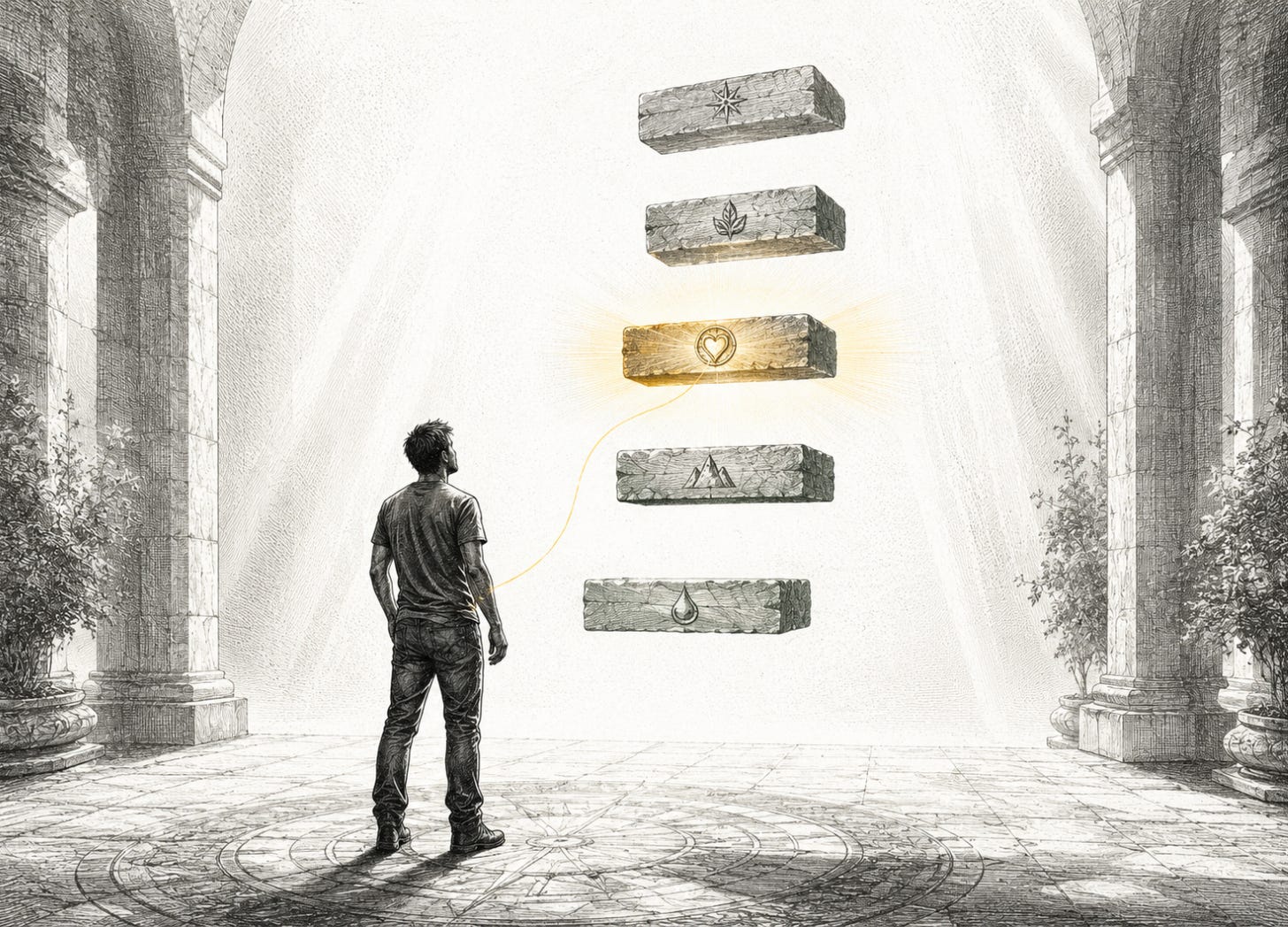
A task can be chosen and still remain too thin to hold you.
You can consent to it.
You can believe you are capable of it.
You can even see why it matters in a general way.
And still your attention does not descend.
Because the system is asking a deeper question:
What is this worth?
Not what is the deadline.
Not what is the reward.
Not what is the pressure.
Not what will happen if I fail.
What is this worth?
That is the problem this manual is built to solve.
The previous essay argued that the mind rarely goes deep under coercion. It showed that autonomy, competence, and self-efficacy help the task become more enterable. But consent is not the same as significance. A person can choose the work and still not give it much of himself. That is why this pair moves from the willing mind to the meaningful task.
This is not sentimental.
The recent flow literature makes the point more serious than that. Barthelmäs, Stöckle and Keller (2025) tested task meaningfulness as an antecedent of flow and found that it was positively related to flow beyond skills-demands fit, with especially strong relevance for absorption and intrinsic reward. That matters because it means meaning is not merely an inspiring layer added after the real mechanics. It may change the depth profile of attention itself.1
This manual is the operational version of that claim.
It is not about finding a grand purpose before you answer an email.
It is not about pretending every task is sacred.
It is not about motivational theatre.
It is about loading work with enough real significance that attention has a stronger reason to stay.
Where this series is going
This season explores the hidden architecture of flow, not as hacks but as a field theory of entry, coherence, and peak mental states.
Today: Load a Task With Enough Meaning to Go Deep
This manual gives you:
The Meaning Audit
The Significance Ladder
The Identity Bridge
The Contribution Map
The Consequence Chain
The Meaning Cue Card
And, the Pre-Block Significance Ritual
Already live:

Next: A Noisy Mind Struggles to Go Deep.
Upgrade for the full sequence of field manuals, templates, and troubleshooting.
Most people fail here because they confuse meaning with intensity.
They think a task is meaningful because it is urgent.
Or visible.
Or profitable.
Or high-stakes.
Or frightening.
Or attached to reputation.
But urgency is not meaning.
Stakes can produce vigilance.
Pressure can produce compliance.
Fear can produce output.
None of those guarantees depth.
Meaning is different. It gives the task weight in a eudaimonic sense: not merely pleasure, but worth, growth, alignment, service, and fuller functioning.2 In meaningful-work research, Steger, Dik and Duffy (2012) describe meaningful work as involving positive meaning in work, work as a route to making meaning, and the perception that one’s work benefits a greater good.3
That gives us the sharper frame:
Meaning changes what attention is willing to spend itself on.
Before the paywall, do this first.
The Meaning Audit
Take one important task that you can consent to, but that still does not draw your full depth.
Then answer five lines.
1. What is this task as it currently appears to me?
A chore? A deadline? A performance? A burden? A box to tick? A threat?
2. What is this task actually in service of?
A person? A standard? A future? A craft? A promise? A responsibility? A repair?
3. Who benefits if this is done well?
Be specific. A reader, client, patient, student, family member, team, future self, or community.
4. What consequence follows from poor work here?
Not melodrama. Reality. What becomes weaker, confused, delayed, cheapened, or less protected?
5. What would make this task feel heavier in the right way?
Identity? Service? Craft? Duty? Truth? Love? Stewardship?
Then write one sentence:
This task needs meaning because ________.
That sentence is the hinge.
Because below the paywall, the manual becomes exact.
You will move the task through a significance ladder.
You will connect it to identity without turning identity into ego.
You will map contribution without faking nobility.
You will trace consequence without using fear as fuel.
You will create a meaning cue card for the block.
And you will use a short pre-block ritual that gives the task the right kind of weight before you ask attention to descend.
