

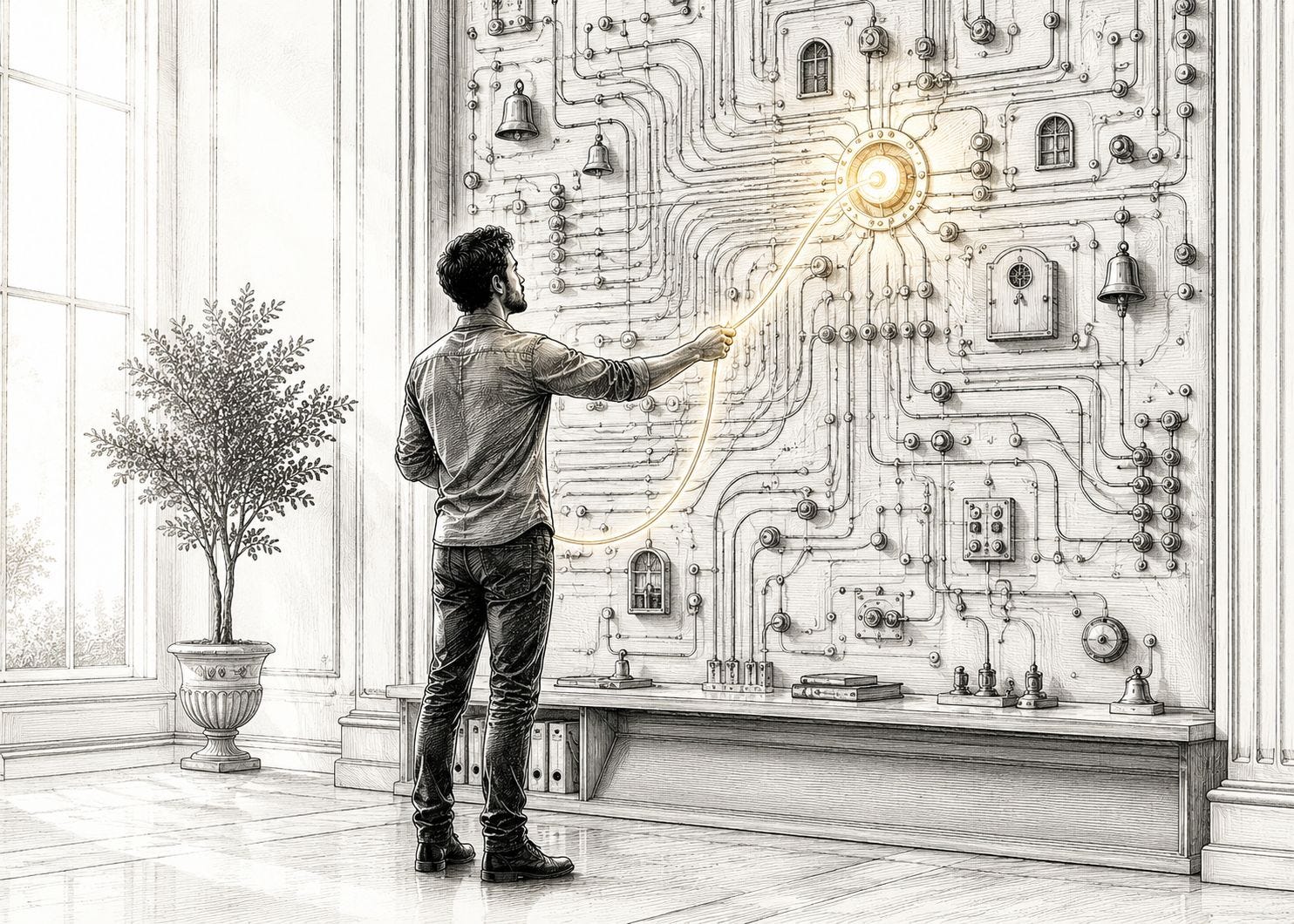
You do not attend to what matters most.
Not always.
You attend to what the system has learned to mark as mattering.
That difference can shape a life.
A phone lights up, and the mind turns.
A criticism from yesterday returns, and the body tightens.
A half-finished task calls from the edge of awareness.
A social risk becomes louder than the work itself.
A reward cue, a threat cue, a familiar loop, a status signal, a bodily sensation, an unresolved question, all of them start competing for admission.
You may still want depth.
But wanting depth is not enough if the wrong signals keep winning the gate.
That is the subject of this essay.
The previous pair asked where compounds belong in peak mental states. It argued that support can help, but support is not sovereignty. A tool may sharpen, steady, energize, or extend a state, but it cannot decide wisely for you what deserves admission into awareness.
That is the next layer.
Salience.
By the end of this essay, you will understand why attention is not merely a spotlight controlled by will, why the reticular activating system should not be turned into pop-neuroscience mythology, why threat, reward, novelty, identity, unfinished business, and environment can all train what gets noticed, and why deep work depends not only on focusing harder, but on teaching the system what deserves entry.
Salience is not magic.
It is the politics of attention.
Where this series is going
This essay continues Act III of The Hidden Architecture of Flow: Field, Support, and Distortions.
Act I dealt with entry: threshold, body, vigilance, boredom, and curiosity.
Act II dealt with consent, meaning, stability, and movement.
Act III has moved through environment, group flow, and state support.
Now we turn to salience: the gate that decides what becomes noticeable, urgent, interesting, threatening, unfinished, valuable, or worthy of attention.
Already live: the threshold, body, vigilance, curiosity, work design, meaning, stability, movement, environment, group-flow, and state-support essays and manuals.
Coming next: Train the Mind to Notice the Right Things, the subscriber protocol for cueing, signal selection, and attentional gating.
New public essays publish on Thursdays. Subscriber protocols follow on Mondays.
Attention is not a blank spotlight
A lot of people talk about attention as if it were a flashlight in the hand.
Point it there.
Hold it there.
Stop pointing it elsewhere.
That picture is useful, but incomplete.
The attention system is not only voluntary. It involves alerting, orienting, selection, executive control, arousal, reward history, threat learning, bodily state, task relevance, and environmental cues.1
That means your attention is not merely asking:
What do I want to focus on?
It is also asking:
What is loud?
What is new?
What is dangerous?
What has mattered before?
What has rewarded me before?
What is unfinished?
What fits my identity?
What does the room keep cueing?
What does the body keep flagging?
What does the social field make risky?
The mind does not admit everything equally.
It gates.
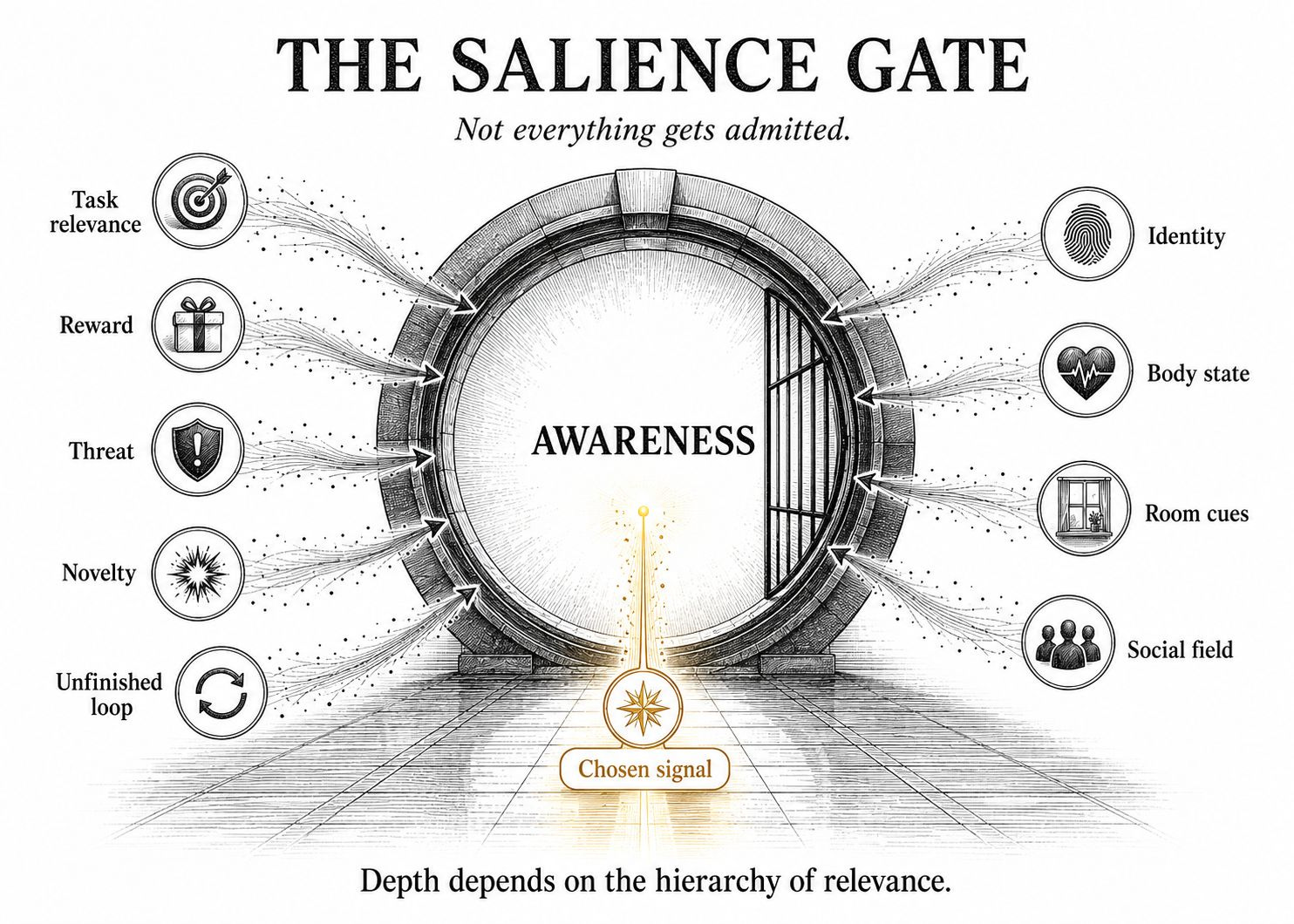
That is why discipline alone is such an incomplete answer.
You can decide that deep work matters and still lose the gate to a signal the system has learned to treat as more urgent.
What salience means here
Salience means something like:
This matters.
Not always consciously.
Not always wisely.
Not always accurately.
But functionally.
A salient signal wins priority. It is admitted into perception, attention, emotion, or action more easily than other signals.
Sometimes salience is physical.
A flash.
A bang.
A red notification.
A moving object.
A sudden sound.
Sometimes salience is motivational.
A reward.
A threat.
A possibility.
A risk.
A person whose opinion matters.
A cue linked to past pain or past pleasure.
Sometimes salience is unfinished.
An open loop.
An unresolved task.
A conversation not yet metabolized.
A decision not yet made.
Sometimes salience is identity-based.
What a father notices.
What a fighter notices.
What a clinician notices.
What an entrepreneur notices.
What a person afraid of rejection notices.
What a person building a life of depth notices.
Salience is not one thing.
It is a gate where many forces meet.
The RAS is not a manifestation machine
We need to clear this early.
The reticular activating system is often abused in popular self-help.
People say:
Tell your RAS what you want and it will filter the world for your goals.
There is a grain of truth buried inside a lot of nonsense.
The reticular activating system, and the broader ascending arousal system, are involved in wakefulness, arousal, and the regulation of conscious state. It is not a mystical assistant scanning reality for whatever you wrote in a journal. It is part of the neurobiology that helps make wakeful attention possible.2
That distinction matters.
Yes, arousal and relevance change what becomes available.
Yes, goals and learning shape attention.
Yes, repeated cues train what the system notices.
But no, the RAS is not a magic filter for attracting outcomes.
If we are going to talk about salience seriously, we have to stay adult.
The better frame is this:
The brain and body constantly regulate wakefulness, relevance, threat, reward, and task engagement. Attention is biased by what the system has learned, what the task requires, what the environment presents, and what the organism is prepared to act on.3
That is enough.
It is also more useful than the myth.
The salience network is not hype
There is also a more specific brain-network conversation here.
The salience network is commonly described as a network anchored in regions such as the anterior insula and anterior cingulate cortex. It is thought to help detect behaviourally relevant internal and external events, and to coordinate switching between internally oriented and externally oriented task states.4
Do not turn that into cartoon neuroscience.
Still, the idea is useful.
A serious mind must constantly decide:
Do I stay with the task?
Do I shift to the body?
Do I respond to the room?
Do I attend to the social threat?
Do I follow the unfinished thought?
Do I remain in the paragraph?
Do I return to the prayer?
Do I keep solving this problem?
Depth depends on the quality of those admissions.
A shallow life is often not a life without attention.
It is a life where the wrong things keep being granted priority.
Salience has three great sources
There are many ways to describe the attention literature, but for practical clarity, we can begin with three forces.
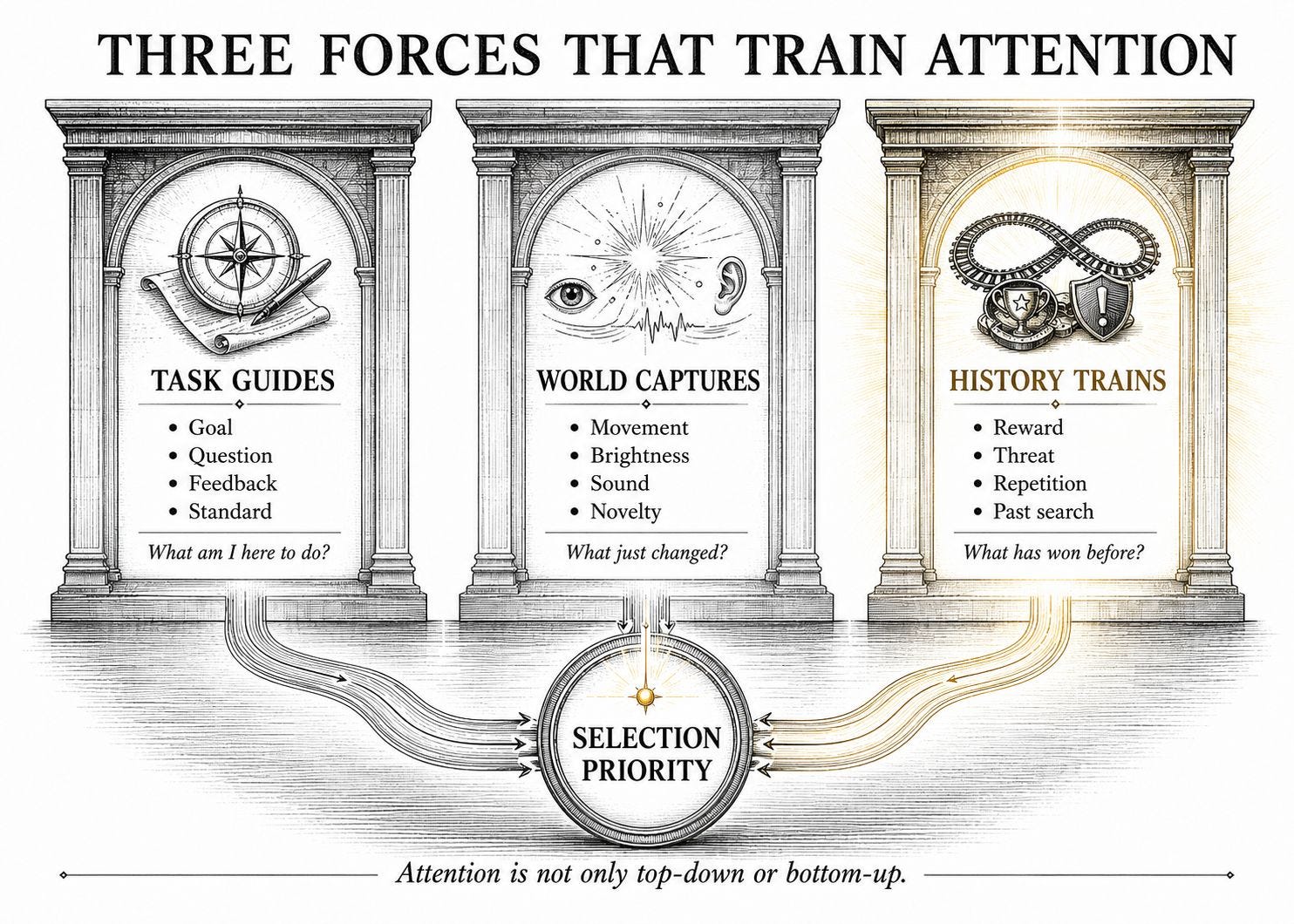
1. The task can guide attention
This is goal-directed attention.
If you are looking for your keys, key-shaped things become more relevant.
If you are editing a paragraph, awkward sentences become more visible.
If you are studying anatomy, structures and relations begin to matter.
If you are praying, the chosen text or burden can become the centre.
Goal matters.
But goal is not sovereign by itself.
That is the mistake.
You can have a noble goal and still be captured by the phone.
2. The world can capture attention
This is stimulus-driven attention.
Movement.
Brightness.
Sound.
Novelty.
Contrast.
A sudden change.
The world is always making claims.
Some are important.
Some are cheap.
Some are emergency signals.
Some are digital traps dressed as urgency.
You are not weak because the world can capture you.
You are human.
The question is whether your environment keeps using that fact against your depth.
3. History can train attention
This may be the most important source for modern life.
Awh, Belopolsky and Theeuwes (2012) argued that the old distinction between top-down and bottom-up attention is incomplete, because attention is also shaped by selection history. Anderson and colleagues later reviewed selection history as a third mechanism of attentional control, showing that learning, reward, aversive outcomes, and prior search experience can bias what gets selected.5
This explains so much.
The phone wins because it has won before.
The inbox wins because it has mattered before.
The criticism wins because it hurt before.
The body sensation wins because it scared you before.
The metric wins because it rewarded or punished you before.
The conflict wins because it remains unresolved.
History marks signals.
Then the present pays for it.
Reward trains the gate
Reward is one of the clearest ways salience becomes trained.
Anderson, Laurent and Yantis (2011) showed that stimuli previously associated with reward could later capture attention even when they were no longer task-relevant.6 That is the core logic behind value-driven attentional capture.
This should disturb modern people more than it does.
Because the modern digital world is built to train selection history.
Notifications.
Metrics.
Likes.
Messages.
Variable rewards.
Novel clips.
Social feedback.
A tiny possibility that something important or flattering has happened.
Each exposure trains the gate.
Then you sit down to write, study, pray, build, or think, and you wonder why the wrong things glow.
They glow because they have been paid before.
Not always with money.
With relief.
With novelty.
With status.
With reassurance.
With escape.
With belonging.
With the feeling that you are still connected to the moving world.
The reward does not need to be large.
It only needs to be repeated.
Threat trains the gate too
Threat may train even faster.
A person who has been criticized starts noticing tone.
A person who has failed publicly starts noticing exposure.
A person who has been interrupted starts listening for interruption.
A person who has felt unsafe around authority starts tracking faces, pauses, and small shifts in voice.
This is not weakness.
It is learning.
Threat-related attentional bias has been repeatedly documented in anxiety research, and motivational-salience work suggests that both reward- and threat-associated stimuli can guide attention through learned relevance.7
That matters for flow.
Because if the system marks threat as the most relevant signal, the task becomes secondary.
The paragraph is there.
The person is watching.
The memory is speaking.
The body is tight.
The consequence is imagined.
The mind says: attend to danger first.
That is not a focus failure.
It is salience being assigned to the wrong master for the work you are trying to do.
Unfinished business keeps asking for entry
Some signals become salient because they are incomplete.
An unfinished task.
An unanswered message.
An unresolved promise.
A decision not made.
A conflict not addressed.
A plan not formed.
Masicampo and Baumeister (2011) found that unfulfilled goals can produce intrusive thoughts and interfere with unrelated tasks, while making specific plans can reduce those cognitive effects.8
That is one reason the mind sometimes refuses to go cleanly into the present task.
Not because the present task is unimportant.
Because another task still has a claim.
An unfinished goal does not always need to be completed before deep work.
But it often needs to be contained.
Otherwise it remains at the gate, tapping on the glass.
This connects directly to everything we have built in the series.
Thresholds matter because they mark what enters.
Rooms matter because they show or hide open loops.
Task containment matters because unfinished business can hijack salience.
Meaning matters because the right task needs enough weight to compete.
Vigilance matters because threat claims priority.
Salience is where many earlier gates meet.
Identity decides what looks important
Identity is one of the deepest salience filters.
A hungry person sees food.
A parent hears a child.
A fighter sees threat and opening.
A clinician sees symptoms and mechanisms.
A writer hears the weakness in a sentence.
A spiritual person notices whether the day is drifting from reverence into noise.
You do not perceive a neutral world.
You perceive through a trained self.
Identity-based motivation research argues that identities can influence action-readiness, what feels congruent, and what strategies seem appropriate.9 That means identity does not only shape what you do after attention arrives. It shapes what appears worth noticing.
This is dangerous and powerful.
Dangerous because a threatened identity can make the wrong signals unbearably loud.
Am I respected?
Am I behind?
Am I winning?
Am I being seen?
Am I safe?
Am I special?
Am I failing?
Powerful because a cultivated identity can make better signals more visible.
Where is the truth?
Where is the craft?
Where is the next rep?
Who is being served?
What does this moment require?
What would make this cleaner?
What is the standard?
You do not only need better focus.
You may need a better self to focus from.
Support can alter salience
This is why Pair 12 follows Pair 11.
Compounds and tools can change what feels salient.
Caffeine can make the task feel more available.
It can also make threat feel sharper.
A calming tool can make the room feel safer.
It can also make the work feel less urgent.
A nootropic can increase mental energy.
It can also increase perseveration on the wrong thing.
A peptide or advanced tool may alter state in ways the user does not fully understand.
The tool does not only change energy.
It can change what gets admitted.
That is why the State-Support Protocol had to come before this essay.
If you use a tool without understanding salience, you may amplify the wrong gate.
More activation can make the right signal brighter.
It can also make the wrong signal louder.
That is why sovereignty matters.
Salience decides whether flow can gather
Flow needs deep absorption, reduced self-consciousness, strong task engagement, clear goals, workable feedback, and action-awareness coupling.10
But those conditions do not assemble cleanly if the gate keeps admitting competitors.
The phone.
The threat.
The unfinished task.
The social risk.
The reward cue.
The bodily sensation.
The identity question.
The wrong environment.
The wrong internal loop.
Each one says:
Attend to me.
Flow requires more than attention.
It requires the right hierarchy of relevance.
The task must become salient enough to hold.
The distractions must become less entitled.
The body must stop flagging needless alarm.
The room must stop offering the wrong invitations.
The meaning must be alive enough to compete.
The mind must stop treating every internal event as urgent.
That is why salience belongs in the series.
It is the gate before the gate.
Not all salience is good salience
This is where the next essay begins to appear.
Some signals feel powerful because they are true.
Others feel powerful because they are intense.
Those are not the same.
A threat cue can feel profound.
A panic signal can feel urgent.
A stimulant state can feel meaningful.
A compulsive loop can feel like destiny.
A deadline can feel sacred because fear has made it bright.
A social status signal can masquerade as purpose.
This is one reason high performers get misled.
They assume the strongest signal is the truest signal.
Not always.
Sometimes the strongest signal is the most trained, the most rewarded, the most threatening, or the most unresolved.
That distinction will matter enormously in the final pair, because not every intense state is flow.
Some intensity is coherent.
Some is distorted.
Salience can lead to both.
Training salience is not manifestation
Let us say this plainly.
Training salience does not mean pretending the universe rearranges itself around your desires.
It means teaching your own system what deserves priority.
That is humbler.
It is also harder.
Because the system is already trained.
It has been trained by every reward you repeat.
Every fear you obey.
Every room you enter.
Every notification you answer.
Every unfinished task you leave uncontained.
Every identity you rehearse.
Every tool you use.
Every group you join.
Every story you tell yourself about what matters.
So the work is not to “set an intention” and wait.
The work is to retrain the gate.
Make the right thing visible.
Make the wrong thing less available.
Close what should not remain open.
Name what should matter.
Cue what should return.
Remove what has been falsely rewarded.
Build a self that notices what the life requires.
That is not manifestation.
That is discipline at the level of perception.
Why this belongs here in the season
The order matters.
We could not start with salience.
Before this, we had to build the architecture.
Threshold tells the system when a new state is being requested.
Body-state affects what the organism can admit without distress.
Vigilance explains why threat can dominate the gate.
Curiosity explains how a task becomes interesting enough to pull.
Consent explains whether the task feels self-endorsed enough to enter.
Meaning explains what gives the task enough weight.
Stability explains how internal noise can be noticed without obeyed.
Movement explains how the organism crosses state boundaries.
Environment explains how the room cues or fractures attention.
Group flow explains how people shape the social field.
State support explains how tools can help or corrupt the architecture.
Now we can ask:
What gets admitted into awareness?
That is salience.
And once we understand that, the final pair can become far sharper.
Because the last danger is this:
the wrong thing can become so salient that we mistake it for flow.
The rep for today
Do not try to fix your whole attention today.
Read the gate.
The Salience Audit
Think of one deep block that failed or fractured recently.
Then answer six lines.
1. What kept winning admission?
Phone, inbox, body sensation, old conversation, metric, fear, unfinished task, social judgment, fantasy, urgency, reward cue?
2. What kind of salience was it?
Threat, reward, novelty, unfinished business, identity, body, environment, social field, or task relevance?
3. Why did this signal feel more important than the work?
Was it trained, feared, rewarded, unresolved, visible, embodied, or identity-linked?
4. What signal should have been more salient?
The first sentence, the client, the prayer, the problem, the decision, the craft, the standard, the person served?
5. What would make the right signal easier to admit next time?
A cue, closed loop, visible question, removed phone, clearer task, stronger meaning sentence, different room, different support tool?
6. What would make the wrong signal less entitled?
Distance, timing boundary, completion, containment, silence, hidden metric, no notification, written plan?
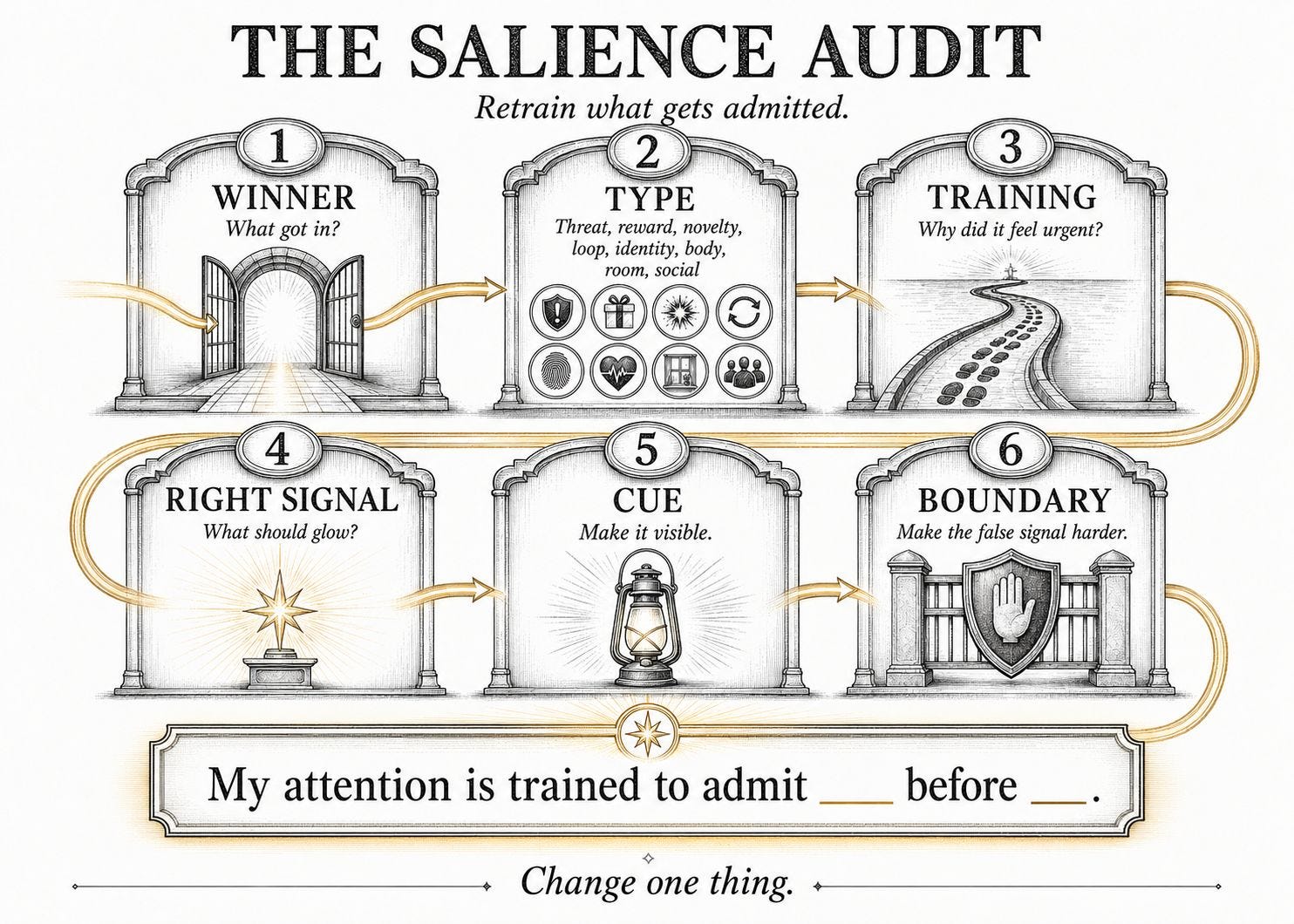
Then write one sentence:
My attention is currently trained to admit ________ before ________.
Make it honest.
Not elegant.
Then change one thing.
One.
Maybe it is:
write the task question before opening the laptop
close one unfinished loop before the block
remove the reward cue from sight
hide metrics until after work
place the first sentence in the centre of the screen
write the meaning cue on paper
turn the phone off before the room is entered
make the desired signal visible and the false signal absent
state one identity cue: “A serious writer notices the claim first”
Do not ask only, “How do I focus harder?”
Ask, “What have I trained my mind to treat as worth admitting?”
That is the sharper question.
The standard to keep
What gets admitted into awareness decides your depth.
That is the standard.
Attention is not only willpower.
It is not only distraction.
It is not only a spotlight.
It is not the private servant of your stated goals.
Attention is trained by threat, reward, novelty, memory, identity, body, room, people, tools, and unfinished business.
The question is not whether you can notice.
The question is what your system has learned to notice first.
A shallow life is often built by repeated admissions.
One more signal.
One more interruption.
One more false urgency.
One more rewarded distraction.
One more threat treated as sovereign.
One more unfinished loop left to haunt the gate.
A deeper life is built differently.
By making the right things visible.
By making the false things harder to reach.
By closing loops.
By naming the task.
By training identity.
By choosing rooms, tools, people, and rituals that teach the mind what matters.
That is why salience belongs in the hidden architecture of flow.
Not because salience is a secret trick.
Because depth depends on what the mind is allowed to treat as important.11
If this series speaks to you, subscribe.
The Thursday essays clarify the architecture.
The Monday manuals turn it into practice: salience audits, cue design, implementation intentions, identity-linked prompts, unresolved-loop clearance, and protocols built to be used under pressure, not merely admired in theory.
Next Monday’s subscriber edition is Train the Mind to Notice the Right Things: The Salience Protocol for cueing, signal selection, and attentional gating.
Posner, M.I. and Petersen, S.E. (1990) ‘The attention system of the human brain’, Annual Review of Neuroscience, 13, pp. 25–42. doi: 10.1146/annurev.ne.13.030190.000325; Awh, E., Belopolsky, A.V. and Theeuwes, J. (2012) ‘Top-down versus bottom-up attentional control: a failed theoretical dichotomy’, Trends in Cognitive Sciences, 16(8), pp. 437–443. doi: 10.1016/j.tics.2012.06.010.
Taran, S., Gros, P., Gofton, T., Boyd, G., Neves Briard, J., Chassé, M. and Singh, J.M. (2023) ‘The reticular activating system: a narrative review of discovery, evolving understanding, and relevance to current formulations of brain death’, Canadian Journal of Anesthesia/Journal canadien d’anesthésie, 70(4), pp. 788–795. doi: 10.1007/s12630-023-02421-6.
Awh, E., Belopolsky, A.V. and Theeuwes, J. (2012) ‘Top-down versus bottom-up attentional control: a failed theoretical dichotomy’, Trends in Cognitive Sciences, 16(8), pp. 437–443. doi: 10.1016/j.tics.2012.06.010; Anderson, B.A., Kim, H., Kim, A.J., Liao, M.-R., Mrkonja, L., Clement, A. and Grégoire, L. (2021) ‘The past, present, and future of selection history’, Neuroscience & Biobehavioral Reviews, 130, pp. 326–350. doi: 10.1016/j.neubiorev.2021.09.004; Taran, S., Gros, P., Gofton, T., Boyd, G., Neves Briard, J., Chassé, M. and Singh, J.M. (2023) ‘The reticular activating system: a narrative review of discovery, evolving understanding, and relevance to current formulations of brain death’, Canadian Journal of Anesthesia/Journal canadien d’anesthésie, 70(4), pp. 788–795. doi: 10.1007/s12630-023-02421-6.
Menon, V. and Uddin, L.Q. (2010) ‘Saliency, switching, attention and control: a network model of insula function’, Brain Structure and Function, 214(5–6), pp. 655–667. doi: 10.1007/s00429-010-0262-0; Seeley, W.W. (2019) ‘The salience network: a neural system for perceiving and responding to homeostatic demands’, Journal of Neuroscience, 39(50), pp. 9878–9882. doi: 10.1523/JNEUROSCI.1138-17.2019.
Awh, E., Belopolsky, A.V. and Theeuwes, J. (2012) ‘Top-down versus bottom-up attentional control: a failed theoretical dichotomy’, Trends in Cognitive Sciences, 16(8), pp. 437–443. doi: 10.1016/j.tics.2012.06.010; Anderson, B.A., Kim, H., Kim, A.J., Liao, M.-R., Mrkonja, L., Clement, A. and Grégoire, L. (2021) ‘The past, present, and future of selection history’, Neuroscience & Biobehavioral Reviews, 130, pp. 326–350. doi: 10.1016/j.neubiorev.2021.09.004.
Anderson, B.A., Laurent, P.A. and Yantis, S. (2011) ‘Value-driven attentional capture’, Proceedings of the National Academy of Sciences of the United States of America, 108(25), pp. 10367–10371. doi: 10.1073/pnas.1104047108.
Bar-Haim, Y., Lamy, D., Pergamin, L., Bakermans-Kranenburg, M.J. and van IJzendoorn, M.H. (2007) ‘Threat-related attentional bias in anxious and nonanxious individuals: a meta-analytic study’, Psychological Bulletin, 133(1), pp. 1–24. doi: 10.1037/0033-2909.133.1.1; Kim, H., Nanavaty, N., Ahmed, H., Mathur, V.A. and Anderson, B.A. (2021) ‘Motivational salience guides attention to valuable and threatening stimuli: evidence from behavior and functional magnetic resonance imaging’, Journal of Cognitive Neuroscience, 33(12), pp. 2440–2460. doi: 10.1162/jocn_a_01769.
Masicampo, E.J. and Baumeister, R.F. (2011) ‘Consider it done! Plan making can eliminate the cognitive effects of unfulfilled goals’, Journal of Personality and Social Psychology, 101(4), pp. 667–683. doi: 10.1037/a0024192.
Oyserman, D. (2009) ‘Identity-based motivation: implications for action-readiness, procedural-readiness, and consumer behavior’, Journal of Consumer Psychology, 19(3), pp. 250–260. doi: 10.1016/j.jcps.2009.05.008.
Abuhamdeh, S. (2020) ‘Investigating the “flow” experience: key conceptual and operational issues’, Frontiers in Psychology, 11, Article 158. doi: 10.3389/fpsyg.2020.00158; Peifer, C., Wolters, G., Harmat, L., Heutte, J., Tan, J., Freire, T., Tavares, D., Fonte, C., Andersen, F.Ø., van den Hout, J., Šimleša, M., Pola, L., Ceja, L. and Triberti, S. (2022) ‘A scoping review of flow research’, Frontiers in Psychology, 13, Article 815665. doi: 10.3389/fpsyg.2022.815665.
Background reading: Aston-Jones, G. and Cohen, J.D. (2005) ‘An integrative theory of locus coeruleus-norepinephrine function: adaptive gain and optimal performance’, Annual Review of Neuroscience, 28, pp. 403–450. doi: 10.1146/annurev.neuro.28.061604.135709; Itti, L. and Koch, C. (2001) ‘Computational modelling of visual attention’, Nature Reviews Neuroscience, 2(3), pp. 194–203. doi: 10.1038/35058500; Kotler, S., Mannino, M., Kelso, S. and Huskey, R. (2022) ‘First few seconds for flow: a comprehensive proposal of the neurobiology and neurodynamics of state onset’, Neuroscience & Biobehavioral Reviews, 143, Article 104956. doi: 10.1016/j.neubiorev.2022.104956; van der Linden, D., Tops, M. and Bakker, A.B. (2021) ‘The neuroscience of the flow state: involvement of the locus coeruleus norepinephrine system’, Frontiers in Psychology, 12, Article 645498. doi: 10.3389/fpsyg.2021.645498.