


“Think’st thou that duty shall have dread to speak
When power to flattery bows?”Kent, King Lear
Florida is freezing.
During the night of 27 January 1986, ice grips Launch Pad 39B at Kennedy Space Center. Challenger stands under the lights while voices travel over telephone lines between Florida, Alabama and Morton Thiokol’s plant in Utah. The question is small enough to fit inside one sentence, yet large enough to hold seven lives: will the rubber O-rings in the solid rocket boosters seal in conditions far colder than any previous launch?
The engineers are deeply concerned. Cold makes the rubber hard and slow. A seal that must move in a fraction of a second may not move fast enough. The launch forecast sits far below the previous experience base, and Thiokol’s engineering recommendation is clear: do not launch if the O-rings will be below 53 degrees Fahrenheit.
They cannot prove the booster will fail. That becomes the problem.
NASA managers challenge the recommendation. The telephone line is muted while Thiokol asks for a five-minute caucus. It lasts about thirty. Inside the room, engineers continue to object. Robert Lund, the vice-president of engineering, is asked to take off his engineering hat and put on his “management hat.” When the line opens again, the recommendation has changed. The cold has not. The O-rings have not. The concern has not. Only the authority carried by the concern has changed.1
Morning comes. Ice still clings to the launch structure. The crew receives a weather briefing, suits up and rides to the pad. They are not told about the concern over what the cold may do to the Shuttle system. At 11:38 a.m., in air measured at 36 degrees Fahrenheit, Challenger rises on a column of fire.
Less than a second after liftoff, grey smoke begins to pulse from the right booster joint. At fifty-nine seconds, flame appears. At seventy-three seconds, the clean line of ascent tears open into fire, white vapour and falling wreckage. Commander Dick Scobee, pilot Michael Smith, mission specialists Ellison Onizuka, Judith Resnik and Ronald McNair, and payload specialists Gregory Jarvis and Christa McAuliffe do not come home.2
The warning did not arrive after the catastrophe.
It was there before ignition.
The Rogers Commission did not reduce Challenger to one villain or one meeting. It found something more disturbing: a flawed decision moving through a flawed system. Senior decision-makers did not receive the full history of the O-ring problem, the initial no-launch recommendation or the continuing opposition of Thiokol engineers after management reversed its position. The Commission found failures in communication, incomplete and sometimes misleading information, and a structure that allowed serious safety concerns to bypass people with the power to stop the launch.3
That is the doorway into a danger far larger than NASA. The truth was known, but it could not survive the journey to power.

The First Price of Power
We think power gives a person more information. Often it does. Reports multiply. Meetings fill. Dashboards glow. More people return the call. Yet the greater your authority becomes, the less likely raw reality is to reach you by accident.
Power does not only increase what you can do. It changes what people dare to tell you.
As information climbs, it pays a tax.
A missed target becomes a timing issue.
A defect becomes an isolated event.
Exhaustion becomes a temporary morale dip.
A customer preparing to leave becomes an account requiring attention.
A direct no becomes insufficient evidence for yes.
No single edit looks fatal. Each person may believe they are being helpful, diplomatic or appropriately calm. Yet by the time the message reaches the person with the greatest power to act, it can be polished, bloodless and almost useless.
This creates one of leadership’s most private fears: that the danger is already visible, that people closer to it are already speaking about it, and that you will be the last person to know.
The threat is not confined to an executive floor. It enters any room where one person controls something another person needs: approval, income, status, belonging, opportunity, peace or love. It can happen between a founder and a team, a doctor and a nurse, a parent and a child, a husband and a wife. Wherever consequence is unequal, truth must cross power. And truth studies the crossing before it moves.
Lear Banishes the Eyes That Could Save Him
Now enter a different room. A map lies open before an old king. Lear has decided to divide his kingdom among his three daughters. But first, he wants each one to declare how much she loves him. Land will follow language. Power has turned affection into a performance.
Goneril speaks richly. Regan gives him more. Their words rise to meet the king’s appetite, and the map opens beneath them. Then Cordelia, the daughter who loves him without theatre, refuses to make her heart a spectacle.
“Nothing, my lord.”
Lear warns her to repair the answer. She does not. He disowns her.
Kent then steps between the king and his rage. His loyalty is so deep that he risks the king’s anger to stop the king from destroying himself. He tells Lear that duty must speak when power bends toward flattery. Kent’s warning narrows to three words: “See better, Lear.” Lear orders him from the kingdom.4
Lear keeps the crown’s name. He keeps the title, the ceremony and the voices that please him. He drives away the daughter who will not perform and the servant who will not lie. Then the storm comes.
But the storm on the heath begins in the throne room. It begins when truth is treated as insolence and flattery is mistaken for love. By the time Lear sees clearly, his kingdom is broken, his family is ruined and the people who loved him most have paid for the blindness he chose.
Power did not take Lear’s sight. He dismissed the people willing to lend him theirs.
This is what flattery really is. It is not only praise. It is any message shaped less by what is true than by what power is willing to hear. Sometimes it sounds like admiration. Sometimes it sounds like a forecast with the sharp edges removed. Sometimes it is silence. Power becomes blind not only when people lie, but when honesty learns that honesty has no home.
The Room Learns From Your First Reaction
Most leaders say they want candour. Many mean it. They tell people that the door is open, that disagreement is welcome, that no one should be afraid to raise a concern. Yet the room does not learn from the sentence. It learns from what happens when someone tests it.
A person brings bad news. Before the second sentence is finished, the leader interrupts. A jaw tightens. A defence begins. The messenger is asked why the problem was not solved already. Perhaps there is no public punishment. Perhaps the meeting simply grows cold. That is enough. Everyone watches, the room remembers, and the next warning arrives later.
This is why truth delay is not mainly a communication problem. It is a consequence problem. People ask, often without words: What will happen to me if I make this problem real for the person above me? Will I be seen as difficult? Disloyal? Weak? Negative? Will I lose access, status or the work I care about?
Amy Edmondson gave the research language for part of this reality: psychological safety. In her study of 51 work teams, it meant a shared belief that taking an interpersonal risk was safe, and it was associated with learning behaviour. Later, a meta-analysis drew together 136 independent samples involving more than 22,000 people and nearly 5,000 groups, showing consistent links between psychological safety, leadership, learning, performance and voice.5
The term is often weakened until it sounds like comfort. That is not what it means. Psychological safety is not permission to be careless. It is not protection from standards. It is not agreement, softness or rule by the most sensitive person in the room. It is the belief that a person can raise a problem, admit uncertainty or challenge an assumption without being punished for useful honesty.
Status raises the price. Across 23 neonatal intensive-care units, Ingrid Nembhard and Edmondson found that when leaders openly invited and valued contributions, professional rank became less able to choke off improvement. In another study involving 3,149 employees and 223 managers, managerial openness was more consistently related to employee voice than transformational leadership. The relationship passed through a simple judgment: is it safe for me to speak?6 In plain language, people do not answer the values printed on the wall. They answer the accumulated evidence in the room.

Power works on the other side too. Across four studies, Kelly See and her colleagues found that greater power was consistently related to taking less advice, partly because power increased confidence in one’s own judgment. In the fourth study, the more powerful participants also made less accurate final judgments. Other experiments found that power was associated with weaker perspective-taking and less accuracy in reading other people’s emotions.7
These studies do not mean that every powerful person becomes arrogant or blind. Power can release courage, speed and decisive action. But it creates a pressure worth respecting. The person below may feel more danger in speaking. The person above may feel less need to listen.
That is the information tax of power: it makes truth expensive below and advice feel optional above.
How a Giant Became Blind
On 9 January 2007, a sheet of glass lit beneath a finger in San Francisco. Apple introduced the iPhone, a phone without the familiar forest of plastic keys, built around a large multi-touch screen and software that changed what a mobile device could be.8
Far away in Finland stood the giant of the industry. Nokia had scale, engineers, distribution, capital and one of the most recognised brands on Earth. In the third quarter of that same year, the company estimated that it held 39 per cent of the global device market and had shipped 111.7 million mobile devices in three months.9 From inside numbers like those, danger can look small.
Nokia was not empty of intelligence. People inside the company could see serious problems. But a long qualitative study of its smartphone struggle between 2005 and 2010 found that fear distorted how attention and information moved. Top managers feared competitors and shareholders. That fear travelled downward as pressure. Middle managers feared superiors and peers. Their fear travelled upward as softened news.
Researchers Timo Vuori and Quy Huy found that negative information was shared less freely, reports were embellished, and senior leaders developed an overly optimistic picture of what Nokia’s technology could deliver and how quickly. The result was not simple ignorance. It was distributed intelligence that could not combine into a clear view soon enough.10
The market did not wait for the organisation to tell itself the truth. Customers touched the future. Engineers wrestled with the present. Between them stood layers of urgency, fear, pride and past success. Each layer altered the signal. By the time the scale of the threat was undeniable, every response had become harder, slower and more expensive.
Nokia’s fall had many causes, and no honest account should pretend otherwise. Technology, software, strategy and market change all mattered. But the human mechanism matters because it appears everywhere: the organisation had knowledge, yet fear damaged its ability to assemble that knowledge into truth.
This is why past success can be so dangerous. It does not merely create pride. It trains the institution to trust its own survival.
Richard Feynman saw the same inversion in the Challenger record. Earlier O-ring erosion had appeared on successful flights. Instead of being treated as evidence of danger, survival slowly became evidence that the danger was acceptable. But a system that escapes consequence has not proved itself safe. It may only have proved itself fortunate.11
The more often we survive a warning, the easier it becomes to rename the warning normal. A customer complains, but revenue still grows. A brilliant employee leaves, but the quarter is still won. A spouse goes quiet, but the home still functions. The body sends pain, but the meeting is still made. Nothing breaks today, so yesterday’s luck is entered into the books as wisdom.
Then one day the bill arrives all at once.
Brutal Facts Are Not Defeat
The answer is not to make leaders timid. It is not to give every objection a veto or to confuse dissent with truth. A warning can be wrong. A critic can be careless. A team can drown in debate as surely as it can suffocate in silence. The answer is to build power that can face reality without losing its nerve.
When Winston Churchill returned to the Admiralty in 1939, his scientific adviser Frederick Lindemann established a small statistical branch. Its specialists gathered large amounts of wartime information, reduced them to clear figures and sent them through a more direct route to Churchill. It gave him another line of sight beyond the ordinary flow of departments and command.12
No information channel is perfect. Lindemann was not infallible, and neither was Churchill. The value of the design was simpler: fact had another road to the most powerful desk in Britain.
Jim Collins carries the principle into a darker room. Admiral James Stockdale spent nearly eight years as a prisoner of war in North Vietnam, including four years in solitary confinement. There, the question was not abstract: how do you keep hope alive inside a place designed to break it?
Stockdale watched optimism become a trap when prisoners fixed their hope on one release date after another. Christmas passed. Then Easter. Then Thanksgiving. Each passing date buried the future they had imagined and demanded that hope be built again. Stockdale did something harder. He refused to choose between hope and fact. He would not surrender his conviction that he would prevail, and he would not soften the horror of the day he had to survive.13
Collins called this the Stockdale Paradox. Great leadership holds those two truths at once. It refuses to surrender faith in a worthy outcome, and it refuses to soften the facts of the present.
That is not pessimism.
Pessimism says the facts decide the future.
Delusion says the facts do not matter.
Leadership says the facts must decide the next move, while courage continues to serve the larger mission.
This balance is why a mechanism matters more than an invitation. Collins describes red-flag devices that give unwelcome information weight when it appears.14 The form can change, but the principle is enduring: if truth must depend on an act of heroism every time it travels upward, the system is badly designed. An open door is not enough. The truth needs a path, protection and consequence.
Find Where the Truth Is Dying
Do not answer the next questions from your identity. Almost every leader believes they are reasonable. Answer from one event.
Choose one team, business, room or relationship you currently lead. Now choose one piece of bad news that reached you late during the last ninety days. It may be a missed number, a technical risk, a customer problem, a brewing conflict, a broken promise or a truth at home that had been visible long before it was finally spoken. Write your answers. Do not polish them.
What bad news reached me late? Name the event, not the category.
Who knew first? Find the person closest to the signal, not merely the person who finally reported it.
What did that person expect would happen if they said it plainly? Look for the feared cost: anger, blame, embarrassment, exclusion, delay or damage to status.
Where was the message softened, delayed or stripped of ownership? Trace its route. Notice every handoff and every change in language.
When someone last challenged me, did my first response make the next warning more or less likely? Judge your face, tone, questions and later behaviour, not your intention.
Which truth is least safe around me: disagreement, uncertainty, error or bad news? Every room has one form of truth it finds hardest to carry.
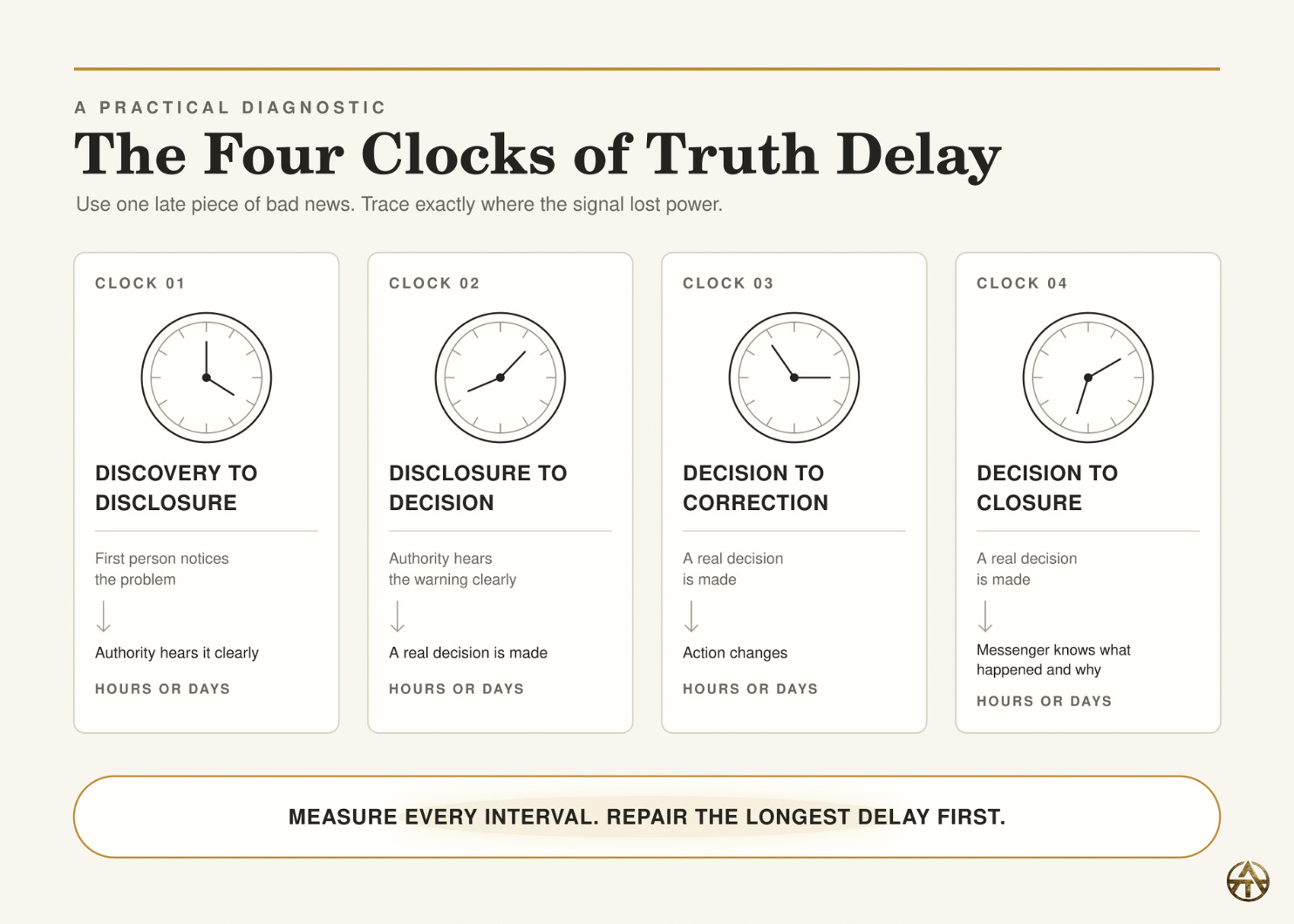
Then place four clocks beside the event:
Discovery to disclosure: How long passed between the first person noticing the problem and someone with authority hearing it clearly?
Disclosure to decision: How long passed before a real decision was made?
Decision to correction: How long passed before the decision changed action?
Decision to closure: How long before the messenger knew what happened and why?
Use hours or days. Do not write “quickly,” “eventually” or “as soon as possible.” The longest clock shows where truth is currently losing its power. That is the first delay to repair.
If you cannot think of any bad news that arrived late, do not congratulate yourself yet. Ask one person close to the work: What did you hesitate to tell me this quarter? Then become quiet enough to hear the answer.
The question is not only, “Are my people honest?” The deeper question is, “What has this system taught them honesty will cost?”
The Highest Duty of Authority
This is not finally a lesson about reports or meetings. It is a lesson about the soul of power.
In John’s Gospel, Pilate stands before Christ. One man holds office, soldiers and the power of sentence. The other stands bound. Pilate asks, “What is truth?” Then he turns from the One before him and goes back to the crowd.15
There is a warning in that movement. The final danger of power is not only that it will refuse to ask what is true. It is that it will ask, then walk away before the answer can command it.
Power is redeemed only when it accepts that truth stands above it.
Humility, then, is not a soft virtue. It is an instrument of sight. It lets a leader receive correction without experiencing correction as annihilation. It separates the mission from the ego, the decision from the need to appear infallible, and authority from the fantasy that rank can make reality obey.
The mature leader does not make every voice equal in expertise, evidence or judgment. That would be another failure of leadership. The leader hears, tests, decides and accepts responsibility. But no voice is made worthless merely because it comes from below.
Sometimes the truth that protects a company comes from the engineer furthest from the boardroom. Sometimes the truth that protects a family comes from the child with no title at all. Sometimes it comes from a friend willing to wound your pride rather than flatter you toward ruin. Sometimes it comes as the quiet unrest in your own soul, long before you can explain it in a room.
To hold authority is to become responsible for whether those truths can reach you while they are still cheap enough to obey.
On Monday, paid subscribers will receive the practical extension: a seven-day Early Truth System for one team or relationship. It will show how to invite specific forms of dissent, receive bad news without punishing the messenger, separate signal from noise, keep decision rights clear and close the loop so that warnings become easier to raise and harder to lose.
For now, return to the cold morning at Kennedy. The ice was visible. The white vapour coiled around the launch structure. The warning already existed. The fatal distance was not between the engineers and the evidence. It was between the evidence and the authority willing to carry it intact.
At less than one second after liftoff, grey smoke escaped from the joint. Reality no longer needed permission to speak. At seventy-three seconds, it crossed the sky where everyone could see it.
By then, there was no decision left to make. Power may give you the final word. It cannot give you final sight.
The truth that saves you will often arrive in a voice with less power than your own.
Presidential Commission on the Space Shuttle Challenger Accident (1986) Report of the Presidential Commission on the Space Shuttle Challenger Accident, Volume I, Chapter V: ‘The Contributing Cause of the Accident’. NASA History Office (Accessed: 3 September 2026).
Presidential Commission on the Space Shuttle Challenger Accident (1986) Report of the Presidential Commission on the Space Shuttle Challenger Accident, Volume I, Chapter II: ‘Events Leading Up to the Challenger Mission’. NASA History Office (Accessed: 3 September 2026); Presidential Commission on the Space Shuttle Challenger Accident (1986) Report of the Presidential Commission on the Space Shuttle Challenger Accident, Volume I, Chapter III: ‘The Accident’. NASA History Office (Accessed: 3 September 2026).
Presidential Commission on the Space Shuttle Challenger Accident (1986) Report of the Presidential Commission on the Space Shuttle Challenger Accident, Volume I, Chapter V: ‘The Contributing Cause of the Accident’. NASA History Office (Accessed: 3 September 2026).
Shakespeare, W. (c.1605–06) King Lear, eds B.A. Mowat, P. Werstine, M. Poston and R. Niles, Act 1, Scene 1. Folger Shakespeare Library (Accessed: 3 September 2026).
Edmondson, A.C. (1999) ‘Psychological safety and learning behavior in work teams’, Administrative Science Quarterly, 44(2), pp. 350–383. doi: 10.2307/2666999; Frazier, M.L., Fainshmidt, S., Klinger, R.L., Pezeshkan, A. and Vracheva, V. (2017) ‘Psychological safety: A meta-analytic review and extension’, Personnel Psychology, 70(1), pp. 113–165. doi: 10.1111/peps.12183.
Nembhard, I.M. and Edmondson, A.C. (2006) ‘Making it safe: The effects of leader inclusiveness and professional status on psychological safety and improvement efforts in health care teams’, Journal of Organizational Behavior, 27(7), pp. 941–966. doi: 10.1002/job.413; Detert, J.R. and Burris, E.R. (2007) ‘Leadership behavior and employee voice: Is the door really open?’, Academy of Management Journal, 50(4), pp. 869–884. doi: 10.5465/amj.2007.26279183.
Galinsky, A.D., Magee, J.C., Inesi, M.E. and Gruenfeld, D.H. (2006) ‘Power and perspectives not taken’, Psychological Science, 17(12), pp. 1068–1074. doi: 10.1111/j.1467-9280.2006.01824.x; See, K.E., Morrison, E.W., Rothman, N.B. and Soll, J.B. (2011) ‘The detrimental effects of power on confidence, advice taking, and accuracy’, Organizational Behavior and Human Decision Processes, 116(2), pp. 272–285. doi: 10.1016/j.obhdp.2011.07.006.
Apple (2007) ‘Apple Reinvents the Phone with iPhone’, Apple Newsroom, 9 January (Accessed: 3 September 2026).
Nokia (2007) Nokia Conference Call: Third Quarter 2007 Financial Results, 18 October (Accessed: 3 September 2026).
Vuori, T.O. and Huy, Q.N. (2016) ‘Distributed attention and shared emotions in the innovation process: How Nokia lost the smartphone battle’, Administrative Science Quarterly, 61(1), pp. 9–51. doi: 10.1177/0001839215606951.
Feynman, R.P. (1986) ‘Personal Observations on Reliability of Shuttle’, in Presidential Commission on the Space Shuttle Challenger Accident, Report of the Presidential Commission on the Space Shuttle Challenger Accident, Volume II, Appendix F. NASA History Office (Accessed: 3 September 2026).
Booth, A. (1986) ‘Economic advice at the centre of British government, 1939–1941’, The Historical Journal, 29(3), pp. 655–675. doi: 10.1017/S0018246X00018951.
Lange, K. (2020) ‘Medal of Honor Monday: Navy Vice Adm. James Stockdale’, DOD News, U.S. Department of Defense, 2 March (Accessed: 3 September 2026); Collins, J. (2001) Good to Great: Why Some Companies Make the Leap ... and Others Don’t. New York: HarperBusiness.
Collins, J. (2001) Good to Great: Why Some Companies Make the Leap ... and Others Don’t. New York: HarperBusiness.
The Holy Bible, King James Version, John 18:37–38 (Accessed: 3 September 2026).