


Everything meaningful is rigged against you at the beginning.
The first month of going back to the gym, the first sales calls in a new business, the first public essays, the first videos. All of it feels heavier than it “should”, right at the moment when you have the least proof that any of it will work.
Most people read that heaviness as a verdict on their character. In Atlas work, we treat it as physics.
Progress, across psychology, neuroscience, and behaviour change, follows a three-phase curve:
Initial inertia, where starting costs feel unjustifiably high.
Momentum, where action begins to generate clarity and desire.
Critical mass, where your habits, identity, and systems start to carry you.
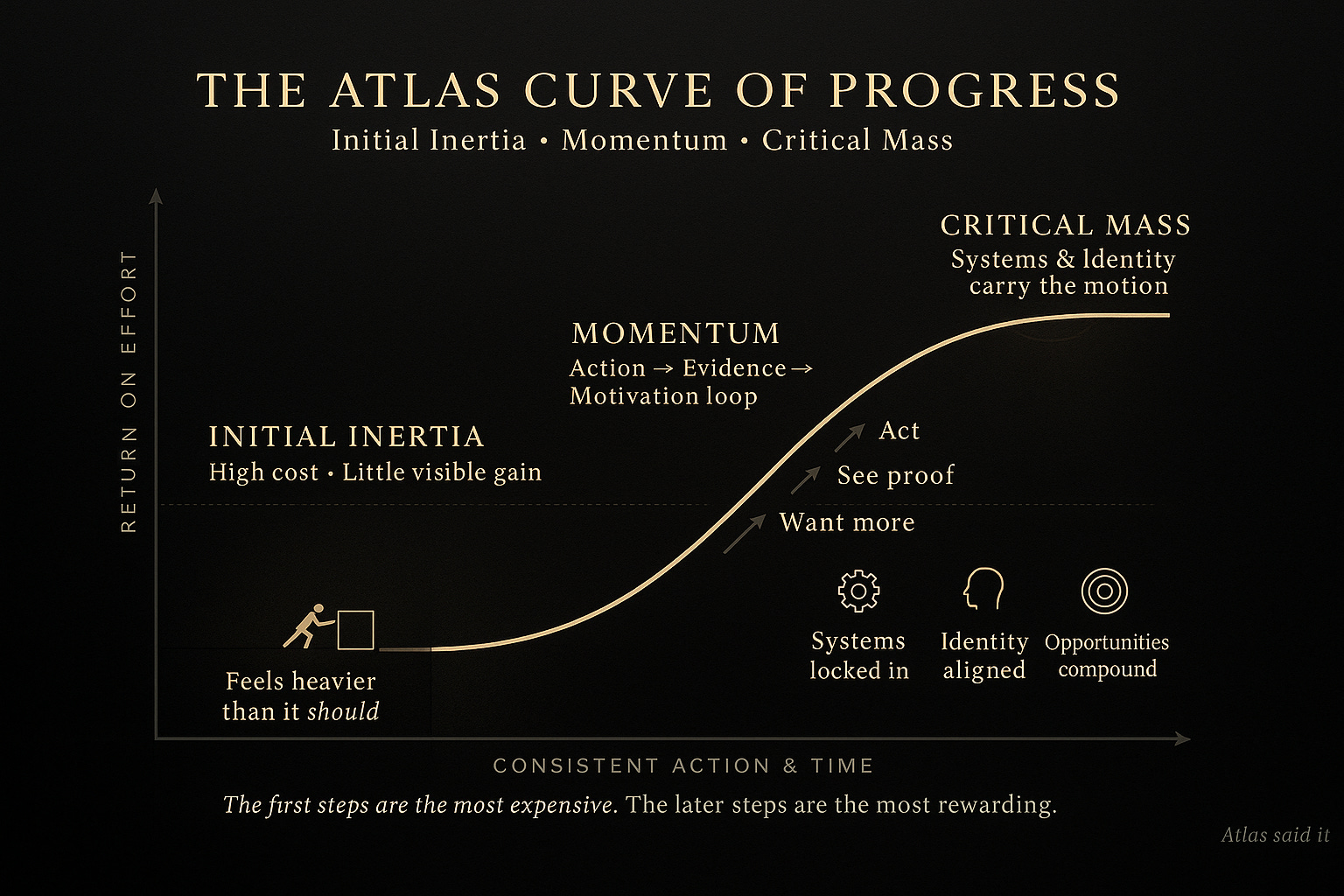
Seen through the Self Matrix, CORE Compass, and Excellence Nexus, this is not a motivational slogan. It is a structural description of how nervous systems, habits, and environments interact over time.
If you misunderstand this physics, you will abandon the work exactly where it is most expensive and most decisive.
If you understand it, you can treat your first moves with the reverence they deserve.
The beginning is supposed to feel heavier than it should
In physics, inertia is a body’s resistance to changes in its state of motion. Psychologically, you experience a parallel every time you stare at a blinking cursor, a quiet gym, or a blank CRM and feel a weight that seems disproportionate to the task.
The task has not changed.
Your potential has not evaporated.
Yet the first move feels like a negotiation with your entire life.
Part of this is simple energy economics. Work in behavioural neuroscience shows that the brain not only tracks reward but also constantly estimates whether a reward is worth the effort required to obtain it. Dopamine sits at the heart of this process, not as a primitive “pleasure chemical”, but as a signal that tilts you toward either high effort, high reward options or toward low effort, lower reward ones (Salamone et al., 2018; Salamone et al., 2024).
In animal studies, when dopamine transmission is disrupted, animals often ignore a larger, effort-requiring reward and select an easier but inferior option instead (Salamone et al., 2018).
Translated into human life: your nervous system is running a quiet, continuous cost–benefit analysis in the background. At the start of a new behaviour:
The subjective cost feels high.
The reward is distant, abstract, and uncertain.
There is no history of successful repetition for your brain to reference.
Conserving energy looks safer than spending it. The “smart” move, from an evolutionary perspective, appears to be not to move.
So the first session back after injury, the first video when nobody is watching, the first attempt to write publicly under your own name, all feel misaligned with what you know of your potential. Your Self Matrix may be rich. Your values may be clear. Your goals can be beautifully articulated. Yet your body resists activation.
That resistance is not moral failure. It is a predictable feature of the system.
You are not broken. You are early.
Action creates motivation more reliably than motivation creates action
Most people wait for motivation before they act. The evidence suggests that, in many cases, you are better off doing the opposite.
When your internal attitudes are fuzzy, you infer them partly by observing what you do. This is the core insight of self-perception theory, initially developed by Daryl Bem, which proposes that people infer their own beliefs and dispositions by reading their behaviour in much the same way they would read someone else’s (Bem, 1972).
In simple language:
You do not only act from who you are.
You decide who you are by noticing what you repeatedly do.
Applied to inertia, the implication is sharp. If you can get yourself to perform even a small action aligned with your goal, your brain starts to revise its story about you. After enough repetitions, “I am not someone who trains consistently” becomes “I am someone who trains, especially when it is hard.”
Clinical psychology has formalised this into treatment. Behavioural activation for depression rests on the premise that mood often follows behaviour, not the other way around. Instead of waiting for patients to feel better before acting, therapists collaboratively plan and schedule small, meaningful activities, then help patients carry them out, step by step. Randomised trials and large pragmatic studies show that behavioural activation can significantly reduce depressive symptoms and is scalable across formats, from in-person protocols to digital and mobile interventions (Dimidjian et al., 2017; McIndoo et al., 2016; Medina-Jiménez et al., 2024; Santopetro et al., 2024).
The same principle applies to high performers. When you wait until you “feel like it”, inertia wins. You remain in a negotiation that your nervous system is designed to resolve in favour of conservation.
When you move first, even briefly, your internal state begins to reorganise itself around your actions. In Atlas language, you are deliberately using behaviour as a lever on the Self Matrix, not relying solely on mindset, belief, or affirmation.
You do not need a new identity to begin. You use the beginning to build a new identity.
Repetition reshapes the system
If you string enough early moves together, you begin to notice a subtle shift.
You still exert effort, but there is less internal argument. You no longer decide whether you will train. You choose how you will train today. You do not debate whether you are “the type of person who writes”. You open the document because that is what your mornings are for.
This transition from sporadic effort to momentum is partly a story of habit.
Phillippa Lally and colleagues followed adults as they attempted to establish simple daily habits, such as drinking water with lunch or engaging in a brief exercise after breakfast. Over weeks, repeated behaviour in a stable context increased its automaticity, with an asymptote typically reached after roughly two months, although individual trajectories varied widely (Lally et al., 2010; UCL, 2009).
Benjamin Gardner’s review of health behaviour argues that many lifestyle changes become sustainable only when they reach a habitual status, in which actions are cued by context and performed with minimal conscious deliberation (Gardner, 2012). Habits drastically reduce cognitive load and emotional friction. You still pay effort, but willpower is no longer the primary fuel.
In CORE Compass terms, this is where Operational and Physical Vitality have been built into the architecture of your day. A fixed morning movement block. A non-negotiable ninety-minute creative session. A weekly long run that anchors the weekend.
At this stage, the work still demands something of you, but it no longer demands a complete identity debate every time. The behaviour has started to become “how life works now”.
Critical mass: when the system starts to move itself
Beyond momentum lies something more powerful: critical mass.
The term comes from physics and systems theory, yet it describes a recognisable psychological and behavioural reality. At a certain point, the combined density of your habits, skills, resources, and relationships becomes high enough that the system begins to generate its own opportunities.
In a business context, critical mass looks like this:
Processes for marketing, delivery, and operations have been standardised.
Reputation begins to generate inbound interest.
People and systems are in place so that stopping becomes harder than continuing.
You still work. Sometimes you still grind. But you are no longer dragging a dead weight. The structure supports motion.
From a health behaviour perspective, this is not a single habit but a network of interlocking routines and cues. Models such as the I-Change model emphasise that sustained change depends on alignment across awareness, motivation, intention, planning, and action, with determinants at each phase supporting the others (De Vries et al., 2003). At critical mass, that alignment is no longer a fragile experiment. It has become your default.
Within the Excellence Nexus, this shift is from isolated efforts in Body Prime or Mind Prime to a compound configuration in which Body, Mind, Wealth, and Impact begin to reinforce one another.
Your training improves your cognitive work.
Your cognitive work sharpens your strategic decisions.
Your strategic decisions increase your resources.
Your resources protect the routines that keep you strong and clear.
The system compounds. It begins to behave more like an asset than a project.
This is why the beginning feels “unfair”. You are paying full price in a structure that has not yet had time to become self-reinforcing.
How to lower activation energy: practical levers
The tactical question is obvious: how do you get from heavy, unrewarded beginnings to the first real sense of momentum, then to critical mass?
Several well-validated lines of research offer levers that integrate naturally with Atlas work.
Implementation intentions: pre-deciding the first move
Peter Gollwitzer’s work on implementation intentions shows that forming concrete “if–then” plans significantly increases the likelihood that people will initiate goal-directed behaviour, especially in challenging contexts (Gollwitzer and Brandstätter, 1997; Gollwitzer, 1999).
“If it is 7:00 on Monday, Wednesday, and Friday, then I am walking into the gym” is qualitatively different from “I will try to train more.”
These plans front-load the decision. When the cue appears, you are not deciding from scratch; you are executing a rule. In CORE Compass language, implementation intentions are a Resilience and Emotional Equilibrium tool because they protect you from your future hesitation.
You have already chosen. The version of you who was not tired made the call.
Behavioural activation principles for high performers
Behavioural activation protocols start with small, scheduled, meaningful actions instead of waiting for inspiration. In clinical practice, this might mean a five minute walk or a single phone call for someone in a depressive episode (Dimidjian et al., 2017; Medina-Jiménez et al., 2024; Santopetro et al., 2024).
For a high performer, the logic scales:
Ten minutes of focused writing rather than “finish the chapter”.
One sales email rather than “fix my pipeline”.
A very brief “entry” workout rather than “return fully to my old programming”.
Inside the Self Matrix, this is the disciplined decision to let behaviour drive state when state is compromised. You are not denying how you feel. You are refusing to let the transient state dictate whether you honour what you know.
Treat each action as a vote for identity
Self-perception theory implies that every repetition is not just “doing the thing”. It is casting a vote for a particular identity (Bem, 1972).
Every training session is a vote for “I am someone who trains”.
Every short writing block is a vote for “I am a creator”.
Every uncomfortable yet honest conversation is a vote for “I am a person who faces difficult things directly”.
Sporadic intensity rarely produces enough evidence to challenge an old identity. Critical mass, at the personal level, is reached when your behavioural record is so dense that any story of “I am not that type of person” becomes impossible to maintain with a straight face.
Integrating the physics of progress into your Atlas system
This three-phase model becomes most powerful when you explicitly embed it into your frameworks.
Help people name the mismatch between their potential and their actual activation as a structural phenomenon, not as a moral flaw.
Map where inertia lives across spiritual, cognitive, and physical dimensions.
Prescribe behaviour-led interventions that generate new evidence: micro actions that cast votes for the identity they are trying to cultivate.
Use implementation intentions, micro-commitments, and behavioural activation principles to build non-negotiable anchors in Curiosity, Operational Vitality, Resilience, and Essence.
Design first moves that are so small and so pre-planned that refusal becomes harder than compliance.
Emphasise that on difficult days, the only requirement is to execute the next pre-decided move.
Teach critical mass as the inflection point where Body, Mind, Heart, Soul, Wealth, and Impact are structured tightly enough to support one another.
Make explicit that the “unfair heaviness” of the beginning is the price of entry to that compound state.
Frame every early repetition as a small contribution to that future self-sustaining architecture.
The through line is simple and non-negotiable:
Initial effort will almost always feel heavier than it seems it should.
Motivation is more often the result of action than its prerequisite.
With enough repetitions inside a stable architecture, your habits and systems reach critical mass, and continuation becomes the path of least resistance.
This is not just encouragement. It is a call to treat your first moves with seriousness and respect. They are the most expensive steps in the entire sequence, and they make all the others possible.
The unfair beginning
If you are currently at the unfair beginning of something that matters, choose one tiny move that could serve as a vote for the person you are becoming, then do it in the next twenty-four hours.
Reply and tell me what that move is. Then send this to someone else who is stuck at their own starting line.
The physics will not change. But you can decide to move first.
References
Bem, D. J. (1972) ‘Self-perception theory’, in Berkowitz, L. (ed.) Advances in Experimental Social Psychology, vol. 6. New York: Academic Press.
De Vries, H., Mudde, A., Leijs, I., Charlton, A., Vartiainen, E., Buijs, G., Clemente, M. P., Storm, H., González Navarro, A., Nebot, M., Prins, T. and Kremers, S. (2003) ‘The European Smoking Prevention Framework Approach (ESFA): short term effects’, Health Education Research, 18(6), pp. 649–663.
Dimidjian, S., Goodman, S. H., Felder, J. N., Gallop, R., Brown, A. P. and Beck, A. (2017) ‘A pragmatic randomized clinical trial of behavioral activation for depressed pregnant women’, Journal of Consulting and Clinical Psychology, 85(1), pp. 26–36.
Gardner, B. (2012) ‘Making health habitual: the psychology of habit formation and general practice’, British Journal of General Practice, 62(605), pp. 664–666.
Gollwitzer, P. M. (1999) ‘Implementation intentions and strong effects of simple plans’, American Psychologist, 54(7), pp. 493–503.
Gollwitzer, P. M. and Brandstätter, V. (1997) ‘Implementation intentions and effective goal pursuit’, Journal of Personality and Social Psychology, 73(1), pp. 186–199.
Lally, P., van Jaarsveld, C. H. M., Potts, H. W. W. and Wardle, J. (2010) ‘How are habits formed: modelling habit formation in the real world’, European Journal of Social Psychology, 40(6), pp. 998–1009.
McIndoo, C. C., File, A. A., Preddy, T., Clark, C. G. and Hopko, D. R. (2016) ‘Mindfulness-based therapy and behavioral activation: a randomized controlled trial with depressed college students’, Behaviour Research and Therapy, 77, pp. 118–128.
Medina-Jiménez, E. A. et al. (2024) ‘Behavioural activation therapy for depression led by health workers’, BMC Psychiatry, 24, 560.
Salamone, J. D., Correa, M., Ferrigno, S., Yang, J. H., Rotolo, R. A. and Presby, R. E. (2018) ‘The psychopharmacology of effort-related decision making: dopamine, adenosine, and insights into the neurochemistry of motivation’, Pharmacological Reviews, 70(4), pp. 747–762.
Salamone, J. D., Yohn, S. E., López-Cruz, L., San Miguel, N. and Correa, M. (2024) ‘The neurobiology of activational aspects of motivation: exertion of effort, effort-based decision making, and the role of dopamine’, Annual Review of Psychology, 75, pp. 1–32.
Santopetro, N. et al. (2024) ‘Examining a fully automated mobile-based behavioural activation intervention’, JMIR Mental Health, 11, e54252.
University College London (UCL) (2009) ‘How long does it take to form a habit?’, UCL News, 4 August. Available at: UCL website.
What I love about this is how you turned that heavy “this is so unfair” feeling into something you can actually work with. Your model of inertia → momentum → critical mass is exactly what people at day 1 need to see.
Anyone building something right now who skips this is honestly robbing themselves of a huge mindset shift.