

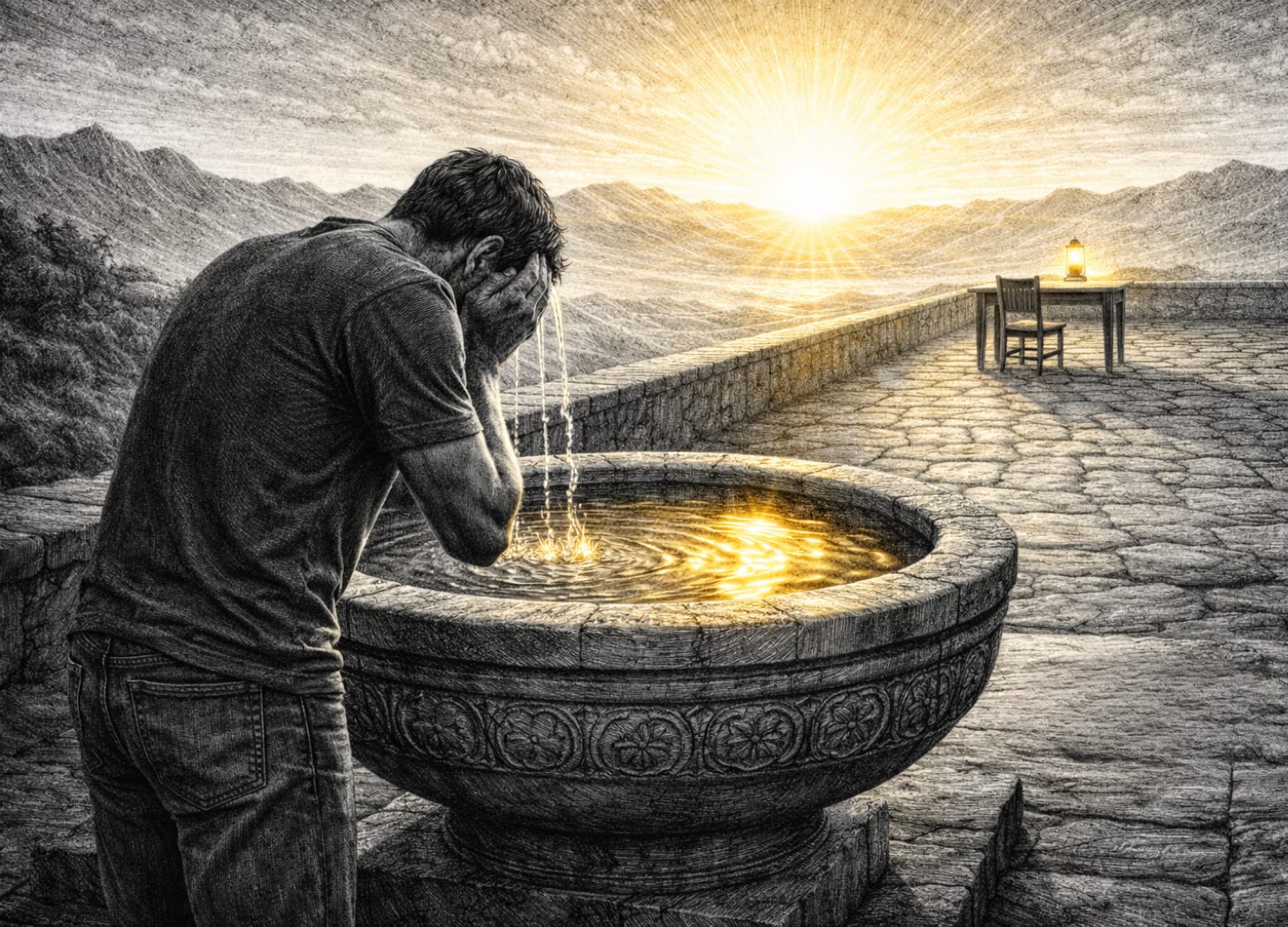
Flow is one of the few states in which human beings stop wasting so much force fighting themselves.
Attention narrows.
Action and awareness begin to move together.
The inner commentator falls quieter.
Time changes shape.
The work remains difficult, but the friction inside the mind changes with it.
Most people know the feeling before they know the term.
A writer who disappears into the page.
An athlete whose movements stop feeling separate from intention.
A musician who is no longer managing the performance from the outside.
A builder who looks up and realizes three dense hours passed without the usual leakage of energy into hesitation, self-surveillance, and drift.
This is what makes flow such an important subject.
It is not merely a pleasant state.
It is one of the clearest windows we have into what human performance looks like when attention, motivation, skill, and challenge stop pulling in different directions.
By the end of this essay, you will understand what flow actually is, why it matters for human performance, why most of the public conversation around it is too shallow, why it begins before the visible work begins, and why this series is not simply another series on flow, but on the larger architecture of peak mental states.
What flow actually is
Mihaly Csikszentmihalyi gave this state its most influential modern name, but the research that followed did not leave the phenomenon untouched. It refined it, complicated it, and forced an important distinction between the state itself and the conditions that make it more likely. Scholars do not agree on every element’s exact taxonomic status. Some features are better treated as antecedents, some as components, some as correlates or consequences. But there is broad convergence around a recognizable pattern: deep absorption, intense concentration, reduced self-consciousness, a strong sense of control or fit, intrinsic reward, and altered time experience, usually in the context of a demanding activity with clear goals, usable feedback, and a workable challenge-skill balance.1
That subtlety matters.
Because if you misunderstand what flow is, you will misunderstand how to approach it.
Flow is not just concentration.
You can concentrate grimly and still be nowhere near flow.
It is not just enjoyment.
You can enjoy something without entering a high-grade state of absorption.
It is not just productivity.
You can produce a lot while remaining internally scattered.
And it is not just being “locked in.”
A soldier in panic can be locked in.
A trader in mania can be locked in.
A person in obsessive compulsion can be locked in.
Flow is a more coherent state than that.
It involves immersion, but not mere fixation.
Intensity, but not only intensity.
Demand, but not just strain.
Reward, but not only pleasure.
A good working definition is this:
Flow is a state of unusually coherent absorption in which action and awareness become tightly coupled, self-conscious monitoring recedes, feedback becomes highly usable, and the task feels both demanding and strangely fluent.
That is not the only possible definition.
But it is a useful one.
Because it is precise enough to orient you, without pretending the science is simpler than it is.
Why flow matters so much
Flow matters because it sits at a rare intersection.
It is one of the few states in which performance and intrinsic reward stop behaving like enemies.
Most of modern life trains the opposite pattern.
You work through friction.
You force attention.
You self-lecture through resistance.
You tolerate fragmentation.
You perform under internal division.
Flow shows another possibility.
The difficulty remains, but the system stops leaking so much energy into conflict.
This is why the concept has attracted serious attention in work psychology, sport, learning, creativity, media, and other performance-relevant domains. Reviews describe flow as a gratifying state of deep involvement associated with intrinsic reward, and in organizational research it is treated as a peak experience tied to enjoyment, creativity, and performance. One recent systematic evaluation also reported a positive relationship between learning flow and academic performance among students.2
It matters for another reason too.
Flow is not just a performance concept.
It is also a wellbeing concept.
Environmental flow research now explicitly treats it as part of meaningful human flourishing, not merely hedonic pleasure. A 2025 scoping review argued that flow contributes to both hedonic and eudaimonic wellbeing, and that it is shaped not only by tasks and individual traits, but by environmental fit, aesthetics, contact with nature, and relationship to place.3
That is a major point.
Flow matters because it tells us something about what a human being is like when not endlessly divided against himself.
It matters because it shows what work, learning, and creation can feel like when the system is no longer paying such a heavy tax to fragmentation.
And it matters because the conditions of modern life are increasingly hostile to it.
Microsoft’s 2025 WorkLab report found that 48% of employees said their work feels chaotic and fragmented, that the most pinged Microsoft 365 users were interrupted roughly every two minutes during core work hours, and that more than half of meetings were ad hoc. This is not a trivial inconvenience. It is an architecture of interruption. It is one reason the question of deep states matters more now, not less.4
So yes, flow matters for beauty, creativity, satisfaction, and even joy.
But it is not a luxury concept.
It is fundamental to any serious discussion of human performance.
Because when people say they were “in the zone,” what they are often describing is not just more effort.
They are describing a temporary reduction in inner waste.
Why the common conversation is too shallow
Most public writing on flow begins too late.
It starts with the visible moment.
The athlete already moving cleanly.
The writer already deep in the page.
The founder already locked in.
The musician already inside the performance.
Then it asks: how do I get there?
That is already one step behind.
The public conversation tends to reduce flow in one of three ways.
First, it treats it as magic.
A gift. A lucky accident. A mysterious zone that descends unpredictably.
Second, it treats it as stimulation.
More caffeine.
More pressure.
More music.
More intensity.
More speed.
Third, it treats it as a focus trick.
Turn off notifications.
Set a timer.
Do harder things.
Try harder.
Each of those perspectives catches something real.
Each misses the larger structure.
Because flow is not just an event that happens inside a task.
It is the visible result of conditions that were established before the task became immersive.
That is the core mistake I want to correct in this series.
Not because the standard flow literature is worthless.
It is not.
Not because applied trigger models are useless.
They are not.
But because even when they are helpful, they are often still too narrow for the real architecture of peak mental states.
Flow begins before the work begins
Most people try to enter flow after the work has already started.
By then, the deeper question has often already been answered.
Did the body arrive regulated enough to stop bargaining.
Did the room stop leaking threat.
Did the task become clear enough to invite descent.
Did the work acquire enough meaning to justify full immersion.
Did the system consent.
That is the threshold before thought.
This is why I do not think flow can be treated as a purely cognitive topic.
The body belongs inside the theory.
A newer allostasis-first proposal in neuroscience argues that bodily regulation is not peripheral to the mind, but near its core. In that account, the brain is not best understood as a detached thinking machine occasionally instructing a body. It is part of a predictive regulatory system managing competing internal demands. If that view is even directionally correct, then physiology is not a side issue for cognition. It is one of its foundations.5
That matters enormously for flow.
Because now the question is not only:
What am I trying to think?
It is also:
What is my system currently budgeting.
What is it defending against.
How much of my available energy is already being spent on hidden regulation before I ever ask for deep work, learning, writing, precision, or creativity.
Suddenly, sleep matters differently.
Light matters differently.
Glucose stability matters differently.
Inflammatory load matters differently.
Movement matters differently.
Breathing matters differently.
Task design matters differently.
Environment matters differently.
Meaning matters differently.
The state is no longer a trick.
It is an outcome of architecture.
This is also where the modern workday becomes such a problem. A human system that is constantly interrupted, context-switched, and kept externally available is being trained into fragmented readiness, not deep descent. In work psychology, flow is increasingly discussed not only as something people stumble into, but as something shaped by proactive strategies, job design, autonomy, competence, relatedness, self-efficacy, and supportive environments.6
This is the deeper thesis of the series:
Flow is not primarily a focus trick. It is an achieved coherence state.
And achieved coherence has preconditions.
The search is older than the science
Long before modern psychology named flow, human beings were already building gates into unusual states of thought, perception, and presence.
Ancient Greece did not treat revelation as casual cognition. The Eleusinian Mysteries surrounded initiation with purification, fasting, procession, secrecy, and kykeon. The chemistry of kykeon remains disputed, and serious people should say so clearly. A 2026 study strengthened the chemical plausibility of one psychedelic hypothesis without proving that this was historically the decisive ingredient in the rites themselves. But the larger pattern is difficult to miss: the Greeks did not assume the unprepared mind was the highest possible instrument of insight.7
Japan preserved a quieter form of the same law. The tea ceremony is not just about drinking matcha. It is a ritualized discipline of room, pacing, gesture, utensil, attention, and presence, shaped over centuries and deeply influenced by contemplative traditions. The drink matters, but the architecture around the drink matters more. The state is prepared before it is requested.8
This is why the history of elevated cognition is not only a history of ideas.
It is a history of ingress rituals.
Different civilizations used different symbols, substances, sequences, and disciplines.
But the law beneath them was often similar.
Great thought was approached.
Not merely awaited.
What makes this series different
This series is not just about flow.
It is about the hidden architecture of flow and peak mental states.
That distinction matters.
Because most flow content does one of two things.
It either stays narrow and classical, challenge-skill balance, clear goals, feedback, absorption, time distortion.
Or it swings to hacks, triggers, tools, playlists, stacks, routines, stimulants.
Both camps capture something real.
Neither captures enough.
This series will keep flow as the anchor phenomenon, but it will place flow inside a broader architecture of entry, coherence, and elevation.
That architecture includes:
allostasis
vigilance
boredom and novelty
autonomy
self-efficacy
meaning
mindfulness
exercise
environment
relationships
group synchrony
state-supporting compounds
salience
and the distinction between clean elevation and distorted intensity
That is not random expansion.
It is a synthesis.
The literature is already pushing in these directions, but it remains scattered. Flow has been connected not only to classic task variables, but to self-determination and proactive work design, to environmental fit and place-based meaning, to mindfulness and stress reduction, and to emerging theories of group flow and coordinated interaction.9
My aim is not to flatten all these things into one bucket.
It is to show how they interlock.
Because my claim is bigger than “flow matters.”
My claim is this:
Flow is one visible expression of a larger architecture of peak mental states.
If we understand that architecture properly, we do not just admire the state.
We become far better at approaching it, protecting it, recovering it, and distinguishing it from other intense but misleading states.
That is the difference.
Where this series is going
This season unfolds in three acts.
Act I: Entry and Preconditions
Threshold. Body-state. Vigilance. Boredom. Curiosity.
Act II: Consent, Meaning, and Stability
Autonomy. Self-efficacy. Meaning. Mindfulness. Exercise.
Act III: Field, Support, and Distortions
Environment. Relationships. Group flow. Compounds. Salience. Pseudo-flow. Recovery and re-entry.
Coming next:
20 April 2026, Subscriber protocol: Enter Deep Work More Reliably
The Threshold Protocol for writing, study, creation, and prayer
23 April 2026, Open essay: The Body Is the Ignition Key
Why physiology sits underneath flow, thought, and creative depth
27 April 2026, Subscriber protocol: Build the Body-State That Makes Depth Easier
The Ignition Protocol for light, movement, feeding, breath, and arousal
New public essays publish on Thursdays. Subscriber protocols follow on Mondays.
One rep for today
Do not try to force flow today.
Map a threshold instead.
The Threshold Audit
Think of one moment in the last twelve months when your mind worked unusually well.
Not merely when you were busy.
When you were clean.
Then write four lines.
1. Body
How had you slept?
What had you eaten, or not eaten?
Had you moved?
What was your arousal level?
2. Environment
What room were you in?
What was absent?
What was present?
What friction had already been removed?
3. Task
What, exactly, were you trying to do?
Was it clear?
Was it demanding enough?
Was it narrow enough to enter?
4. Meaning
Why did it matter?
To whom?
What inner consent was present?
Then choose one threshold rule to protect in the next 24 hours.
One.
Not ten.
Maybe it is:
phone outside the room
light before screens
movement before writing
one defined question before opening the laptop
no shallow admin before deep work
no meaningful work in a room that leaks threat
Do not chase the state directly.
Rebuild the gate.
The standard to keep
You do not need to worship spontaneity.
You need to respect ingress.
The mind that goes somewhere uncommon is rarely a mind that wandered there by accident.
It is usually a mind that was prepared, protected, and properly approached.
That is the standard.
Not random inspiration.
Not stimulant worship.
Not productivity theatre.
Threshold.
If this series speaks to you, subscribe.
The Thursday essays will clarify the architecture.
The Monday manuals will turn it into practice: threshold audits, ingress rituals, state sequencing, troubleshooting, and field-tested protocols built to be used under pressure, not merely admired in theory.
Next Monday’s subscriber edition is Enter Deep Work More Reliably: The Threshold Protocol for writing, study, creation, and prayer.
Sami Abuhamdeh, ‘Investigating the “Flow” Experience: Key Conceptual and Operational Issues’, Frontiers in Psychology, 11 (2020), art. 158, doi: 10.3389/fpsyg.2020.00158; Steven Kotler, Michael Mannino, Scott Kelso and Richard Huskey, ‘First Few Seconds for Flow: A Comprehensive Proposal of the Neurobiology and Neurodynamics of State Onset’, Neuroscience & Biobehavioral Reviews, 143 (2022), art. 104956, doi: 10.1016/j.neubiorev.2022.104956; Corinna Peifer, Gina Wolters, László Harmat, Jean Heutte, Jasmine Tan, Teresa Freire, Dionísia Tavares, Carla Fonte, Frans Orsted Andersen, Jef van den Hout, Milija Šimleša, Linda Pola, Lucia Ceja and Stefano Triberti, ‘A Scoping Review of Flow Research’, Frontiers in Psychology, 13 (2022), art. 815665, doi: 10.3389/fpsyg.2022.815665.
Arnold B. Bakker and Marianne van Woerkom, ‘Flow at Work: a Self-Determination Perspective’, Occupational Health Science, 1(1–2) (2017), pp. 47–65, doi: 10.1007/s41542-017-0003-3; Zhang Jinmin and Fang Qi, ‘Relationship between Learning Flow and Academic Performance among Students: a Systematic Evaluation and Meta-analysis’, Frontiers in Psychology, 14 (2023), art. 1270642, doi: 10.3389/fpsyg.2023.1270642; Steven Kotler, Michael Mannino, Scott Kelso and Richard Huskey, ‘First Few Seconds for Flow: A Comprehensive Proposal of the Neurobiology and Neurodynamics of State Onset’, Neuroscience & Biobehavioral Reviews, 143 (2022), art. 104956, doi: 10.1016/j.neubiorev.2022.104956; Corinna Peifer, Gina Wolters, László Harmat, Jean Heutte, Jasmine Tan, Teresa Freire, Dionísia Tavares, Carla Fonte, Frans Orsted Andersen, Jef van den Hout, Milija Šimleša, Linda Pola, Lucia Ceja and Stefano Triberti, ‘A Scoping Review of Flow Research’, Frontiers in Psychology, 13 (2022), art. 815665, doi: 10.3389/fpsyg.2022.815665.
Megan Cumming, Birgitta Gatersleben, Jason Davies, Aïsha van Buuringen and Amy Isham, ‘Environments and the Experience of Flow: A Scoping Review’, Journal of Environmental Psychology, 104 (2025), art. 102605, doi: 10.1016/j.jenvp.2025.102605.
Microsoft WorkLab, ‘Breaking down the infinite workday’, Microsoft, 17 June 2025. Available at: https://www.microsoft.com/en-us/worklab/work-trend-index/breaking-down-infinite-workday (accessed 10 March 2026).
Jordan E. Theriault, Yuta Katsumi, Henning M. Reimann, Jiahe Zhang, Philip Deming, Bradford C. Dickerson, Karen S. Quigley and Lisa Feldman Barrett, ‘It’s Not the Thought That Counts: Allostasis at the Core of Brain Function’, Neuron, 113(24) (2025), pp. 4107–4133, doi: 10.1016/j.neuron.2025.09.028.
Arnold B. Bakker and Marianne van Woerkom, ‘Flow at Work: a Self-Determination Perspective’, Occupational Health Science, 1(1–2) (2017), pp. 47–65, doi: 10.1007/s41542-017-0003-3.
Romanos K. Antonopoulos, Evangelos Dadiotis, Kostas Ioannidis, Antigoni Cheilari, Vangelis Mitsis, Ana M. Garcia-Campaña, Laura Gámiz-Gracia, Maykel Hernández-Mesa, Alfonso Narváez, Mark A. Hoffman, Carl A. P. Ruck, Zacharoula Gonou-Zagou, Nektarios Aligiannis and Prokopios Magiatis, ‘Investigating the Psychedelic Hypothesis of Kykeon, the Sacred Elixir of the Eleusinian Mysteries’, Scientific Reports, 16 (2026), art. 8757, doi: 10.1038/s41598-026-39568-3.
Japan National Tourism Organization, ‘Japanese Tea Ceremony’, Travel Japan (web page, no date stated). Available at: https://www.japan.travel/en/guide/tea-ceremony/ (accessed 16 April 2026); Asian Art Museum, ‘Chanoyu: The Japanese Art of Tea’ (educational resource, no date stated). Available at: https://education.asianart.org/resources/chanoyu-the-japanese-art-of-tea/ (accessed 25 March 2026).
Arnold B. Bakker and Marianne van Woerkom, ‘Flow at Work: a Self-Determination Perspective’, Occupational Health Science, 1(1–2) (2017), pp. 47–65, doi: 10.1007/s41542-017-0003-3; Megan Cumming, Birgitta Gatersleben, Jason Davies, Aïsha van Buuringen and Amy Isham, ‘Environments and the Experience of Flow: A Scoping Review’, Journal of Environmental Psychology, 104 (2025), art. 102605, doi: 10.1016/j.jenvp.2025.102605; Charlotte Hohnemann, Florian Engel, Corinna Peifer and Stefan Diestel, ‘Trajectories of Mindfulness, Flow Experience, and Stress during an Online-Based MBSR Program: The Moderating Role of Emotional Exhaustion’, Frontiers in Psychology, 15 (2024), art. 1385372, doi: 10.3389/fpsyg.2024.1385372; Raymond Lavoie, Markus Baer and Elizabeth D. Rouse, ‘Group Flow: A Theory of Group Member Interactions in the Moment and Over Time’, Academy of Management Review, 50(3) (2025), pp. 493–518, doi: 10.5465/amr.2021.0458.