


Not every powerful state deserves your trust.
Some states feel clean.
Some only feel strong.
Some sharpen the task.
Some narrow the world.
Some leave you more coherent.
Some leave you spent, compulsive, brittle, or strangely proud of the damage.
That distinction matters.
Because high achievers are often too easily impressed by intensity.
The late-night surge.
The deadline panic.
The stimulant edge.
The compulsive tunnel.
The all-consuming sprint.
The time-warped emergency.
The state where everything else disappears and the body feels hijacked by the task.
People call this being locked in.
Sometimes it is.
Sometimes it is not.
Sometimes what looks like flow is really overdrive wearing the clothes of excellence.
That is the subject of this essay.
The previous pair dealt with salience. Those essays showed that attention is not merely a spotlight controlled by will. What gets admitted into awareness depends on threat, reward, novelty, identity, unfinished business, body-state, environment, and learned relevance.
Now we arrive at the final distinction of the season.
Because once the wrong thing becomes salient enough, it can feel profound.
A threat can feel like destiny.
A deadline can feel like purpose.
A stimulant surge can feel like clarity.
A compulsive tunnel can feel like devotion.
A panic-speed state can feel like power.
But intensity is not the same as coherence.
By the end of this essay, you will understand why flow must be separated from clutch, hyperfocus, stress arousal, dissociation, and tachypsychia-like time distortion, why many ambitious people romanticize overdrive, why clean elevation and distorted intensity feel similar from the outside but different from the inside, and why maturity in peak performance requires better discrimination, not merely stronger states.
This is the final warning of the season:
Do not worship intensity.
Learn to read it.
Where this series is going
This essay is the final Thursday doctrine essay in The Hidden Architecture of Flow.
Act I dealt with entry: threshold, body, vigilance, boredom, and curiosity.
Act II dealt with consent, meaning, stability, and movement.
Act III moved through environment, group flow, state support, and salience.
Now the season reaches its closing distinction:
not every altered, powerful, time-warped, narrowed, or accelerated state is flow.
Already live: the threshold, body, vigilance, curiosity, work design, meaning, stability, movement, environment, group-flow, state-support, and salience essays and manuals.
Coming next: Recover Cleanly When Intensity Distorts the System, the final subscriber protocol for stress, time distortion, and clean return.
New public essays publish on Thursdays. Subscriber protocols follow on Mondays.
Flow is coherent absorption, not mere force
We need to return to the beginning.
Flow is not just working hard.
It is not just disappearing into something.
It is not just intensity.
It is not just the world going quiet.
A good working definition from the first essay was this:
Flow is a state of unusually coherent absorption in which action and awareness become tightly coupled, self-conscious monitoring recedes, feedback becomes highly usable, and the task feels both demanding and strangely fluent.
That definition matters more now than it did at the start.
Because as the season has progressed, we have seen how many neighbouring states can imitate pieces of flow.
Vigilance can narrow the world.
Curiosity can pull attention.
Meaning can increase commitment.
Movement can change arousal.
Support tools can sharpen state.
Salience can make one signal dominate the field.
Stress can make time feel strange.
But none of those alone equals flow.
Flow research continues to describe the state through absorption, concentration, reduced self-consciousness, action-awareness coupling, intrinsic reward, altered time experience, and a workable challenge-skill relation, even while researchers debate how best to classify its features and antecedents.1
The important word is not only absorption.
It is coherence.
Flow is not simply that everything else disappears.
It is that the system becomes unusually well ordered around the task.
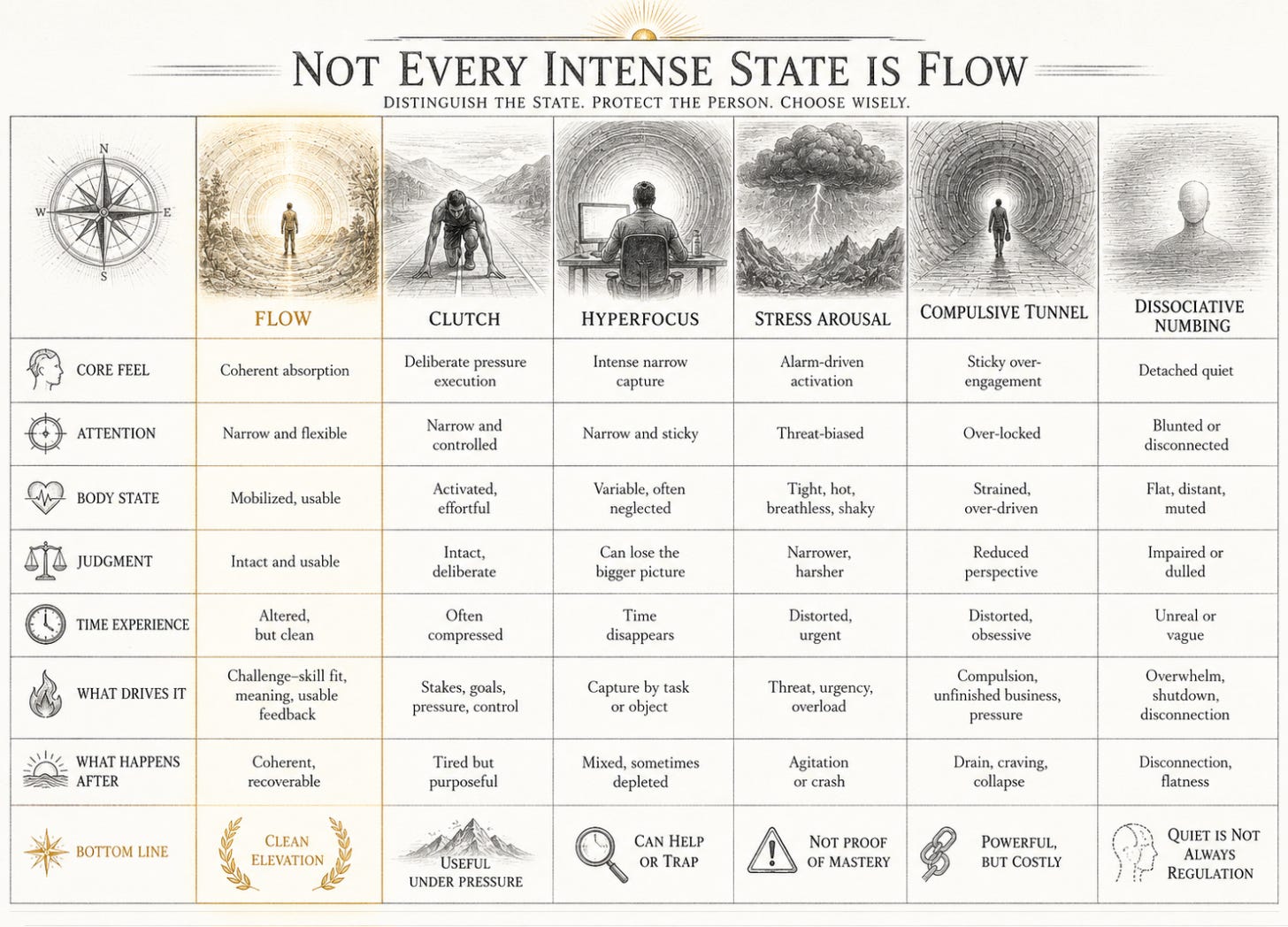
Clutch is not flow
This is one of the most important distinctions in performance psychology.
Clutch states and flow states can both support excellent performance. But they are not the same state.
Recent sport psychology has argued for a more dynamic model of optimal performance, where both flow and clutch states can underlie excellent performance. Clutch states are generally more effortful, deliberate, pressure-linked, and goal-focused, while flow is often more fluent, absorbed, and less consciously controlling.2
That matters for real life.
The state you need before a deadline may not be flow.
The state you need in the final minutes of a competition may not be flow.
The state you need to close, decide, respond, or deliver under pressure may be closer to clutch.
Clutch is not inferior.
It is different.
This matters because many people damage themselves by trying to turn every high-stakes moment into flow.
Sometimes the right state is controlled effort.
Sometimes the right state is deliberate concentration.
Sometimes the right state is narrow execution.
Sometimes the right state is to finish the mission under pressure, not to disappear blissfully inside the task.
The error is not entering clutch.
The error is misnaming it.
If you call every excellent state flow, you lose the ability to train each state properly.
And if you call every pressure success flow, you may start romanticizing the pressure that produced it.
Hyperfocus is not automatically flow
Hyperfocus is another neighbouring state.
It can look similar from the outside.
A person is absorbed.
Time passes.
The world is ignored.
The task or object dominates awareness.
But hyperfocus is not automatically coherent.
Ashinoff and Abu-Akel (2021) describe hyperfocus as intense absorption in a task to the point where unrelated stimuli appear to be ignored or tuned out, and they note its relevance across neurotypical and clinical populations, including ADHD and autism discussions.3
The danger is simple:
hyperfocus can serve the task, or it can trap the person.
A person can hyperfocus on writing.
A person can hyperfocus on a game.
A person can hyperfocus on research that no longer serves the project.
A person can hyperfocus on editing one sentence while the real work collapses.
A person can hyperfocus on metrics, argument, self-attack, or threat.
The narrowness alone proves nothing.
The question is:
Does this state serve the whole task?
Flow tends to organize attention around a meaningful and workable activity.
Hyperfocus can become sticky attention without sufficient wisdom about what deserves the tunnel.
That is why hyperfocus can be useful and dangerous at the same time.
It may feel like power.
It may also be capture.
Stress can distort time too
Many people associate flow with time changing.
That is fair.
Altered time experience is one of the familiar features of flow.
But here is the warning:
flow is not the only state that changes time.
Stress can distort time. Threat can distort time. Acute arousal can alter subjective duration. Time can speed, slow, fragment, stretch, or feel unreal under conditions that have nothing to do with clean mastery.
Hancock and Weaver (2005) argued that stress can distort both perceptual space and time, including through attentional narrowing and failures in processing under high demand.4 Van Hedger and colleagues (2017) found that social stress influenced time perception, with participants reproducing emotional stimuli as lasting longer after stress exposure.5 Blom, Nanuashvili and Waters (2021) also reviewed clinical reports of time distortions, including slow-motion and quick-motion phenomena, though their review concerns Alice in Wonderland syndrome and related clinical cases rather than performance states.6
This is where the word tachypsychia sometimes appears.
Tachypsychia is commonly used to describe altered time perception under intense arousal, stress, danger, or traumatic events. I want to use the idea carefully.
Not every time distortion is tachypsychia.
Not every pressure state is trauma.
Not every altered temporality is pathology.
But the broader point is crucial:
time distortion is not proof of flow.
It may be absorption.
It may be stress.
It may be overload.
It may be panic.
It may be salience.
It may be memory distortion after the event.
A mature performance theory has to read time change more carefully than, “time slowed down, therefore I was in flow.”
That sentence is not serious enough.
Arousal has a ceiling
Performance culture often worships activation.
More energy.
More urgency.
More pressure.
More stimulation.
More demand.
More intensity.
But flow does not simply increase in a straight line with arousal.
Peifer and colleagues (2014) found an inverted-U-shaped relationship between flow experience and sympathetic arousal and cortisol under stress, with moderate physiological arousal more favourable than extremes.7 Van der Linden, Tops and Bakker (2021) similarly discuss flow in relation to optimized arousal, especially through locus coeruleus-norepinephrine dynamics, rather than maximal activation.8
This is one of the key scientific points of the whole season.
The state you are seeking is not maximum force.
It is organized force.
Too low, and the system drifts.
Too high, and the system guards, narrows, rushes, or fragments.
This matters because distorted intensity often feels convincing precisely because it is strong.
The body is loud.
The mind is fast.
The stakes feel vivid.
The task becomes all-consuming.
The world contracts.
That can create output.
But output is not the same as flow.
Arousal can drive performance while degrading coherence.
The question is not, “Was I intense?”
The question is, “Was I clean?”
Dissociation is not calm
Another dangerous confusion:
quiet does not always mean regulated.
Sometimes a person appears calm because the system has become coherent.
Sometimes a person appears calm because the system has detached.
Dissociation, depersonalization, and derealization involve forms of disconnection from the body, self, emotion, or surrounding reality. Lanius and colleagues (2012) discuss depersonalization and derealization in the dissociative subtype of PTSD, and related clinical literature treats these states as significant alterations in consciousness and self-experience under overwhelming conditions.9
This does not mean ordinary deep work should be medicalized.
It means we need a sharper distinction.
Not every quiet state is good.
A person can be still because he is present.
A person can also be still because he is gone.
A person can seem unbothered because he is disciplined.
A person can also seem unbothered because the system has muted what it cannot process.
Flow is not numbness.
It is not disappearance from the self in a deadened sense.
It is a living absorption where the task is vivid, feedback is usable, and the system remains functionally connected to the work.
If the state leaves you less human, less aware, less capable of judgment, less able to re-enter life, or proud of your own detachment, be careful.
That may not be mastery.
It may be shutdown with good branding.
Why high achievers get fooled
High achievers are especially vulnerable to this confusion.
Not because they are weak.
Because they have often been rewarded for distorted intensity.
They pushed through exhaustion and were praised.
They delivered under panic and were promoted.
They sacrificed sleep and were admired.
They entered a compulsive tunnel and produced something valuable.
They learned that damage followed by output is called discipline.
This creates a dangerous equation:
If it hurts and works, it must be excellence.
No.
Sometimes it is excellence.
Sometimes it is exploitation of the organism.
Sometimes it is emergency adaptation.
Sometimes it is an unsustainable debt disguised as identity.
The body can produce under stress.
The mind can narrow under threat.
A person can perform while paying more than the result is worth.
This is why the earlier essay on vigilance matters. A guarded system can still perform. It may even outperform for a short period. But performance under guard is not the same as clean depth.
The same is true here.
Distorted intensity can produce impressive output.
That does not make it flow.
The signature of clean elevation
So what should we look for?
Not perfection.
Not ease.
Not pleasure alone.
Clean elevation has a different signature.
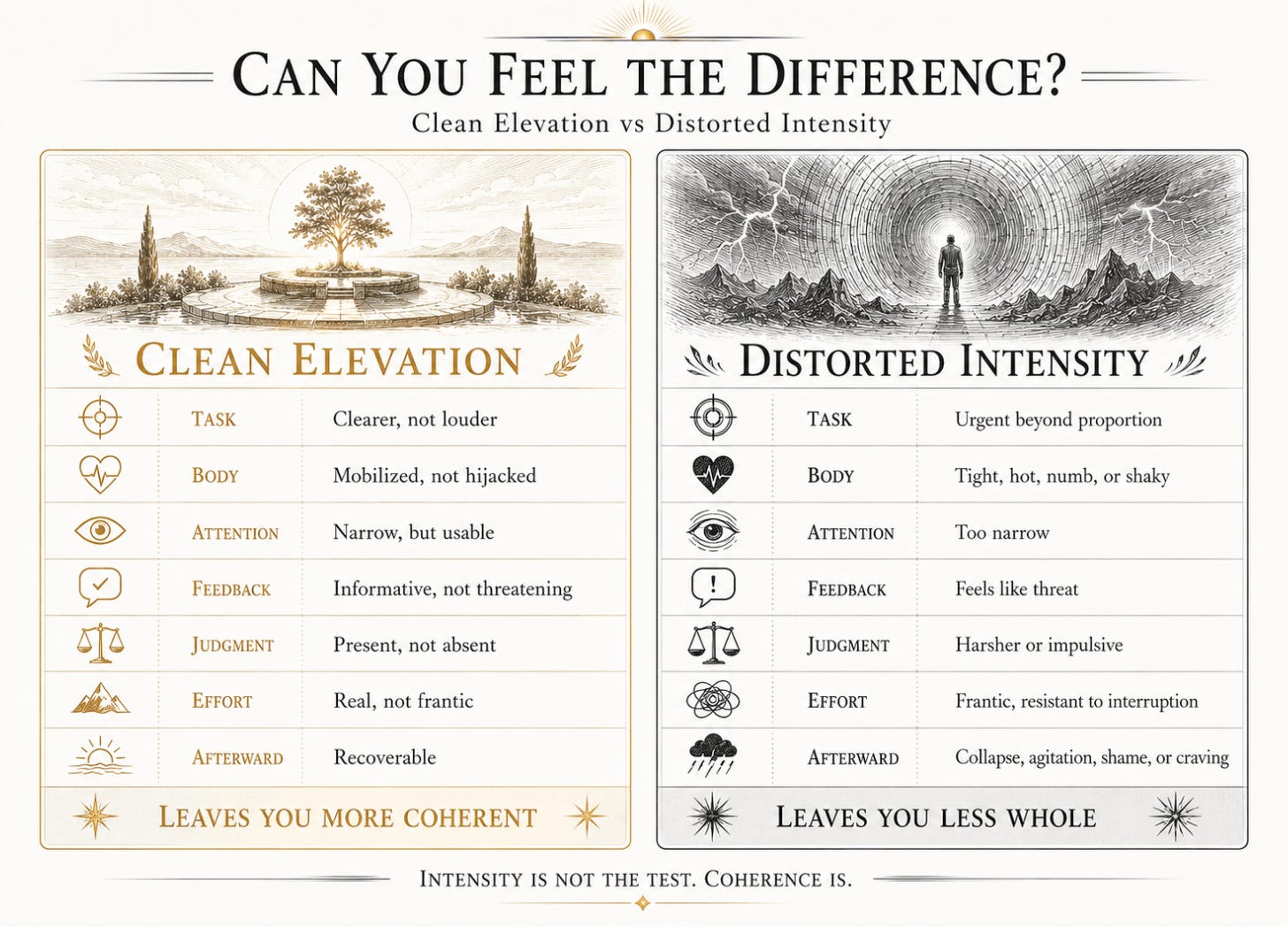
The task becomes clearer, not merely louder.
The body feels mobilized, not hijacked.
The mind narrows usefully, not blindly.
Feedback becomes more usable, not more threatening.
Self-consciousness recedes, but judgment does not disappear.
Effort remains present, but it is not frantic.
Time may change, but the state does not depend on panic.
The work gains coherence.
The person remains recoverable afterward.
That last line matters.
Recoverable.
A state that helps you do excellent work but leaves you wrecked, compulsive, ashamed, dissociated, or unable to re-enter ordinary life cleanly must be examined.
It may still have helped you survive a demand.
It may still have produced something.
But do not call every survival state a peak state.
Clean elevation should not require contempt for the organism.
The signature of distorted intensity
Distorted intensity has a different feel.
The task becomes urgent beyond proportion.
The body is loud, tight, hot, numb, or shaky.
Attention narrows too much.
Other values disappear.
Feedback becomes threat.
The state resists interruption with disproportionate anger.
The person cannot downshift when the block ends.
Time feels strange in a way that reflects alarm more than absorption.
The work becomes a tunnel, not a field.
Afterward there is collapse, agitation, shame, or craving for the state again.
This is the hidden cost.
Distorted intensity often creates a false holiness around the task.
Nothing else matters.
But sometimes that is not devotion.
Sometimes it is dysregulation.
A serious person has to know the difference.
The moral risk of intensity
There is also an ethical dimension.
When intensity becomes the highest proof of seriousness, people start making bad moral decisions.
They neglect the body and call it commitment.
They damage relationships and call it focus.
They intimidate collaborators and call it standards.
They become unreachable and call it depth.
They romanticize exhaustion and call it legacy.
They use support tools to keep the state going and call it optimization.
This is why the final essay could not be only about recovery.
First, we need doctrine.
The doctrine is this:
Intensity is not moral evidence.
It does not prove the work is good.
It does not prove the state is clean.
It does not prove the person is disciplined.
It does not prove the sacrifice is justified.
The state must be judged by what it serves and what it costs.
That is a much harder standard.
It is also a better one.
The field needs better discrimination
This may be one of the most important contributions of the whole series.
The public conversation around flow often wants more state.
More absorption.
More energy.
More focus.
More intensity.
More productivity.
More access.
More neurochemistry.
More tools.
But mature performance is not only about stronger states.
It is about better discrimination.
Which state is this?
What created it?
What does it serve?
What does it cost?
Can I recover from it?
Does it preserve judgment?
Does it improve the work without degrading the person?
Is this coherence, clutch, hyperfocus, vigilance, compulsion, panic, shutdown, or clean elevation?
That is the adult map.
Not every state that feels powerful belongs on the altar.
Some belong in the toolbox.
Some belong in the emergency kit.
Some belong in therapy.
Some belong in recovery.
Some belong nowhere near your life.
Why this is the final doctrine essay
The sequence matters.
The season began by arguing that flow begins before the work begins.
Then it moved through the gates:
body-state,
vigilance,
boredom,
curiosity,
autonomy,
self-efficacy,
meaning,
mindfulness,
movement,
environment,
trust,
state support,
salience.
Each gate affects what becomes possible.
But this final doctrine essay asks a more severe question:
What if you reach a powerful state and still misread it?
That is why the season ends here.
Because after all the architecture is built, the final skill is discernment.
Not how to enter.
How to know what you entered.
That is the difference between a person chasing states and a person building mastery.
The rep for today
Do not chase a state today.
Name one.
The State Discrimination Audit
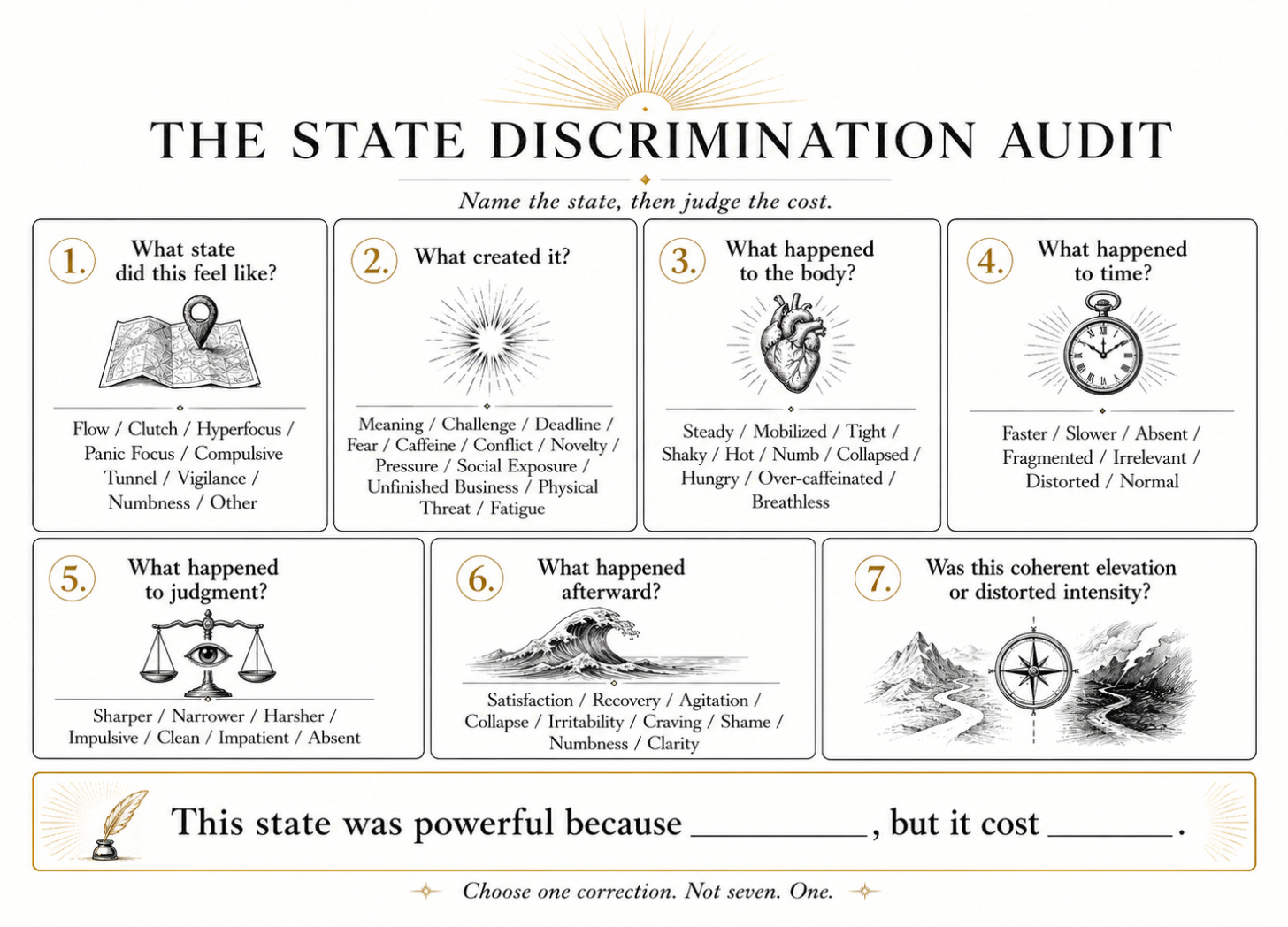
Think of one recent period where you felt intensely “locked in.”
Then answer seven lines.
1. What state did this feel like?
Flow, clutch, hyperfocus, panic focus, compulsive tunnel, vigilance, numbness, or something else?
2. What created it?
Meaning, challenge, deadline, fear, caffeine, conflict, novelty, pressure, social exposure, unfinished business, physical threat, or fatigue?
3. What happened to the body?
Steady, mobilized, tight, shaky, hot, numb, collapsed, hungry, over-caffeinated, breathless?
4. What happened to time?
Faster, slower, absent, fragmented, irrelevant, distorted, or normal?
5. What happened to judgment?
Sharper, narrower, harsher, impulsive, clean, impatient, or absent?
6. What happened afterward?
Satisfaction, recovery, agitation, collapse, irritability, craving, shame, numbness, or clarity?
7. Was this coherent elevation or distorted intensity?
Then write one sentence:
This state was powerful because ________, but it cost ________.
Be honest.
Not dramatic.
Then choose one correction.
One.
Maybe it is:
stop calling deadline panic flow
separate clutch from flow
reduce caffeine when bracing is already high
stop using late-night panic as identity
recover after overdrive instead of stacking another demand
notice when hyperfocus stops serving the whole task
ask whether a powerful state leaves you more coherent afterward
Do not ask only, “How do I get into flow?”
Ask, “What state am I actually entering, and is it worthy of repetition?”
That is the sharper question.
The standard to keep
Do not worship intensity.
That is the standard.
Intensity can serve.
Intensity can distort.
Intensity can save a moment.
Intensity can ruin a life when it becomes identity.
Flow is not merely force.
It is not merely time distortion.
It is not merely narrowing.
It is not merely output.
It is not merely the feeling of being locked in.
Flow is a cleaner state than that.
It is coherent absorption.
And if we care about human performance, we need to protect that distinction.
Because the aim is not to become a person who can enter stronger and stranger states at will.
The aim is to become a person who can build, enter, use, recover from, and discern states wisely.
That is where the season ends.
Not with intoxication.
With discrimination.10
If this series speaks to you, subscribe.
The Thursday essays clarify the architecture.
The Monday manuals turn it into practice: state-discrimination checklists, recovery decisions, downshift routines, re-entry plans, and protocols built to be used under pressure, not merely admired in theory.
Next Monday’s subscriber edition is Recover Cleanly When Intensity Distorts the System: The Recovery and Re-Entry Protocol for stress, time distortion, and clean return.
Abuhamdeh, S. (2020) ‘Investigating the “flow” experience: key conceptual and operational issues’, Frontiers in Psychology, 11, Article 158. doi:10.3389/fpsyg.2020.00158; Peifer, C., Wolters, G., Harmat, L., Heutte, J., Tan, J., Freire, T., Tavares, D., Fonte, C., Andersen, F.O., van den Hout, J., Šimleša, M., Pola, L., Ceja, L. and Triberti, S. (2022) ‘A scoping review of flow research’, Frontiers in Psychology, 13, Article 815665. doi:10.3389/fpsyg.2022.815665.
Swann, C., Crust, L. and Vella, S.A. (2017) ‘New directions in the psychology of optimal performance in sport: flow and clutch states’, Current Opinion in Psychology, 16, pp. 48–53. doi:10.1016/j.copsyc.2017.03.032; Swann, C., Crust, L., Jackman, P.C., Vella, S.A., Allen, M.S. and Keegan, R.J. (2017) ‘Psychological states underlying excellent performance in sport: toward an integrated model of flow and clutch states’, Journal of Applied Sport Psychology, 29(4), pp. 375–401. doi:10.1080/10413200.2016.1272650.
Ashinoff, B.K. and Abu-Akel, A. (2021) ‘Hyperfocus: the forgotten frontier of attention’, Psychological Research, 85(1), pp. 1–19. doi:10.1007/s00426-019-01245-8.
Hancock, P.A. and Weaver, J.L. (2005) ‘On time distortion under stress’, Theoretical Issues in Ergonomics Science, 6(2), pp. 193–211. doi:10.1080/14639220512331325747.
van Hedger, K., Necka, E.A., Barakzai, A.K. and Norman, G.J. (2017) ‘The influence of social stress on time perception and psychophysiological reactivity’, Psychophysiology, 54(5), pp. 706–712. doi:10.1111/psyp.12836.
Blom, J.D., Nanuashvili, N. and Waters, F. (2021) ‘Time distortions: a systematic review of cases characteristic of Alice in Wonderland syndrome’, Frontiers in Psychiatry, 12, Article 668633. doi:10.3389/fpsyt.2021.668633.
Peifer, C., Schulz, A., Schächinger, H., Baumann, N. and Antoni, C.H. (2014) ‘The relation of flow-experience and physiological arousal under stress: can u shape it?’, Journal of Experimental Social Psychology, 53, pp. 62–69. doi:10.1016/j.jesp.2014.01.009.
van der Linden, D., Tops, M. and Bakker, A.B. (2021) ‘The neuroscience of the flow state: involvement of the locus coeruleus norepinephrine system’, Frontiers in Psychology, 12, Article 645498. doi:10.3389/fpsyg.2021.645498.
Lanius, R.A., Brand, B., Vermetten, E., Frewen, P.A. and Spiegel, D. (2012) ‘The dissociative subtype of posttraumatic stress disorder: rationale, clinical and neurobiological evidence, and implications’, Depression and Anxiety, 29(8), pp. 701–708. doi:10.1002/da.21889.
Background reading: Csikszentmihalyi, M. (1990) Flow: The Psychology of Optimal Experience. New York: Harper & Row; Kotler, S., Mannino, M., Kelso, S. and Huskey, R. (2022) ‘First few seconds for flow: a comprehensive proposal of the neurobiology and neurodynamics of state onset’, Neuroscience & Biobehavioral Reviews, 143, Article 104956. doi:10.1016/j.neubiorev.2022.104956.