

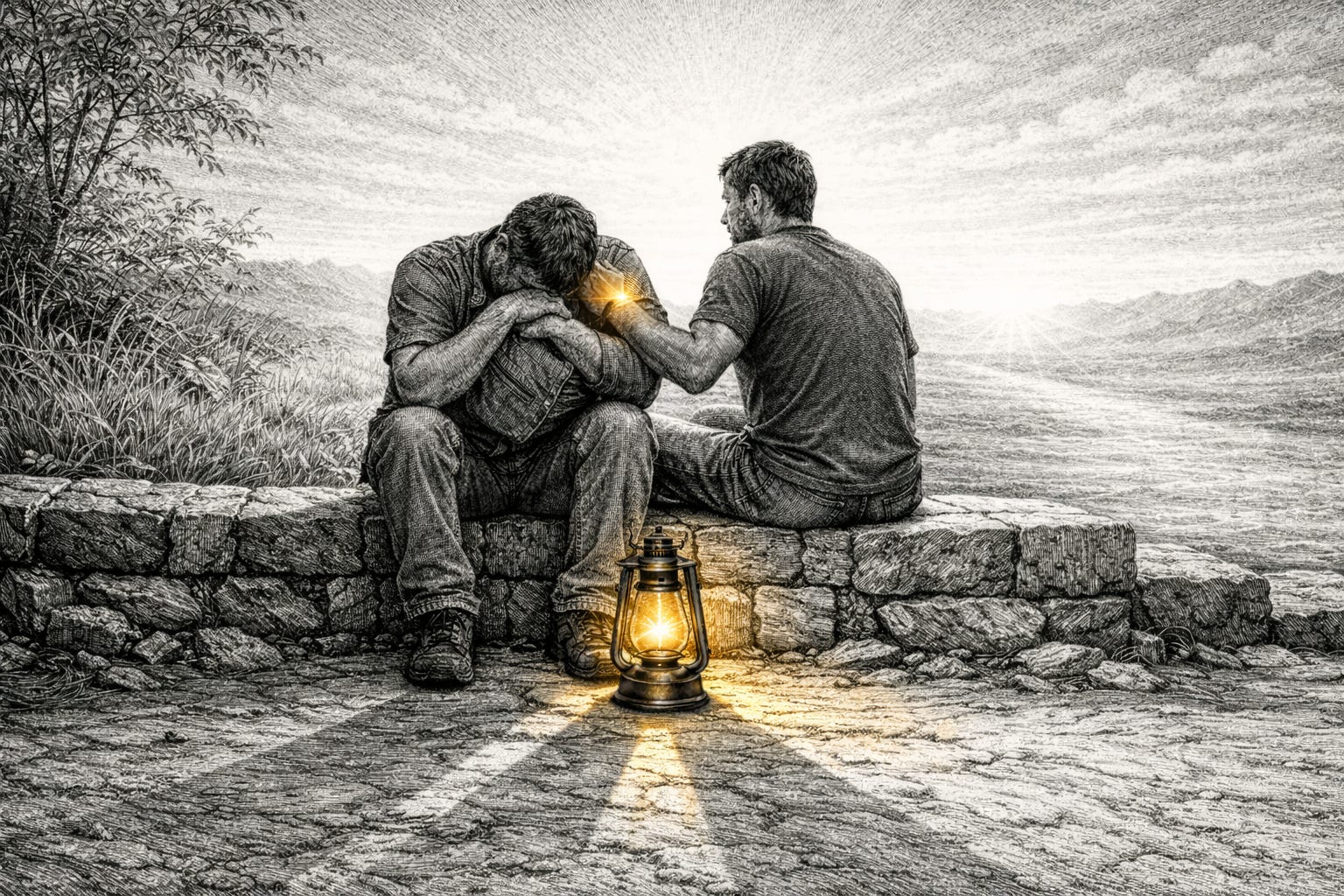
“Bear one another’s burdens, and so fulfill the law of Christ.”
Galatians 6:2
Holy Week strips life back to what is essential. It leaves less room for image, performance, and noise. It brings us again to suffering, love, sacrifice, and presence.
By a certain age, you stop asking whether people are suffering. You ask only how quietly they are carrying it.
Some people carry pain in their bodies. Some carry it in the mind. Some carry it in silence so practiced that even those closest to them barely notice. Some carry it behind humor. Some behind competence. Some behind strength. Some, behind the calm face they have learned to wear in public.
Not all suffering is equal. Not all wounds are the same. But no one gets through life untouched.
That is one of the reasons Holy Week matters so much. It tells the truth about burden. It tells the truth about cost. And if we let it, it teaches us how to look at one another with greater tenderness.
The burden you cannot see
I have known great blessings in my life. I was raised by exceptional parents who loved me well. I have been blessed with a beautiful wife, whom I love beyond measure, and with two beautiful children, each with a soul and character of their own.
And I have also known suffering.
As a teenager, I lived with pain that made ordinary life feel far away. I still remember a school visit to a winery. We were young and foolish and drank more than we should have. What stayed with me was not the immaturity. It was the relief. For a brief moment, the pain loosened its grip, and I realized how long it had been since my body had felt any ease.
Years later, my body broke down more severely. I lost so much weight that people looked at me with alarm. Some barely recognized me. In those years, I often woke with a question I was ashamed to ask and unable to silence:
Why me?
Why this body?
Why this path?
Why does life seem to move so freely for others, while even small attempts at normal life seem to cost me so much?
I do not think that is a noble question. I think it is a human one.
Many people ask it, even if they never say it aloud. They ask it in hospital rooms. They ask it in marriages that have gone cold. They ask it in exhausted parenthood, in private grief, in loneliness, in debt, in fear, in burnout, in disappointment, in nights when the body or mind will not let them rest.
Pain narrows the field of vision. It pulls everything toward the wound. It can make suffering feel intensely personal, as if life itself has leaned in your direction with unusual severity.
For a time, I think many of us believe that.
Then, if suffering does not make us bitter, and if grace enters the room, pain can begin to teach us something else.
What pain can make of us
“Your pain is the breaking of the shell that encloses your understanding.”
Kahlil Gibran, The Prophet
That line has always stayed with me because it is both severe and merciful.
Pain breaks things open.
It breaks illusions. It breaks entitlement. It breaks the childish belief that life should unfold evenly, or that burden belongs only to the unlucky few. It breaks the quiet fantasy that everyone else has been spared.
Over time, I began to understand that my suffering had not singled me out. It had introduced me to something universal.
Every person is carrying something.
Some carry it visibly. Some carry it in ways the world rewards. Some carry it so gracefully that others mistake endurance for ease. Some are holding themselves together with more effort than anyone around them can see.
Once you really understand that, it should change the way you move through the world.
It should soften you.
It should slow your judgment.
It should make you more careful with your words.
It should make you more patient with the hesitation, tiredness, sharpness, or silence of others.
Not because all behavior is excused. Not because boundaries no longer matter. But because you begin to see that much of what is hardest in people may be connected to what is hardest in their lives.
There is a kind of suffering that turns a person inward. The wound becomes a world. But there is another kind of suffering, or perhaps another stage of the same suffering, that enlarges the heart. It makes a person slower to condemn and quicker to understand. It teaches them that hidden burdens are everywhere.
That is one of the quiet gifts of pain when it has been purified by grace. It teaches compassion without sentimentality.
Humility is not performance
It is easy to misunderstand humility.
We mistake quiet for depth. We mistake silence for holiness. We mistake self-erasure for virtue. We imagine that if we speak less, appear smaller, or keep our suffering hidden enough, we have automatically become humble.
But things are not always what they seem.
“It is not the one who reproaches himself who shows humility, for who will not put up with himself?”
Saint John Climacus
That is a hard sentence. It is also a liberating one.
Humility is not theater. It is not a performance of smallness. It is not silence for display. It is not speech for display either. Even restraint can become a form of vanity in finer clothing. Even suffering can become a throne if we are not careful.
The deeper question is simpler and harder:
What serves love here?
Sometimes love is quiet. Sometimes it speaks. Sometimes it withdraws. Sometimes it stays very near. Sometimes humility means saying less. Sometimes it means telling the truth plainly. Discernment matters because arrogance has many disguises, and even good things can be bent back toward the self.
True humility does not deny that your burden is real. It does not ask you to pretend that pain does not hurt. It does not forbid the cry, Why me?
It does something harder than that.
It reminds you that your wound is real, but it is not the only wound in the room.
It reminds you that your burden matters, but it does not make you the center of the world.
It teaches you to tell the truth about your suffering without turning yourself into its monument.
That is why humility and love belong together. Humility clears space for another person to exist fully in your sight. Love steps into that space and says, I will not make this heavier for you.
Love stays near
Holy Week does not permit cheap metaphors. The Cross is not a decorative label for a hard week or a difficult season. It is holy. It stands above our easy language.
But Holy Week does teach us this much with unusual force: no human life escapes burden, and no burden is meant to be met without love.
Not the same burden.
Not the same wound.
Not the same cost.
But burden, nonetheless.
This is why kindness is never small. This is why mockery is so cheap. This is why patience is a form of love. This is why presence matters so much.
Much of life comes down to this: being there for one another while we carry what has been given to us.
Not solving everything.
Not explaining everything.
Not always fixing everything.
Sometimes, simply not increasing the weight.
Sometimes listening without rushing to correct.
Sometimes staying near when another person has grown tired of being strong.
Love is often less dramatic than people imagine. Very often it looks like this:
I see that you are carrying something.
You do not have to carry it alone.
That is no small thing. In many lives, it is one of the holiest things a person will ever hear.
A great deal of unnecessary suffering comes not only from pain itself, but from isolation within pain. From the feeling that no one sees. No one understands. No one is willing to stay. That is why presence matters. Not because it removes the burden, but because it refuses to let another person carry it alone.
One quiet rep for Holy Week
Before this day ends, think of one person who may be carrying more than they say.
Send one honest message.
Do not lead with advice. Lead with presence.
You can say something as simple as: You came to mind. I do not need anything back. I just wanted you to know I am here if you need me.
Small acts do not always feel small to the person receiving them.
After Easter
After Easter, I want to turn toward another question that lives very close to this one.
How does a human being carry weight well?
How do we remain clear under pressure?
How do we stay disciplined without becoming hard?
How do we stay ambitious without losing our souls?
How do we carry sacrifice, fatigue, standards, uncertainty, and responsibility without letting them deform our character?
These are performance questions, yes, but not in the glossy and shallow sense the phrase often suggests. They are human questions. They are questions about steadiness. About self-command. About endurance. About what keeps a person whole under load.
That is where I want to go next.
But before all that, this is enough for today:
Be slower to judge.
Be quicker to love.
Be careful not to make another person’s burden heavier.
There is a very good chance that the person in front of you is carrying more than they have words for.
And one of the most sacred things we do in this life is help one another bear what would be too heavy to bear alone.
If someone came to mind as you read this, send it to them before Easter.