


You can remain productive long after the way you are producing has become unsustainable.
The deadline is met. The meeting is led. The training session is completed. The people around you continue to see someone capable, disciplined and dependable.
Inside, the arithmetic has changed.
The same output now requires more negotiation before you begin, more urgency once you start and more recovery after you finish. Rest helps for a few hours but does not quite return you to the person you were. Your patience shortens. Ordinary demands begin feeling strangely expensive.
Because the result still exists, you use it as proof that nothing serious is wrong.
That is precisely why capable people can miss the warning.
Research on human performance under stress shows that people can sometimes protect the result by investing greater effort and control. Performance remains visible, while the rising cost of producing it does not.1
So can you be burned out and still productive?
A person can certainly remain outwardly productive while exhaustion, work-related detachment and the force required to keep functioning are increasing. Whether that person meets a formal measure of burnout is a separate question. High-functioning burnout is useful public language, not a clinical diagnosis. The World Health Organization applies burnout specifically to chronic workplace stress and classifies it as an occupational phenomenon rather than a medical condition.2
The practical point is simpler:
Visible performance can remain intact while the way you are producing it becomes increasingly costly.
I call that pattern Discipline Debt.
What Discipline Debt Means
Discipline is not the enemy.
It may be one of the reasons you have built anything worth protecting. Discipline lets you act before motivation arrives. It keeps promises intact. It protects standards when circumstances are inconvenient.
But a strength can serve two very different purposes.
Discipline can help you build capacity.
It can also help you conceal that capacity is falling.
Discipline Debt is the growing gap between the output you continue to produce and the capacity available to sustain it, temporarily covered by greater force and eventually paid through poorer recovery, judgment, mood, health, relationships or future performance.
It is a conceptual model, not a clinical diagnosis.
Hard work is not automatically debt. Neither is a difficult launch, an intense training block or a season of unusual responsibility. A demanding period may be justified, time-limited and followed by genuine recovery.
Debt is a pattern.
The same result repeatedly requires more force. Appropriate recovery no longer returns you to baseline. Your standards become harsher as your capacity falls. The cost begins spreading into parts of life that are not being measured.
The work still looks respectable.
The operating system underneath it is weakening.
Stress, Productive Adaptation or Accumulated Debt?
Serious work includes discomfort. So does serious training. Any useful model must distinguish between a hard day that stretches you and a pattern that is slowly reducing your ability to respond.
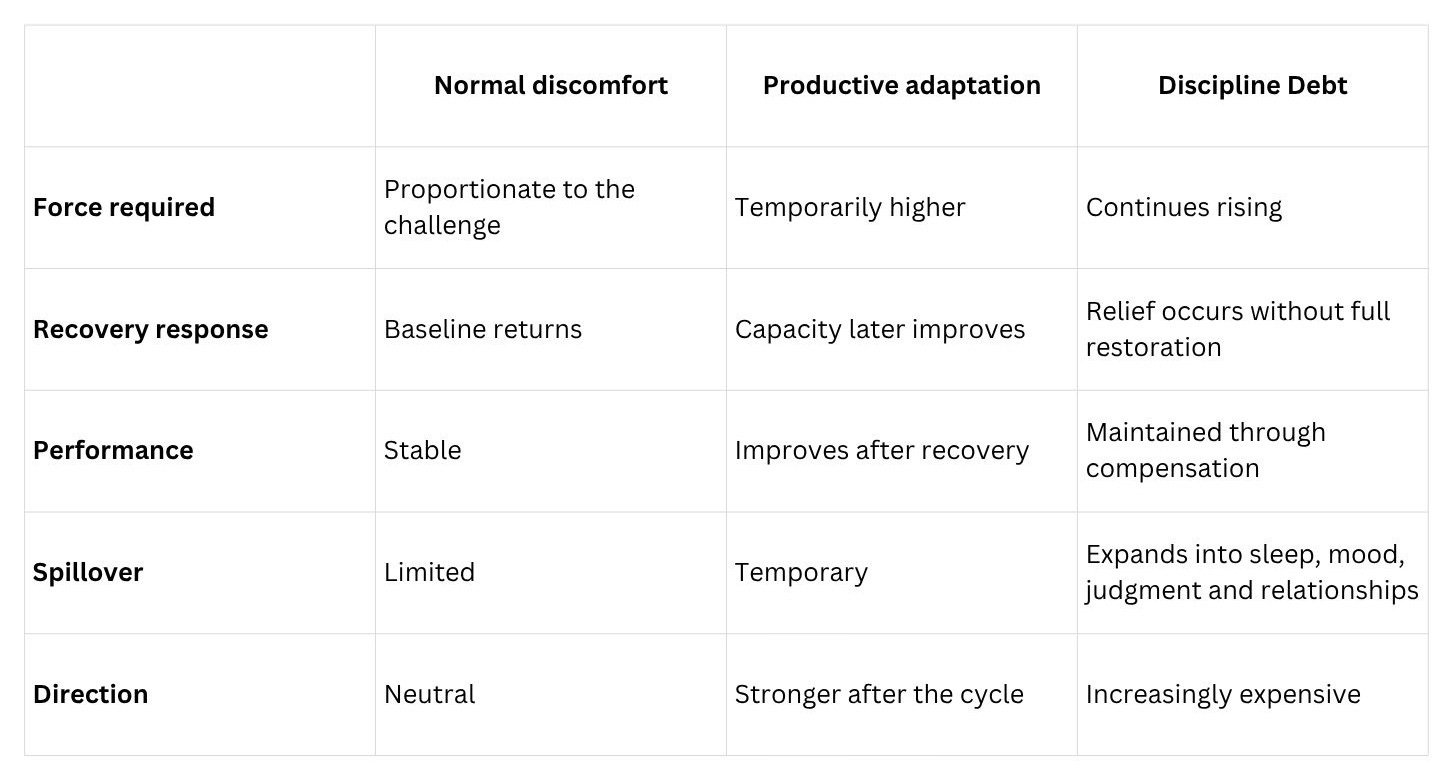
Sport science makes a related distinction between planned overload that can produce adaptation and prolonged maladaptation that reduces the athlete’s ability to recover and perform.3
Work strain and overtraining syndrome are not the same condition. The comparison is useful for one reason:
The value of a demanding stimulus cannot be judged only by whether you survived it. It must also be judged by what happened after it.
Did capacity return?
Did it grow?
Or did you preserve the result by spending more of tomorrow?
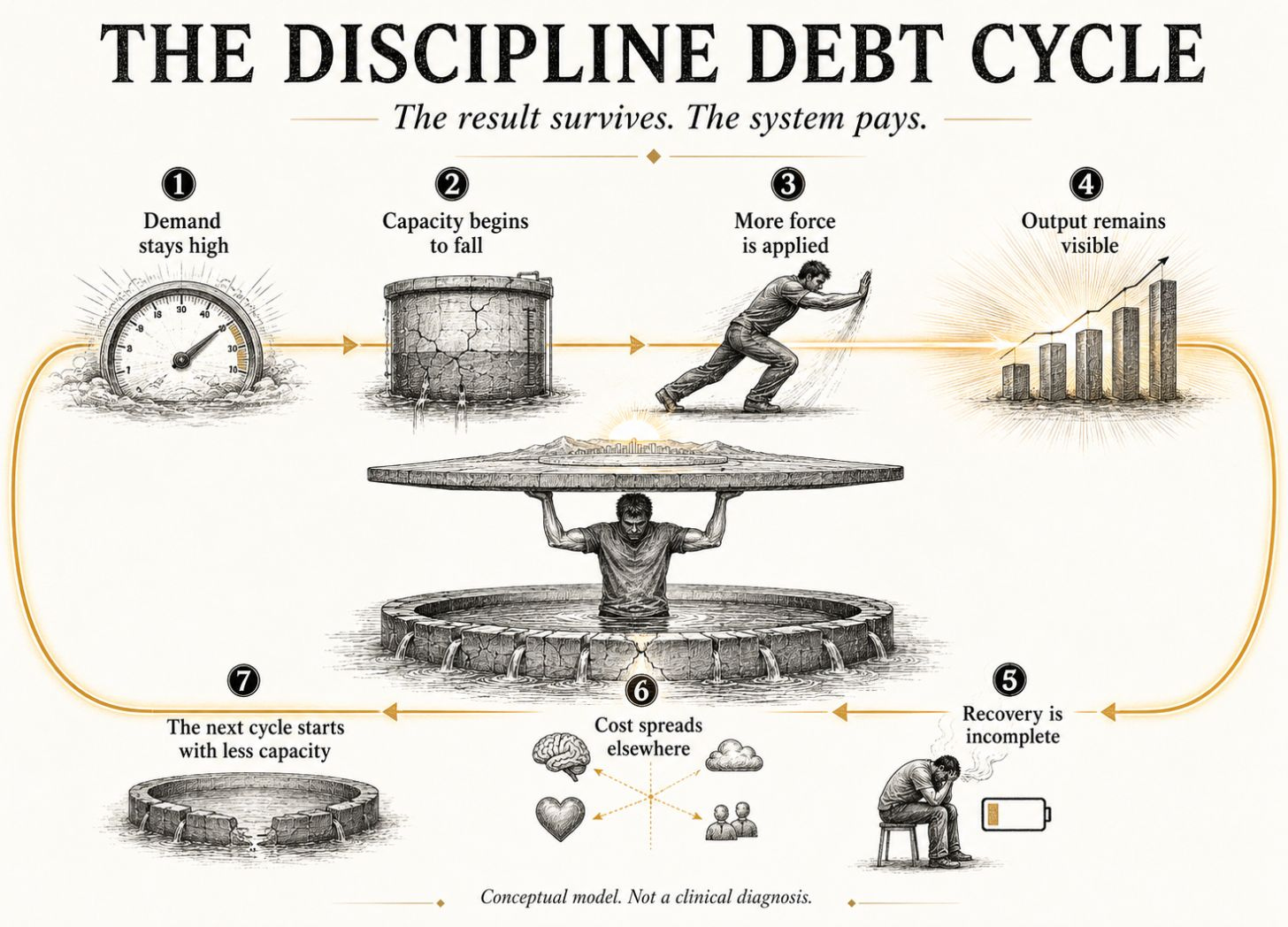
1. The Same Output Requires More Force
The first warning is not always that you can no longer do the work.
It may be that ordinary work has become unusually expensive.
Beginning requires more internal negotiation. Simple decisions feel heavier. You need pressure to create focus. Caffeine shifts from support to entry fee. Work expands later into the day, and small requests begin producing reactions that feel disproportionate to the request itself.
Under strain, people can compensate by increasing effort and control, preserving performance for a time.4 That capacity is valuable in a genuine emergency. It is expensive as a permanent operating model.
One difficult day proves very little. The signal is the direction of travel.
Ask:
What does the same output require from me now compared with four weeks ago?
More time? More fear? More stimulation? More self-attack? More sacrifice elsewhere?
When the task is broadly stable but the force required keeps rising, the answer is not automatically more discipline.
The rising force may be the information.
2. Rest Relieves You but Does Not Restore You
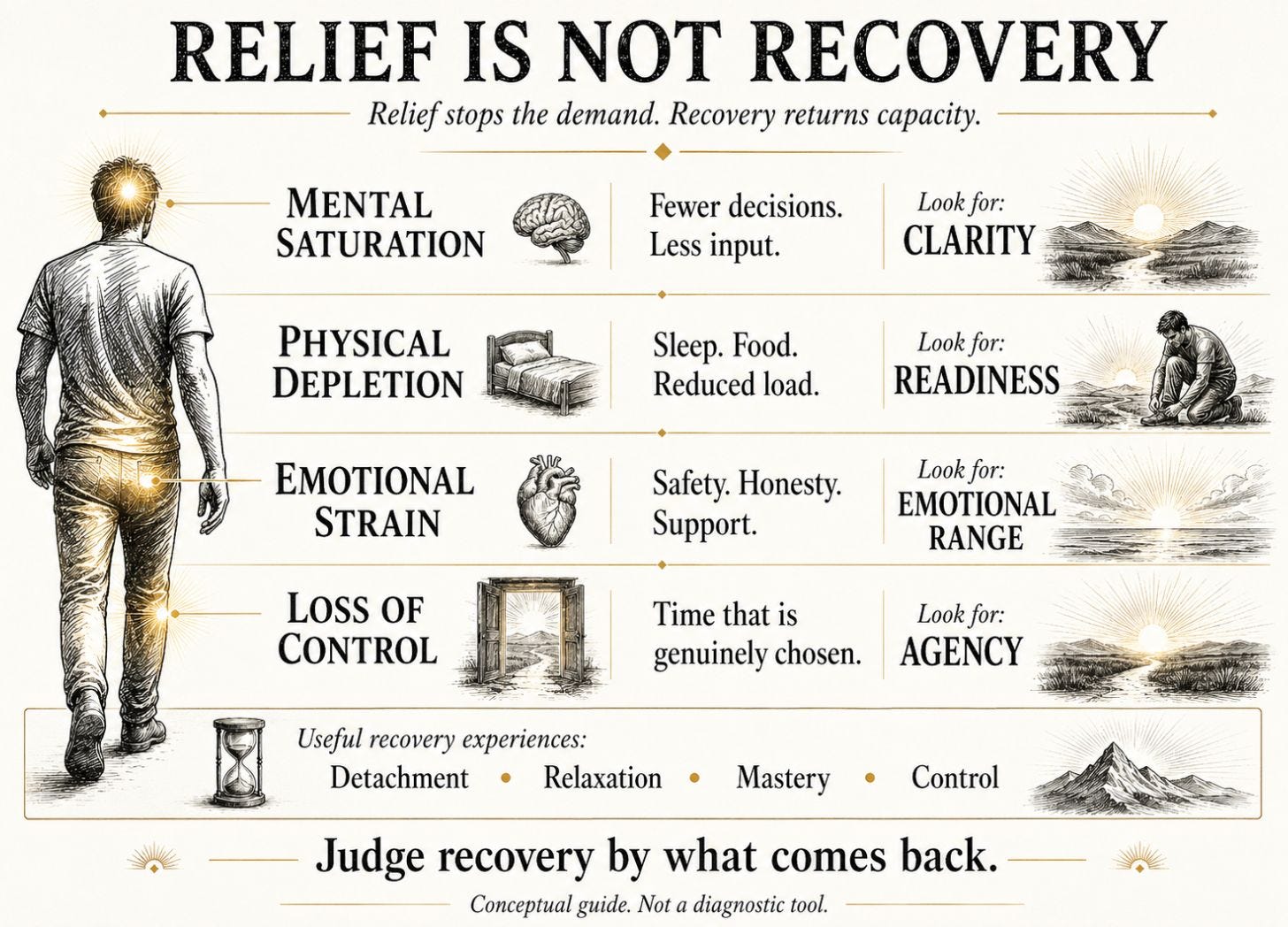
Relief and recovery are not the same.
Relief means the demand stopped.
Recovery means capacity returned.
You can stop working while your mind continues the meeting. You can lie on a sofa while remaining available to every message. You can spend a weekend consuming low-effort stimulation because nothing more demanding feels possible. You can take a holiday and return to the same workload, unresolved conflict and permanent availability.
Recovery research identifies experiences such as psychological detachment from work, relaxation, mastery and a sense of control as relevant to unwinding and recuperation.5 The precise need depends on what the day spent.
Mental saturation may need fewer decisions and less input. Physical depletion may need sleep, food and reduced load. Emotional strain may need safety, honesty or support. Loss of control may need time that is genuinely chosen.
The question is not only whether you stopped.
It is:
What capacity returned?
When rest repeatedly lowers the discomfort without restoring your baseline, another passive weekend may not solve the problem. The recovery may not match the depletion. The demand may be returning too quickly. Or the underlying structure may be asking recovery to compensate for something recovery cannot fix.
Judge recovery by what comes back.
3. Your Standards Become Harsher as Capacity Falls
This is where disciplined people are most easily deceived.
As capacity falls, they do not always reduce the unnecessary load. They tighten the rules.
A missed training session becomes evidence that they are losing themselves. A slower day becomes a character problem. A temporary minimum feels like surrender. Good work stops counting because it was not produced at the old speed.
The person becomes harsher precisely when accurate adjustment is most necessary.
Research on perfectionism suggests an important distinction. Wanting to do excellent work is not the same as living under chronic concern over mistakes, self-criticism and threat-based evaluation. Perfectionistic concerns are associated with burnout, while the problem cannot be reduced simply to having high standards.6
A healthy standard says:
This work needs correction.
A threatened standard says:
This difficulty reveals something unacceptable about me.
The standard stops improving the work and begins policing the person.
That creates a damaging loop. Capacity falls. The person feels less like themselves. Stricter discipline is used to restore identity. The additional force increases the debt. The worsening cost is then interpreted as proof that they need to become stricter again.
The lower the capacity falls, the harsher the internal manager becomes.
4. The Cost Moves Somewhere Performance Reports Do Not Show
A system under pressure protects what is measured.
If the deadline is measured, the deadline survives. If revenue is measured, revenue receives the energy. If the team needs certainty, certainty is performed.
The cost moves into places with less immediate accountability:
sleep,
patience,
curiosity,
emotional range,
physical readiness,
time with the people you love,
the ability to stop thinking about work,
the quality of decisions made after capacity is spent.
Burnout research has found associations with difficulties in several areas of cognitive functioning, although the evidence is heterogeneous and should not be used to diagnose ordinary lapses in attention or memory.7
The wider pattern matters more:
The work gets completed. The rest of the life pays the invoice.
This is how ambitious people can look successful while becoming increasingly absent from the life their success was meant to support.
Their body receives what work leaves behind.
Their partner receives what leadership leaves behind.
Their children receive what the calendar leaves behind.
Their judgment receives what sleep leaves behind.
Nothing has collapsed publicly.
Ownership is already shrinking privately.
Why Capable People Miss the Warning
Capable people do not miss Discipline Debt because they are foolish. They miss it because capability can conceal it.
Competence compensates. You have more ways to preserve the result. You can plan around the fatigue, work around the strain and make up the difference through force.
The environment rewards output. The organisation sees delivery. Clients see reliability. Other people praise endurance without seeing what endurance is consuming.
Identity rewards endurance. You may have built self-respect around being the person who does not need special conditions. Adjustment can therefore feel less like strategy and more like betrayal.
Responsibility is real. Reducing load may affect income, employees, family, reputation or momentum. Generic advice to “take a break” often fails because it ignores the consequences the reader is carrying.
The answer is not to pretend responsibility is imaginary.
It is to preserve the ability to choose before accumulated debt removes the choice.
Capability does not make you immune to debt.
It gives you a larger credit limit.
When This Is Not a Discipline Problem
Not every decline in energy, focus or mood is Discipline Debt.
Persistent, severe, sudden, unexplained or worsening fatigue, concentration problems, mood changes, sleep disruption or physical symptoms deserve appropriate professional assessment. Similar experiences can have medical, psychological, sleep-related or medication-related causes.
Do not use a content framework to explain away symptoms that deserve assessment.
The problem may also be structural.
The Job Demands-Resources model shows why workload cannot be separated from resources such as control, support, clarity and the conditions needed to meet the demand.8
No breathing exercise can make an impossible workload reasonable.
No morning routine can repair chronic value conflict.
No individual recovery plan can permanently compensate for a system built on understaffing, permanent availability or fear.
Sometimes the right intervention is personal. Sometimes it is organisational. Often it is both.
The Question to Ask Before You Push Again
Before adding more force, ask:
Is this effort increasing my capacity, maintaining it, or borrowing it?
Then examine three things.
Force: What does the same output require now compared with four weeks ago?
Restoration: After appropriate recovery, does your baseline return?
Spillover: What part of your life is currently paying for the result?
Choose one recurring commitment and write three lines:
Output: What must be delivered?
Force: What does it currently take to deliver it?
Cost: What becomes worse afterward?
Do not redesign your whole life tonight.
Collect accurate evidence.
The first correction is not always to stop.
It is to stop lying to yourself about the price.
What to Do Today
Identify one demand being maintained mainly through escalating force.
Reduce it by one level for seven days while protecting the essential outcome. That may mean shortening a low-value meeting, reducing one training variable, delaying one non-urgent project, ending one late-night catch-up block, delegating one decision or replacing a peak standard with a temporary minimum.
Change one variable, then watch what happens to the force required, recovery, patience, judgment, interest and presence.
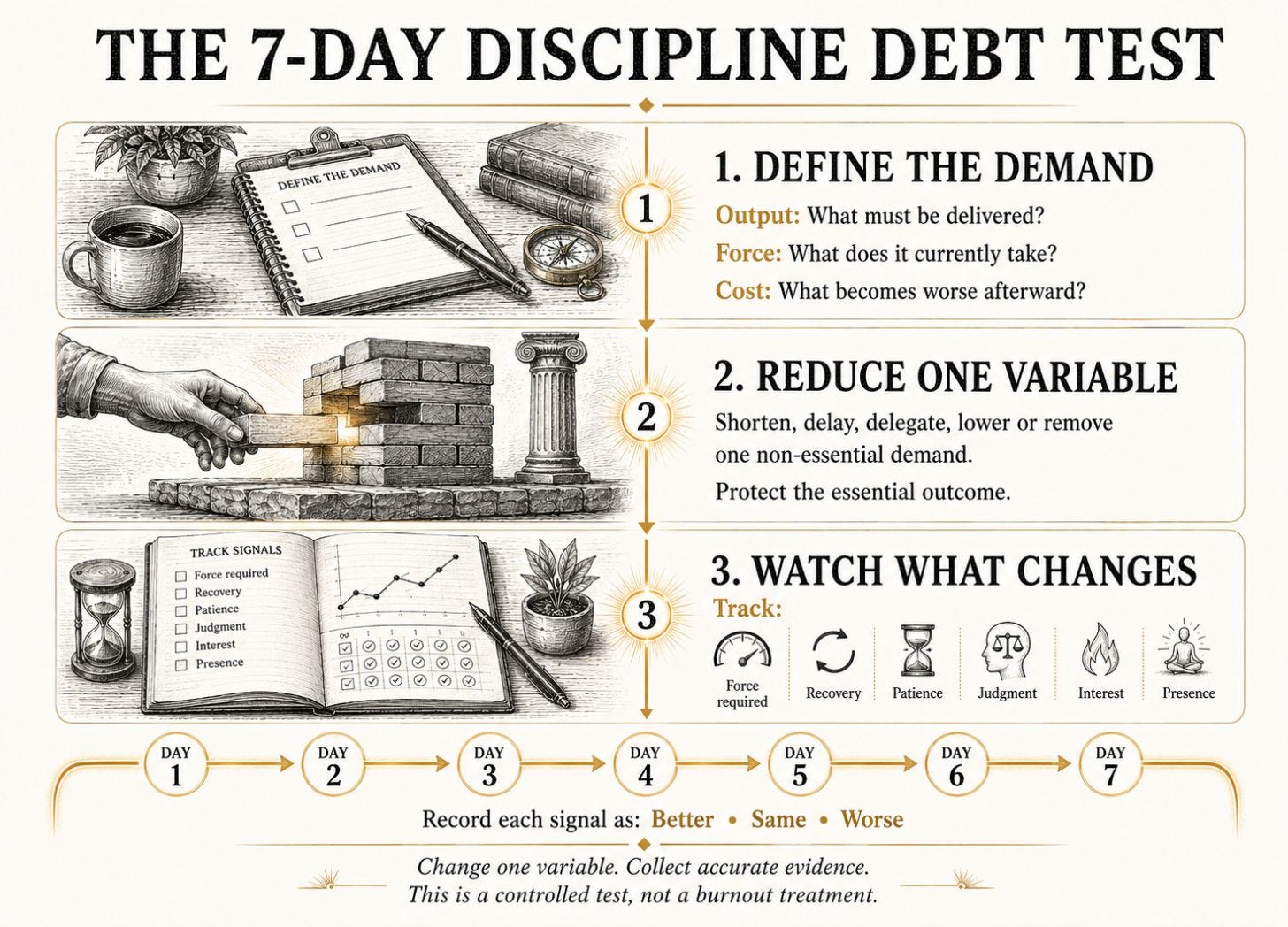
This is not a complete burnout treatment. It is a controlled test of the mechanism.
The purpose is not to become softer.
It is to discover whether the current standard is building the person who carries it or merely preserving the appearance of strength.
Ambition deserves more than emergency power.
It deserves a body, mind and life capable of carrying it repeatedly.
Discipline should build the person carrying the standard.
When it only preserves the output, the bill has already begun.
On Monday: The Discipline Debt Recovery Plan
A practical system for identifying what is borrowing capacity, reducing load without abandoning your most important commitments, and deciding when you are ready to build again.
Important note
This essay is educational and does not diagnose burnout or any medical or psychological condition. Burnout is defined by the World Health Organization specifically in relation to occupational stress. Persistent or concerning symptoms deserve assessment from an appropriately qualified professional.
G. Robert J. Hockey (1997), ‘Compensatory control in the regulation of human performance under stress and high workload: A cognitive-energetical framework’, Biological Psychology, 45(1–3), pp. 73–93, doi:10.1016/S0301-0511(96)05223-4
World Health Organization (2019), ‘Burn-out an “occupational phenomenon”: International Classification of Diseases’, 28 May, accessed 26 June 2026.
Romain Meeusen, Martine Duclos, Carl Foster, Andrew Fry, Michael Gleeson, David Nieman, John Raglin, Gerard Rietjens, Jürgen Steinacker and Axel Urhausen (2013), ‘Prevention, diagnosis, and treatment of the overtraining syndrome: Joint consensus statement of the European College of Sport Science and the American College of Sports Medicine’, Medicine & Science in Sports & Exercise, 45(1), pp. 186–205, doi:10.1249/MSS.0b013e318279a10a.
G. Robert J. Hockey (1997), ‘Compensatory control in the regulation of human performance under stress and high workload: A cognitive-energetical framework’, Biological Psychology, 45(1–3), pp. 73–93, doi:10.1016/S0301-0511(96)05223-4.
Sabine Sonnentag and Charlotte Fritz (2007), ‘The Recovery Experience Questionnaire: Development and validation of a measure for assessing recuperation and unwinding from work’, Journal of Occupational Health Psychology, 12(3), pp. 204–221, doi:10.1037/1076-8998.12.3.204.
Andrew P. Hill and Thomas Curran (2016), ‘Multidimensional perfectionism and burnout: A meta-analysis’, Personality and Social Psychology Review, 20(3), pp. 269–288, doi:10.1177/1088868315596286
Pavlos Deligkaris, Efharis Panagopoulou, Anthony J. Montgomery and Elvira Masoura (2014), ‘Job burnout and cognitive functioning: A systematic review’, Work & Stress, 28(2), pp. 107–123, doi:10.1080/02678373.2014.909545.
Evangelia Demerouti, Arnold B. Bakker, Friedhelm Nachreiner and Wilmar B. Schaufeli (2001), ‘The job demands-resources model of burnout’, Journal of Applied Psychology, 86(3), pp. 499–512, doi:10.1037/0021-9010.86.3.499.