

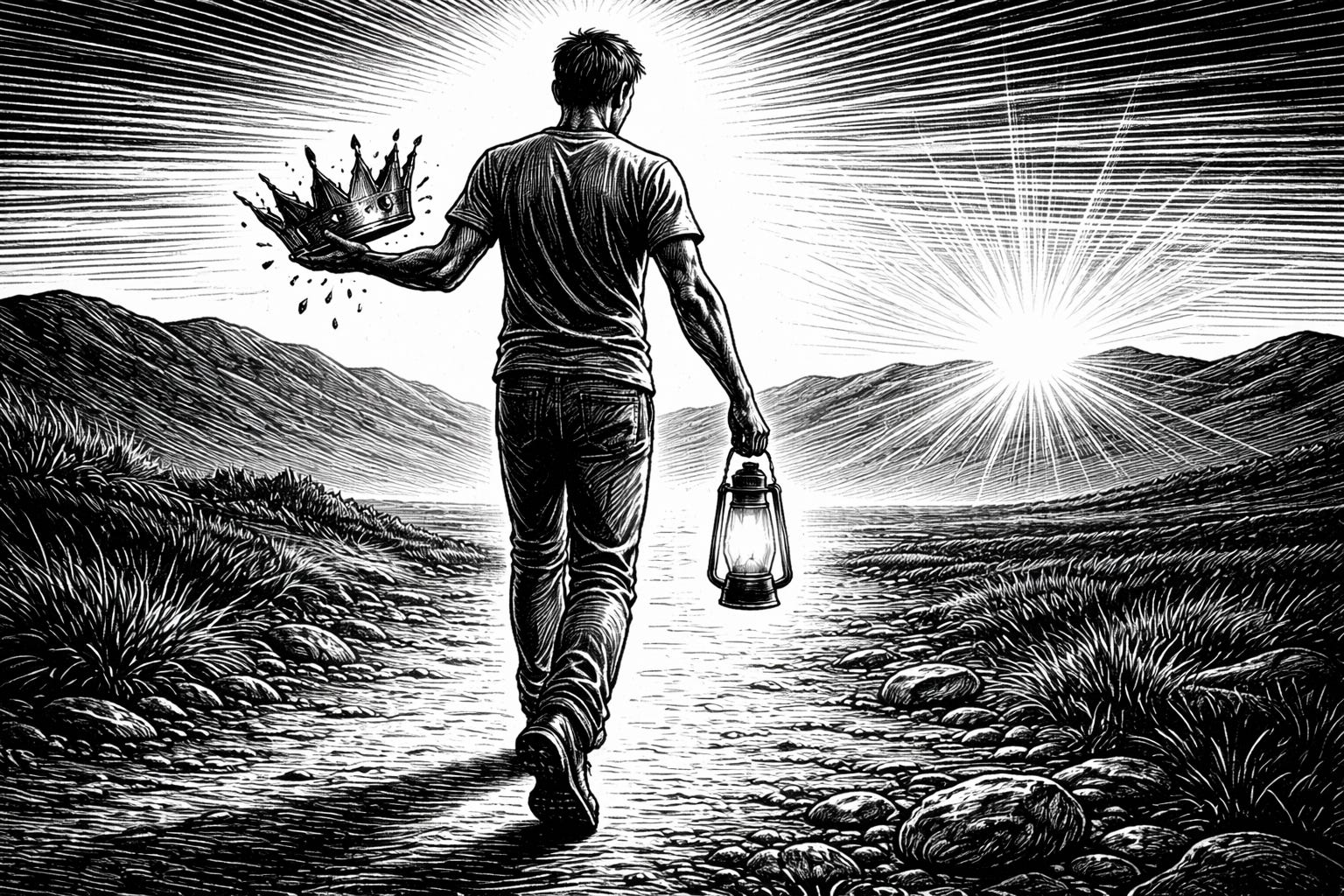
Smart people fail in a distinctive way.
They can explain what to do. They can diagnose the bias. They can quote the research. They can see the pattern.
And still they do not move.
The sentence that sabotages them is quiet and lethal: I already know.
Not because knowledge is bad. Knowledge is leverage. Knowledge is the beginning of mastery.
The danger is what knowledge does to the ego when it becomes identity.
Two lines name the crisis:
“The fundamental cause of the trouble is that in the modern world the stupid are cocksure while the intelligent are full of doubt.” (Russell, 1933)
“The best lack all conviction, while the worst are full of passionate intensity.” (Yeats, 1920)
Russell and Yeats are not only describing politics. They are describing the human soul. The loud move first. The thoughtful hesitate. The arrogant stop learning. The wise delay acting.
The aim is not to choose between humility and conviction.
The aim is to unite them.
Humility that learns fast. Conviction that acts. Virtue that serves.
The Paradox of Knowing
“I know” can mean two very different things.
For the immature, it becomes a crown: “I am the kind of person who cannot be wrong.” Growth stops. Feedback becomes an insult. Reality does not negotiate.
For the intelligent, it can become a shield: “It is complicated.” Insight turns into hesitation. Doubt becomes a polished excuse for never stepping forward.
Both lead to failure.
One fails by arrogance. The other fails by abdication.
When Confidence Stops Listening, a Market Parable
Morgan Housel tells a story that is not merely about finance. It is a parable about the ego (Housel, 2020).
Jesse Livermore became famous for making a fortune around the 1929 crash, and for later destroying his own wealth. Housel’s point is simple and brutal: getting wealthy and staying wealthy are different skills (Housel, 2020; Housel, 2022).
The mechanism matters.
A major win can mutate into a dangerous narrative: “I have special sight.” Once that story takes hold, risk scales up, feedback is ignored, and the world is treated as something that should obey the mind.
Behavioral research shows that prior gains can change the psychological meaning of risk, increasing willingness to take further bets (Thaler and Johnson, 1990).
This pattern is not confined to markets.
It shows up in health, leadership, relationships, and self-mastery.
A man has one disciplined season and believes he is now immune to relapse.
A leader wins early and stops listening.
A thinker finds the “right framework” and stops being open to correction.
“I know,” and therefore I fail.
The “I Already Know” Trap, When Learning Dies
Plato depicts Socrates as powerful precisely because he refuses finality. He does not pretend closure. He remains teachable (Plato, c.399 BCE).
That posture is not self-deprecation. It is strategic openness. It keeps the mind porous, alert, and corrigible.
Modern psychology names how that openness collapses.
A fixed mindset treats criticism as a threat. Feedback becomes humiliation rather than instruction (Dweck, 2006). Pride becomes defense. The person protects identity, not progress.
Dunning and Kruger add another blade: people can overestimate their competence because they lack the metacognitive skill to detect their deficits (Kruger and Dunning, 1999). This is not merely foolishness. It is blindness that thinks it is sight.
So the tragedy is not ignorance alone.
It is ignorance armed with certainty.
Humility as Truth, Orthodox Christianity and the End of Self-Deception
Orthodox Christianity treats humility as more than a virtue. It treats humility as truth, truth about God, and truth about the self.
St Isaac the Syrian calls humility “the garment of divinity,” linking humility to the Incarnation itself (Isaac of Nineveh, 1984). Philippians describes that self-emptying pattern with severe clarity (Philippians 2:5–8, NRSV).
The Desert Fathers drive the theology into flesh.
A brother is judged. Abba Moses is summoned. He arrives carrying a leaking jug, water trailing behind him. When asked why, he answers in essence: My sins run behind me, and I do not see them, so how can I judge another (Ward, 1984).
That image is not quaint. It is an assault on arrogance.
It says: the first blindness is moral. The first ignorance is self-ignorance. Humility is the beginning of sight.
St John Climacus goes further. Humility, he says, is a grace known only by those who have tasted it. It is not a concept you win by argument. It is a gift revealed in the soul that has stopped defending itself (Climacus, 1982).
St Silouan condenses the struggle into one sentence: “Keep thy mind in hell and despair not” (Sophrony, 1973). Humility without romance, paired with hope that refuses to collapse.
Orthodoxy is ruthless here: humility is not a mood. It is not performative self-disgust. It is the courage to stand before God and reality without a costume.
And once you see clearly, you can finally act rightly.
The Missing Half: Humility Without Action Is Abdication
Here is the trap many intelligent people fall into, and why Russell’s diagnosis still burns.
They see complexity, so they hesitate. They see risk, so they wait. They see nuance, so they soften their voice until it disappears.
Meanwhile, those with less wisdom but more intensity occupy the field (Yeats, 1920; Russell, 1933).
This is not virtue.
This is surrender.
The world does not change through correct opinions. It changes through embodied action. It changes when wise men and women step into responsibility, lead, build, protect, and create.
But action must be purified.
If action is driven by ego, it becomes domination. If action is driven by fear, it becomes control. If action is only driven by love of self, it becomes exploitation.
So the requirement is a synthesis:
Conviction that moves, and humility that listens.
Calibrated Conviction, Acting Without Worshipping Certainty
What you are seeking is not the elimination of doubt.
It is the discipline of doubt.
A posture that says: I will act decisively, but I will never confuse my current model with the final truth.
This is the posture that Tetlock and Gardner describe in the best forecasters: people who take uncertainty seriously while still making concrete predictions, then updating quickly when they are wrong (Tetlock and Gardner, 2015).
In self-mastery, calibrated conviction looks like this:
You move forward with force, but you hold your beliefs with open hands.
You lead, but you remain teachable.
You build, but you keep checking reality.
You do not fear being wrong, because being wrong is how the mind becomes accurate.
The Humble Action Protocol, Five disciplines that prevent the “I know” collapse
Rename certainty as a hypothesis.
Replace “I know” with “My current best model is…” This keeps the mind corrigible (Tetlock and Gardner, 2015).Define what would change your mind.
Before you act, write one disconfirming sign that would require adjustment. This keeps you in reality, not ego (Tetlock and Gardner, 2015).Act in disciplined increments.
Many collapses come from scaling the bet faster than the learning. Size your actions so failure teaches rather than destroys (Housel, 2020; Thaler and Johnson, 1990).Install feedback loops that ego cannot bribe.
Use metrics, peer review, recording, journaling, and objective checkpoints. Humble leadership is observable behavior: admitting limits, spotlighting others, and staying teachable (Owens and Hekman, 2012).Anchor your power in service and love of good.
Humility is not passive. It is ordered love. If your strength is directed toward the good of others, arrogance loses its fuel. Service stabilizes power. It turns competence into contribution.
Conclusion: The World Needs the Wise, and the Humble
Russell and Yeats are warnings, but they are also a summons.
The world will always have fools who are cocksure. The world will always have the worst, who are full of intensity. The question is whether the wise will remain spectators (Russell, 1933; Yeats, 1920).
Do not become arrogant, so you can act.
But do not become so cautious that you refuse to act.
Act, because action is how life is built.
Act, because responsibility is love in motion.
Act, but do it with humility, virtue, and a love of mankind that keeps your power clean.
If you want a life that is strong, become teachable.
If you want a life that is great, become useful.
If you want a life that endures, unite humility with conviction.
Every time “I know” rises in your chest, treat it as a signal.
Ask instead: What am I missing?
Then move.
Atlas said it.
References
Climacus, J. (1982) The Ladder of Divine Ascent. Translated by C. Luibheid and N. Russell. New York: Paulist Press.
Dweck, C.S. (2006) Mindset: The New Psychology of Success. New York: Random House.
Housel, M. (2020) The Psychology of Money: Timeless Lessons on Wealth, Greed, and Happiness. Petersfield: Harriman House.
Housel, M. (2022) ‘Getting wealthy vs. staying wealthy’, Collaborative Fund, 28 November.
Isaac of Nineveh (St Isaac the Syrian) (1984) The Ascetical Homilies of Saint Isaac the Syrian. Translated by D. Miller. Boston, MA: Holy Transfiguration Monastery.
Kruger, J. and Dunning, D. (1999) ‘Unskilled and unaware of it: How difficulties in recognising one’s own incompetence lead to inflated self-assessments’, Journal of Personality and Social Psychology, 77(6), pp. 1121–1134.
Owens, B.P. and Hekman, D.R. (2012) ‘Modeling how to grow: An inductive examination of humble leader behaviors, contingencies, and outcomes’, Academy of Management Journal, 55(4), pp. 787–818.
Plato (c.399 BCE) Apology, in Plato (1966) Euthyphro, Apology, Crito, Phaedo, Phaedrus. Translated by H.N. Fowler. Cambridge, MA: Harvard University Press.
Russell, B. (1933) ‘Stupidity Rules’ (also reprinted as ‘The Triumph of Stupidity’), San Francisco Examiner, 10 May.
Sophrony (Archimandrite) (1973) Saint Silouan the Athonite. Translated by R. Edmonds. London: Mowbrays.
Thaler, R.H. and Johnson, E.J. (1990) ‘Gambling with the house money and trying to break even: The effects of prior outcomes on risky choice’, Management Science, 36(6), pp. 643–660.
The Holy Bible (1989) New Revised Standard Version. New York: National Council of the Churches of Christ in the United States of America.
Tetlock, P.E. and Gardner, D. (2015) Superforecasting: The Art and Science of Prediction. New York: Crown.
Ward, B. (trans.) (1984) The Sayings of the Desert Fathers: The Alphabetical Collection. Revised edn. Kalamazoo, MI: Cistercian Publications.
Yeats, W.B. (1920) ‘The Second Coming’, The Dial, November.
I love this because it’s not just theory. I’ve watched how humility keeps you teachable and conviction keeps you moving. And that quote is gold: when action is driven by ego, fear, or exploitation, it degrades the person and the relationship. Conviction that moves. Humility that listens.