

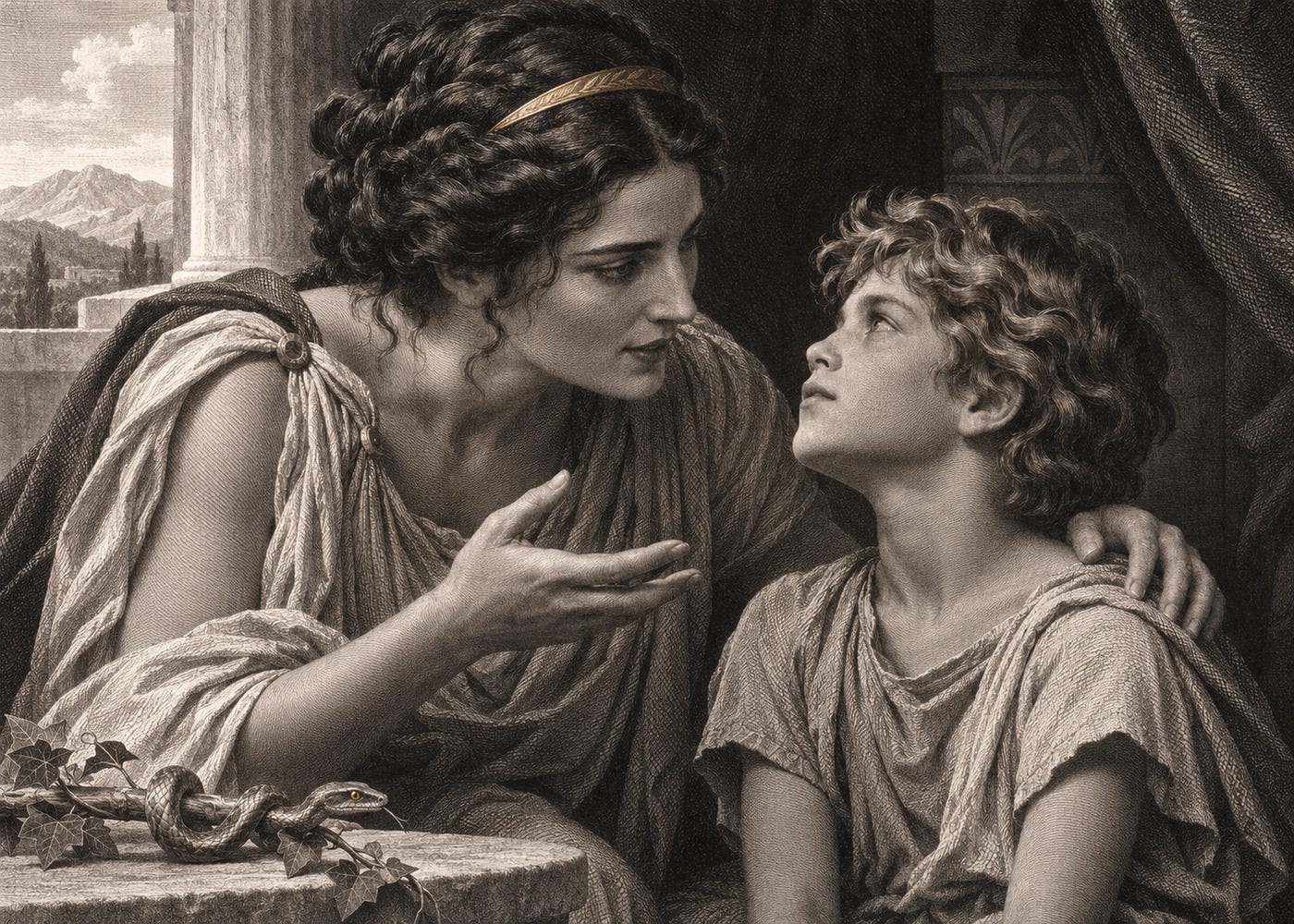
I want to take us back for a moment to the ancient Greek kingdom of Macedon. Plutarch tells us of a woman of royal descent who sleeps with snakes. In one of the legends about her, King Philip puts his eye to a crack in the door and sees a serpent sharing his wife’s bed. At Delphi, the oracle tells Philip’s messenger that the king will lose that eye for having seen a god in his wife’s bed.1
This woman is Olympias, a princess of the Molossian royal house in Epirus, whose strange affinity to snakes adds another layer of intrigue and mystery to her personality. At the rites of Dionysus she brings tame serpents that lift their heads out of the ivy and coil around the women’s garlands, to the terror of the men. Before she first lies with Philip, she has a dream. Lightning striking her womb, and from the place where it strikes, a fire spreading in every direction. In the stories that grew up around her son, his father might have been Zeus himself, the king of the gods.2
The child, of course, was Alexander the Great, but his birth was just the beginning of a long-standing struggle.
Olympias considered herself a descendant of Achilles. So Alexander considered himself a descendant of the great heroes of history and myth and, on the other hand, possibly of the king of the gods. I want you to imagine what it would mean, as a child, to be convinced that you were the flesh and blood of heroes and gods. If Olympias believed her child was of divine descent, how was his mother’s belief to affect the child’s belief in himself?3
How was this to affect the perception of others towards this child? One of Alexander’s tutors, Lysimachus, called him Achilles. He called Philip Peleus, the father of Achilles, and took for himself the name of Phoenix, who had helped bring Achilles up. Think of that boy going to his lessons and hearing the name his mother’s family reveres spoken to him as his own.4
And in the midst of this, a child gets trained by none other than one of the greatest philosophers the world has ever known, Aristotle. How was this young child’s mind formed, transformed, shaped by such an education? On campaign Alexander carried Aristotle’s edition of the Iliad. He is said to have slept with it under his pillow, beside his dagger. And when he ran short of books in the interior of Asia, he sent for more.5
Hard work, consistency, persistence, and the desire to thoughtfully engage with ideas have been the secret behind so many of history’s most prominent figures being called geniuses. Philip could send for Aristotle. Years after those lessons were over, it was Alexander who wanted another book.
While considering this, we have to consider the broader military and political environment. King Philip has made strides, great strides, in establishing his kingdom as one of the dominant powers in the military and political affairs of greater Greece. But was this success even Philip’s?6
Long before Philip, King Archelaus had cut roads through Macedon, built strongholds and supplied horses and arms. Yet when Philip’s brother died fighting the Illyrians, the army he left behind had suffered a terrible defeat. Philip rearmed his men and drilled them in the close ranks of the phalanx. All this went into the army Alexander would one day lead. From the boy’s point of view, every victory his father won presented another difficulty. Plutarch tells us that whenever news came of another city taken or another battle won, Alexander would complain to his friends that his father was going to leave them nothing great to do.7
At Chaeronea, Philip gave his son command of one wing of that army and placed some of his best commanders beside him. Alexander was the first to break the enemy line, Diodorus tells us. After that battle, one could be forgiven for thinking that Alexander’s place at his father’s side was secure. Then came his father’s wedding.8
Philip married another wife, Cleopatra. At the feast her uncle Attalus called on the Macedonians to pray that this marriage would give them a legitimate heir. Alexander demanded to know whether Attalus was calling him a bastard and threw his cup at him. Philip rose against his son with his sword drawn, stumbled and fell. Alexander took Olympias home to Epirus and went on to Illyria.9
The same young man who could claim Achilles through his mother had just heard his own birth called into question in front of his father and the Macedonians. And Attalus was one of the men Philip entrusted with his advance force in Asia. Had Philip not been assassinated, there could well have been a power struggle that would have changed the course of history and placed Alexander’s kingship in doubt. A different outcome at that court could have left the same young man, with all his gifts, serving under somebody else’s command.10
But the assassination of Philip allowed Alexander to rise. He was twenty when he won the Macedonians’ support. As he was setting out for Asia, one tradition has it that Olympias told him, and him alone, the secret of his birth and urged him to do something worthy of it. When he reached Troy, he went to the tomb of Achilles and laid a wreath there. Can Alexander’s belief in himself be separated from his mother’s belief in him?11
At the river Granicus, Alexander chose to cross against the advice of one of his generals. He rode into the water with his cavalry. On the far bank a Persian struck his helmet with an axe. Before the man could strike again, Cleitus killed him. Neither Olympias nor Aristotle could ride into that river for him. And there, on the far bank, with his father’s cavalry around him, his life depended on what another man did in the space of a second.12
Alexander’s persistence, his perceptiveness, his hardiness in the face of all that he endured, were his own. What he went through to achieve what he achieved cannot be diminished by anyone, and it would be wrong to do so.
But are we really looking at reality if we separate everything that led to his achievements from the achievements themselves? How delusional would it be to assign his achievements to his ability alone?
Was Walt Disney a self-made man?
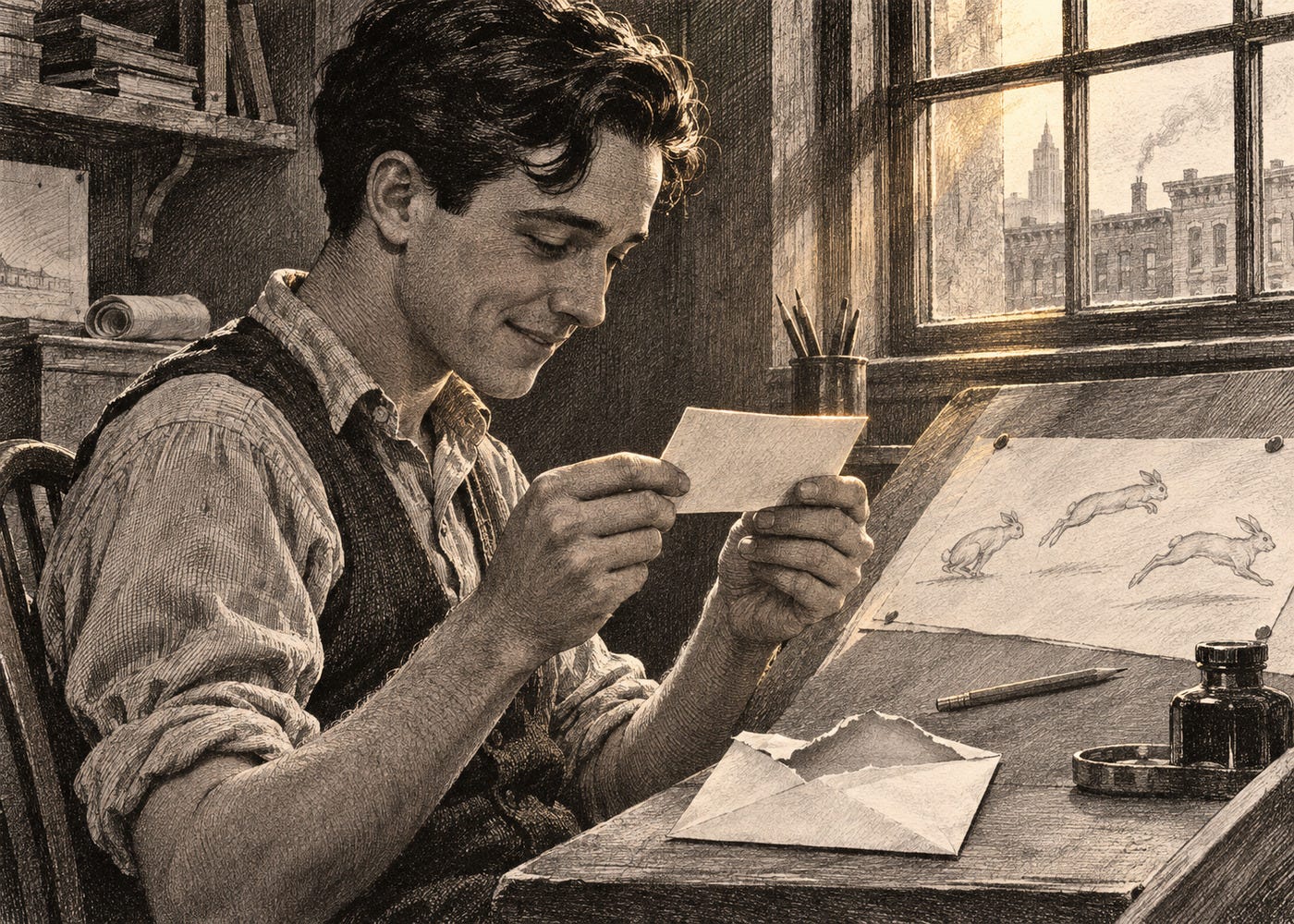
People know how Walt Disney persisted. They hear much less often about his brother’s contribution. When Walt was struggling in Kansas City, his older brother Roy sent him cheques. Years later, Walt recalled how much he had wanted Roy as his partner in California. “Roy had a faith in me,” he said. In 1923 they founded the Disney Brothers Cartoon Studio.13
When Walt died in 1966, the Florida park was still to be built. A week after his death, Roy gathered the staff in a projection room. One designer remembered that Roy could barely speak, but he told them they were going to finish the park the way Walt had wanted. Roy put off his retirement, saw to the financing and lived to see the park open in 1971. He insisted on the name Walt Disney World. When you read Walt’s name above that park, you are seeing a choice Roy made about how his brother would be remembered.14
People know the story of Walmart, but few know that Sam Walton’s father-in-law secretly negotiated a lease for him when he was getting started. The lease was on a barbershop. Walton had spent five years building up a business in Newport, Arkansas. When the lease was up, the landlord wanted the store for his own son.
So in 1950 Sam and Helen Walton went looking for somewhere to begin again. In Bentonville they found Harrison’s Variety Store. Sam reckoned he would need about twice the space. There was a wall he could knock through into the barbershop next door, if only the two widows in Kansas City who owned it would give him a long enough lease. After his experience in Newport, he had ninety-nine years in mind.15
Helen’s father, L. S. Robson, went to Kansas City without telling Sam and persuaded the women to agree. Looking back on that visit years later, Walton wrote, “I’m not sure where the Waltons would have ended up.” I find it rather moving that it was Sam himself who wanted us to know this. He understood perfectly well what he had done to build up that first store. He had also had the experience of having to hand it over to another man’s son. And when his turn came to tell the story, he remembered to tell us about Helen’s father.
Could someone else have taken that same little barbershop and built Walmart? I very much doubt it. But could Sam have done it without Robson? Sam, who knew a good deal more about it than we do, leaves the question open.16
Consider what happens when someone is tall or short. It might predispose him to certain sports or activities. But when it comes to achievement? Take two girls who would both like to play basketball. One of them is a head taller than the other. If I have one place left on my team and I want somebody who can reach up for the ball under the basket, I have a perfectly good reason for choosing the taller girl. The interesting question, to my mind, is what can I possibly know about the girl I sent home?
In the first chapter of Outliers, Malcolm Gladwell tells a story about Paula Barnsley, who was at a hockey game with her husband and their boys in Alberta. She was looking down the list of players in the programme when something about their birthdays caught her eye. Her husband Roger and a colleague checked the birthdays of the boys in two Canadian junior leagues. Of 1,048 players, 435 had been born in the first three months of the year. Only 102 had birthdays in the last three.
The boys were grouped by year of birth. When it came time to choose a team of nine-year-olds, the boy with a birthday in early January might have nearly a year’s growth on another born in December. Think what a year meant to you at nine.
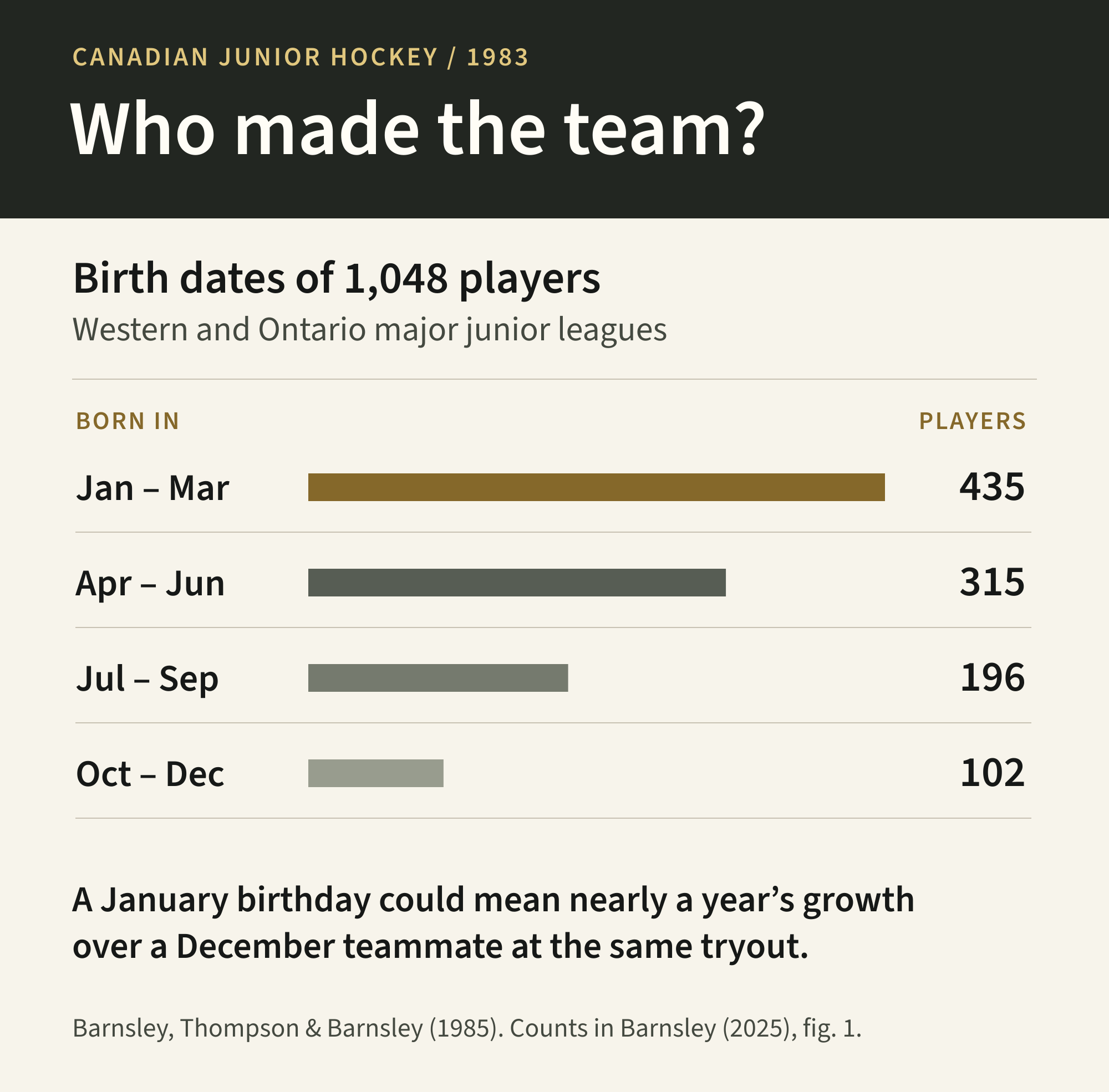
Gladwell’s point is that if an older boy gets chosen, he gets more instruction and more hours on the ice. By sixteen he has had years in which to become the player the coach thought he saw at nine.17
With so many moving pieces, can we really isolate heredity or environment from the whole picture? I come back to our two girls because I think there are two quite different questions here. If you ask me about height, we can take their shoes off and put their backs against a wall. We can study families and learn something about why some people grow taller than others.
But you were asking me about achievement. What am I supposed to measure the day the girl I picked takes a rebound over somebody taller than she is? I have spent three winters teaching her how to get there first. Her height is part of the reason she had those three winters with me in the first place. The hours she spent practising are hers. I cannot for the life of me see where one of those influences ends and the other begins.18
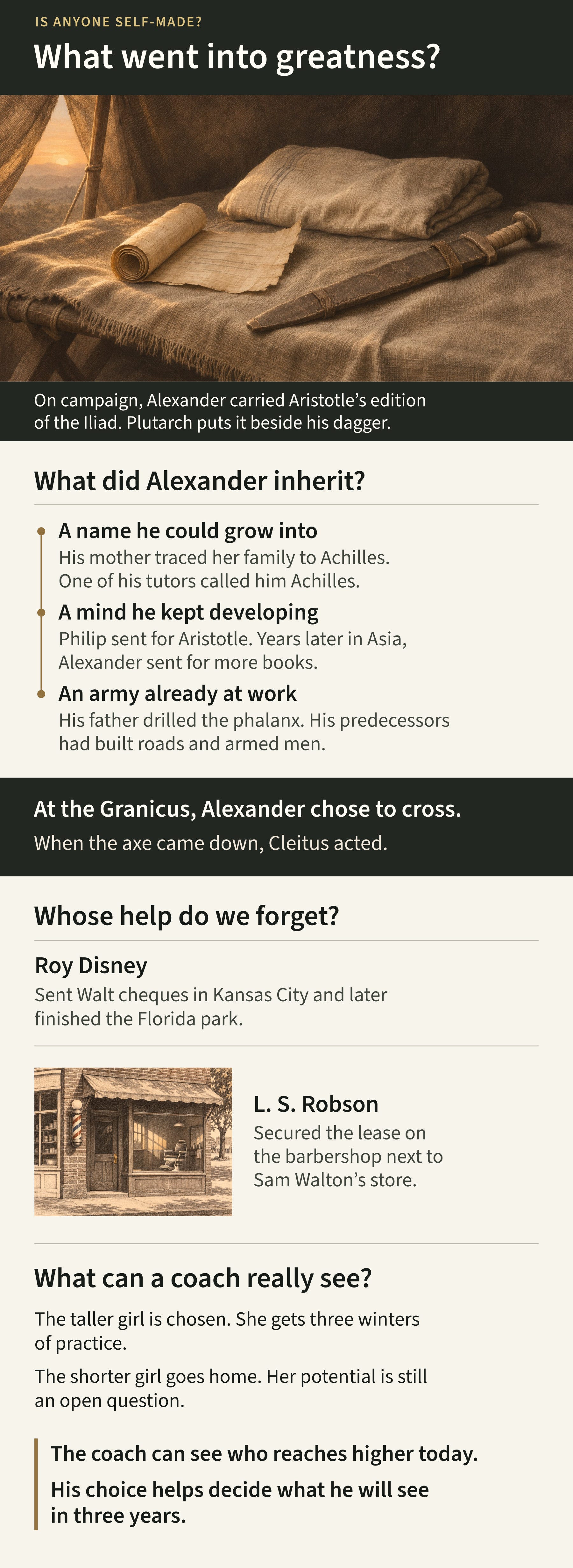
Is anyone self-made?
I don’t believe so. Consider again the boy whose tutor actually called him Achilles. Can Alexander’s achievements be separated from the political and military reality that he inherited? And to put the cherry on the cake, can Alexander’s genius be separated from his education by Aristotle himself? For all the advantages that child was given, I should still like to know who among us would have ridden into that river. And if Cleitus had been looking the other way when the axe came down, just how much of what you and I know as the greatness of Alexander would there have been for us to discuss?
There is a reason I feel strongly about the girl the coach sent home. In three years’ time he could point out every skill she lacks and be perfectly right about every one of them. I would take issue with him the moment he claimed to know, on the strength of that, what she was capable of.
And I feel the same about the people we allow close to us. If a person keeps focusing on your weaknesses, they do not mean you well. Even if they claim they are objective. The person who sees you struggling with something and stays after practice to teach it to you has seen the very same weakness. What a difference to go home knowing there is somebody who wants you back tomorrow.
When Walt spoke about those years when he could barely make a living, he could still remember getting Roy’s cheques. I wonder what it was worth to him to open one of those envelopes and know what his brother believed about him.
References
Barnsley, R.H. (2025) ‘40-years of relative age effects: life is not fair!’, Frontiers in Sports and Active Living, 6, 1516173. Article
Barnsley, R.H., Thompson, A.H. and Barnsley, P.E. (1985) ‘Hockey success and birthdate: the relative age effect’, Canadian Association for Health, Physical Education and Recreation Journal, 51(8), pp. 23–28. Article
Bosworth, A.B. (2016) ‘Olympias’, Oxford Classical Dictionary. Oxford: Oxford University Press. Entry
Diodorus Siculus (1952) Library of History. Vol. VII. Translated by C.L. Sherman. Cambridge, MA: Harvard University Press. Book 16
Diodorus Siculus (1963) Library of History. Vol. VIII. Translated by C.B. Welles. Cambridge, MA: Harvard University Press. Book 16
Disney, W. (2014) ‘In Walt’s own words: his brother Roy’. Interview with Pete Martin, c. 1956. San Francisco: The Walt Disney Family Museum, 17 September. Interview
Gladwell, M. (2008) Outliers: The Story of Success. New York: Little, Brown and Company. Chapter 1. Book
Hendrickson, J. (2016) ‘Roy Disney made Walt’s dream come true after Walt’s passing’. San Francisco: The Walt Disney Family Museum, 22 October. Account
King, C.J. (2024) ‘Macedonia’, in Ogden, D. (ed.) The Cambridge Companion to Alexander the Great. Cambridge: Cambridge University Press, pp. 147–164. Chapter
Plutarch (1919) ‘Alexander’, in Lives. Vol. VII. Translated by B. Perrin. Cambridge, MA: Harvard University Press. Life of Alexander
The Walt Disney Family Museum (2023) ‘Mrs. Davis letter on display for The Walt Disney Company’s 100th anniversary’. San Francisco: WDFM Collections Department, 30 November. Collection
Thucydides (1919) History of the Peloponnesian War. Vol. I. Translated by C.F. Smith. Cambridge, MA: Harvard University Press. Book 2
US National Library of Medicine (2021) ‘What is heritability?’, MedlinePlus Genetics. Bethesda, MD: National Library of Medicine, 16 September. Overview
Walton, S. with Huey, J. (1992) Sam Walton: Made in America. My Story. New York: Doubleday. Chapters 2–3. Book
Notes on the sources
The serpent at the door. Plutarch (1919), Alexander 2.6–3.1. It was Philip who looked through the door and Chaeron of Megalopolis who went to Delphi. The tame snakes appear in the account of the rites of Dionysus. Plutarch (1919) ‘Alexander’, in Lives. Vol. VII. Translated by B. Perrin. Cambridge, MA: Harvard University Press. Life of Alexander
Olympias of Epirus. Bosworth (2016), “Olympias”. For her son’s ancestry see Plutarch (1919), Alexander 2–3, 27–28. At 3.2 Plutarch gives two traditions. In one Olympias privately tells her son who his father was. In the other she reproaches Alexander for getting her into trouble with Hera, the wife of Zeus. Bosworth, A.B. (2016) ‘Olympias’, Oxford Classical Dictionary. Oxford: Oxford University Press. Entry Plutarch (1919) ‘Alexander’, in Lives. Vol. VII. Translated by B. Perrin. Cambridge, MA: Harvard University Press. Life of Alexander
Bosworth, A.B. (2016) ‘Olympias’, Oxford Classical Dictionary. Oxford: Oxford University Press. Entry Plutarch (1919) ‘Alexander’, in Lives. Vol. VII. Translated by B. Perrin. Cambridge, MA: Harvard University Press. Life of Alexander
Lysimachus of Acarnania. Plutarch (1919), Alexander 5.5. Plutarch (1919) ‘Alexander’, in Lives. Vol. VII. Translated by B. Perrin. Cambridge, MA: Harvard University Press. Life of Alexander
The Iliad and the dagger. Plutarch (1919), Alexander 7–8. Onesicritus is Plutarch’s source for the story of the pillow. The request for more books went to Harpalus. Plutarch (1919) ‘Alexander’, in Lives. Vol. VII. Translated by B. Perrin. Cambridge, MA: Harvard University Press. Life of Alexander
The making of the Macedonian army. Thucydides (1919), 2.100.2 (Archelaus). Diodorus Siculus (1952), 16.2–3 (Philip). King (2024), pp. 147–164. For the disappointment with which the young Alexander received news of a victory, see Plutarch (1919), Alexander 5.2–3. King, C.J. (2024) ‘Macedonia’, in Ogden, D. (ed.) The Cambridge Companion to Alexander the Great. Cambridge: Cambridge University Press, pp. 147–164. Chapter Diodorus Siculus (1952) Library of History. Vol. VII. Translated by C.L. Sherman. Cambridge, MA: Harvard University Press. Book 16
Thucydides (1919) History of the Peloponnesian War. Vol. I. Translated by C.F. Smith. Cambridge, MA: Harvard University Press. Book 2 Diodorus Siculus (1952) Library of History. Vol. VII. Translated by C.L. Sherman. Cambridge, MA: Harvard University Press. Book 16 Plutarch (1919) ‘Alexander’, in Lives. Vol. VII. Translated by B. Perrin. Cambridge, MA: Harvard University Press. Life of Alexander
Chaeronea and the marriage to Cleopatra. Diodorus Siculus (1963), 16.86.1–4. Plutarch (1919), Alexander 9.6–11. Diodorus Siculus (1963) Library of History. Vol. VIII. Translated by C.B. Welles. Cambridge, MA: Harvard University Press. Book 16
Plutarch (1919) ‘Alexander’, in Lives. Vol. VII. Translated by B. Perrin. Cambridge, MA: Harvard University Press. Life of Alexander
The succession and the visit to Troy. Diodorus Siculus (1963), 16.91.2, 16.94 and 17.2. Plutarch (1919), Alexander 3.2, 11 and 15. Plutarch names Eratosthenes as his source for the farewell to Olympias. What might have happened had Philip lived is my reading of the position Alexander found himself in. Diodorus Siculus (1963) Library of History. Vol. VIII. Translated by C.B. Welles. Cambridge, MA: Harvard University Press. Book 16 Plutarch (1919) ‘Alexander’, in Lives. Vol. VII. Translated by B. Perrin. Cambridge, MA: Harvard University Press. Life of Alexander
Plutarch (1919) ‘Alexander’, in Lives. Vol. VII. Translated by B. Perrin. Cambridge, MA: Harvard University Press. Life of Alexander Diodorus Siculus (1963) Library of History. Vol. VIII. Translated by C.B. Welles. Cambridge, MA: Harvard University Press. Book 16
Cleitus at the Granicus. Plutarch (1919), Alexander 16.1–11. Plutarch (1919) ‘Alexander’, in Lives. Vol. VII. Translated by B. Perrin. Cambridge, MA: Harvard University Press. Life of Alexander
Walt and Roy. Disney (2014), interview with Pete Martin, c. 1956. The Walt Disney Family Museum (2023), on the 1923 contract. Hendrickson (2016), on the gathering in the projection room after Walt died and on Roy’s decision about the name of the Florida park. Disney, W. (2014) ‘In Walt’s own words: his brother Roy’. Interview with Pete Martin, c. 1956. San Francisco: The Walt Disney Family Museum, 17 September. Interview The Walt Disney Family Museum (2023) ‘Mrs. Davis letter on display for The Walt Disney Company’s 100th anniversary’. San Francisco: WDFM Collections Department, 30 November. Collection
Hendrickson, J. (2016) ‘Roy Disney made Walt’s dream come true after Walt’s passing’. San Francisco: The Walt Disney Family Museum, 22 October. Account
Helen Walton’s father. Walton with Huey (1992), chapters 2–3. It is worth attending to the dates. In 1950 Sam was making a fresh start with a variety store. The lease the two widows granted him was for the barbershop alongside it. Walton, S. with Huey, J. (1992) Sam Walton: Made in America. My Story. New York: Doubleday. Chapters 2–3. Book
Walton, S. with Huey, J. (1992) Sam Walton: Made in America. My Story. New York: Doubleday. Chapters 2–3. Book
The birthdays. Barnsley, Thompson and Barnsley (1985), pp. 23–28. Gladwell (2008), chapter 1. Barnsley (2025), figure 1, gives the figures for 1,048 players in the Western and Ontario major junior leagues in 1983. Gladwell, M. (2008) Outliers: The Story of Success. New York: Little, Brown and Company. Chapter 1. Book Barnsley, R.H. (2025) ‘40-years of relative age effects: life is not fair!’, Frontiers in Sports and Active Living, 6, 1516173. Article Barnsley, R.H., Thompson, A.H. and Barnsley, P.E. (1985) ‘Hockey success and birthdate: the relative age effect’, Canadian Association for Health, Physical Education and Recreation Journal, 51(8), pp. 23–28. Article
The question about height. US National Library of Medicine (2021), “What is heritability?” The estimate concerns variation among people in a given environment. The two girls trying out for a basketball team are an illustration. US National Library of Medicine (2021) ‘What is heritability?’, MedlinePlus Genetics. Bethesda, MD: National Library of Medicine, 16 September. Overview