

“Develop the clarity, the courage, and the sensitivity to exert the right leverage, in the right place, at the right time.”
Dan Millman
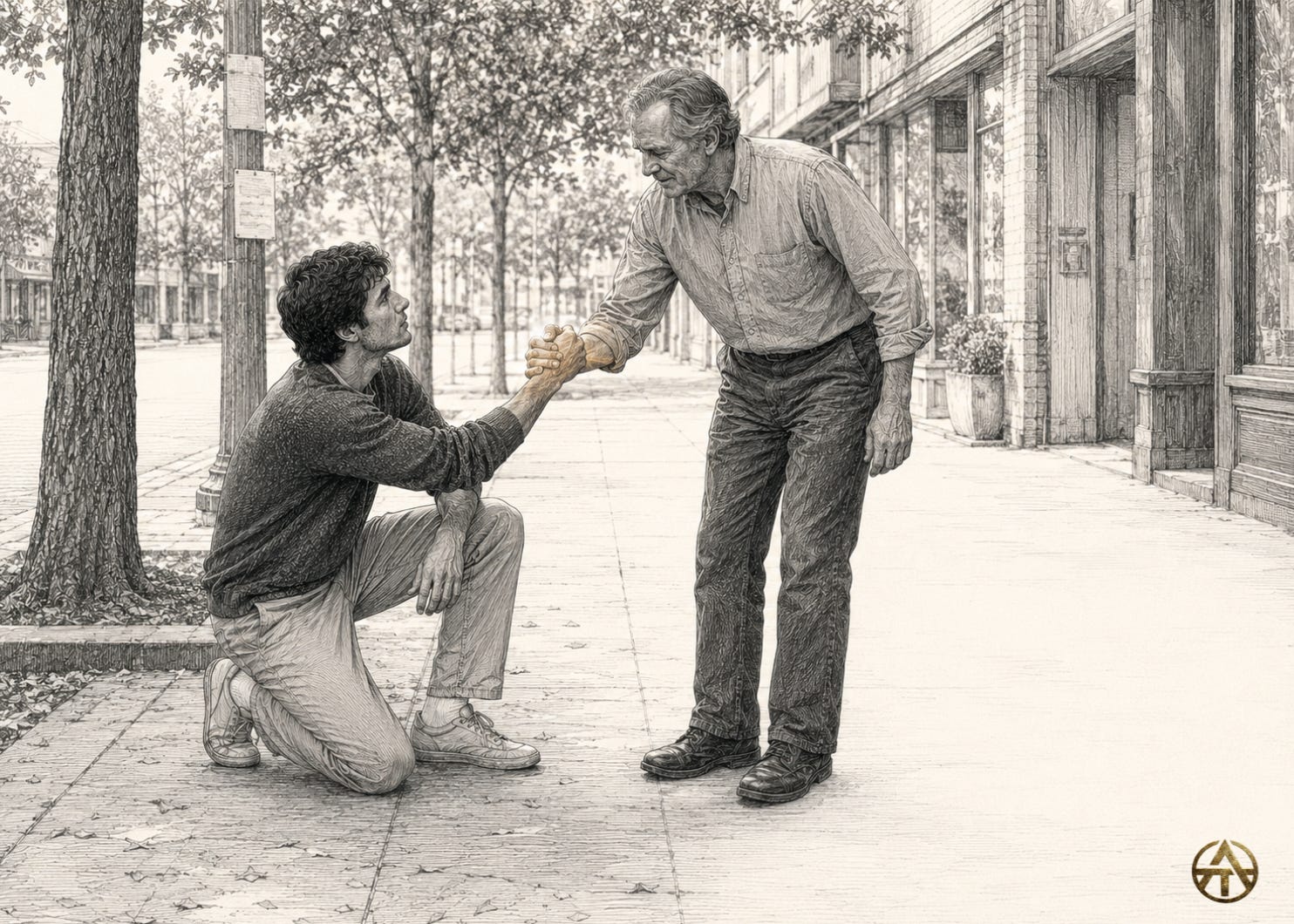
Dan Millman’s fist cuts through the Berkeley air. It never lands.
A heartbeat later, he is on the ground. His wrist is bent into a painful lock. Above him stands the old man he calls Socrates. It is the late 1960s. The Vietnam War is raging. Telegraph Avenue is covered with posters about the war, starving children and oppressed people. Millman has been looking inward, examining his fears, watching his thoughts, trying to understand himself. Now, beside the suffering of the world, that work feels small. Selfish, even.
He tells Socrates he should be doing more. Socrates listens. Then he offers him five dollars if he can slap him across the face.
“Take a swing at me.”
Millman is young, strong and trained. He moves. Socrates moves less.
That is why Millman falls.
As he helps him from the ground, Socrates asks whether he noticed how effective a little leverage could be. If Millman truly wants to help others, he tells him, he must first develop the clarity to know where and when to apply it.1
Two men stand on the same street, inside the same second. One spends force. The other places it. That difference can change a life.
The Clock Is a Poor Accountant
We all receive twenty-four hours in a day. We do not receive them under equal conditions. One person has health, money and freedom. Another carries illness, debt or the care of a family. Clock time is equal. Life is not.
Yet even within the same life, one hour can vanish without a trace while another changes everything that follows. One conversation can end a decade of confusion. One diagnosis can stop years of treating the wrong problem. One decision can release work that has been trapped behind fear.
And then there are hours that appear to produce nothing. No applause. No visible gain. Yet beneath the surface, skill is deepening, trust is forming, roots are taking hold.
This is why some people remain stuck for years while others seem to fit years of progress into months.
The clock has not changed. The consequence of the action has.
What we call a quantum leap is rarely magic. It is usually one of two things: the right lever has finally been pulled, or work that was hidden has finally broken into view. To see the difference, we must understand three kinds of time: dead time, leveraged time and gestational time.
Dead Time: The Years That Leave Nothing Behind
In 1979, the pharmaceutical company Warner-Lambert declared that it would become a great consumer-products company. One year later, it turned toward healthcare. In 1981, it turned back toward consumer goods and diversification. In 1987, it turned again. This time it wanted to compete with Merck. Then the winds of healthcare reform began to blow, and Warner-Lambert changed direction once more.
Between 1979 and 1998, the company went through three major restructurings under three chief executives. Each new leader arrived with a new programme. Each new programme killed the momentum of the one before it. In 2000, Pfizer acquired the company.2
Warner-Lambert was not standing still. It was running in circles.
Jim Collins called this the Doom Loop: disappointing results produce reaction without understanding; reaction produces a new direction; the new direction is abandoned before it can gather force; and the absence of force produces another disappointing result.3
This is dead time. It is rarely empty. It is full of plans, meetings, effort and noise. What makes it dead is that nothing accumulates. Yesterday does not make today stronger.
The same loop appears in ordinary life. A person changes training plans every three weeks and concludes that their body refuses to respond. A founder keeps rewriting the product when too few buyers know it exists. A writer polishes the same page while refusing to publish. A leader fills the calendar with meetings because one decision is too painful to make. They are not always lazy. Often they are exhausted. They are simply working where effort can be absorbed without changing the result.
Research on production systems gives this a hard edge. Improving a part that does not limit the whole may create local activity without increasing total output. Until the true bottleneck moves, the system does not move.4
Human beings are not machines. But the lesson travels: the wrong problem can eat an extraordinary amount of life.
Leveraged Time: The Move That Releases a Decade
Now cut to another room. Intel is in trouble. The memory-chip business on which the company was built is collapsing beneath the force of Japanese competition. Prices are falling. Market share is bleeding. But leaving memory feels like betrayal. Memory is not merely something Intel makes. It is part of what Intel believes itself to be.
Andy Grove turns to Gordon Moore and asks a brutal question. If the board removed them and brought in a new chief executive, what would that person do?
Moore answers:
“He would get us out of memories.”
Grove sees it at once. Why wait to be replaced? Why not walk out of the room, return as if they were new leaders, and make the decision themselves? Intel left memory and placed its future behind microprocessors.5 That conversation did not invent Intel’s engineers. It did not create its knowledge, capital, or technology. Years of work were already there.
The decision released them. That is leveraged time. The right action does more than improve the present hour. It changes what every later hour can do.
M.J. DeMarco makes the same point through the economics of work. If your income is your hourly rate multiplied by the hours you can sell, the day closes around you like a wall. There are only so many hours. But a product, process, platform or owned system can allow one act of work to serve many people. The hour survives itself.6
This is why leverage is not the same as ease. Building the asset may be brutally hard. Making the decision may cost status, certainty or comfort. Leverage does not remove effort. It gives effort reach.
A difficult conversation can end a pattern that explanation has kept alive for years.
A strong hire can improve thousands of later decisions.
A piece of code can perform the same useful act a million times.
A book can carry one mind across continents and generations.
Sometimes the lever is not a grand decision. It is a better question. In a randomised trial involving 116 Italian start-ups, founders in the treatment group were taught to identify their assumptions, form hypotheses and decide in advance what evidence would make them persist or change direction. One company, MiMoto, planned to rent sturdy three-wheeled scooters to university students in Milan. Instead of building first and hoping later, the founders tested ten scooter models with 600 students.
The students did not want what the founders intended to sell. Public transport was cheaper. The three-wheeled scooters felt awkward. But the test revealed another opening: young professionals wanted a fast, light way through Milan’s crowded streets. MiMoto changed the scooter, the customer and the offer. By the time INSEAD reported the case, the company had attracted more than 70,000 users and raised over €1 million.7
The experiment did not give the founders an instant empire. It stopped them from spending years building the wrong one.
That is the great gift of right action: it does not always make success immediate. It makes waste shorter.
Gestational Time: The Years Beneath the Breakthrough
But leverage carries a danger. Once we discover that one action can change everything, we begin searching for such an action everywhere. Every delay starts to feel like failure. Every quiet season looks like stagnation. We pull at the roots to see whether the tree is growing. Then our hunger for speed begins to destroy the very thing we want.
In a 2001 essay, Collins asks us to picture a vast iron flywheel. It is one hundred feet across, ten feet thick, and weighs twenty-five tons. You place your shoulder against it and push. At first, it barely moves. You push again. The wheel turns a little. You keep pushing in the same direction. One turn becomes two. Two become ten. Then something changes. The weight that resisted you begins to work for you. The wheel gathers force. It moves faster, although you are no longer pushing harder.8
People standing nearby see the speed. They did not feel the first push.
This is gestational time. The result is absent, but the causes are alive.
Hemingway gave bankruptcy one of literature’s most memorable rhythms: “Gradually and then suddenly”.9 Progress often arrives in the same way, only upward.
Morgan Housel tells the story of Ronald Read, a gas-station attendant and janitor from rural Vermont. Read did not command Wall Street. He fixed cars, swept floors, lived quietly and bought shares in strong companies. When he died at ninety-two, he left more than $6 million to his local hospital and library.10 There was no visible leap.
Then the will was read.
Housel makes the pattern even clearer through Warren Buffett. Based on Buffett’s wealth at the time of his analysis, 99 per cent of it came after his fiftieth birthday and 97 per cent after sixty-five. Buffett’s skill mattered. But skill had something most people never give it: eighty years to compound.11
This is where Housel and DeMarco appear to disagree, but do not.
Housel shows that time can multiply what is already working. DeMarco shows that the wrong economic structure can consume most of a life before freedom arrives. One teaches us not to interrupt compounding. The other teaches us not to mistake a low-leverage road for a law of nature.
Some things need more time. Some things need a different vehicle.
Science finds the same hidden movement across different parts of life. Habits form along curved and highly variable paths, not after one magical number of days.12 Incubation can improve creative problem-solving when preparation has already occurred.13 Trust grows through repeated actions and accepted vulnerability across time.14 Reputation, knowledge, and capability can accumulate over time before their full strategic value becomes visible.15
These are different processes, but they share one truth: nothing visible is not the same as nothing happening.
Gestation, however, is not blind hope. A real process leaves signs. The movement becomes cleaner. The conversations become better. Error falls. Strength rises. Trust deepens. The result has not arrived, but the capacity to produce it is growing. If no cause is moving and no leading sign is changing, patience becomes a beautiful word for denial.
Speed Is Not the Enemy
We should not worship slowness. Human beings crave speed because life is short. We want the pain gone, the body healed, the business growing, the money made and the freedom won. This hunger built ships, railways, printing presses, vaccines, aircraft and the internet. Much of civilisation is the refusal to accept how long the old way took.
The desire for speed is not the error. The error is demanding the same speed from everything.
Research across 459 large oil and gas projects found that faster accumulation usually lowered rather than increased cost. In that setting, 88 per cent of projects displayed economies of time compression.16 Speed removed waste.
But a study of orbital launches from 1957 to 2017 found a boundary. Faster activity often improved learning in repeatable work, while novel, complex and post-failure work benefited from more time between attempts.17 Speed helped until the interval itself became part of learning.
The answer is not fast or slow. It is the fastest speed reality will allow without breaking the result. I call this maximum legitimate speed.
Compress every delay created by fear, confusion, weak feedback or the wrong method.
Protect every delay required by biology, trust, mastery, coordination or genuine compounding.
Right action compresses wasted time.
Right timing protects necessary time.
What Creates Extraordinary Progress
The people who fit years into months are not always the people who work the longest. They are the people whose work keeps gaining power.
First, they know where they are going. A person with ten competing ambitions does not have ten times the power. They have divided force. Direction gathers the life behind one worthy result.
Second, they find the point that governs the whole. The missing skill. The weak offer. The absent distribution. The damaged body. The unspoken truth. Other improvements may feel useful, but until that point moves, the life keeps paying.
Third, they build things that survive the day. Knowledge. Strength. Trust. Reputation. Systems. Assets. Relationships. Distribution. Each hour leaves something behind to help the next.
Finally, they listen to reality without becoming its prisoner. They test quickly enough to stop waste, then stay steady long enough for sound work to compound. Feedback without constancy becomes panic. Constancy without feedback becomes stubbornness.
Right timing binds all four together.
A weak signal should not destroy a worthy direction.
A dead method should not receive another decade.
A body should not be punished because it cannot heal by Friday.
An open door should not be studied until it closes.
There is also a higher order. Leverage has no conscience. It can spread medicine or deceit. It can deepen love or scale exploitation. A quantum leap toward the wrong life is not progress. Speed must serve what is true, worthy and life-giving.
Scripture does not speak of one speed. It says there is a season for every purpose: a time to plant and a time to pluck up what is planted, a time to break down and a time to build up, a time to keep silence and a time to speak.18
Wisdom is not always patience. Wisdom is obedience to the season.
Which Kind of Time Are You In?
Before you spend another year, ask what your present effort is actually changing.
Is it touching the obstacle that governs the result, or merely improving what is already good? If one condition changed, would several other problems become easier? That is where leverage may be waiting.
Does today’s work survive today? Is it building an asset, a skill, a relationship, a reputation, a body of knowledge or a clearer decision? If every month begins at the same line, you may not be persisting. You may be repeating.
And if the final result is still absent, are the signs beneath it alive? Are you learning faster, becoming stronger, earning trust, reducing error or receiving better responses? Gestation has evidence. Stagnation has explanations.
If no meaningful process is moving, stop calling it patience.
If one constraint is holding back the whole, find the lever and act.
If the right causes are alive, protect them from your impatience.
The Decisive Hour
Return to Telegraph Avenue.
Millman’s fall takes less than a second. Yet Socrates’s ability to place that force was built across years. The wrist lock is leveraged time. The training behind it is gestational time. Had Millman kept swinging in the same way, that would have been dead time. All three kinds of time were present on the same patch of ground.
This is the deeper lesson: extraordinary progress is not born from speed alone. It comes from preparation meeting perception, and perception becoming action at the moment action can matter most.
The decisive battlefield is inside us. It is where impatience demands force, fear asks for another year, and wisdom must decide.
Do not worship speed. Do not worship slowness. Serve what is worthy. See what reality requires. Then act with the full weight of your life.
Some time must be compressed.
Some time must be protected.
Wisdom is knowing the difference.
And courage is obeying it.
On Monday, paid subscribers will receive the practical extension: a complete fourteen-day method for identifying the constraint, testing the right action and deciding from evidence whether to act, adjust or wait.
Millman, D. (1991) Sacred Journey of the Peaceful Warrior. Tiburon, CA: H.J. Kramer; Simon, T. (2018) ‘Dan Millman: No ordinary moments in the school of life’, DailyGood, 13 July, transcript of an Insights at the Edge interview, syndicated from Sounds True. Available at: https://www.dailygood.org/story/1926/dan-millman-no-ordinary-moments-in-the-school-of-life-tami-simon/ (Accessed: 27 August 2026).
Collins, J. (2001) Good to Great: Why Some Companies Make the Leap... and Others Don’t. New York: HarperBusiness.
Collins, J. (2001) Good to Great: Why Some Companies Make the Leap... and Others Don’t. New York: HarperBusiness.
Skoogh, A., Thürer, M., Subramaniyan, M., Matta, A. and Roser, C. (2023) ‘Throughput bottleneck detection in manufacturing: A systematic review of the literature on methods and operationalization modes’, Production & Manufacturing Research, 11(1), article 2283031. https://doi.org/10.1080/21693277.2023.2283031.
Grove, A.S. (1996) Only the Paranoid Survive: How to Exploit the Crisis Points That Challenge Every Company and Career. New York: Currency Doubleday, p. 89.
DeMarco, M.J. (2011) The Millionaire Fastlane: Crack the Code to Wealth and Live Rich for a Lifetime! Phoenix, AZ: Viperion Publishing Corporation.
Camuffo, A., Cordova, A., Gambardella, A. and Spina, C. (2020) ‘A scientific approach to entrepreneurial decision making: Evidence from a randomized control trial’, Management Science, 66(2), pp. 564–586. https://doi.org/10.1287/mnsc.2018.3249; Spina, C. (2020) ‘Is there a scientific formula for start-up success?’, INSEAD Knowledge, 14 December. Available at: https://knowledge.insead.edu/entrepreneurship/there-scientific-formula-start-success (Accessed: 27 August 2026).
Collins, J. (2001) ‘Good to Great’, Fast Company, 30 September. Available at: https://www.fastcompany.com/43811/good-great/ (Accessed: 27 August 2026).
Hemingway, E. (1926) The Sun Also Rises. New York: Charles Scribner’s Sons, ch. 13.
Housel, M. (2020a) The Psychology of Money: Timeless Lessons on Wealth, Greed, and Happiness. Petersfield, Hampshire: Harriman House.
Housel, M. (2020b) ‘Last Man Standing’, Collaborative Fund, 17 December. Available at: https://collabfund.com/blog/standing/ (Accessed: 27 August 2026).
Lally, P., van Jaarsveld, C.H.M., Potts, H.W.W. and Wardle, J. (2010) ‘How are habits formed: Modelling habit formation in the real world’, European Journal of Social Psychology, 40(6), pp. 998–1009. https://doi.org/10.1002/ejsp.674.
Sio, U.N. and Ormerod, T.C. (2009) ‘Does incubation enhance problem solving? A meta-analytic review’, Psychological Bulletin, 135(1), pp. 94–120. https://doi.org/10.1037/a0014212.
Serva, M.A., Fuller, M.A. and Mayer, R.C. (2005) ‘The reciprocal nature of trust: A longitudinal study of interacting teams’, Journal of Organizational Behavior, 26(6), pp. 625–648. https://doi.org/10.1002/job.331.
Dierickx, I. and Cool, K. (1989) ‘Asset stock accumulation and sustainability of competitive advantage’, Management Science, 35(12), pp. 1504–1511. https://doi.org/10.1287/mnsc.35.12.1504.
Hawk, A. and Pacheco-de-Almeida, G. (2018) ‘Time compression (dis)economies: An empirical analysis’, Strategic Management Journal, 39(9), pp. 2489–2516. https://doi.org/10.1002/smj.2915.
Desai, V. and Madsen, P.M. (2022) ‘Take your time? How activity timing affects organizational learning and performance outcomes’, Organization Science, 33(5), pp. 1707–1723. https://doi.org/10.1287/orsc.2021.1490.
The Holy Bible, King James Version, Ecclesiastes 3:1–7. Available at: https://www.biblegateway.com/passage/?search=Ecclesiastes+3%3A1-7&version=KJV (Accessed: 27 August 2026).