

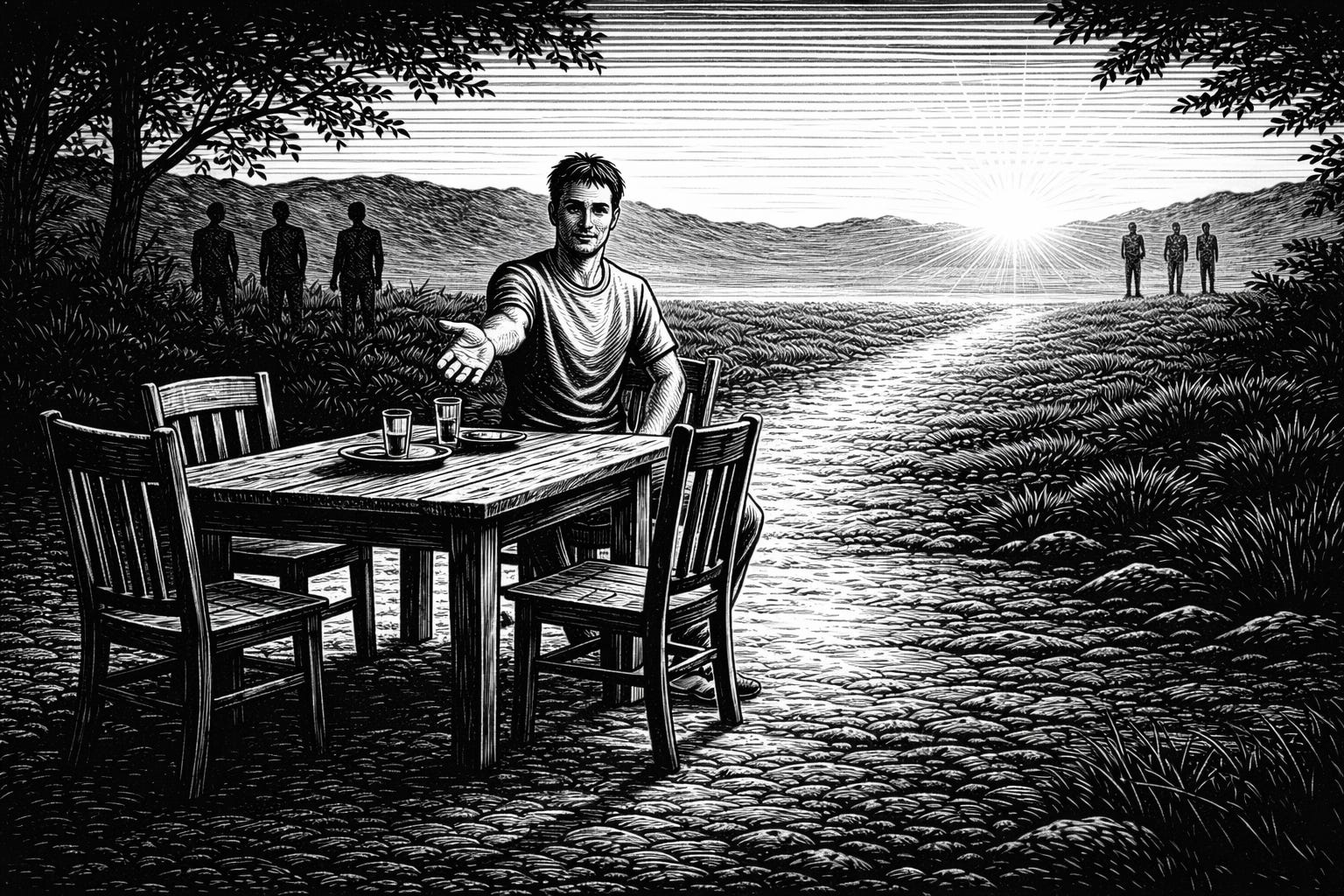
Formation by Exposure and Repetition
You are shaped, daily, by what surrounds you, and by who surrounds you. Not by slogans.

By exposure. By repetition. By the slow, compounding force of the ordinary conversations you keep, the standards you inhale, the permission structures you live inside (Bronfenbrenner, 1979; Wood and Neal, 2007).
Potential Is Relational
This is the line in the sand: your potential is not a private possession that sits safely inside you, untouched by the world. Potential is relational. It is evoked, suppressed, trained, redirected. It rises when you are placed near excellence, and it decays when you are placed near contempt (Bandura, 1977; Vygotsky, 1978; Tajfel and Turner, 1979).
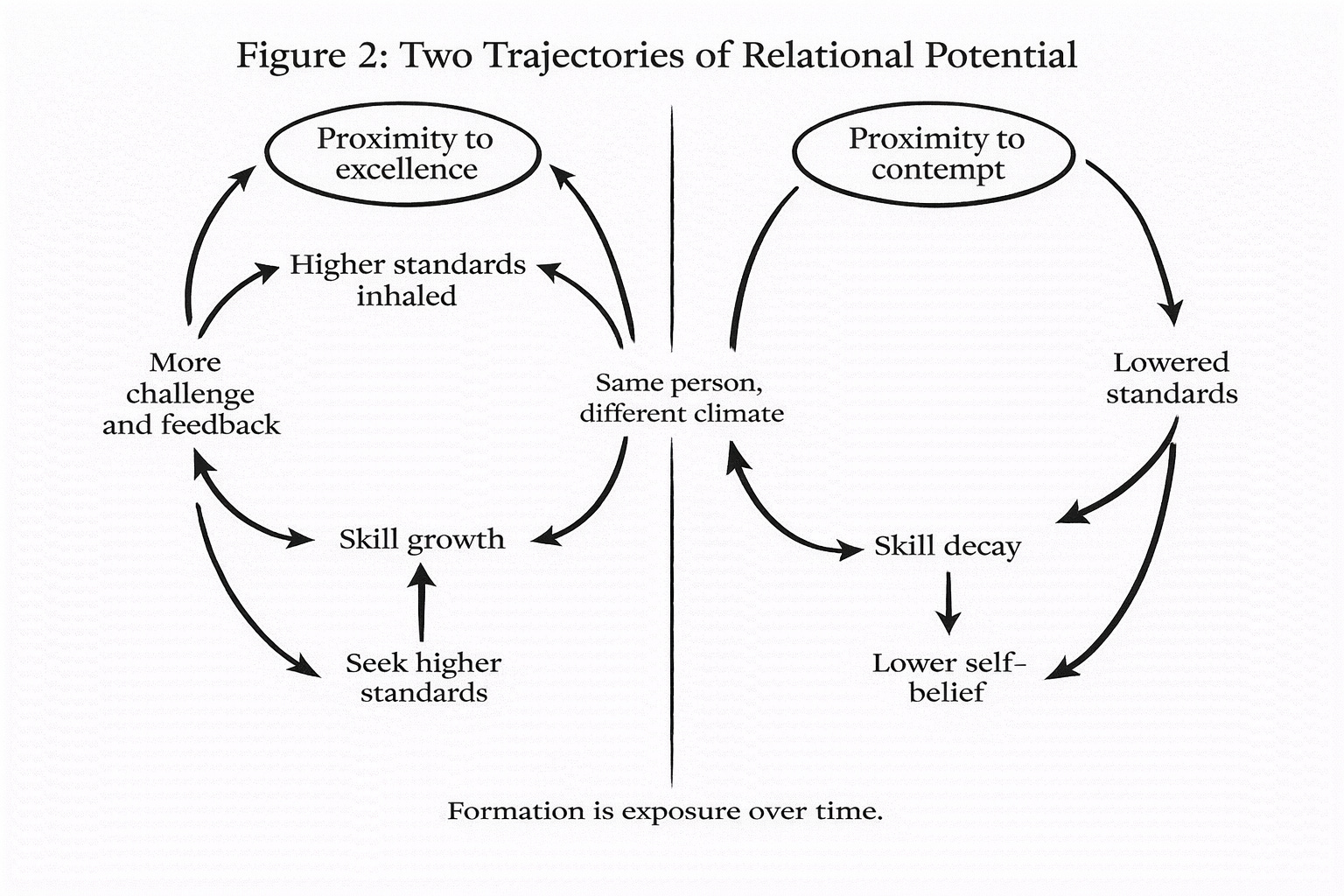
The people closest to you do not merely influence your mood. They shape what you attempt, what you tolerate, what you believe you are allowed to become. They become your social mirror, your ceiling, your climate.
And the strongest truth is this: no one affects you more than those who consistently see greatness in you.
Not because they flatter you. Because expectation is not a compliment. Expectation is an environment.
Expectation as Environment
When leaders expect more, they behave differently. They give more attention, more challenge, more feedback, more patience. Those micro-behaviours build competence and identity over time. That is the logic behind the Pygmalion effect and the broader literature on expectancy effects (Rosenthal and Jacobson, 1968; Rosenthal and Rubin, 1978; Raudenbush, 1984). Belief is not magic. Belief is a behavioural pipeline. It changes how people treat you, and how you treat yourself.
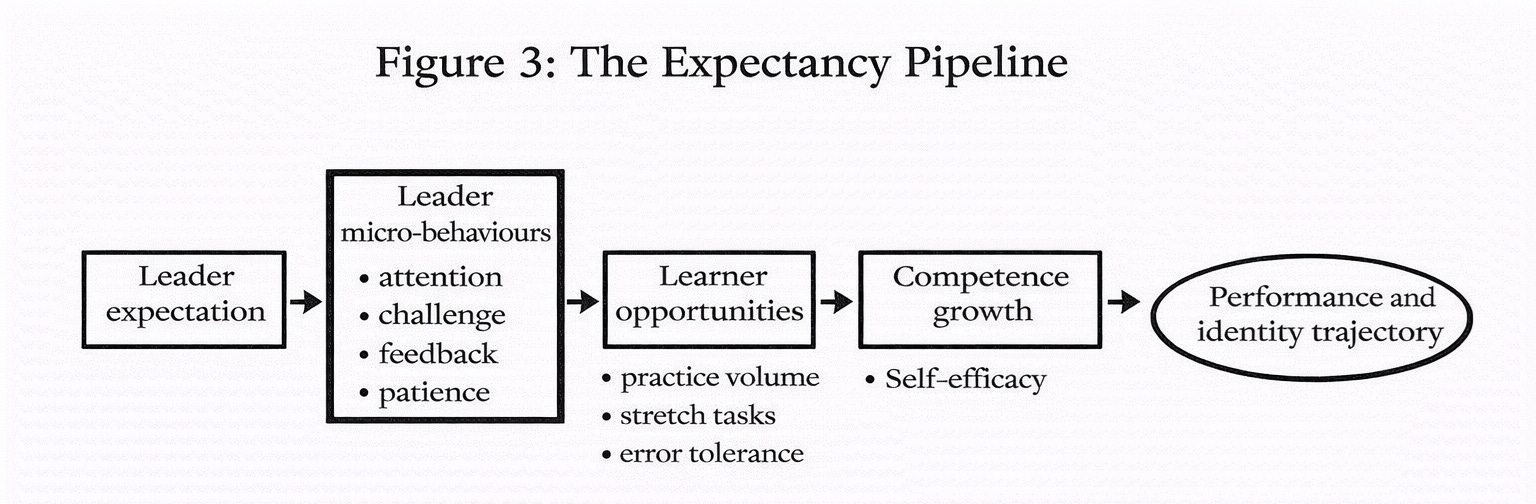
Self-belief then becomes self-efficacy, the conviction that your actions can produce outcomes, and that conviction predicts persistence under pressure (Bandura, 1997). Persistence changes skill. Skill changes options. Options change destiny.
So yes, choose who you keep close. Not as a lifestyle tip. As a life-or-death decision for the trajectory of your mind.
The Slow Violence of “Realism”
Because the opposite is also true. There are people whose presence shrinks you.
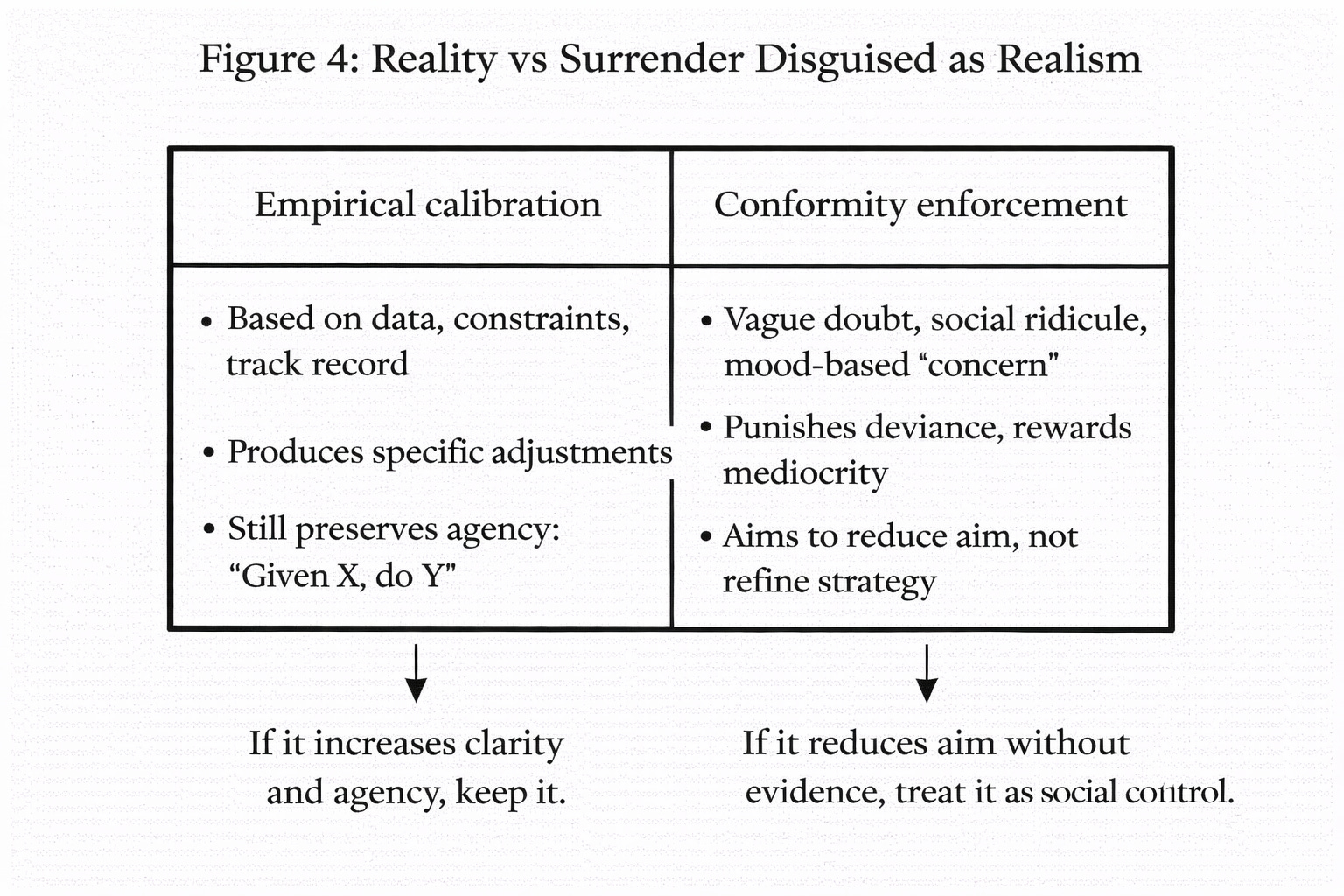
Small people make you feel small. Not always with cruelty. Often with “concern.” They will call it “realism.” They will dress it in calm tones and responsible language. But when “realistic expectations” are used to downgrade your aim, to mock your aspiration, to reduce your hunger to something embarrassing, that is not realism. That is fear seeking legitimacy.
There is reality, and there is surrender. Do not confuse them.
A “realistic” expectation can be an empirical forecast based on constraints and data. It can also be a social weapon, a way to enforce conformity and punish deviance. Groups pressure people to match the local norm, even when the norm is mediocre, even when the crowd is wrong (Asch, 1951; Deutsch and Gerard, 1955).
The moment you lift your standard, you expose everyone else’s choice to keep theirs low.
But it’s not only groups. It’s the coach, the teacher, the friend who keeps telling you you can’t do better, or that your aims aren’t realistic. Some will make it emotional, some will quote science. It doesn’t matter. Those people will not forgive you for that exposure, for your desire to do great things; they will not forgive you for the desire to express the greatness within you. They will try to drag you back down, then call it humility.
Those who truly care about you, those who are worth your presence, will show you the way to greatness, even at their inconvenience. They will never dampen your desire for greatness.
Social Psychology of Drift
This is why you must understand something deeper than motivation. You must understand social psychology.
Humans learn by observation. You adopt behaviours, emotional reactions, and even self-concepts by watching what is rewarded and what is ridiculed in your environment (Bandura, 1977). Norms become cues. Cues become habits. Habits become identity (Wood and Neal, 2007). You do not rise or fall in one dramatic decision. You drift, daily, toward the level of the people you allow to set your emotional weather.
Even emotion itself spreads. Groups transmit affect. The cynical atmosphere of a room becomes your baseline without your consent, unless you actively resist it (Hatfield, Cacioppo and Rapson, 1993; Barsade, 2002).
The Biology of Social Climate
And there is a biological layer to this. Social climates modulate stress. Support buffers stress. Chronic, unresolved stress damages health and narrows cognition, reducing the very executive functions required for discipline and long-term striving (Cohen and Wills, 1985; McEwen, 1998). If your inner circle keeps you in a low-grade fight with yourself, you will not have the bandwidth to build anything great. Your ambition will feel like exhaustion. Not because you are weak, but because your environment is draining you at the level of physiology.
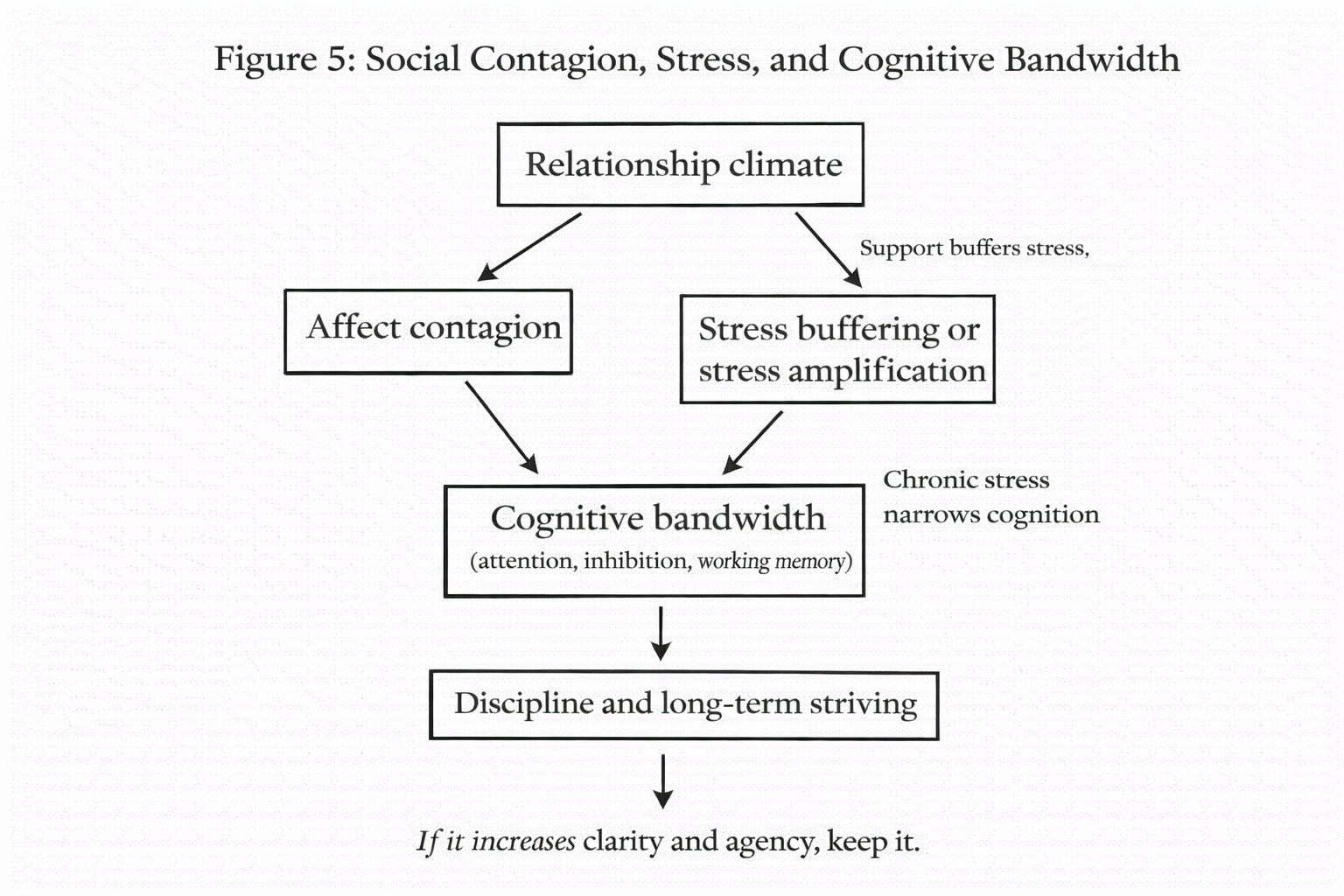
This is why the closest relationship in your life matters so much. Not as a romantic myth, but as exposure science. The person who shares your daily life becomes a constant source of cues, standards, emotional reinforcement, and stress regulation. Marital and partnership processes, especially relationship quality, are tightly linked to health outcomes and stress pathways (Kiecolt-Glaser and Newton, 2001). You cannot build a world-class life on top of a relationship that quietly corrodes your spirit.
Spiritual Realism, Not Modern Discovery
Now, let us speak spiritually, because the saints do not treat this as a modern discovery.
“Bad company ruins good morals” is not a proverb for children. It is a diagnostic statement about formation (The Holy Bible, 1989, 1 Corinthians 15:33). “Whoever walks with the wise becomes wise” is not moral decoration. It is a map of human development (The Holy Bible, 1989, Proverbs 13:20). The Orthodox ascetic tradition insists that what you repeatedly allow near your heart becomes your inner life. Guarding the senses, guarding companionship, guarding the thoughts, this is not paranoia. It is spiritual realism (Climacus, 1982; Palmer, Sherrard and Ware, 1979; Ward, 1975).
The Ladder of Divine Ascent is, among other things, an anatomy of how environments and relationships shape the soul’s trajectory, upward or downward (Climacus, 1982). The Philokalia is relentless on this point: attention is shaped by what you feed it, and the heart becomes what it repeatedly contemplates (Palmer, Sherrard and Ware, 1979). In this vision, companionship is not neutral. It either cultivates you or corrodes you.
The Stance, Without Hedging
So here is the stance, without hedging.
The habit of diminishing others is spiritual cancer. It metastasises through families, workplaces, friendships, and cultures. It does not only injure the person it targets. It poisons everyone who watches and learns that greatness will be punished.
Cut it out of your life. Not with hatred. With clarity.
If someone cannot bear your expansion, they cannot be trusted with your proximity.
Do not negotiate your future with people who profit from your smallness. Remove their access. Withdraw the intimacy. Withdraw the ear. Withdraw the seat at your table. Choose the kind of company that calls you upward, not because it is “nice,” but because it is true.

Keep people who see greatness in you, and who demand responsibility worthy of that greatness. Keep people whose belief translates into standards, honesty, challenge, and unwavering support. Those people do not merely comfort you. They create the conditions in which your best self becomes normal (Edmondson, 1999; Bandura, 1997).
Then become that kind of person for others. Be the one who does not envy a friend’s ascent. Be the one who refuses to mock ambition. Be the one whose presence makes discipline more likely, courage more accessible, and purpose more stable.
Because man is made, not born. And you are being made right now, by the voices you keep closest.
Choose accordingly.
-Atlas Said It
References
Asch, S.E. (1951) ‘Effects of group pressure upon the modification and distortion of judgments’, in Guetzkow, H. (ed.) Groups, Leadership and Men: Research in Human Relations. Pittsburgh, PA: Carnegie Press, pp. 177–190.
Bandura, A. (1977) Social Learning Theory. Englewood Cliffs, NJ: Prentice-Hall.
Bandura, A. (1997) Self-Efficacy: The Exercise of Control. New York: W.H. Freeman.
Barsade, S.G. (2002) ‘The ripple effect: Emotional contagion and its influence on group behavior’, Administrative Science Quarterly, 47(4), pp. 644–675.
Bronfenbrenner, U. (1979) The Ecology of Human Development: Experiments by Nature and Design. Cambridge, MA: Harvard University Press.
Climacus, J. (1982) The Ladder of Divine Ascent. Translated by C. Luibheid and N. Russell. New York: Paulist Press.
Cohen, S. and Wills, T.A. (1985) ‘Stress, social support, and the buffering hypothesis’, Psychological Bulletin, 98(2), pp. 310–357.
Deutsch, M. and Gerard, H.B. (1955) ‘A study of normative and informational social influences upon individual judgement’, Journal of Abnormal and Social Psychology, 51(3), pp. 629–636.
Edmondson, A. (1999) ‘Psychological safety and learning behavior in work teams’, Administrative Science Quarterly, 44(2), pp. 350–383.
Hatfield, E., Cacioppo, J.T. and Rapson, R.L. (1993) Emotional Contagion. Cambridge: Cambridge University Press.
Kiecolt-Glaser, J.K. and Newton, T.L. (2001) ‘Marriage and health: His and hers’, Psychological Bulletin, 127(4), pp. 472–503.
McEwen, B.S. (1998) ‘Protective and damaging effects of stress mediators’, The New England Journal of Medicine, 338(3), pp. 171–179.
Palmer, G.E.H., Sherrard, P. and Ware, K. (trans.) (1979) The Philokalia: The Complete Text, Volume 1. London: Faber and Faber.
Raudenbush, S.W. (1984) ‘Magnitude of teacher expectancy effects on pupil IQ as a function of the credibility of expectancy induction: A synthesis of findings from 18 experiments’, Journal of Educational Psychology, 76(1), pp. 85–97.
Rosenthal, R. and Jacobson, L. (1968) Pygmalion in the Classroom: Teacher Expectation and Pupils’ Intellectual Development. New York: Holt, Rinehart and Winston.
Rosenthal, R. and Rubin, D.B. (1978) ‘Interpersonal expectancy effects: The first 345 studies’, Behavioral and Brain Sciences, 1(3), pp. 377–386.
Tajfel, H. and Turner, J.C. (1979) ‘An integrative theory of intergroup conflict’, in Austin, W.G. and Worchel, S. (eds.) The Social Psychology of Intergroup Relations. Monterey, CA: Brooks/Cole, pp. 33–47.
The Holy Bible (New Revised Standard Version) (1989) NRSV text copyright © 1989 National Council of Churches. Oxford: Oxford University Press
Vygotsky, L.S. (1978) Mind in Society: The Development of Higher Psychological Processes. Edited by M. Cole, V. John-Steiner, S. Scribner and E. Souberman. Cambridge, MA: Harvard University Press.
Ward, B. (trans.) (1975) The Sayings of the Desert Fathers: The Alphabetical Collection. Kalamazoo, MI: Cistercian Publications.
Wood, W. and Neal, D.T. (2007) ‘A new look at habits and the habit-goal interface’, Psychological Review, 114(4), pp. 843–863.
That line ‘no one makes you more than those who see the greatness in you’ felt like a mirror and a warning. The close circle is either a forge or a cage. This piece made that impossible to unsee.