

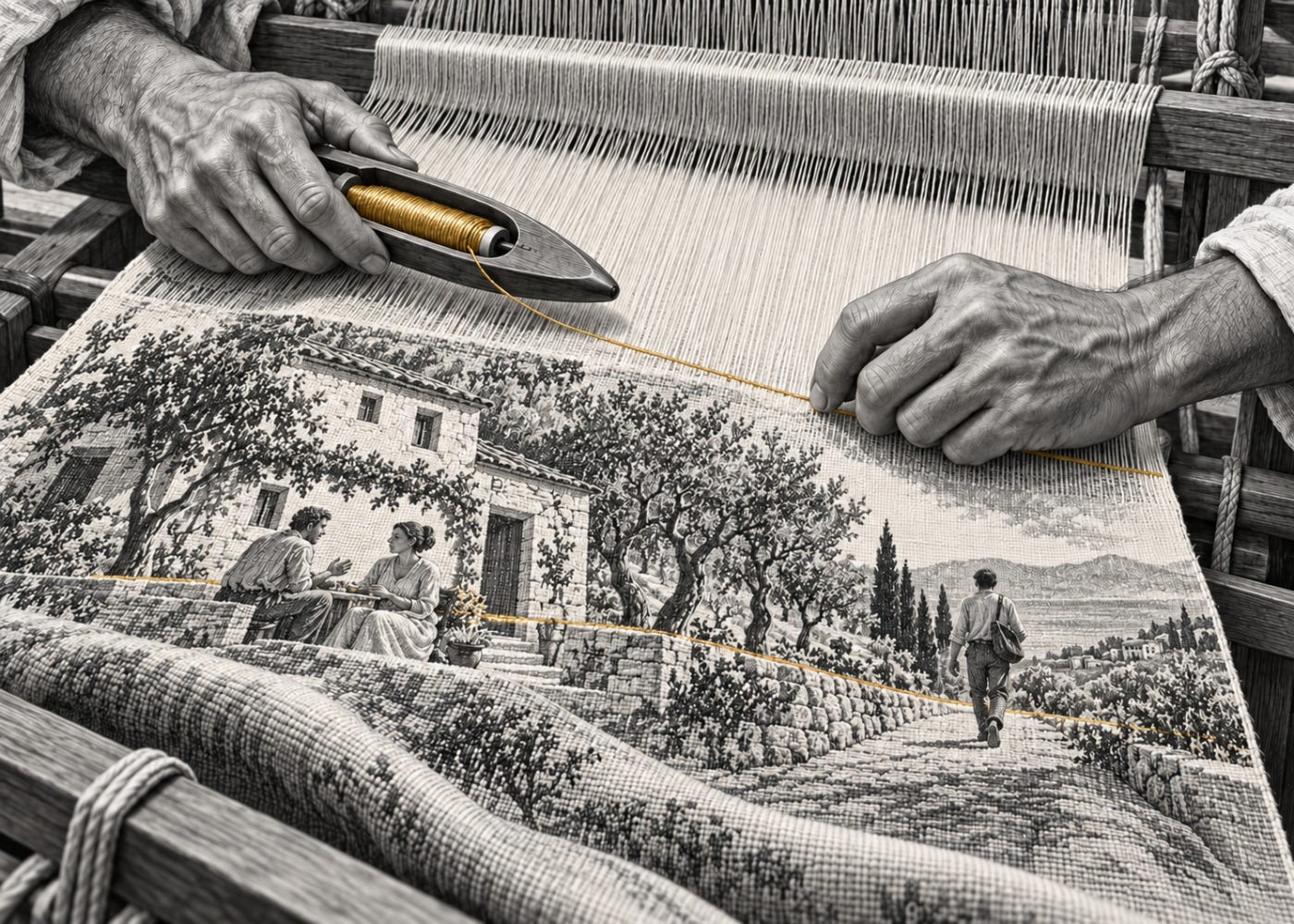
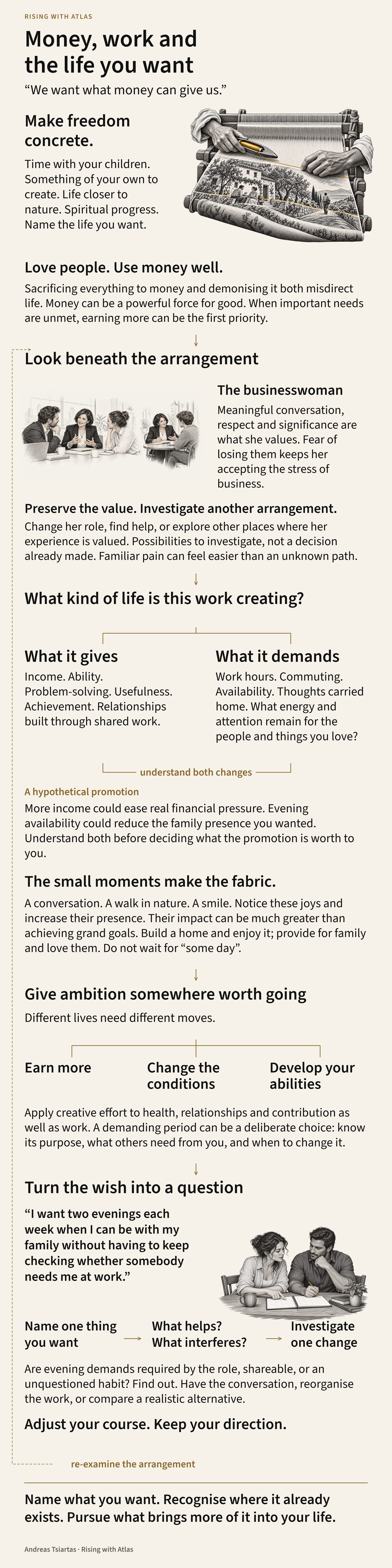
You do not want money. None of us do. We want what money can give us. Reframing our thinking and looking at the subject from this perspective is a good step towards insight into ourselves.
For many of us, the desire for money has to do with owning material things. Things we believe will make our life better. One of the things people most frequently quote as the reason they desire money is freedom.
This thought requires deeper examination. What does freedom really mean to us? And how does the way we go about acquiring money or setting up streams of income affect our freedom?
Consider a lady who thinks she loves business because she enjoys meeting with people and talking, who, despite the pressures and stresses of what she does, wants to continue doing it due to the fear that stopping her business activities will deprive her of a reason to have meaningful conversations or associations with people.
She also talks a lot to her family, her children, anyone willing to discuss things really. But she considers the underlying cause of all this to be her business activities and fears that stopping will make her lose the ability to meaningfully connect to people.
What does this woman truly enjoy? And is her fear founded?
The first step in understanding is that the source of her joy is not business at all. But rather having meaningful conversations. She fears that outside the realm of business her word will not be as meaningful because she is respected in the field of what she does. So she chooses to take the bitter with the sweet because the FEAR of losing the sweetness she perceives (from the act of having meaningful conversations, from being respected, from feeling significant) is greater than the discomfort she experiences as a result of the stresses and problems that this life brings her.
Once she understands this, she has a different question to consider. How can she preserve what she loves while changing the parts of her working life that make her unhappy? Perhaps she can change her role in the business. Perhaps she can spend more of her time doing the work that brings her into contact with people, and find help with the things that consume her without giving her the same satisfaction. Perhaps she will discover other places where her experience is valued and where she can contribute.
She has to investigate these possibilities. But before she can do that, she has to see that they are possibilities at all.
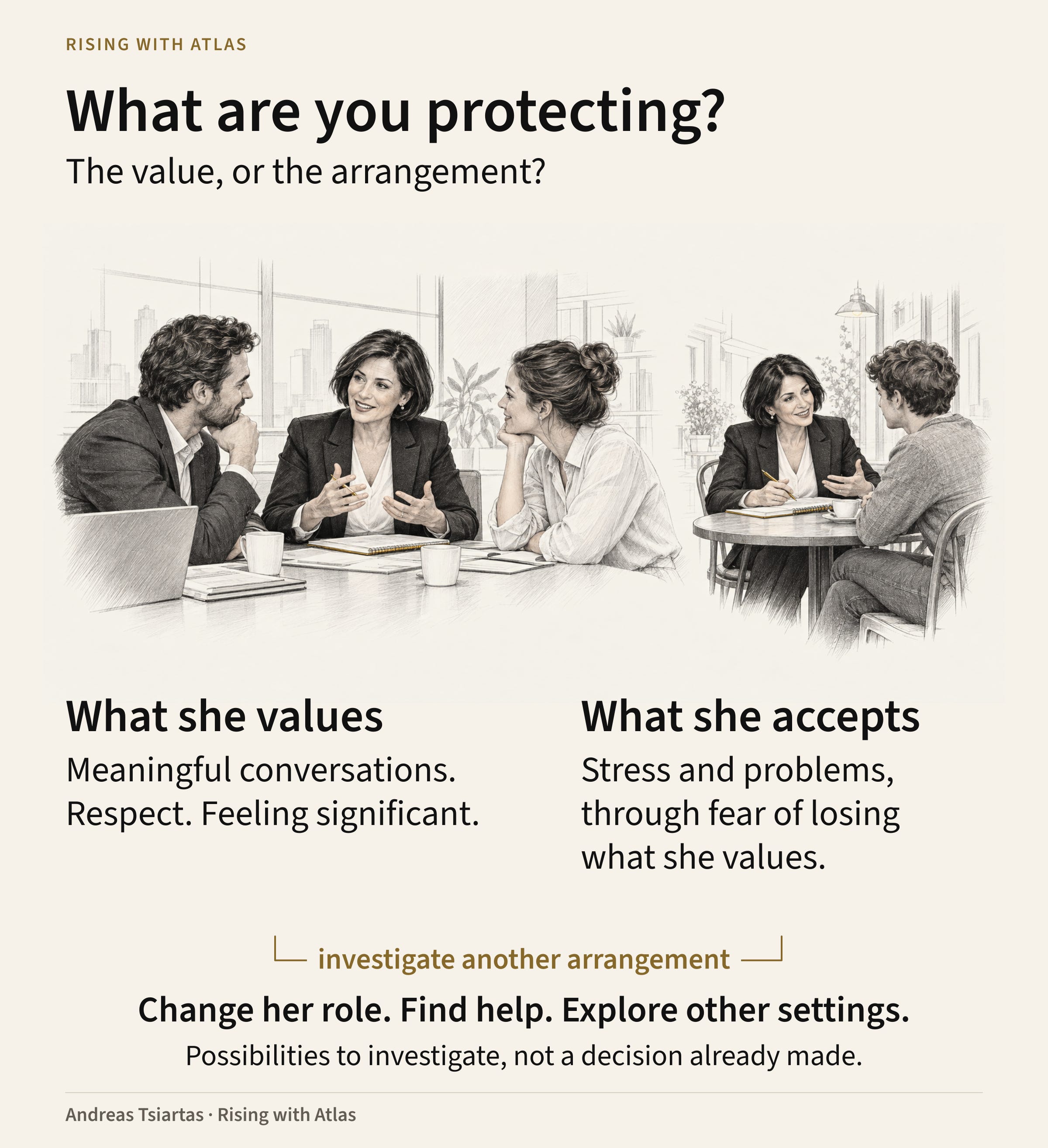
This is a trap that too many of us fall into in life: making our choices based on fear, not understanding. The greatest difficulty in overcoming it lies in the fact that most of us are completely unaware that we are doing it. And many of us are even afraid of thinking about it because thinking may lead us to change our perspectives. Any change, in turn, means walking into the unknown, and a familiar pain is more easily accepted than an unknown path, despite the promise of greater happiness and fulfilment.
We can spend years protecting an arrangement because it gives us something important, without ever asking whether there is a better way to have that thing. The money is real. The relationships are real. The satisfaction of being good at what we do is real. Understanding their value should help us make better choices about how to preserve and develop them.
What is the money for?
Some people are so focused on money that everything else, including their health, their relationships and many other important facets of their life, simply takes a back seat. Others demonise money and argue that it is the source of all evil, that only bad people have money, or that we should not pursue it. Both of these perspectives are completely wrong and lead our lives in very wrong directions.
In life, it is people that we ought to love and money that we should use.
The way that we treat people with respect, the way that we treat people with love, the way that we choose to elevate people through our actions and through the way we conduct ourselves: these things matter. Money used in the correct way can be a beautiful and powerful force for good.
If you cannot support your family, if the lack of money prevents you from meeting important needs, then increasing your income can be the most important thing to address. There is nothing enlightened about ignoring that. Financial security gives us room to care for people, to build things, to contribute, and to make choices that would otherwise be beyond our reach.
But we need to understand what exactly we are trying to achieve. Just loosely saying that we want to be successful does not actually mean anything. We need a concrete and tangible idea of what success means to us. That might mean money. It might mean the freedom to do the things we like to do. It might mean living closer to nature, being a good human being or progressing spiritually. These things are individual, but we need to understand what exactly it is that we want.
The same is true of freedom. If you want to be more present with your children, what would that look like? Would you be there when they come home? Would you have an evening together when your attention was actually with them? If you want to create something of your own, when would you do it, and what would you need in order to begin?
These questions give the ambition a direction. They also give you something against which to judge the way you are pursuing it. A larger income may bring that life closer. You need to examine the work that produces it, the demands that come with it, and what it will allow you to do.
Suppose a promotion pays more but requires you to be available most evenings. That money could ease a real financial pressure. It could also leave you with less of the freedom you meant to gain if what you wanted was to be home with your family, with your attention actually there. You need to understand both changes before deciding what the promotion is worth to you.
The life inside the working week
Work can itself contain much of what we want from life. There is satisfaction in developing an ability, solving a difficult problem, being useful to others and seeing something take shape because of our effort. There are relationships we value because we have built and achieved things together. These are part of what we are choosing when we choose our work.
The businesswoman's meaningful conversations belong in the assessment just as surely as her income does. So do the pressures she is accepting in order to keep them. Looking at the whole arrangement allows her to ask a much more useful question than whether she should simply work more or work less.
What kind of life is this way of working creating?
Consider the week as you actually experience it. The time you spend working, the time you spend getting there, and the thoughts that accompany you home. When you have finished, what do you have the energy and attention to enjoy? What are you able to give to the people you love? Is there room for the things you keep saying are important to you?
The difficulty here is that the mind drifts immediately to grand concepts of satisfaction. But if we pay attention, we will soon learn that it is the little things that add up. A short conversation with our spouse or a dear friend; a quick walk in nature, perhaps at a park or on our way to work; the smile of the staff at the place where we buy our morning coffee or breakfast.
If we pay attention, we will soon learn that the greatest joys in our lives come from the simplest things. Things that often go unnoticed because of their simplicity or seeming insignificance. But identifying these things and making a conscious effort to increase their frequency and presence in our lives can have a profound impact. Much greater, in fact, than achieving our grand goals or aims.
Viewing it this way reminds us that life is simply sequences of small moments that slowly add up to great trends and make up the fabric of our lives, stitch by stitch.
We want our achievements to make that fabric richer. We want to build a home and enjoy living in it. We want to provide for our family and have a loving relationship with them. We want the freedom to pursue something meaningful and the capacity to give ourselves to it.
Remembering that these small moments make up the sum of our lives gives us a practical reason to be more present in what we do. It also protects us from one of the greatest traps of all: living our lives waiting for “some day”.
Give your ambition somewhere worth going
Everything important to you is worth the time, the passion, the creativity, the effort and the persistence to achieve it.
We understand this when we are building a business or developing an ability. We try things. Some things do not work. We continue to look, we continue to seek out solutions, we continue to experiment. The same creative effort belongs in our health and our relationships, in the way we spend our days and in the kind of contribution we want to make.
For one person, the next move will be to earn more. For another, it will be to change the conditions under which they earn it. Someone else may discover that the work they are doing gives them very little opportunity to use the abilities they most want to develop. Each has a different problem to solve. Telling all three to work less would make as little sense as telling all three to keep doing more of the same.
And sometimes we will choose a demanding period because we deeply value what it makes possible. We can make that choice intelligently. We can be clear about what we are building, what the people affected need from us, and what would tell us that it is time to change the arrangement.
The danger is becoming so entangled in one way of doing things that we cannot see any other way. Perhaps there is more fulfilling work available. Perhaps there is more lucrative work. Perhaps there is a change we can make within the work we already do. But how can you think of other options when you don't think about it?
Start with one thing you want your work to make possible. Write it down in a way that describes your life, rather than leaving it as a word like “freedom” or “success”. For example: “I want two evenings each week when I can be with my family without having to keep checking whether somebody needs me at work.”
Then look at your current arrangement.
What helps you have that?
What interferes with it?
What is one change you could investigate this week?
You might need to find out whether those evening demands are a requirement of the role, something that could be shared, or a habit that has never been questioned. You might need a conversation about responsibilities, a different way to organise the work, or a realistic alternative to compare. The point is to turn something you want into a question you can act on.
As you take action, allow yourself the flexibility to change your course while maintaining your sight on where you want to go. You can value what you have built and still examine whether the way you are living allows you to enjoy it.
We want what money can give us. Take that thought seriously enough to name what you want, to recognise where it already exists, and to pursue the changes that will bring more of it into your life.
On Monday, in the paid companion, “How to Choose Between Two Jobs (Beyond the Salary)”, we will put this into practice with a worked comparison, a reusable worksheet and an illustrated map. You will be able to compare two offers, or your present role with a realistic alternative, and identify what you need to know before deciding.