


A cup of coffee can change the room inside your head.
So can tea.
So can cocoa.
So can light.
So can creatine.
So can medication.
So can a peptide.
So can the wrong thing, at the wrong time, for the wrong reason.
This is where the conversation usually becomes childish.
One camp treats enhancement as corruption.
Another treats it as salvation.
Both are too simple.
The body has never been separate from chemistry.
The mind has never worked outside biology.
Human beings have always used food, fasting, drink, ritual, plants, light, movement, rhythm, breath, heat, cold, silence, song, and substances to alter the conditions of consciousness.
The real question is not whether support exists.
It always has.
The real question is where support belongs.
The previous essay argued that some rooms are made of people. It showed that trust, rhythm, role clarity, and social safety can either open the mind or split it into self-protection. That moved the series from the physical field into the social field.
Now we enter a more charged field.
The support layer.
Not the body itself.
Not the room.
Not the group.
Not the task.
The tools that modify state.
By the end of this essay, you will understand why compounds belong inside a serious theory of peak mental states, why support must never be confused with sovereignty, why evidence has to be handled in different proof lanes, why the strongest use of support is architectural rather than substitutive, and why the mature question is not, “What can I take?” but, “What is this tool supporting, replacing, or corrupting?”
That is the adult conversation.
Not purity.
Not worship.
Placement.
Where this series is going
This essay continues Act III of The Hidden Architecture of Flow: Field, Support, and Distortions.
Act I dealt with entry: threshold, body, vigilance, boredom, and curiosity.
Act II dealt with consent, meaning, stability, and movement.
Act III has moved through the physical field and the social field. Now it turns to state support: compounds, foods, nootropics, peptides, devices, and the ethics of using tools without becoming ruled by them.
Already live: the threshold, body, vigilance, curiosity, work design, meaning, stability, movement, environment, and group-flow essays and manuals.

Coming next: Use State-Supporting Tools Without Becoming Ruled by Them, the subscriber protocol for coffee, tea, nootropics, peptides, and cleaner use.
New public essays publish on Thursdays. Subscriber protocols follow on Mondays.
Support is older than biohacking
Modern people act as if state support began with online nootropic stacks.
That is historically naïve.
Cultures have always prepared states.
The first essay in this season touched this through Eleusis and the tea ceremony. The Eleusinian kykeon remains pharmacologically debated, and serious people should not pretend the case is settled. But the larger pattern is harder to deny: the rites embedded preparation, secrecy, fasting, procession, drink, symbol, place, and sequence into an architecture of altered encounter.1
Japan’s tea ceremony carries a quieter version of the same law.
The drink matters.
But the drink is not the whole state.
Room.
Gesture.
Pace.
Utensil.
Attention.
Silence.
Training.
Sequence.
The cup belongs inside the threshold.
That is the point many modern people miss.
They isolate the molecule from the architecture and then wonder why the result becomes shallow.
A compound outside architecture becomes a trick.
A compound inside architecture becomes support.
That distinction is everything.
The childish binary
The modern enhancement debate often collapses into two bad positions.
The first says:
Do not touch anything.
Enhancement is cheating.
Natural is always better.
The unsupported mind is morally superior.
The second says:
Stack harder.
Push the state.
Upgrade the brain.
Find the substance that fixes the self.
Both fail.
The first ignores the obvious fact that human performance has always been biologically supported. Sleep supports cognition. Food supports cognition. Light supports cognition. Caffeine supports alertness. Training changes the nervous system. Breath changes state. The line between “natural” and “enhanced” is not as clean as people pretend.
The second ignores something even more important.
Support can make you stronger.
It can also make you less sovereign.
A tool that helps you enter a state can become a tool you believe you cannot enter without.
A substance that supports clarity can become a substitute for sleep.
A stimulant that helps alertness can become a disguise for poor timing.
A nootropic can become a way to avoid task design.
A peptide can become an identity signal.
A device can become a ritual of dependency.
The issue is not whether the tool is good or bad in the abstract.
The issue is what role it plays in the architecture.
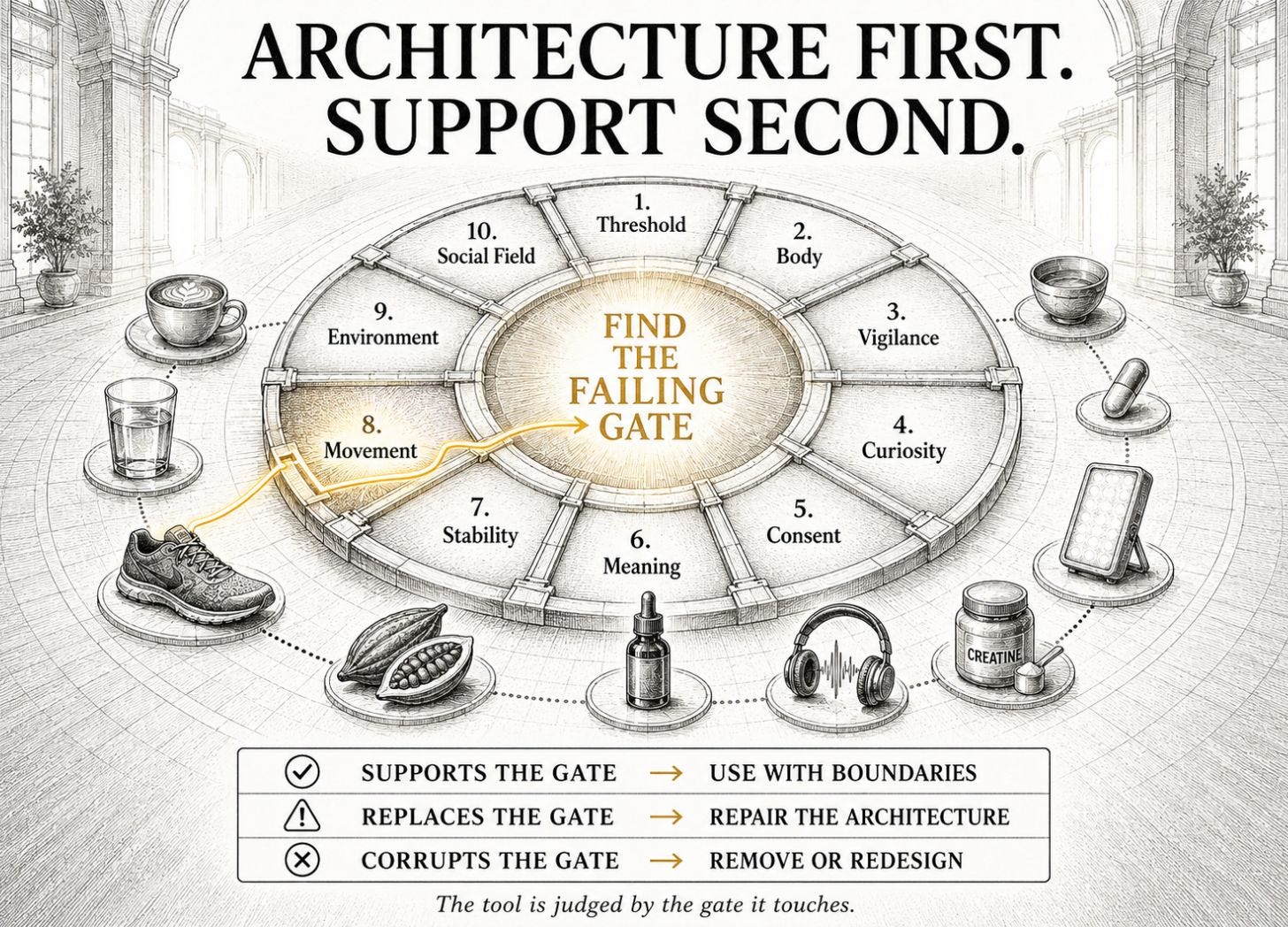
Architecture first, support second
This is the law of the whole essay.
Architecture first.
Support second.
That does not mean support is weak.
It means support has a place.
The architecture of this season has been building toward this point. A serious state is shaped by threshold, body, vigilance, curiosity, autonomy, meaning, perceptual stability, movement, environment, and social field. If those layers are broken, a compound may still do something, but it may not solve the real problem.
Caffeine can sharpen attention, but it cannot turn a coercive task into chosen work.
Tea can soften the edge of stimulation, but it cannot give meaning to dead labour.
Creatine may support brain energetics, but it cannot make a hostile room safe.
Nitrate-rich foods may support vascular pathways, but they cannot stop social guarding.
Photobiomodulation may be promising, but it cannot replace a threshold.
A peptide may modulate a biological pathway, but it cannot provide a life architecture.
This is the adult order.
First ask:
What gate is failing?
Then ask:
Would support help that gate?
Never reverse those questions.
Evidence does not come in one shape
This is where this essay needs to be more mature than standard supplement discourse.
Most people speak in two categories:
Proven.
Fake.
That is not enough.
There are at least three proof lanes.
Lane 1: Evidence-established
This is where the literature is strong enough that we can speak plainly, while still respecting individual difference and context.
Caffeine belongs partly here. A 2025 systematic review and meta-analysis found that caffeine acutely improves attention in healthy, rested adults, especially reaction time and accuracy, although dose-response and individual variability still matter.2
Creatine also belongs partly here, but in a different way. The performance and safety literature is much stronger than the cognition literature. The International Society of Sports Nutrition has long described creatine monohydrate as effective and well tolerated in healthy individuals when used appropriately, while newer cognitive meta-analytic work suggests possible benefits for cognition in adults, especially memory and processing-related domains, but calls for larger and stronger trials.3
This lane allows more direct language.
Not reckless certainty.
Direct language.
Lane 2: Mechanism-supported
This is where mechanisms are plausible, some human evidence exists, but the effect is context-dependent, mixed, or not yet strong enough for sweeping claims.
Cocoa flavanols are a good example. Their vascular and endothelial effects make them interesting for cognition, and meta-analytic work has examined cognitive outcomes, but effects vary by population, dose, timing, and task.4
Dietary nitrate is similar. The nitrate-nitrite-nitric oxide pathway is biologically plausible for neurovascular function, and some work suggests dietary nitrate can affect cerebral blood flow and certain cognitive outcomes, but this is better framed as a possible physiological support layer than as a direct flow switch.5
Photobiomodulation also belongs here. Recent systematic review work suggests potential cognitive benefits, including in populations with cognitive impairment, but the field remains heterogeneous and the findings should be treated cautiously.6
Mechanism-supported does not mean useless.
It means the right sentence is:
This may help under certain conditions, through plausible pathways, but it should not be inflated beyond the evidence.
That is the language of seriousness.
Lane 3: Practice-proven
This is the most delicate lane.
It is also one of the places where your voice can become most distinctive.
Some tools are stronger in field experience than in formal literature. Some are used by serious practitioners before the academy has caught up. Some have plausible mechanisms and meaningful lived reports, but weak, narrow, or geographically limited evidence. Some are too new, too niche, too difficult to study, or too far outside mainstream funding incentives to have the evidence base they may one day deserve.
Peptides often live here.
Semax is an example that must be handled carefully. There is some intriguing human and mechanistic literature, including work on default mode network activity, but the evidence base remains limited and much of it is clustered in Russian and post-Soviet contexts.7 That does not make it worthless. It means it must be framed with precision, not theatre.
Practice-proven does not mean “anything goes.”
It means:
I have seen enough to take the signal seriously, but not enough to pretend consensus.
That is an honest proof lane.
It is also where authority matters.
Not internet authority.
Not bravado.
Not affiliate-driven certainty.
Real authority.
The kind earned by technical literacy, repeated exposure, client observation, personal experimentation, pattern recognition, and enough humility to separate what is known from what is inferred.

Neurochemistry is not a shopping list
Flow is often described online through a list of chemicals.
Dopamine.
Norepinephrine.
Endorphins.
Anandamide.
Serotonin.
Acetylcholine.
The list is not useless.
But it is often used badly.
Flow neuroscience is still debated. Reviews discuss multiple systems, including attention, arousal, reward, cognitive control, network dynamics, and neuromodulation, but no serious account reduces flow to “take something that increases X and you get the state”.8
That reduction is one of the great mistakes in performance culture.
The brain is not a vending machine.
A molecule does not equal a state.
A state is an organized pattern across body, brain, attention, task, meaning, environment, and action.
Support may alter part of that pattern.
It does not own the pattern.
This is why state support has to remain inside architecture.
Coffee is not a personality
Let us make this concrete.
Coffee is useful.
For many people, it genuinely improves alertness, attention, reaction speed, and willingness to begin. Caffeine has one of the more established evidence bases among commonly used cognitive supports, and recent systematic review work continues to support acute attentional benefits in healthy adults.9
But coffee can also become a disguise.
It can hide sleep debt.
It can intensify bracing.
It can turn vigilance into speed.
It can make a task feel urgent without making it meaningful.
It can train the system to associate depth only with stimulation.
So the adult question is not:
Is coffee good?
The adult question is:
What role is coffee playing here?
Is it supporting a clean threshold?
Or is it covering a broken one?
Those are different uses.
Tea is a lesson in architecture
Tea is interesting because it resists crude categories.
It is not simply caffeine.
It is not simply calm.
It is not simply ritual.
It can be all of these, depending on context.
A recent systematic review and meta-analysis found that the combination of theanine and caffeine likely confers small-to-moderate improvements in attentional task performance compared with placebo, while also emphasizing uncertainty, heterogeneity, and the need for more real-world tea-relevant studies.10
That is exactly the kind of evidence that requires adult language.
Likely useful.
Not magic.
Context-dependent.
Even more importantly, tea teaches the architectural lesson.
A cup of tea used as part of a threshold is different from a pill swallowed inside chaos.
The same compound profile can sit inside different meanings.
Tea before writing.
Tea inside prayer.
Tea in a rushed car.
Tea during doomscrolling.
Tea after a night of ruined sleep and three coffees.
Those are not the same state.
The compound is not the whole story.
The context changes what the support becomes.
The danger is not only side effects
Most discussions of enhancement ethics focus on safety, fairness, coercion, and access. Those matter. Greely and colleagues argued for a responsible social response to cognitive enhancement, one that does not treat enhancement as inherently dirty but still manages risks, research, regulation, fairness, and coercion. Neuroethical work has continued to raise questions about healthy users, risk, equity, motivation, and the social meaning of enhancement.11
But there is another danger that matters for this series.
Dependency of identity.
Not physical dependence in the clinical sense, though that can matter too.
Something subtler.
The belief that the tool is the source of the self.
I am only sharp with this.
I am only creative with this.
I am only confident with this.
I am only disciplined with this.
I am only spiritual with this.
I am only capable with this stack, this capsule, this device, this ritual.
That is where support begins to threaten sovereignty.
A tool should widen your access to capacity.
It should not shrink your image of who you are without it.
Enhancement can become coercion
There is another ethical layer.
Enhancement does not remain purely private when it enters a competitive environment.
If everyone in a room feels they must stimulate, medicate, optimize, stack, or push sleep aside to keep up, the support layer has become coercive. The individual decision is now part of a social pressure field.
That is one reason this essay had to follow the group-flow pair.
The social field changes what support means.
A compound used freely inside a healthy architecture is one thing.
A compound used because the environment punishes human limits is another.
A tool used to help a person serve meaningful work is one thing.
A tool used so an extractive system can demand more output from a less recovered organism is another.
The same object can participate in different moral architectures.
That is why “what works” is not the only question.
We also have to ask:
What kind of human system is this tool helping to build?
The three corruptions of state support
State support becomes dangerous when it falls into one of three corruptions.
1. Substitution
The tool replaces a gate it should only support.
Caffeine replaces sleep.
A nootropic replaces task clarity.
A peptide replaces patience with training.
A device replaces recovery.
A stimulant replaces meaning.
Substitution is the most common corruption.
It feels productive.
It often creates a short-term win.
But it trains the wrong lesson.
The system learns that the support is the solution, when the real gate remains broken.
2. Escalation
The tool that once supported entry now has to become stronger, more frequent, more complex, or more exotic to feel useful.
More caffeine.
More compounds.
More stacking.
More devices.
More stimulation.
More novelty.
Escalation often means the architecture has not been repaired.
It also makes the person less sensitive to basic levers.
Sleep.
Light.
Movement.
Food.
Room.
Meaning.
Task design.
Silence.
When ordinary supports lose authority, the person is no longer optimizing.
He may be drifting.
3. Identity capture
The tool becomes part of self-image.
The biohacker.
The nootropic person.
The stimulant person.
The peptide person.
The stack person.
Now the compound is no longer just a tool.
It is a tribe, a persona, a signal.
That is dangerous because identity resists correction.
If a tool becomes who you are, evidence becomes threatening.
The right question is placement
This is the central contribution of the essay.
Do not ask first:
Is this compound good?
Is this natural?
Is this advanced?
Is this cutting-edge?
Is this what high performers use?
Ask:
Where does it belong?
Does it support sleep, or replace it?
Does it support alertness, or intensify guarding?
Does it support curiosity, or create stimulation without pull?
Does it support consent, or help you override the unwilling mind?
Does it support meaning, or help you work on what you do not believe in?
Does it support stability, or make internal noise faster?
Does it support movement and transition, or remove the need to listen to the body?
Does it support environment, or compensate for a hostile field?
Does it support group flow, or let a team normalize impossible demands?
The tool must be judged by the gate it touches.
That is architecture.
The strongest support is often boring
This is where many people will be disappointed.
Good.
The disappointment is diagnostic.
Some of the strongest state support is not exotic.
Morning light.
A well-timed coffee.
Enough water.
A steady meal.
A walk.
Creatine monohydrate, when appropriate.
Tea as threshold.
A room that does not fracture you.
A sound field that holds attention.
An honest task.
A body that slept.
That does not mean frontier tools are useless.
It means exotic tools should not become a way to avoid the ordinary levers that still carry enormous power.
The ordinary is not beneath you.
It is often the foundation your ambition keeps trying to skip.
Frontier tools require frontier honesty
This does not mean we should be timid.
The frontier matters.
Peptides matter.
Photobiomodulation may matter.
Nootropics may matter.
Precision nutrition may matter.
Targeted support may matter.
Future compounds may matter even more.
But frontier tools require frontier honesty.
Not hype.
Not dismissal.
Not “biohacking” as costume.
Not academic cowardice that refuses to discuss what serious people are already using.
A better stance is possible:
Curious.
Literate.
Structured.
Ethical.
Precise.
The adult position is not to pretend the frontier is empty.
The adult position is to separate signal from story.12
Why this belongs here in the season
The sequence matters.
We could not begin with compounds.
That would have made the whole season shallow.
If the first answer to flow is a substance, the architecture collapses.
So we began elsewhere.
Threshold.
Body.
Vigilance.
Curiosity.
Consent.
Meaning.
Stability.
Movement.
Environment.
Group field.
Only now do we ask where compounds belong.
That order is the doctrine.
Support comes after architecture because support belongs to architecture.
This is why Pair 11 is not a detour.
It is the test of whether the whole season has been understood.
A person who understands the architecture can use tools without worshipping them.
A person who does not will turn tools into shortcuts, excuses, identities, or dependencies.
The rep for today
Do not change your stack today.
Audit the role of support.
The State Support Audit
Choose one thing you currently use to change state.
Coffee.
Tea.
A supplement.
A nootropic.
A device.
A peptide.
A food.
A light tool.
A breathing practice.
A sound tool.
Then answer five lines.
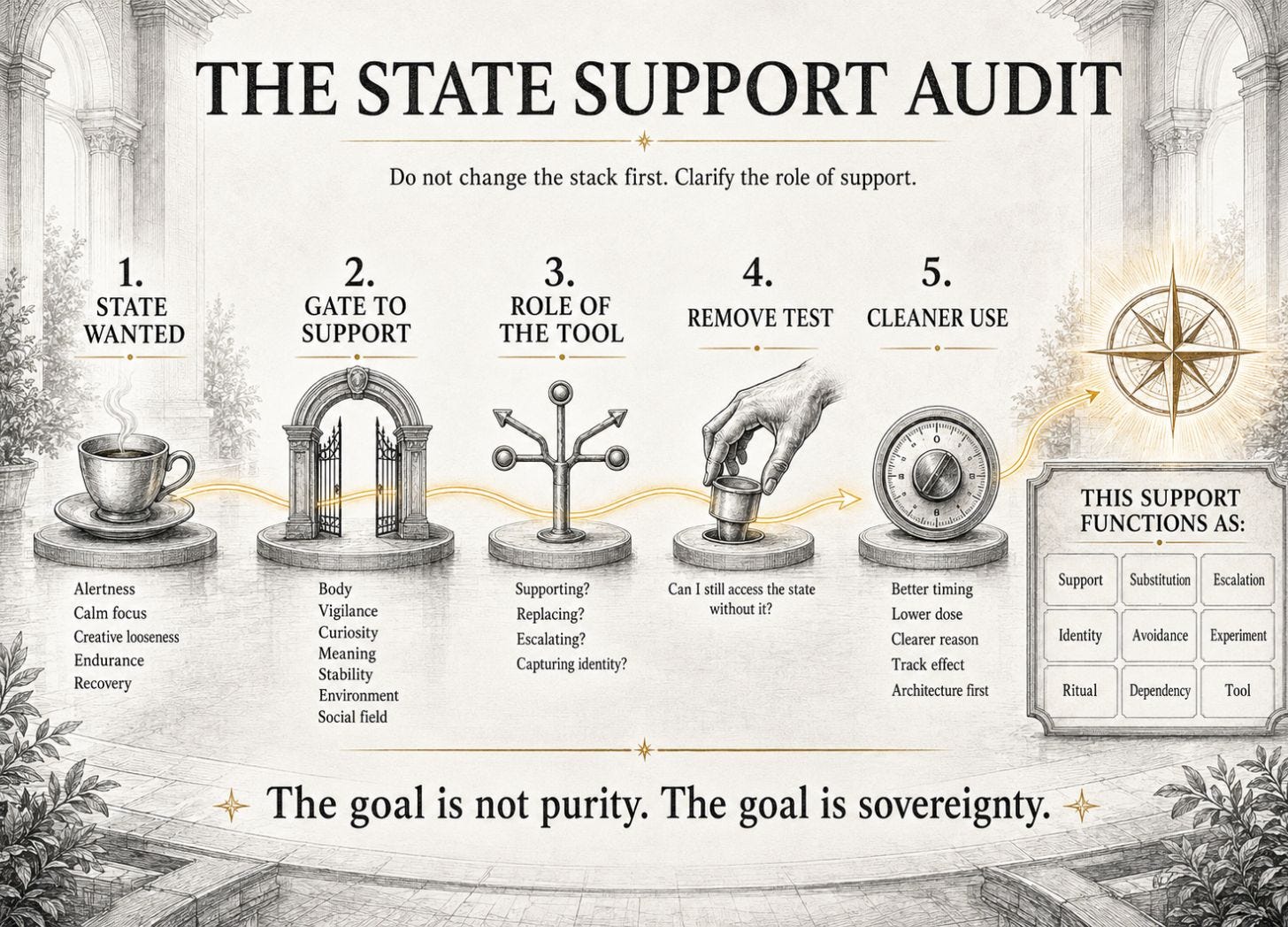
1. What state am I trying to create?
Alertness, calm focus, creative looseness, endurance, motivation, confidence, stability, recovery?
2. What gate am I trying to support?
Threshold, body, vigilance, curiosity, consent, meaning, stability, movement, environment, or social field?
3. Is this tool supporting the gate or replacing it?
4. What happens when I remove the tool?
Do I still have access to the state in some form, or do I feel psychologically helpless without it?
5. What would cleaner use look like?
Less often? Better timing? Lower dose? Better reason? More honest tracking? Architecture first?
Then write one sentence:
This support currently functions as ________.
Be honest.
Support.
Substitution.
Escalation.
Identity.
Avoidance.
Experiment.
Ritual.
Dependency.
Tool.
Do not make the answer flattering.
Make it true.
Then choose one correction.
One.
Maybe it is:
no caffeine before light
no stimulant before task clarity
no new compound until sleep is repaired
tea only as threshold, not distraction
track effect instead of believing the story
stop stacking tools with no defined target state
ask whether the tool is supporting the work or avoiding it
The goal is not purity.
The goal is sovereignty.
The standard to keep
Support can help.
Support is not sovereignty.
That is the standard.
The right tool in the right place can change a block.
It can sharpen attention.
It can steady arousal.
It can support endurance.
It can widen access to a state that was already architecturally possible.
But the wrong tool, or the right tool in the wrong place, can train dependence, cover broken gates, intensify vigilance, replace meaning, and make a person less willing to repair the architecture underneath.
This is why compounds belong in the series.
Not at the beginning.
Here.
After threshold.
After body.
After vigilance.
After curiosity.
After consent.
After meaning.
After stability.
After movement.
After room.
After trust.
Because by now the question is finally mature enough.
Not “what can I take?”
But:
What is this tool serving?
That is the difference between enhancement and escape.
If this series speaks to you, subscribe.
The Thursday essays clarify the architecture.
The Monday manuals turn it into practice: support audits, evidence lanes, timing decisions, baseline-first rules, stack boundaries, tolerance checks, and protocols built to be used under pressure, not merely admired in theory.
Next Monday’s subscriber edition is Use State-Supporting Tools Without Becoming Ruled by Them: The State-Support Protocol for coffee, tea, nootropics, peptides, and cleaner use.
Antonopoulos, R.K., Dadiotis, E., Ioannidis, K., Cheilari, A., Mitsis, V., Garcia-Campaña, A.M., Gámiz-Gracia, L., Hernández-Mesa, M., Narváez, A., Hoffman, M.A., Ruck, C.A.P., Gonou-Zagou, Z., Aligiannis, N. and Magiatis, P. (2026) ‘Investigating the psychedelic hypothesis of kykeon, the sacred elixir of the Eleusinian Mysteries’, Scientific Reports, 16, article 8757. doi: 10.1038/s41598-026-39568-3.
Kløve, K. and Petersen, A. (2025) ‘A systematic review and meta-analysis of the acute effect of caffeine on attention’, Psychopharmacology, 242, pp. 1909–1930. doi: 10.1007/s00213-025-06775-1.
Kreider, R.B., Kalman, D.S., Antonio, J. et al. (2017) ‘International Society of Sports Nutrition position stand: safety and efficacy of creatine supplementation in exercise, sport, and medicine’, Journal of the International Society of Sports Nutrition, 14, article 18. doi: 10.1186/s12970-017-0173-z; Xu, C., Bi, S., Zhang, W. and Luo, L. (2024) ‘The effects of creatine supplementation on cognitive function in adults: a systematic review and meta-analysis’, Frontiers in Nutrition, 11, article 1424972. doi: 10.3389/fnut.2024.1424972; Citherlet, T. (2026) ‘Commentary: The effects of creatine supplementation on cognitive function in adults: a systematic review and meta-analysis’, Frontiers in Nutrition, 13, article 1716285. doi: 10.3389/fnut.2026.1716285.
Shateri, Z., Kooshki, A., Hormoznejad, R., Hosseini, S.A., Mousavi, R. and Foroumandi, E. (2023) ‘Effects of chocolate on cognitive function in healthy adults: a systematic review and meta-analysis on clinical trials’, Phytotherapy Research, 37(9), pp. 3688–3697. doi: 10.1002/ptr.7896; Vyas, C.M., Manson, J.E., Sesso, H.D. et al. (2024) ‘Effect of cocoa extract supplementation on cognitive function: results from the clinic subcohort of the COSMOS trial’, American Journal of Clinical Nutrition, 119(1), pp. 39–48. doi: 10.1016/j.ajcnut.2023.10.031.
Clifford, T., Babateen, A., Shannon, O.M., Capper, T., Ashor, A. and Stephan, B.C.M. (2019) ‘Effects of inorganic nitrate and nitrite consumption on cognitive function and cerebral blood flow: a systematic review and meta-analysis of randomized clinical trials’, Critical Reviews in Food Science and Nutrition, 59(15), pp. 2400–2410. doi: 10.1080/10408398.2018.1453779; Gonçalves, J.S., Marçal, A.L., Marques, B.S., Costa, F.D., Laranjinha, J., Rocha, B.S. and Lourenço, C.F. (2024) ‘Dietary nitrate supplementation and cognitive health: the nitric oxide-dependent neurovascular coupling hypothesis’, Biochemical Society Transactions, 52(1), pp. 279–289. doi: 10.1042/BST20230491.
Rodríguez-Fernández, L., Zorzo, C. and Arias, J.L. (2024) ‘Photobiomodulation in the aging brain: a systematic review from animal models to humans’, GeroScience, 46, pp. 6583–6623. doi: 10.1007/s11357-024-01231-y; Zhu, Z., Zhang, R., Chi, Y., Li, W. and Gong, W. (2025) ‘Photobiomodulation effects on cognitive function—a systematic review and meta-analysis of randomized controlled trials’, Lasers in Medical Science, 40, article 234. doi: 10.1007/s10103-025-04484-x.
Lebedeva, I.S., Panikratova, Y.R., Sokolov, O.Y., Kupriyanov, D.A., Rumshiskaya, A.D., Kost, N.V. and Myasoedov, N.F. (2018) ‘Effects of Semax on the default mode network of the brain’, Bulletin of Experimental Biology and Medicine, 165, pp. 653–656. doi: 10.1007/s10517-018-4234-3.
Kotler, S., Mannino, M., Kelso, S. and Huskey, R. (2022) ‘First few seconds for flow: a comprehensive proposal of the neurobiology and neurodynamics of state onset’, Neuroscience & Biobehavioral Reviews, 143, article 104956. doi: 10.1016/j.neubiorev.2022.104956; van der Linden, D., Tops, M. and Bakker, A.B. (2021) ‘The neuroscience of the flow state: involvement of the locus coeruleus norepinephrine system’, Frontiers in Psychology, 12, article 645498. doi: 10.3389/fpsyg.2021.645498.
Kløve, K. and Petersen, A. (2025) ‘A systematic review and meta-analysis of the acute effect of caffeine on attention’, Psychopharmacology, 242, pp. 1909–1930. doi: 10.1007/s00213-025-06775-1.
Payne, E.R., Aceves-Martins, M., Dubost, J., Greyling, A. and de Roos, B. (2025) ‘Effects of tea (Camellia sinensis) or its bioactive compounds l-theanine or l-theanine plus caffeine on cognition, sleep, and mood in healthy participants: a systematic review and meta-analysis of randomized controlled trials’, Nutrition Reviews, 83(10), pp. 1873–1891. doi: 10.1093/nutrit/nuaf054.
Greely, H., Sahakian, B., Harris, J., Kessler, R.C., Gazzaniga, M., Campbell, P. and Farah, M.J. (2008) ‘Towards responsible use of cognitive-enhancing drugs by the healthy’, Nature, 456(7223), pp. 702–705. doi: 10.1038/456702a; Sahakian, B.J. and Morein-Zamir, S. (2011) ‘Neuroethical issues in cognitive enhancement’, Journal of Psychopharmacology, 25(2), pp. 197–204. doi: 10.1177/0269881109106926.
Background reading: Abuhamdeh, S. (2020) ‘Investigating the “flow” experience: key conceptual and operational issues’, Frontiers in Psychology, 11, article 158. doi: 10.3389/fpsyg.2020.00158; Battleday, R.M. and Brem, A.K. (2015) ‘Modafinil for cognitive neuroenhancement in healthy non-sleep-deprived subjects: a systematic review’, European Neuropsychopharmacology, 25(11), pp. 1865–1881. doi: 10.1016/j.euroneuro.2015.07.028.