“A system of local optimums is not an optimum system at all; it is a very inefficient system.”
Eliyahu M. Goldratt
Herbie is falling behind.
The boys are ten miles from camp, walking single file beneath the weight of their packs. At the front, the trail rises towards Devil’s Gulch. At the back, the line keeps breaking. Gaps open between boots. Boys stop, wait, hurry, catch up and fall behind again.
The faster scouts blame the slower ones. The troop leader pushes for more speed. Yet every attempt to move faster stretches the troop farther apart.
Then Alex, the manager at the centre of Eliyahu Goldratt and Jeff Cox’s fictional business novel The Goal, notices something simple.
The troop can move no faster than Herbie.
He walks down the line and finds the boy bent beneath an enormous rucksack. Inside it are bottles of soda, tins of food, spaghetti, candy, pickles, a steel shovel and an iron skillet. Herbie is not weak. He is carrying too much.
Alex moves him to the front. At once, the gaps disappear. Then the boys open Herbie’s pack and divide the load among them. The strongest shoulders take more. Herbie stands straighter. The line begins to move.
Soon, the whole troop is travelling at twice its former speed.1
No boy became twice as strong. No hour gained another sixty minutes. They stopped demanding more from every part and changed the one condition that governed the whole.
This is how years are sometimes recovered.
The Decision That Can Save a Decade
On Thursday, we saw that progress moves through three kinds of time. There is dead time, when effort repeats but nothing accumulates. There is leveraged time, when one well-placed action changes everything that follows. And there is gestational time, when the right causes are alive but the visible result is not ready.
Understanding the difference is liberating. Living it is harder.
From the inside, stagnation and gestation can feel exactly the same. The business is still not growing. The book is still not finished. The body still feels heavy. The relationship still feels distant. You have worked, waited and hoped. Nothing decisive has appeared.
Now two fears take hold.
What if you quit one week before the breakthrough?
What if the breakthrough is a story you have been telling yourself for ten years?
One fear tells you to persist. The other tells you to pivot. Both can sound wise. Both can destroy a life when obeyed at the wrong time.
The answer is not more motivation. It is not blind patience. It is not a dramatic reinvention every time the result disappoints you. It is a better decision process.
The precise question is this:
Given several real problems and incomplete knowledge, which action most deserves the next fourteen days, and what evidence will determine what happens after that?
Fourteen days is not a promise that every result will appear in two weeks. A habit, a reputation, a body, a company or a marriage does not obey the calendar of a marketing campaign. Fourteen days is a bounded decision window. It is long enough to stop reacting to every mood, short enough to prevent another year of vague effort, and precise enough to reveal whether the causes beneath the result are beginning to move.
The goal is not certainty. You will rarely possess it.
The goal is to turn uncertainty into evidence.
The Distinction That Changes the Diagnosis
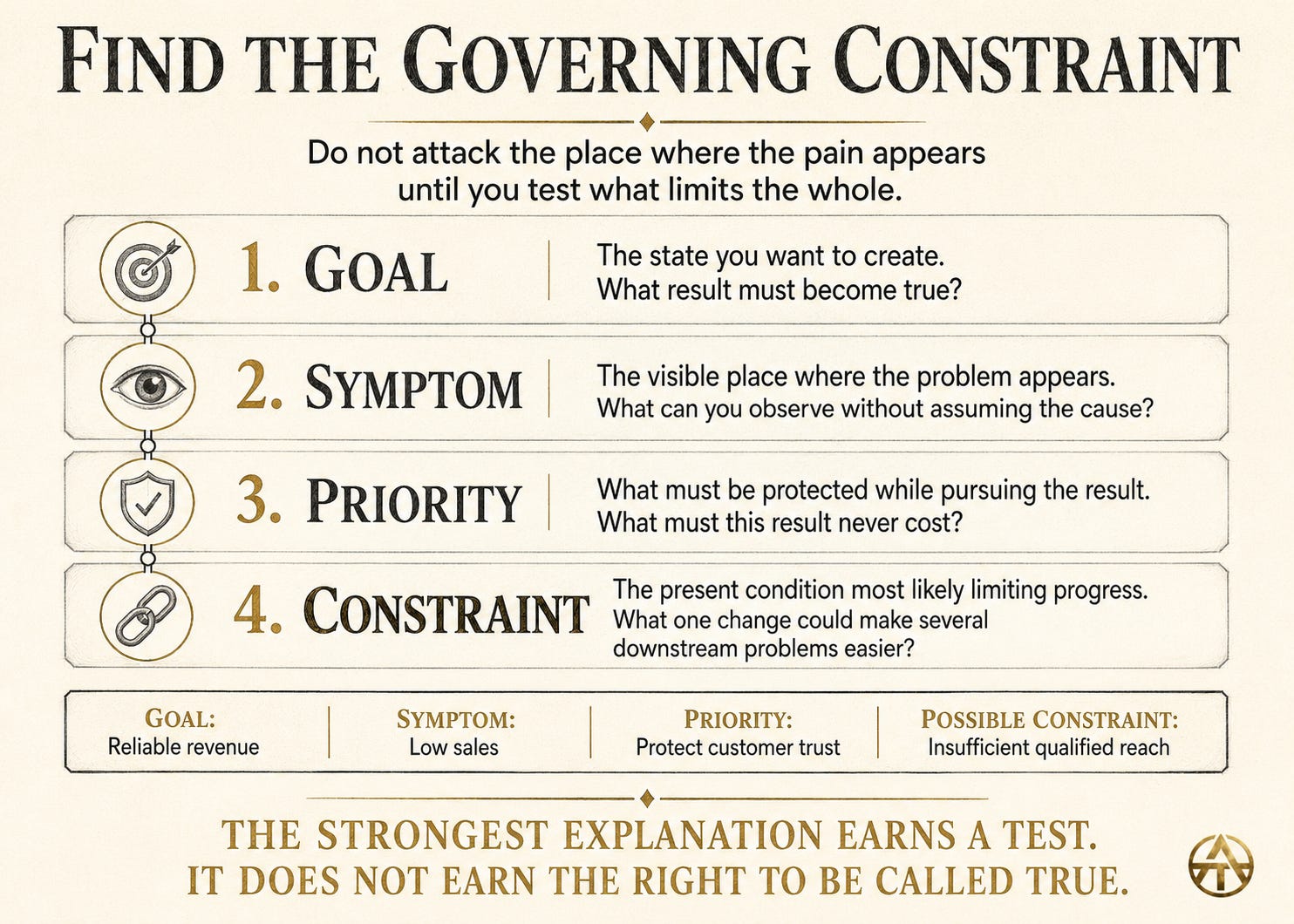
Before you run any test, separate four things that the mind constantly confuses: the goal, the symptom, the priority and the constraint.
The goal is the state you want to create. The symptom is where the pain appears. The priority is what deserves protection because it matters most. The constraint is the present condition limiting movement towards the goal.
A founder’s goal may be reliable revenue. The symptom is low sales. The priority may be preserving trust with early customers. The constraint may not be the product at all. It may be that too few qualified people ever see it.
A writer’s goal may be a finished book. The symptom is a stalled manuscript. The priority may be telling the truth without neglecting the family that gives the work meaning. The constraint may not be talent. It may be an unprotected morning continually surrendered to messages.
A person’s goal may be greater energy. The symptom is poor concentration. The priority is the integrity of the whole life. The constraint might be sleep opportunity, workload, nutrition, distress, illness or something else entirely. Naming the symptom is not the same as finding the cause.
That error consumes years. We feel pain in one place and attack that place directly. We polish the offer when the problem is distribution. We buy another planning system when the problem is fear. We train harder when the problem is recovery. We demand more discipline from a person whose life is already carrying Herbie’s pack.
So take a page and complete four sentences:
The result I want is...
The visible problem is...
What must not be sacrificed to obtain it is...
The condition most likely governing the result is...
That final sentence is not a verdict. It is a hypothesis. This matters. The moment you mistake a plausible explanation for truth, you stop learning.
What follows is a method for testing it.