


Some people make your mind larger.
You know it when it happens.
You speak, and the room does not punish the unfinished thought.
You reach for an idea, and someone catches the edge of it.
You miss a word, and the other person does not close the door.
You take a risk, and the group does not turn that risk into social exposure.
Something changes.
The mind stops spending so much force managing its own image.
The body stops bracing for correction.
Attention stops splitting between the task and the politics of the room.
The work becomes more alive because the social field becomes safer to think inside.
Other rooms do the opposite.
A person enters, and the whole system tightens.
A superior watches, and language becomes careful.
A competitor listens, and the mind begins defending itself.
A careless comment lands, and the group loses the courage to explore.
A dominant voice takes over, and everyone else stops contributing before they have even gone silent.
Nothing obvious has exploded.
But the shared mind has closed.
That is the subject of this essay.
The previous essay argued that the room is part of the mind. It showed that light, sound, tools, visual order, air, friction, and place meaning are not passive background details. They are part of the sensory field in which thought happens.
Now we move to a more dangerous field.
Other people.
By the end of this essay, you will understand why flow is not only a solitary phenomenon, why trust changes cognition, why psychological safety is not softness, why synchrony and timing matter, why some groups become sharper than their members and others make every member smaller, and why any mature theory of peak mental states must include the social mind.
Because some rooms are made of people.
Where this series is going
This essay continues Act III of The Hidden Architecture of Flow: Field, Support, and Distortions.
Act I dealt with entry: threshold, body, vigilance, boredom, and curiosity.
Act II dealt with consent, meaning, stability, and movement.
Act III now moves through the fields that shape peak states from the outside:
Environment
Relationships
Group flow,
State support,
Salience,
The difference between clean elevation and distorted intensity.
The previous pair moved from the physical room to the environment protocol.
This pair moves from the physical field to the social field.
Already live: the threshold, body, vigilance, curiosity, work design, meaning, stability, movement, and environment essays and manuals.
Coming next: Build Conditions for Shared Depth, the subscriber protocol for trust, synchrony, and collaborative absorption.
New public essays publish on Thursdays. Subscriber protocols follow on Mondays.
Flow is not only private
Most people imagine flow alone.
The writer in the room.
The athlete in the zone.
The coder at the screen.
The musician disappearing into practice.
That image is useful, but incomplete.
Human beings do not think, perform, create, or regulate only as isolated units. We think inside relationships, around status, through imitation, in response to trust, under the pressure of judgment, and within shared rhythms of speech, attention, and action.
The research on group flow makes this clear. Pels, Kleinert and Mennigen (2018) reviewed the field and found that group flow has been defined and measured in different ways, but that recurring components include synchronization, trust, social interaction, shared goals, and experiences that cannot be reduced cleanly to solitary flow.1 Van den Hout, Davis and Weggeman (2018) similarly treat team flow as a shared optimal experience that emerges when team members experience flow together while working on interdependent tasks for the benefit of the team.2
That distinction matters.
A group is not in flow just because several individuals are focused at the same time.
A group begins to enter flow when attention, contribution, response, timing, trust, and shared direction begin to move together.
The state is no longer merely inside one person.
It is between people.
Trust is not softness
This is where the conversation often becomes weak.
People hear the word trust and think the argument has become sentimental.
It has not.
Trust is not politeness.
It is not endless affirmation.
It is not the removal of standards.
It is not pretending every idea is good.
It is not avoiding conflict.
In a high-quality group, trust is one of the conditions that lets people stop spending so much of their attention on self-protection.
That is the performance relevance.
When trust is low, a person does not merely speak less.
He monitors more.
How will this sound?
Who will use this against me?
Will I look foolish?
Will I be interrupted?
Will the dominant person dismiss it?
Will the group punish the half-formed idea before it can become useful?
That kind of monitoring is not free.
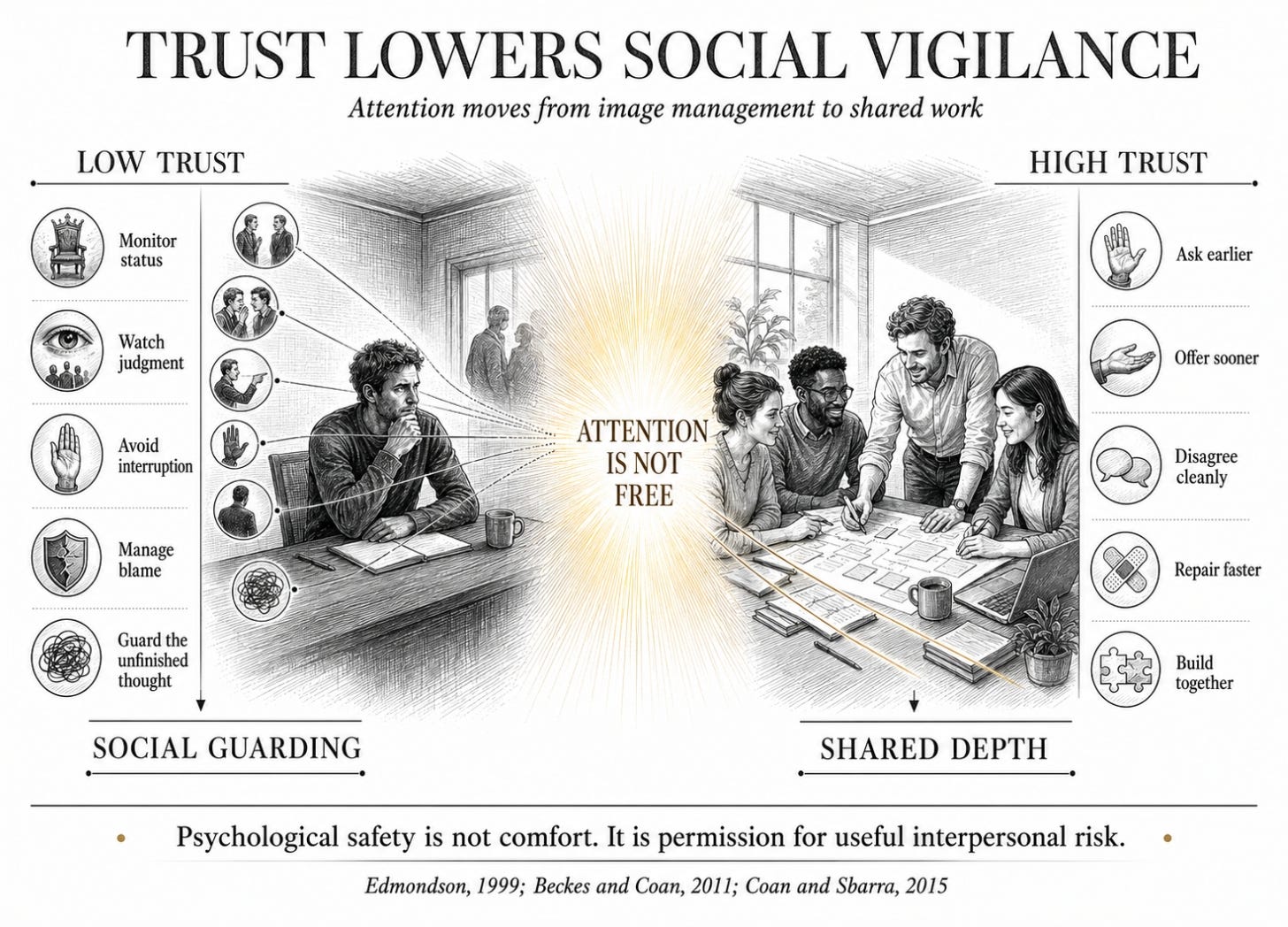
It takes energy that could have gone into the task.
This connects directly to the earlier essay on vigilance. A guarded system and a descending system are doing different jobs. The same is true socially. A guarded group and a creative group are doing different jobs.
One protects position.
The other thinks.
Psychological safety is a threshold
Amy Edmondson’s foundational work defines team psychological safety as a shared belief that the team is safe for interpersonal risk-taking. In her 1999 study, psychological safety was linked to learning behavior in teams, especially because it shaped whether people felt able to speak up, ask for help, admit errors, and engage in learning rather than self-protection.3
This is often misunderstood.
Psychological safety is not comfort.
It is permission to take the kinds of interpersonal risks that learning, creativity, correction, and collaboration require.
That is exactly why it belongs in a series on flow.
Flow asks for reduced self-conscious monitoring.
Group flow asks for reduced social self-protection.
If I cannot risk an unfinished contribution, I will not offer the raw material the group needs.
If I cannot ask the obvious question, the group may preserve ignorance politely.
If I cannot disagree without social punishment, the group may converge early on a weaker answer.
If I cannot make a small error safely, the group may hide larger errors until they become expensive.
A team without psychological safety may still perform.
It may even perform at a high level for a while.
But the cost is hidden.
People begin optimizing their image instead of the shared task.
That is not group flow.
That is social guarding with professional language.
Belonging changes the load
There is a deeper biological reason the social field matters.
Social baseline theory argues that the human brain expects access to reliable social resources, and that proximity to trusted others can reduce perceived risk and the effort required to regulate emotion and act in the world.4
That does not mean people cannot do hard things alone.
They can.
It means the nervous system is not indifferent to whether it is surrounded by predictable allies, ambiguous observers, hostile evaluators, or people whose intentions are unclear.
A trusted person can make a difficult task feel more enterable.
An unsafe person can make a manageable task feel exposed.
This is not weakness.
It is social physiology.
You have felt this.
A room where your mind expands.
A person around whom your language becomes more precise.
A group that makes hard work feel lighter because nobody is wasting force on posturing.
A conversation that gives you access to a thought you could not reach alone.
And you have felt the opposite.
A room where every sentence shrinks.
A person who turns ordinary thinking into performance.
A group that makes you less intelligent because you are busy measuring threat, status, and reaction.
Same mind.
Different social field.
Synchrony is not magic
Group flow also depends on timing.
Not mystical timing.
Interactional timing.
Lavoie, Baer and Rouse (2025) argue that group flow emerges through momentary patterns of contribution: how fast people respond, whether contributions build on one another, whether the group gains momentum, and whether the interaction becomes increasingly synchronized. Their process account is useful because it moves group flow away from vague atmosphere and toward what people actually do with one another in real time.5
That is important.
A group does not become excellent because everyone likes one another.
It becomes excellent when people can listen, respond, build, adjust, and move in a shared direction without constantly breaking rhythm.
Interpersonal synchrony research supports the broader social importance of coordinated timing. Meta-analytic work suggests that synchrony can increase prosocial behavior, perceived social bonding, social cognition, and positive affect, although the exact effects depend on task, method, and context.6 Physiological synchrony research also suggests that changes in synchrony during group interaction can predict perceived group cohesion, though this field is still developing and should not be oversold.7
The practical point is simple.
Groups have rhythm.
Some rhythms invite contribution.
Some rhythms crush it.
Some people enter too late.
Some dominate too early.
Some interrupt before the idea has a body.
Some never contribute enough to give the group anything to build from.
Some groups move so slowly that energy dies.
Some move so fast that thought becomes panic.
Group flow lives between those failures.
It needs enough pace to create momentum.
It needs enough patience to preserve quality.
Close listening is a performance skill
Keith Sawyer’s work on group flow is valuable because it keeps returning to improvisation, jazz, conversation, and collaborative creativity. In his account, group flow depends on conditions such as shared goals, close listening, complete concentration, equal participation, familiarity, good communication, and forward movement.8
The phrase close listening matters.
Because a great deal of collaboration fails before anyone appears rude.
People are waiting to speak.
Or protecting their own idea.
Or rehearsing a clever answer.
Or listening only for agreement.
Or listening only for error.
Or preparing to restore their status.
That is not listening.
That is self-management with another person making sound nearby.
Close listening is different.
It means the other person’s contribution actually changes the next move.
In a group capable of flow, listening is not passive.
It is structural.
One person’s thought becomes the beginning of another person’s next contribution. The group starts to think by extension.
That is why group flow can feel almost impossible to fake.
You can fake enthusiasm.
You can fake politeness.
You cannot easily fake additive contribution over time.
The rhythm exposes you.
Equal participation matters more than status wants to admit
Another uncomfortable point:
The smartest person in the room can still damage the shared mind.
Not because intelligence is bad.
Because domination breaks contribution.
Collective intelligence research found evidence for a general collective intelligence factor in groups, and that this was associated not simply with the average or maximum intelligence of group members, but with social sensitivity and more equal conversational turn-taking.9
That finding should humble many rooms.
A group does not become brilliant by gathering impressive individuals and letting the loudest status signal run the table.
It becomes more capable when perception, contribution, response, and participation are distributed well enough for the group to use what its members actually know.
This does not mean every person should speak exactly the same amount in every situation.
That would be mechanical and false.
But it does mean chronic domination is expensive.
So is chronic withdrawal.
If one person controls the field, others begin to protect themselves, disengage, or shrink their contribution to what feels socially safe.
That is not shared depth.
That is hierarchy pretending to think.
Role clarity is not bureaucracy
Trust alone is not enough.
A group also needs enough structure to know how to move.
Who is holding the question?
Who is generating options?
Who is challenging assumptions?
Who is deciding?
Who is recording?
Who has authority?
Who is responsible for quality?
Who is allowed to interrupt drift?
Without role clarity, groups often leak energy into invisible negotiation.
People hesitate.
Duplicate effort.
Step on one another.
Wait for permission.
Perform intelligence instead of making progress.
This is why team flow models often include shared goals, mutual commitment, clear communication, mutual trust, and alignment between personal and team-level activity.10
The point is not bureaucracy.
The point is cognitive economy.
A group that knows how it is moving can spend more attention on the work itself.
A group that does not know how it is moving spends too much attention figuring out the group.
That is one of the hidden costs of badly run collaboration.
People do not only fail at the task.
They fail at the social architecture around the task.
Hidden competition breaks shared depth
Not all groups fail because people dislike one another.
Some fail because the real task is not the stated task.
The stated task is:
solve the problem.
The real task becomes:
look intelligent, avoid blame, defend territory, protect status, win the meeting, control the narrative, prevent exposure, stay indispensable.
Once that happens, the group is no longer thinking together.
It is negotiating self-protection in public.
This is why trust matters so much.
Without trust, intelligence becomes armored.
People still speak.
But their speech carries a second agenda.
They are not only contributing to the problem.
They are managing what the contribution says about them.
That double task destroys depth.
This is also why group flow is morally demanding in a subtle way. It requires people to bring real ability without making the group serve their ego. It requires contribution without conquest. It requires enough humility to build on another person’s thought and enough courage to offer your own before it is perfect.
That combination is rare.
And when it appears, the room changes.
Group flow is not harmony
This distinction is critical.
Group flow is not everyone agreeing.
It is not a warm mood.
It is not conflict avoidance.
It is not smoothness at the cost of truth.
It is not the absence of tension.
In fact, a group may need real tension to think well.
But the tension must be held inside trust and shared aim.
There is a difference between productive friction and social threat.
Productive friction says:
the idea needs to be sharpened.
Social threat says:
the person is unsafe.
Productive friction improves the work.
Social threat makes the person defend himself.
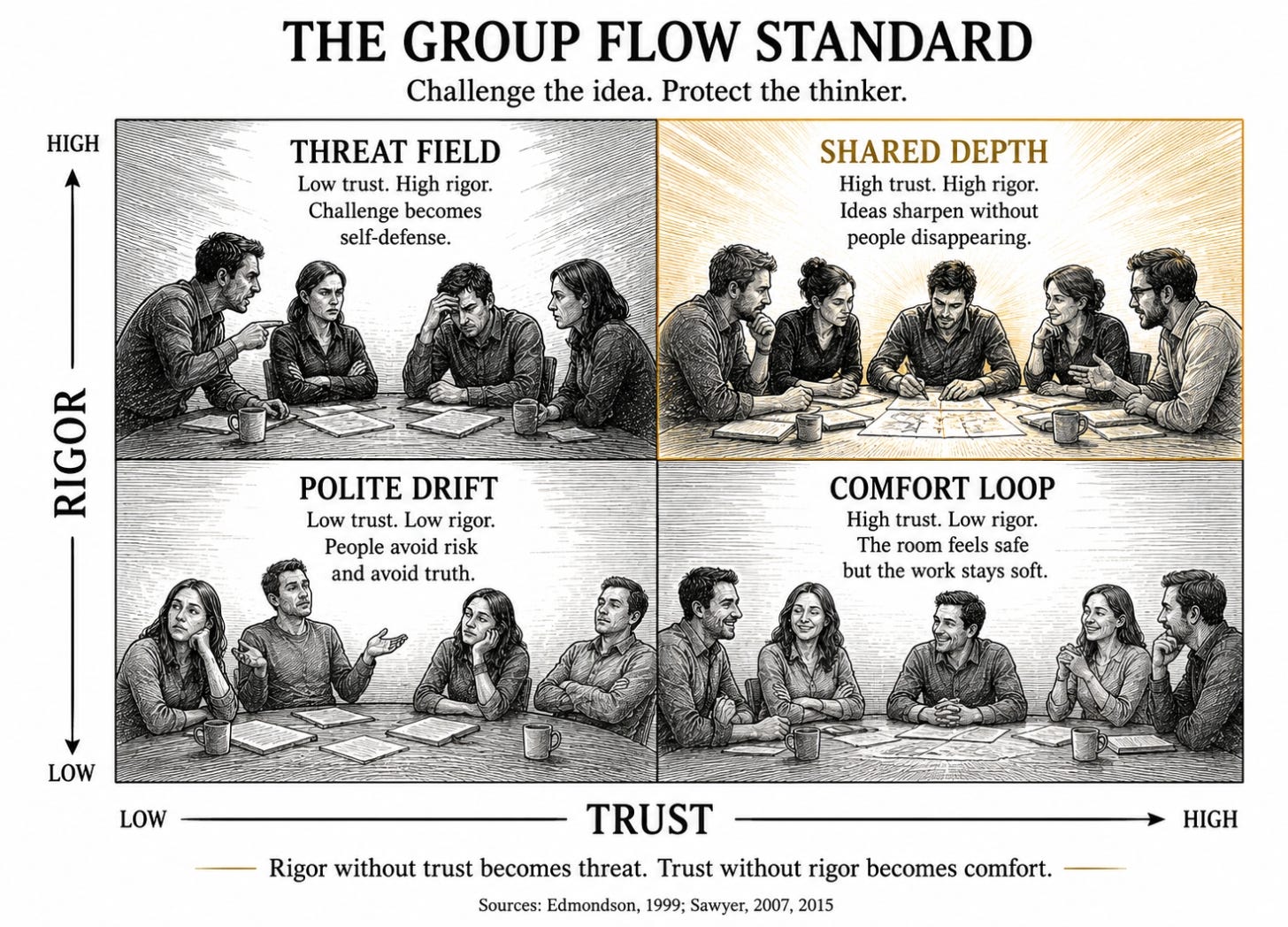
A serious group can challenge an idea without making the thinker disappear.
That is the standard.
And it is difficult.
Because many groups confuse niceness with safety and aggression with rigor.
Both are weak.
Niceness can hide truth.
Aggression can destroy thought.
Rigor without trust becomes threat.
Trust without rigor becomes comfort.
Group flow needs something harder:
a field where people can risk real contribution in service of the work.
The social mind is part of the architecture
This is why relationships belong inside the hidden architecture of flow.
Not as a side note.
Not as a soft human layer added after the serious performance material.
As architecture.
A person’s access to depth changes around other people.
Sometimes for the better.
A trusted collaborator can sharpen a vague idea.
A skilled coach can lower threat and raise standard at the same time.
A group with the right rhythm can create momentum no individual could produce alone.
A partner who listens well can help the next sentence appear.
Sometimes for the worse.
A status-heavy room can make people cautious.
A mocking person can kill intellectual risk.
A vague leader can make everyone monitor politics.
A dominant voice can turn collective intelligence into obedience.
A hidden rivalry can make every contribution strategic instead of truthful.
This is not merely interpersonal preference.
It is state architecture.
The mind goes deeper in some social fields and shallower in others.
That is the point.
Why this belongs after environment
The sequence matters.
The previous pair argued that the room is part of the mind.
But the room is not always made of walls.
Sometimes the field that shapes thought is a person.
Sometimes it is a team.
Sometimes it is a family.
Sometimes it is an audience.
Sometimes it is a culture.
Sometimes it is the imagined judgment of people who are not even present.
That is why Pair 10 follows Pair 9.
First, the physical field.
Now, the social field.
Both can invite depth.
Both can prevent it.
And both belong in any serious theory of peak mental states.
If this season stopped at the solitary individual, it would remain incomplete.
Flow is not only an inward event.
Sometimes it is a shared achievement.
The rep for today
Do not try to fix every relationship.
Read the social field.
The Social Field Audit
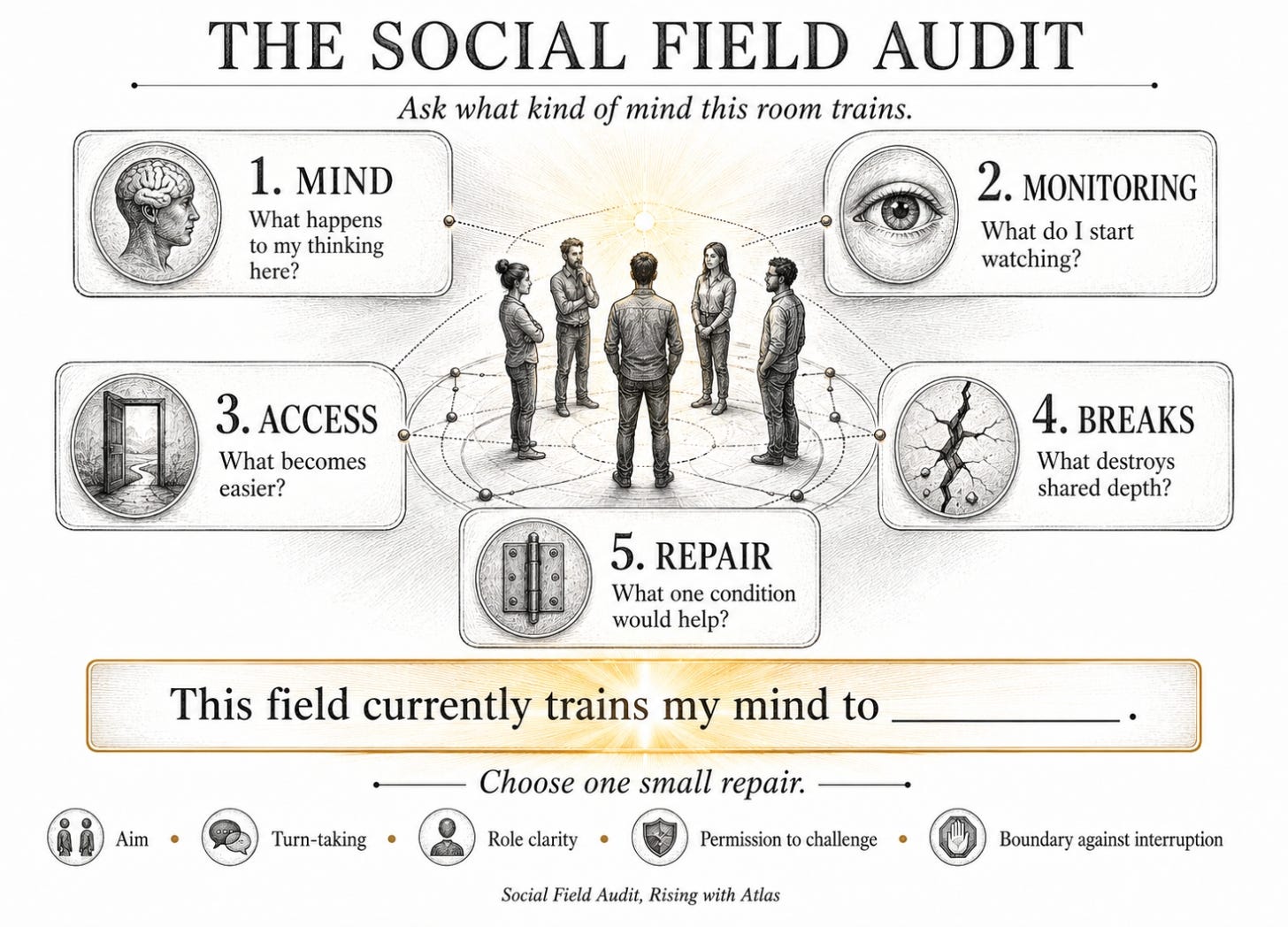
Think of one person or group that regularly affects the quality of your thinking.
Not your mood in general.
Your thinking.
Then answer five lines.
1. What happens to my mind in this field?
Does it expand, sharpen, soften, guard, perform, shrink, rush, freeze, or become more honest?
2. What does this field make me monitor?
Status? Judgment? Approval? Error? Pace? Tone? Interruption? Dominance? Rejection?
3. What does this field make easier?
Truth? Courage? Precision? Creativity? Listening? Risk? Contribution? Silence?
4. What breaks shared depth here?
Ambiguity, mistrust, hidden competition, one-person dominance, politeness, fear, lack of role clarity, poor listening, rushing, or no shared aim?
5. What one condition would make this field safer for serious thought?
A clearer goal?
A better opening question?
Role clarity?
Turn-taking?
Permission to challenge?
A boundary against interruption?
A short warm-up?
A norm for building rather than performing?
Then write one sentence:
This social field currently trains my mind to ________.
Make it true.
Not dramatic.
Then choose one small repair.
One.
Maybe it is:
naming the aim before the conversation
asking one better opening question
slowing the first five minutes
protecting equal contribution
inviting disagreement before consensus
closing status games early
clarifying who decides
separating idea critique from person critique
not bringing delicate thinking into a hostile room too early
Do not ask only, “Do I like these people?”
Ask, “What kind of mind do I become around them?”
That is the sharper question.
The standard to keep
Some rooms are made of people.
That is the standard.
A person can become more intelligent in the right social field.
A group can become more capable than its strongest individual.
A conversation can open a door no solitary mind could find.
Trust can lower self-protection enough for truth to move.
Synchrony can give thought a rhythm.
Role clarity can free the group from invisible negotiation.
Close listening can turn one person’s contribution into another person’s beginning.
But the opposite is also true.
A person can become smaller in the wrong field.
A group can reduce its members to guarded performances.
A room can become polite and still be dead.
A meeting can be full of intelligent people and still fail to think.
A team can mistake intensity for alignment and domination for leadership.
That is why group flow begins with trust.
Not trust as softness.
Trust as the condition that allows the social mind to stop defending itself long enough to work.11
If this series speaks to you, subscribe.
The Thursday essays clarify the architecture.
The Monday manuals turn it into practice: social-field audits, role clarity, group preconditions, synchrony rituals, meeting rhythm, dyad prompts, collaboration resets, and protocols built to be used under pressure, not merely admired in theory.
Next Monday’s subscriber edition is Build Conditions for Shared Depth: The Group Flow Protocol for trust, synchrony, and collaborative absorption.
Pels, F., Kleinert, J. and Mennigen, F. (2018) ‘Group flow: a scoping review of definitions, theoretical approaches, measures and findings’, PLOS ONE, 13(12), e0210117. doi: 10.1371/journal.pone.0210117.
van den Hout, J.J.J., Davis, O.C. and Weggeman, M.C.D.P. (2018) ‘The conceptualization of team flow’, The Journal of Psychology, 152(6), pp. 388–423. doi: 10.1080/00223980.2018.1449729.
Edmondson, A.C. (1999) ‘Psychological safety and learning behavior in work teams’, Administrative Science Quarterly, 44(2), pp. 350–383. doi: 10.2307/2666999.
Beckes, L. and Coan, J.A. (2011) ‘Social baseline theory: the role of social proximity in emotion and economy of action’, Social and Personality Psychology Compass, 5(12), pp. 976–988. doi: 10.1111/j.1751-9004.2011.00400.x; Coan, J.A. and Sbarra, D.A. (2015) ‘Social baseline theory: the social regulation of risk and effort’, Current Opinion in Psychology, 1, pp. 87–91. doi: 10.1016/j.copsyc.2014.12.021.
Lavoie, R., Baer, M. and Rouse, E.D. (2025) ‘Group flow: a theory of group member interactions in the moment and over time’, Academy of Management Review, 50(3), pp. 493–518. doi: 10.5465/amr.2021.0458.
Mogan, R., Fischer, R. and Bulbulia, J.A. (2017) ‘To be in synchrony or not? A meta-analysis of synchrony’s effects on behavior, perception, cognition and affect’, Journal of Experimental Social Psychology, 72, pp. 13–20. doi: 10.1016/j.jesp.2017.03.009.
Tomashin, A., Gordon, I. and Wallot, S. (2022) ‘Interpersonal physiological synchrony predicts group cohesion’, Frontiers in Human Neuroscience, 16, 903407. doi: 10.3389/fnhum.2022.903407.
Sawyer, R.K. (2007) Group Genius: The Creative Power of Collaboration. New York: Basic Books; Sawyer, R.K. (2015) ‘Group flow and group genius’, NAMTA Journal, 40(3), pp. 29–52.
Woolley, A.W., Chabris, C.F., Pentland, A., Hashmi, N. and Malone, T.W. (2010) ‘Evidence for a collective intelligence factor in the performance of human groups’, Science, 330(6004), pp. 686–688. doi: 10.1126/science.1193147.
van den Hout, J.J.J., Davis, O.C. and Weggeman, M.C.D.P. (2018) ‘The conceptualization of team flow’, The Journal of Psychology, 152(6), pp. 388–423. doi: 10.1080/00223980.2018.1449729; van den Hout, J.J.J. and Davis, O.C. (2022) ‘Promoting the emergence of team flow in organizations’, International Journal of Applied Positive Psychology, 7(2), pp. 143–189. doi: 10.1007/s41042-021-00059-7.
Background reading: Abuhamdeh, S. (2020) ‘Investigating the “flow” experience: key conceptual and operational issues’, Frontiers in Psychology, 11, Article 158. doi: 10.3389/fpsyg.2020.00158.