


“The beginning, as the proverb says, is half of the whole.”1
Aristotle, Politics, Book V
It is 8:28 in the morning.
The strategy document is open. The source material is ready. You know the work matters and you have already decided that today is the day.
At 8:31, you check the inbox in case something urgent has arrived.
At 8:38, you rename the document and reorganise two folders.
At 8:47, you search for one more article that might make the argument stronger.
At 9:03, you have been active for thirty-five minutes.
The work has not begun.
Time was available. Knowledge may not be the problem either. You can know why the work matters and still fail to place your hands on its first meaningful action.
What is missing is a reliable way to cross the threshold.
By the end, you will have chosen one stalled task, identified its dominant barrier, matched it to a response, built a ten-minute launch and created a seven-day test.
Not more motivation.
A system you can use when motivation is absent.
What start friction actually is
Start friction is the time, force and emotional cost between intending to do meaningful work and performing its first meaningful action.
That is an editorial definition, not a clinical diagnosis or validated scientific construct. It is more useful than the vague confession, “I am procrastinating,” because it directs attention to the interval in which intention is failing to become action.
Choosing, starting, continuing and finishing are different performance problems. The START Check separates five costs commonly crushed into one character verdict:
State: your present capacity;
Task: the clarity of the first action;
Aversiveness: the emotional cost of entry;
Reward: the reason the work deserves to begin; and
Terrain: the environment through which you must reach it.
START is an Atlas synthesis, not a validated universal instrument. Evidence supports its parts. Task aversiveness is associated with procrastination. A seven-day study of 88 students linked greater task ambiguity with more delay. If-then plans can improve initiation when goal commitment is already strong.2
The system is for ordinary resistance and mild-to-moderate procrastination. It does not diagnose or treat ADHD, depression, anxiety, sleep disorders, burnout or medical causes of cognitive change. Severe, persistent or widespread difficulty, especially alongside changes in mood, sleep, cognition or daily functioning, may require qualified support.3 Precision includes knowing the limits of the tool.
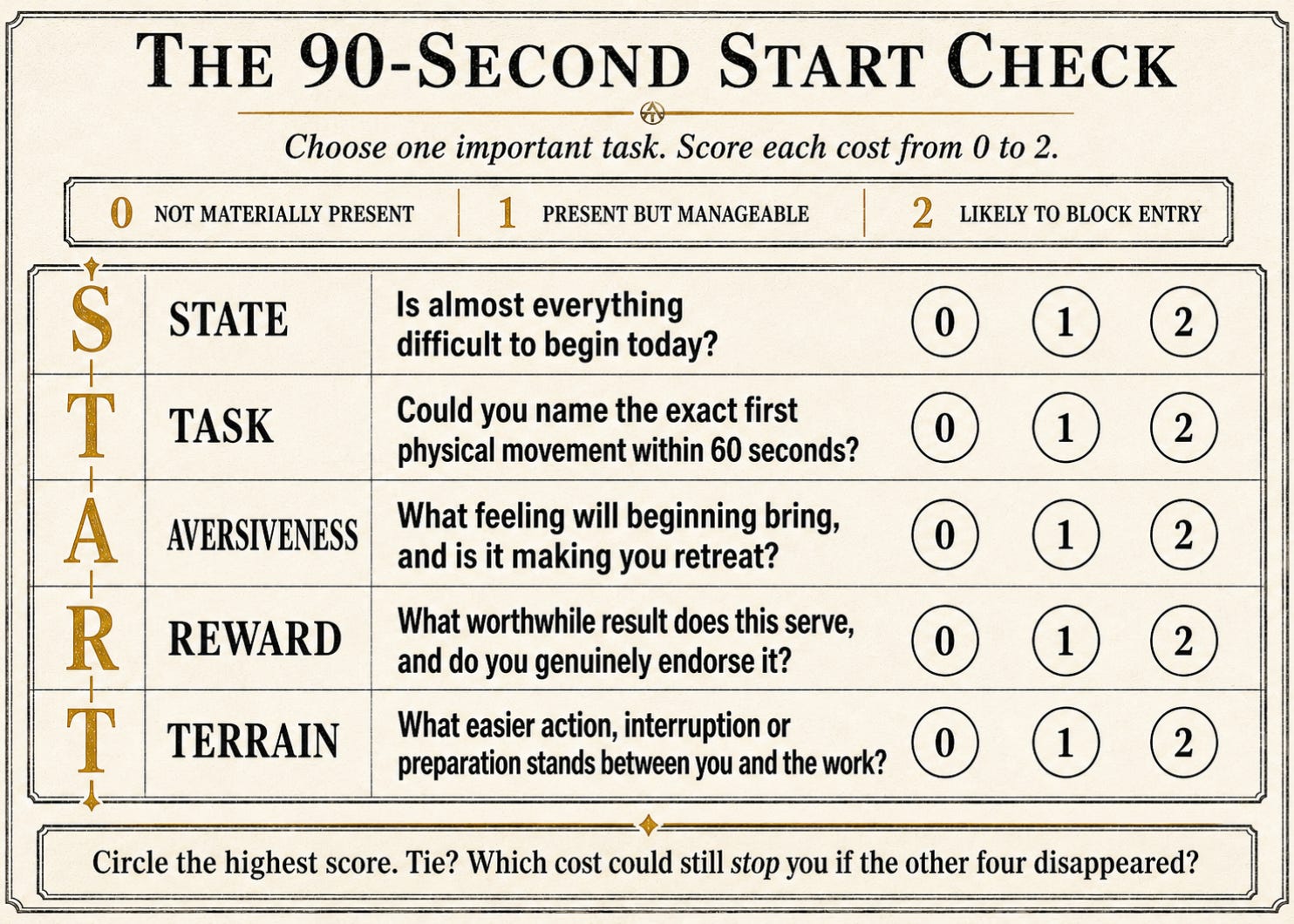
The 90-second START assessment
Write one important task you have decided should be done. Not “fix the business” or “sort out my life.” Choose the proposal, call, training session, accounts or report.
Now score each cost from 0 to 2.
START cost
Ask yourself
ScoreState
Is almost everything difficult to begin today, including things I normally enjoy?
0, 1 or 2Task
If I had to start within sixty seconds, do I know the exact movement my hands or body would make?
0, 1 or 2Aversiveness
What feeling will beginning bring, and is that feeling making me retreat?
0, 1 or 2Reward
What worthwhile result does this serve, for whom, and do I genuinely endorse the reason?
0, 1 or 2Terrain
What easier competing action, interruption or piece of preparation stands between me and the work?
0, 1 or 2
Use 0 when the cost is not materially present, 1 when it is present but manageable and 2 when it is likely to block entry.
Do not engineer the perfect answer. Circle the highest score.
If two costs tie, ask:
If the other four costs disappeared, which one could still stop me from beginning?
That is your dominant barrier. Treat State first when it is high across nearly everything. If Task and Aversiveness tie, clarify the action, then see what discomfort remains. If all five are low, diagnosis has finished.
Ordinary resistance has not earned another meeting.
Begin.
