


“The mind commands the body, and it obeys immediately; the mind commands itself, and is resisted.”
St Augustine, Confessions, Book VIII1
At 11:20 one morning, I sent a message I had delayed for longer than its difficulty could justify.
I have helped very high-calibre people achieve outcomes that mattered deeply to them. Their acknowledgement could help others understand the value of my work and recognise where consequential help was available.
The message itself was simple. It required no new research and no complex strategy.
Still, the threshold felt expensive.
I had deliberately cultivated humility over many years. Somewhere along the way, however, humility had become entangled with a habit of diminishing the gravity of my contribution. Asking for a testimonial felt uncomfortably close to vanity.
But accurate acknowledgement is not vanity when it helps people find help they genuinely need.
It is not humility to make ourselves small.
So I chose the person I thought was least likely to respond quickly or positively, opened the message field, typed the request and pressed send.
At approximately 11:40, the answer arrived:
“Yes!! I would be very happy to do so.”
About twenty minutes had passed.
The hesitation was more in my mind than in reality.
That first request led to the second, then the third and fourth. What had felt heavy began to move, and the movement became a virtuous circle.
This is the contradiction many people live every day.
The document remains untouched while messages are answered. The important call waits while small administrative tasks multiply. The training session feels impossible until the first few steps have been taken. Then, once the real work begins, it may move well for the next hour.
Why can the first ten minutes require more force than the next sixty?
Because doing the work and entering the work are not always the same problem.
Starting is a separate performance problem
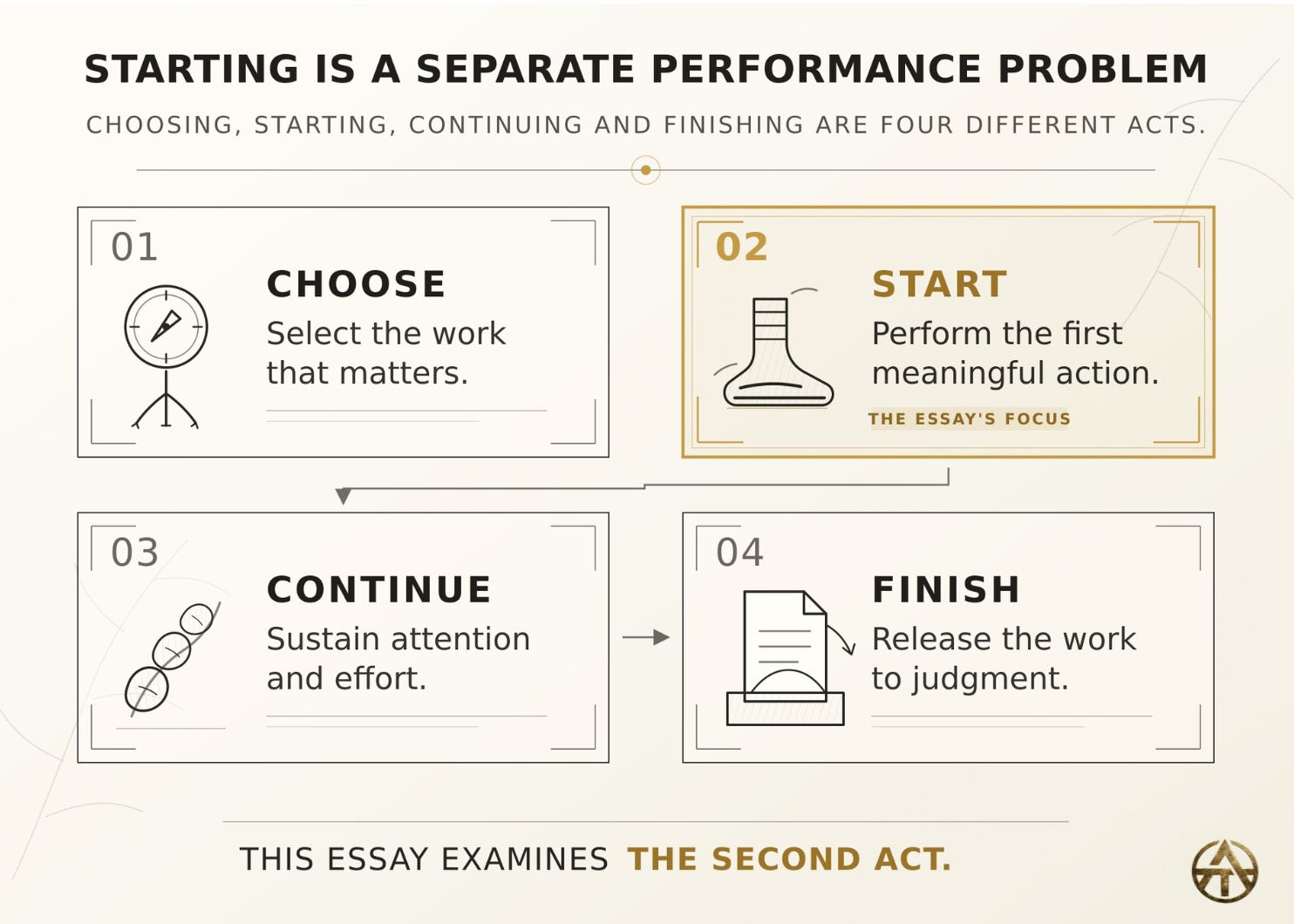
Choosing, starting, continuing and finishing are four different acts.
You can choose the right task and fail to begin it. You can begin quickly and fail to continue. You can work for hours and refuse to finish because completion exposes the work to judgment.
This essay owns the second problem: the moment between knowing what matters and performing its first meaningful action.
St Augustine described the mystery with extraordinary precision more than sixteen centuries ago. The mind commands the hand and the hand moves. Yet the mind commands itself and meets resistance. St Paul gave the deeper spiritual conflict its own language in Romans: the will can recognise the good without carrying it into action.2
Neither man was writing a productivity manual. To reduce their words to a work hack would be absurd. They were speaking about the divided human will, sin, habit and the need for grace.
Yet their observation reaches directly into the modern workday.
A person can know.
A person can sincerely intend.
And still the hand does not move.
Modern research illuminates parts of this problem without exhausting it. Piers Steel’s large review found task aversiveness among the more consistent predictors of procrastination. In a seven-day study of 88 university students, greater task ambiguity was associated with a higher risk of postponing intended study sessions. Across 94 independent tests, specific if-then plans improved goal attainment and helped people initiate action, although complementary work showed that such plans did not manufacture commitment to a goal that was weakly held.3
No study can tell you why you are avoiding this task today.
But the evidence makes one conclusion harder to defend: that every failure to begin is proof of laziness.
“Lazy” is a verdict on the person.
Start friction is a question about the threshold.
Responsibility begins by telling the truth about which one you are facing.
The five costs hidden inside “I don’t feel like it”
Popular advice tells us to set a timer, break the task down, put the phone away or start before we feel ready. These methods work when they meet the right problem. A timer does not clarify ambiguity. A detailed plan does not restore a depleted body. Removing the phone does not make an unworthy task meaningful. More pressure can make threatening work harder to approach.
I have often used a small start in training. When energy is sparse, I take myself to the track, the gym or outside and say: It doesn’t matter if you can’t do the whole workout, just do the first few steps. Often the state changes and momentum carries me through. But the same push would be foolish if the real condition were illness, sustained overload or a higher duty that should govern the hour.
When you pay attention, everything becomes your teacher. Resistance is no exception. But a teacher can be misunderstood.
Choose one important task you have already decided should be done.
Do not choose your whole career, your health or the future of your marriage. Choose the document, conversation, training session, proposal or decision that is presently waiting.
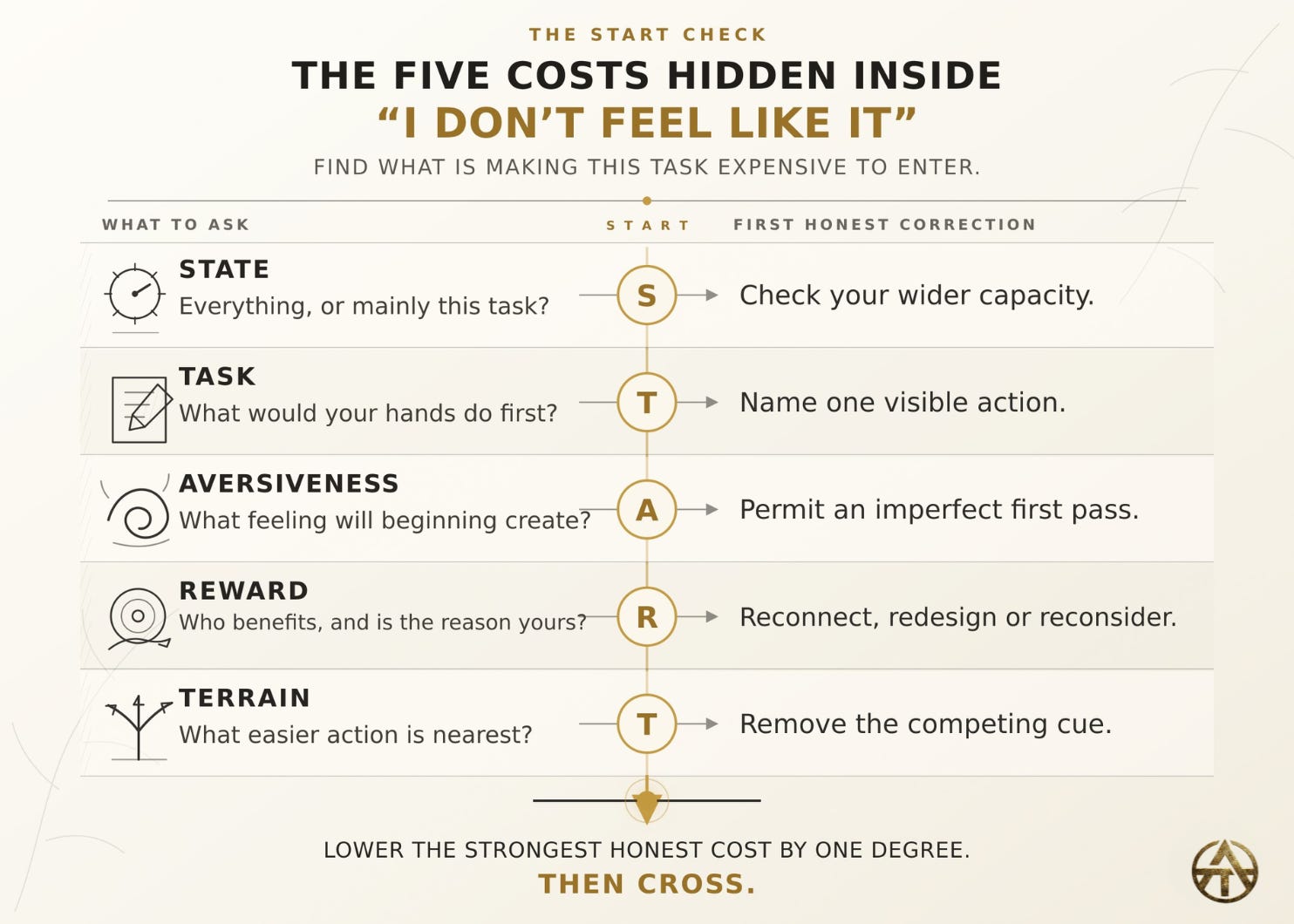
Then run what I call the START Check.
It is an Atlas synthesis, not a validated psychological test or a diagnosis.
State: Is almost everything difficult to begin today, or mainly this task? Look honestly at sleep, illness, accumulated load, stress, nutrition and present physical condition.
Task: If you had to begin within sixty seconds, what exact movement would your hands make? “Work on the proposal” is not an action. Opening the figures and writing the first three questions is.
Aversiveness: What will beginning make you feel? Boredom, uncertainty, frustration, exposure, shame, conflict or the fear of producing something inadequate?
Reward: What worthwhile result does the task serve, who benefits, and is the reason genuinely yours? Some work is difficult because its reward is distant. Some is difficult because it should be redesigned, delegated or refused. Other work remains a duty because someone is depending on you.
Terrain: What easier action is already within reach? The open inbox, the flashing notification, the safer task and the unfinished conversation are not neutral. Your environment is offering the mind somewhere easier to go.
The question that creates the strongest honest resistance is a useful first place to investigate.
Then lower that cost by one degree.
If the task is unclear, define one visible physical movement.
If the emotional cost is high, permit a private and deliberately imperfect first pass.
If distraction is nearest, remove the nearest competing action.
If capacity is low across everything, examine the wider pattern instead of converting it into a character accusation.
If the reason is weak, reconnect the task to the person or purpose it serves. If no worthy reason survives repeated examination, question whether the task should exist.
Do not attempt to repair all five costs before you begin. Ambitious people can turn even self-understanding into a sophisticated form of avoidance.
Make the smallest honest correction.
Then cross.
“Stop intellectualising and do the work”
The hard-edged objection is obvious.
You are giving procrastinators five new excuses. Stop negotiating and do the work.
There is truth in that objection.
Some tasks are unpleasant and still necessary. A promise does not cease to be a promise because the mood changed. A client, child, spouse, colleague or reader may be depending on what you said you would do. Discomfort is not an unquestionable command. Duty is real.
My own relationship with decision is severe in this respect. When I decide to do something, that decision carries me half the way there. I open the posture of the body, root attention in the action, keep emotion in the present moment and refuse to allow the mind to drift freely into negotiation.
For me, a decision to move is not complete until it contains certainty in taking the action.
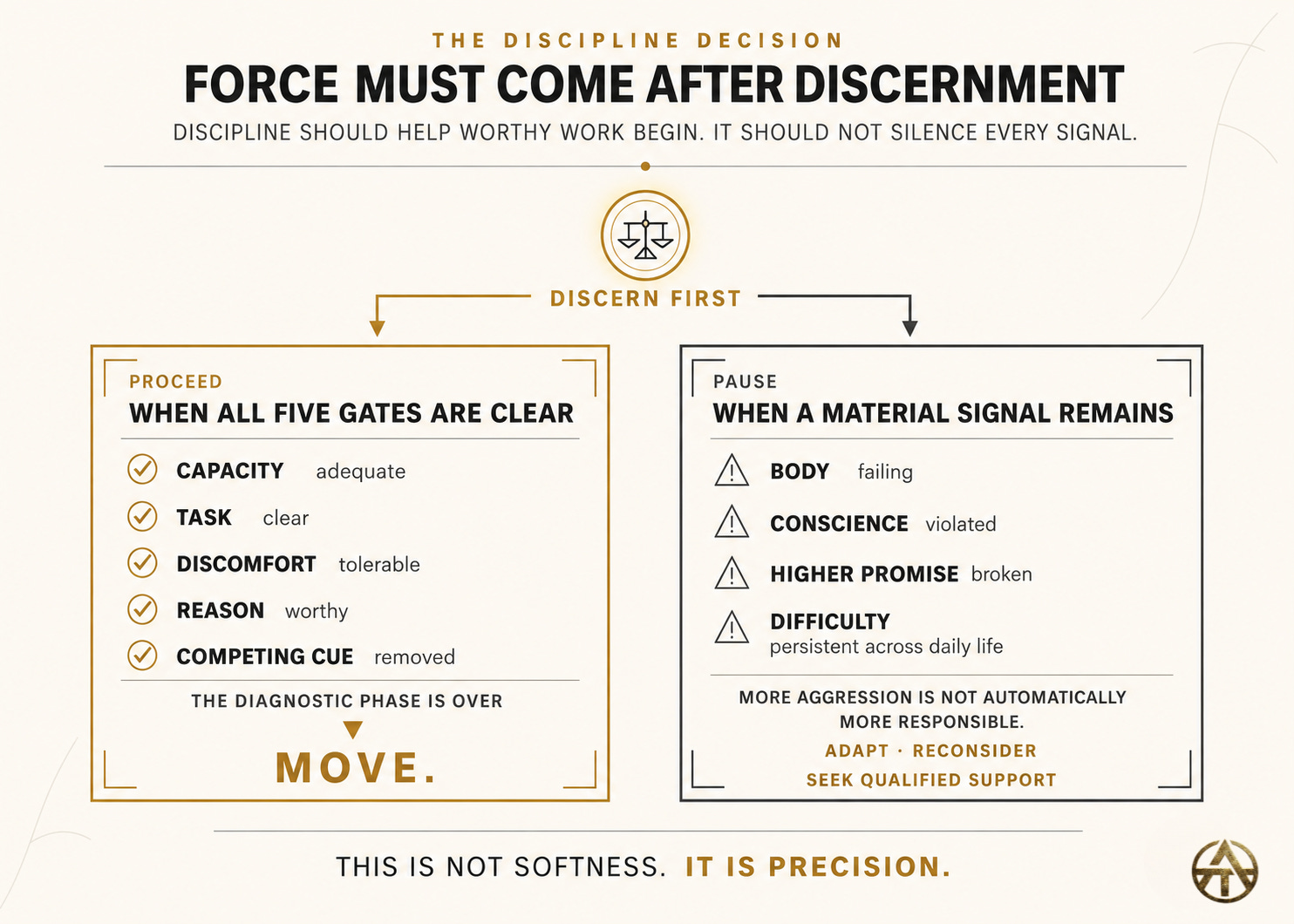
But force must come after discernment, not instead of it.
If capacity is adequate, the task is clear, the discomfort is tolerable, the reason is worthy and the competing cue has been removed, the diagnostic phase is over.
Ordinary resistance has not earned another meeting.
Move.
But if the body is failing, the task violates conscience, the demand breaks a higher promise or the difficulty is persistent across daily life, more aggression is not automatically more responsible. Persistent difficulty concentrating or completing ordinary tasks, especially alongside meaningful changes in mood, sleep or functioning, may deserve qualified support rather than another productivity slogan.4
This is not softness.
It is precision.
Discipline should help worthy work begin. It should not silence every signal indiscriminately.
The work that never enters the world
Failed initiation costs more than output.
The untouched task expands until it occupies the evening. The mind keeps paying attention to work the hands have not begun. Family receives the residue of a conflict that appears to be happening at a desk. Creative and commercial assets remain ideas. Repeated self-accusation consumes the very capacity needed for action. Eventually, a person stops trusting his own promises.
And service is delayed.
The message not sent cannot open a relationship. The proposal not written cannot solve a problem. The difficult conversation not begun cannot restore trust. The insight kept in the mind cannot help the person who needs it.
There is no higher calling than being of service.
This does not mean your value rises when you produce and falls when you fail. Nothing could be further from the truth. Your value as a human being, the value of your soul, does not depend on an achievement, possession, title or another person’s recognition. In the Christian understanding that governs my life, human worth is given by God. It is not awarded by the market.
But given worth does not remove entrusted responsibility.
Your worth is not waiting at the end of the task.
Someone else’s good may be.
On Monday
The START Check can help you identify the cost that deserves attention first.
It cannot yet give you the complete matched response for each barrier, tell you how to structure the first ten minutes, show you what to measure for seven days or decide when to persist, adapt, redesign, reconsider or seek help.
On Monday, paid subscribers will receive the complete First 10-Minute Start System:
the five START response lanes;
a First 10-Minute Contract;
an if-then launch cue;
a complete worked example;
a seven-day Start Scorecard; and
exact rules for continuing, adapting, redesigning, delegating, removing or escalating.
The purpose is not to give you more motivation.
It is to help you find what is making this task expensive to enter, lower the right cost and begin without waiting for the perfect mood.
For now, imagine a seed held inside a closed hand.
It has lost none of its value. It may contain a great oak. But while it remains protected in the palm, it gives no shade, no shelter and no fruit. Its hidden life cannot serve anything beyond itself.
At some point, the hand must open.
The seed must enter the dark earth.
The beginning does not create its value.
It is how that value enters the world.
Augustine of Hippo (1887) Confessions, Book VIII, Chapter 9, section 21. Translated by J.G. Pilkington, in Schaff, P. (ed.) Nicene and Post-Nicene Fathers, First Series, Vol. 1. Buffalo, NY: Christian Literature Publishing Co. Available via New Advent (Accessed: 12 August 2026).
The Holy Bible, King James Version, Romans 7:18–19. Available via Bible Gateway (Accessed: 11 August 2026).
Steel, P. (2007) ‘The nature of procrastination: A meta-analytic and theoretical review of quintessential self-regulatory failure’, Psychological Bulletin, 133(1), pp. 65–94. https://doi.org/10.1037/0033-2909.133.1.65; Wieland, L.M., Hoppe, J.D., Wolgast, A. and Ebner-Priemer, U.W. (2022) ‘Task ambiguity and academic procrastination: An experience sampling approach’, Learning and Instruction, 81, article 101595. https://doi.org/10.1016/j.learninstruc.2022.101595; Gollwitzer, P.M. and Sheeran, P. (2006) ‘Implementation intentions and goal achievement: A meta-analysis of effects and processes’, Advances in Experimental Social Psychology, 38, pp. 69–119. https://doi.org/10.1016/S0065-2601(06)38002-1; Sheeran, P., Webb, T.L. and Gollwitzer, P.M. (2005) ‘The interplay between goal intentions and implementation intentions’, Personality and Social Psychology Bulletin, 31(1), pp. 87–98. https://doi.org/10.1177/0146167204271308.
National Institute of Mental Health (2025) ‘My Mental Health: Do I Need Help?’ Revised 2025 (Accessed: 11 August 2026); Centers for Disease Control and Prevention (2026) ‘ADHD in Adults’ Reviewed 30 July 2026 (Accessed: 12 August 2026).