


We were sitting on a bench in a beautiful park on an autumn day when he told me about the day his career ended.
He was a man I knew and respected. He had been extraordinarily successful, highly compensated, and trusted with serious responsibility. He had also tried to help me when I was finding my own way early in my career.
He was not an unreflective man. He thought deeply about life. But, like many of us, he kept doing what was in front of him.
The work was demanding. The pressure was relentless. Important family moments passed while he was somewhere else, closing the deal, carrying the responsibility, meeting the next expectation.
I did not attend his retirement celebration. He described it to me on that bench.
People gathered. They honoured him, shook his hand and marked the end of an exceptional career. Yet as he looked around the room, he felt something he could not ignore. The event seemed mechanical. The people around him were already absorbed in the demands of their own lives.
Listening to him, I could only think of the absence of love in their eyes.
He lowered his own eyes as he spoke. I remember the resignation in his face. What was gone was gone.
It was as though years of effort, sacrifice and irreplaceable human moments had been poured into a black well. The well had accepted everything. It could return the money, the reputation and the ceremonial recognition.
It could not return the years.
A successful career is not a failed life
It would be unfair to turn this man into a cautionary prop.
His work mattered. He created livelihoods. He led people, formed relationships and helped produce value on a scale few people ever will. Work can be a genuine source of purpose, belonging, identity and service.1
He also retired with enough money to live extremely well.
The question is not whether his life was meaningful. I am not entitled to make that judgment.
The question is whether money at the end can compensate for time that had a different value when it was lived.
What is a year in your mid-forties worth compared with a year in your mid-sixties?
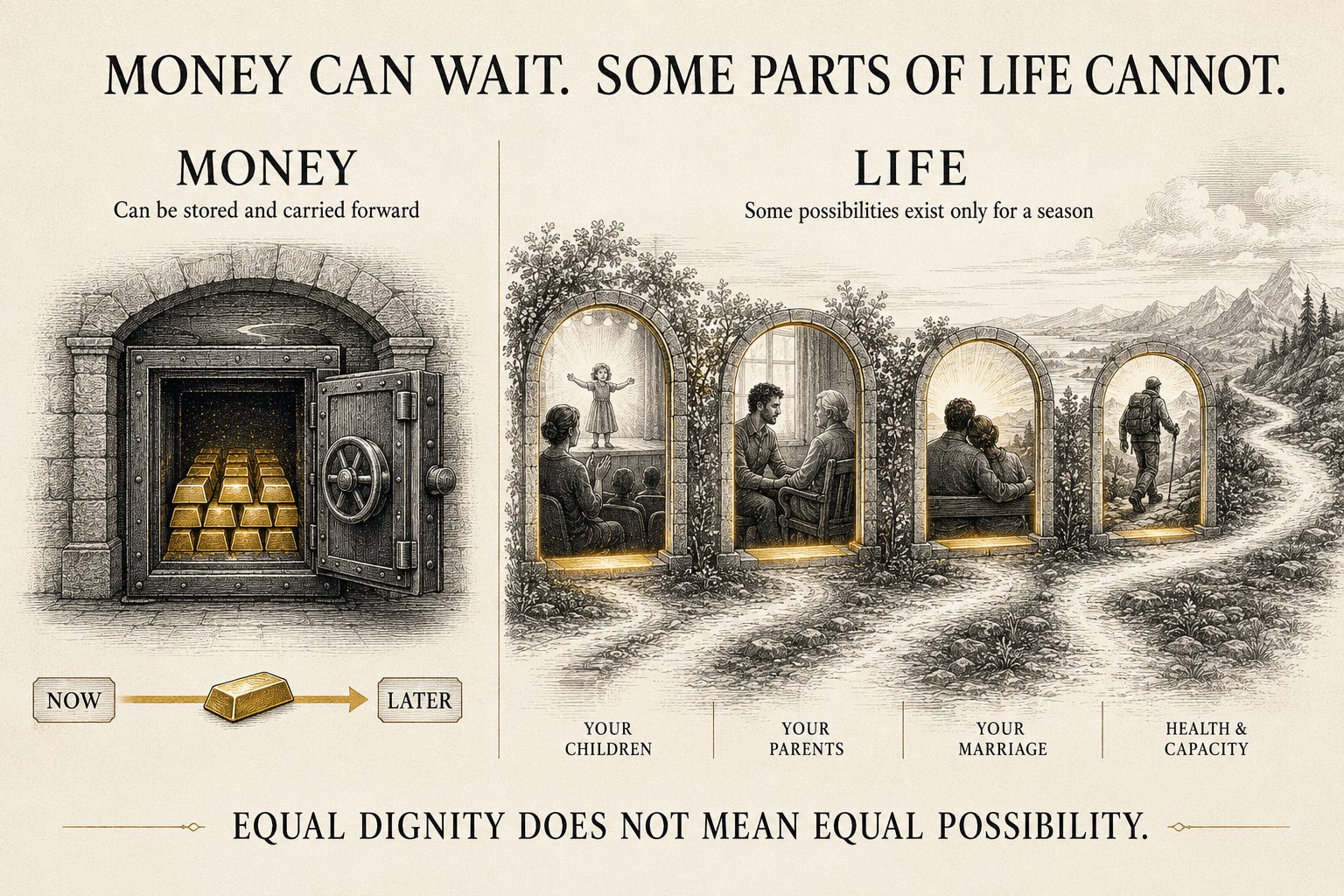
This does not mean that later life is less valuable. The soul does not lose value with age. But years of equal dignity do not contain equal possibilities.
Your child will have only one first play. Your parents will not remain at their present age. A marriage cannot be sustained indefinitely on whatever energy work leaves behind. Health, physical capacity, risk tolerance and opportunity change. Some experiences can be postponed. Others vanish with the season in which they were possible.
Research supports part of this distinction without being able to measure its full human meaning. People who experience greater time affluence tend to report greater well-being, while working more hours than people would prefer is associated with lower job and life satisfaction.2
Warren Buffett once compared indefinitely postponing the work one truly wants to do with “saving up sex for your old age”.3
The language is deliberately provocative. The principle is exact.
Money can be stored.
Life cannot.
The answer is not reckless escape
Is the solution to quit your job tomorrow in the hope of “living your dream”?
That is just silly.
A person may have children, a mortgage, ageing parents or others who depend upon them. Their job may provide more than money. It may provide relationships, mastery, dignity and a place to perform deeply meaningful work.
Leaving without evidence, runway or a viable alternative is not sovereignty. It may simply exchange one form of dependence for another, more frightening one.
Nor does self-employment automatically create freedom. If every sale, decision and hour of delivery still depends upon you, you may own the company while the company owns your life.
There is a more responsible path. Research on hybrid entrepreneurship shows that people often begin building a venture while remaining employed, using that period to learn before assuming greater risk. Those who later entered full-time entrepreneurship through this incremental route showed better venture survival than people who moved directly from employment into self-employment.4
This does not mean everyone should build a company.
It means the choice is not limited to permanent dependence or an irresponsible leap.
He was his own man
Relatively early in his life, my father made a different choice.
He held a senior position and was earning extremely well. But the environment did not meet his standards of dignity, principle or human association. Remaining would have been easier financially.
He left.
He built an auditing firm in Cyprus. It was not effortless. There was risk, uncertainty and significant pressure. The first years of creating something are often the most demanding because the work carries its full cost before the system has acquired momentum, proof or reputation.
But he was his own man.

That did not mean he was free from responsibility. It meant he could decide what kind of work he would accept, whom he would work with and the standards by which the work would be done. He could refuse what violated his principles. He could build around service rather than making money the only authority in the room.
His integrity became the foundation of the business.
People recommended him because they trusted him. The firm became respected. Years later, people would hear my name and ask, “Are you Elias Tsiartas’s son?”
Money followed, but that is not the deepest lesson he left me.
He showed me that choosing principle over immediate advantage does not require rejecting prosperity. Service, reputation, ownership and wealth can reinforce one another when they are placed in the correct order.
Build something useful that remains
The familiar advice is to find the meeting point between four questions:
What do you care about enough to practise for years?
What can you do, or learn to do, exceptionally well?
What do people genuinely need?
What will they support financially?
All four matter.
“Do what you love” is incomplete advice. We do not live alone. We are relational beings. Meaning deepens when ability becomes useful to another person. The market does not owe us a living merely because we enjoy an activity.
But even useful, skilful and well-paid work leaves one more question unanswered:
What does this work leave behind?
Most of us must exchange time for money at the beginning. The decisive distinction is whether every future unit of value will require another equivalent unit of our time.
There is no such thing as passive income in the way the phrase is normally sold.
A book may take years to write and still require distribution. Software requires development, security, support and improvement. A firm needs people, systems, judgment and stewardship. Property requires capital, diligence and maintenance.
But each can be built so that value continues beyond the original hour.
That is the relevant feature of an asset. It does not eliminate effort. It changes the relationship between effort, value and time.
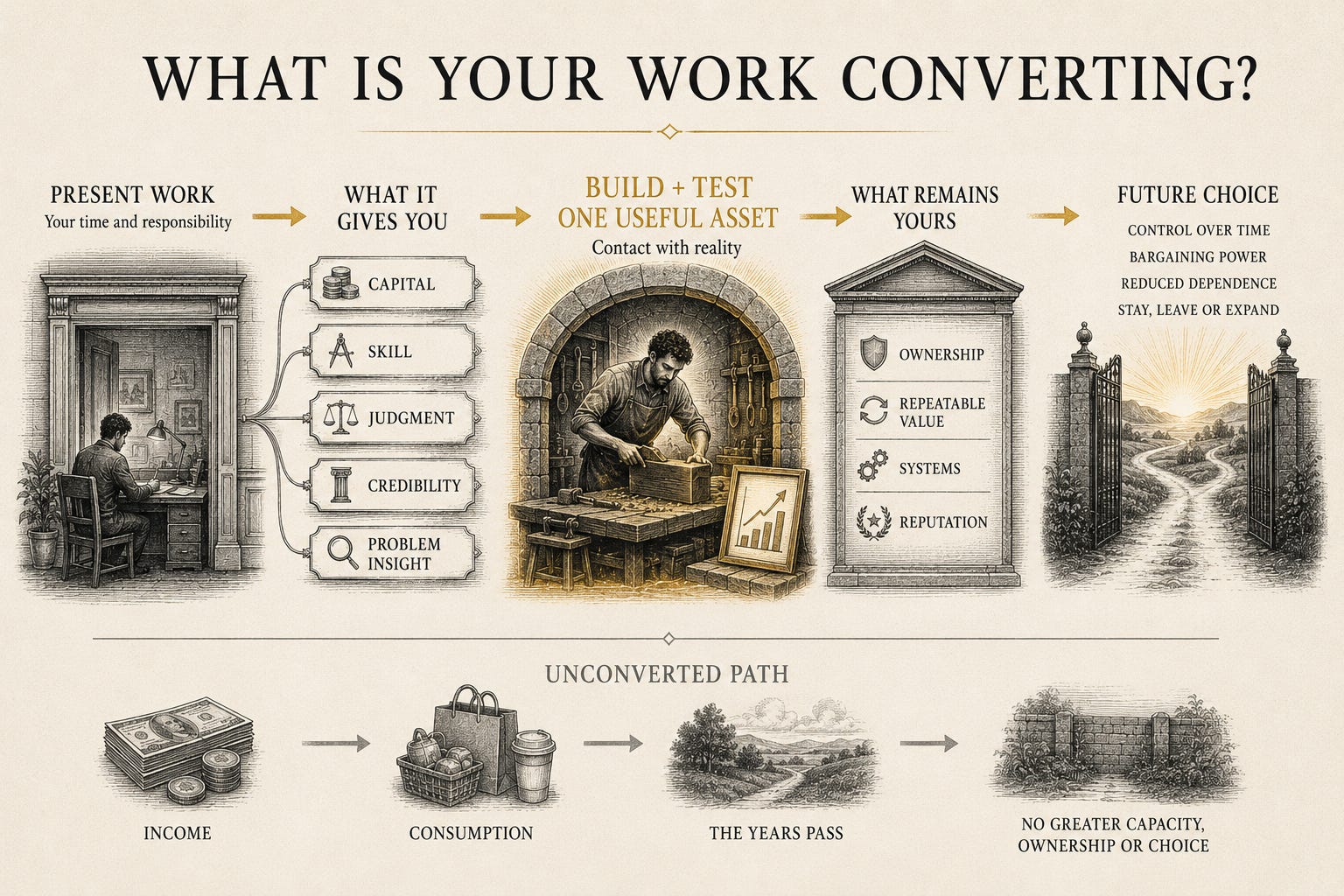
A salary can help fund such an asset. A job can develop the skill, judgment, credibility and understanding from which it grows. Employment can be the runway rather than the enemy.
The problem begins when income is consumed, the years pass, and nothing is being converted into greater capacity, ownership, or choice.
Ask what your work is converting
Before you start a side hustle, buy a course, or resign from anything, answer these seven questions:
What does my present work pay me now?
What does it teach or give me that will remain mine?
What is it costing elsewhere in my life?
What useful problem am I unusually positioned to understand or solve?
What could I build or own that preserves value beyond the original hour?
What maintenance, capital, and risk would still remain?
What future choice is this meant to create?
Do not start five projects.
Choose one problem, one kind of person who genuinely experiences it and one small asset hypothesis that could be tested without abandoning your present duties.
Do not ask first whether the idea expresses you perfectly.
Ask whether it is useful.
Then bring it into contact with reality.
The golden road
There is a saying that we must make our own mistakes.
Sometimes that is true. Some lessons enter us only through experience.
But human beings possess another power. We can learn from the mistakes and successes of others. We can receive judgment from years we did not personally have to lose.
That is a human superpower. It is a golden road.
The man on the London bench taught me that extraordinary financial success cannot purchase an earlier version of your life.
My father taught me that principle, service, ownership and wealth do not have to be enemies.
Neither life tells you to resign tomorrow.
Together, they ask whether the way you work today is building the future you actually want to inhabit.
I often imagine the final moments of my own life.
I see myself somewhere beautiful in the mountains, looking back on the love I experienced, the people I served, the work I created and the moments I was present enough to receive. I see my wife, my children, my parents and the people whose lives crossed mine.
I do not want to discover that I postponed what was most valuable until the season for living it had passed.
I want to know that I have not left my song unsung.
That I made choices which elevated people, remained faithful to what mattered, and made my soul flutter with joy.
That I have sung my song and fulfilled the meaning of my life with love and with service.
That is what greater control over time is for.

On Monday, I will publish How to Build Assets While Working a Full-Time Job. It contains the complete Work-to-Asset Plan for selecting one useful asset, testing demand, protecting your duties and deciding when to stop, persist or expand. Subscribe to receive it.
Rosso, B.D., Dekas, K.H. and Wrzesniewski, A. (2010) ‘On the meaning of work: A theoretical integration and review’, Research in Organizational Behavior, 30, pp. 91–127. https://doi.org/10.1016/j.riob.2010.09.001.
Kasser, T. and Sheldon, K.M. (2009) ‘Time affluence as a path toward personal happiness and ethical business practice: Empirical evidence from four studies’, Journal of Business Ethics, 84(Suppl 2), pp. 243–255. https://doi.org/10.1007/s10551-008-9696-1; Wooden, M., Warren, D. and Drago, R. (2009) ‘Working time mismatch and subjective well-being’, British Journal of Industrial Relations, 47(1), pp. 147–179. https://doi.org/10.1111/j.1467-8543.2008.00705.x.
Buffett, W.E. (2001) ‘Warren Buffett, Chairman, Berkshire Hathaway Investment Group | Terry Leadership Speaker Series’, guest lecture and Q&A at the University of Georgia Terry College of Business, 18 July. Video recording, 6:52–7:02, uploaded by Terry College of Business at the University of Georgia, 4 April 2011. Available at:
(Accessed: 6 August 2026).
Folta, T.B., Delmar, F. and Wennberg, K. (2010) ‘Hybrid entrepreneurship’, Management Science, 56(2), pp. 253–269. https://doi.org/10.1287/mnsc.1090.1094; Raffiee, J. and Feng, J. (2014) ‘Should I quit my day job? A hybrid path to entrepreneurship’, Academy of Management Journal, 57(4), pp. 936–963. https://doi.org/10.5465/amj.2012.0522.
👏🏻👏🏻