


You can be safe, and still feel hunted.
Nothing is happening, yet your shoulders are slightly raised. Your jaw is slightly set. Your mind is scanning for the next impact. You live through the day as if something is about to fall.
This is the modern sword. It does not need to touch you to ruin the meal.
In my last essay, I used Damocles to show the principle: you can sit in abundance and still be unable to taste, because threat cancels presence1.
This essay is the operating system.
Not inspiration. Not reassurance. Not “think positive.”
A one-page method to stop paying for tomorrow in advance.
The uncomfortable truth
Stress is not only what happens. Stress is what is represented.
The body mobilizes when homeostasis is threatened, or perceived to be threatened, and it does not require a physical tiger to do it2.
Your nervous system is designed to prepare before certainty, because a system that waits to be sure gets eaten.
The problem in modern life is frequency and duration. The stress response is activated too often, for too long, by threats that are cognitively present even when physically absent.
Brosschot and colleagues identified a central mechanism: perseverative cognition, the sustained cognitive representation of stress through worry and rumination, which prolongs physiological activation before, during, and after the event3.
In other words:
The meeting ends, but your body does not.
The message goes quiet, but your mind does not.
The bill is paid, but your nervous system does not receive the memo.
A large meta-analysis in healthy participants found that perseverative cognition is associated with measurable changes across systems, including higher heart rate and blood pressure, altered cortisol, and lower heart rate variability4.
You do not need drama to get damaged.
You only need a brain that keeps the sword present.
Why worry feels productive, and why it is not
Worry often feels like responsibility.
It carries an implied promise: if I rehearse the threat, I will suffer less when it arrives.
But rehearsal without conversion is not preparation. It is prolonged activation.
Uncertainty makes this worse. When the future is ambiguous, systems bias toward vigilance, threat estimation, and anticipatory arousal5.
So the mind tries to buy certainty with imagination. It paints the future darker than it may be, because a dark story feels more controllable than an unknown one.
That is why you can work hard, live well, and still feel wrong.
Your mind is gripping the horsehair.
The Threat Ledger
The Threat Ledger is a one-page system that does one thing:
It converts worry into one next action or a clean release.
No third option.
Because the third option is what destroys you: holding the threat in your mind all day, while doing nothing that changes it.
This method overlaps with public CBT tools like “worry time” and “worry trees,” but with tighter constraints and a sharper aim: reduce threat representation time outside scheduled action.6
The Ledger, five steps
Step 1: Name the sword.
Write the threat in one sentence. Specificity is the first reduction in load.
Bad: “Everything is falling apart.”
Good: “I am afraid I cannot cover expenses if March revenue drops.”
Step 2: Classify it.
Every worry is one of three categories.
Solvable problem: there is a real next action that changes the probability or impact.
Uncertain future: you cannot solve it now, but you can prepare within limits.
Unsolvable reality: you cannot change it, you can only respond with meaning, support, and acceptance.
Step 3: The control test.
Ask one question:
“What is one action I can take in the next 24 hours that meaningfully improves this?”
If there is an action, it becomes one next step, scheduled.
If there is no action, you do not rehearse. You contain.
Step 4: Convert, action or release.
If action exists, schedule it. Put it in your calendar. Add a start time.
If action does not exist, you use a worry window and a release practice.
Worry windows are a known technique in CBT self-help guidance: set a specific time to worry, and postpone worries outside that time.7
Your rule here is tighter:
Outside the worry window, you are not allowed to rehearse.
You are only allowed to capture the worry in the ledger.
Capture is not suppression. Capture is containment.
Step 5: Close the ledger.
End with a closing line that tells the nervous system the loop is complete.
Use a simple script:
“I have named the sword. I have chosen the next step or the release. I will not pay for this twice today.”
The worry window, done correctly
Most people fail this method because they turn it into a second rumination session.
So the worry window has constraints.
Time: 15 to 25 minutes.
Place: one chair, one location, not your bed.
Tool: ledger in front of you.
Output: every worry becomes either one next action or a release statement.
If a worry cannot produce action, it must produce a sentence of clean realism, for example:
“This is uncertain. I cannot solve it today. I will revisit it at my scheduled review.”
This is how you stop the mind from smuggling threat into every hour.
Three worked examples
Example 1: Money worry
Sword: “I am afraid cash flow will tighten and I will not be able to pay obligations.”
Category: solvable problem plus uncertainty.
Control test: “One action in 24 hours?”
Next action: “Send invoices today at 16:00, cut one discretionary expense, schedule a 30-minute finance review on Friday.”
Worry window output: “I will not run numbers at midnight. Review is Friday at 11:00.”
Example 2: Health uncertainty
Sword: “I am afraid this symptom means something serious.”
Category: uncertainty.
Control test: “One action in 24 hours?”
Next action: “Book appointment, write symptom notes, stop internet searching.”
Release statement: “I am not allowed to diagnose myself through fear.”
If the health fear is severe, persistent, or accompanied by panic, insomnia, or impairment, seek professional care. This essay is educational, not an alternative to medical treatment.
Example 3: Relationship silence
Sword: “They did not reply, I think I am being rejected.”
Category: uncertainty.
Control test: “One action in 24 hours?”
Next action: “Send one clean message, then stop checking.”
Release statement: “I will not build a story from absence.”
What will sabotage you
If you do not name failure modes, you will mistake them for responsibility.
1) Checking and reassurance-seeking
Refreshing messages, scanning bank accounts, googling symptoms, asking for repeated reassurance. It relieves you for minutes and trains the loop to persist.
2) Over-preparation
You call it diligence. Often it is fear in a suit. Preparing becomes a way to stay fused to the threat.
3) Doomscrolling
You call it staying informed. Often it is threat maintenance. It keeps the nervous system warm.
4) Using the ledger as a rumination tool
The ledger is not a diary of fear. It is a conversion tool.
If you write the same sword three days in a row with no action and no release, you are not doing the method. You are rehearsing.
The standard
Responsibility is not continuous apprehension.
High standards do not require a surveillance state.
A sovereign mind does two things:
It faces reality.
Then it stops paying for it all day.
So take one minute now.
Open a page.
Write the sword above your head.
Then write one next action, or one release sentence.
Close the ledger.
That is the rep.
Your next step
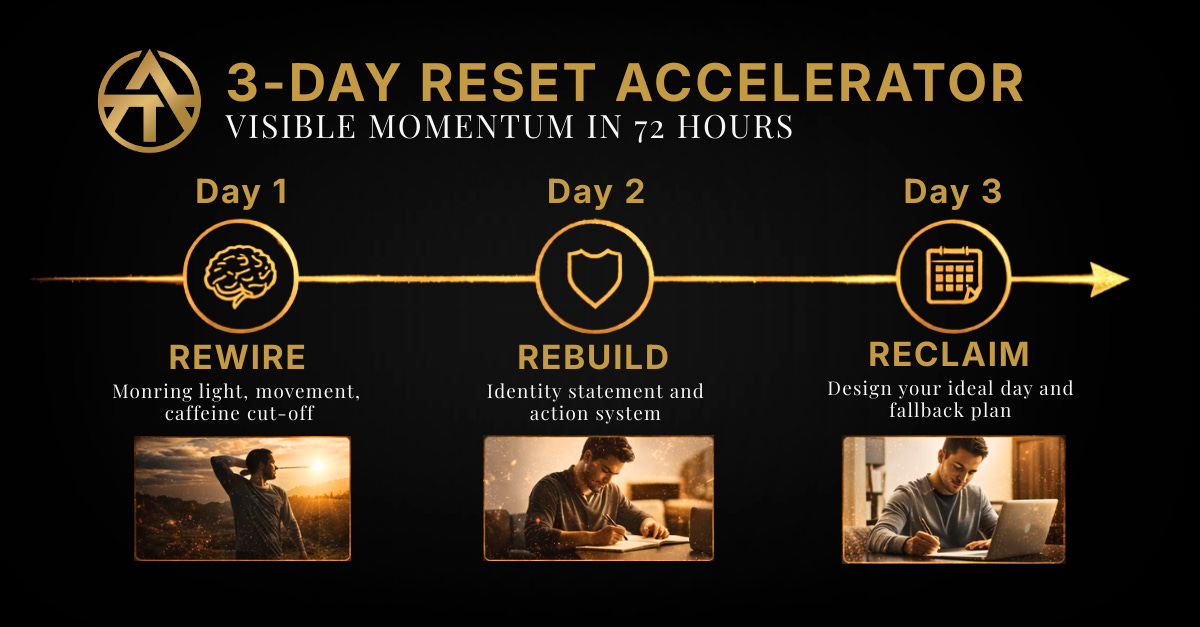
If you want this implemented with structure and momentum, start the World-Class Reset Accelerator, a 3-day guided reset with short videos, guided prompts, and a workbook, designed to create visible change in 72 hours.
What you do inside the 3 days:
Day 0, Setup: choose your primary pain point, lock your target, start clean
Day 1, Rewire: morning light, 10-minute movement, caffeine cut-off
Day 2, Rebuild: identity statement, fiction audit, 3-action plan
Day 3, Architect: ideal day design plus a fallback plan for chaos
7-day focus streak to keep momentum compounding after Day 1
And the tyrant can be dethroned.
Cicero, M.T. (45 BC) Tusculan Disputations. Translated chiefly by C.D. Yonge (1877). New York: Harper & Brothers.
Chrousos, G.P. (2009) ‘Stress and disorders of the stress system’, Nature Reviews Endocrinology, 5(7), pp. 374–381. doi:10.1038/nrendo.2009.106.
Ulrich-Lai, Y.M. and Herman, J.P. (2009) ‘Neural regulation of endocrine and autonomic stress responses’, Nature Reviews Neuroscience, 10(6), pp. 397–409. doi:10.1038/nrn2647.
Brosschot, J.F., Gerin, W. and Thayer, J.F. (2006) ‘The perseverative cognition hypothesis: a review of worry, prolonged stress-related physiological activation, and health’, Journal of Psychosomatic Research, 60(2), pp. 113–124. doi:10.1016/j.jpsychores.2005.06.074.
Brosschot, J.F. (2010) ‘Markers of chronic stress: prolonged physiological activation and (un)conscious perseverative cognition’, Neuroscience & Biobehavioral Reviews, 35(1), pp. 46–50. doi:10.1016/j.neubiorev.2010.01.004.
Ottaviani, C. et al. (2016) ‘Physiological concomitants of perseverative cognition: a systematic review and meta-analysis’, Psychological Bulletin, 142(3), pp. 231–259. doi:10.1037/bul0000036.
Grupe, D.W. and Nitschke, J.B. (2013) ‘Uncertainty and anticipation in anxiety: an integrated neurobiological and psychological perspective’, Nature Reviews Neuroscience, 14(7), pp. 488–501. doi:10.1038/nrn3524.
ABCT (Association for Behavioral and Cognitive Therapies) (2021) ‘Worry’. Fact sheet. Association for Behavioral and Cognitive Therapies.
NHS (2025) ‘Tackling your worries’. NHS Every Mind Matters.
ABCT (Association for Behavioral and Cognitive Therapies) (2021) ‘Worry’. Fact sheet. Association for Behavioral and Cognitive Therapies.
NHS (2025) ‘Tackling your worries’. NHS Every Mind Matters.