


What would you like your body to let you do?
It is a question worth answering before choosing your next training programme. Perhaps you want to spend a day exploring a new city and still feel ready to go out that evening. Perhaps you want to return to a sport you loved, carry your children while they still want to be carried, or reach your seventies with the strength to manage your own home.
These are things we train for, even when we have never written them into a training plan. They give physical development a purpose beyond the session itself. We are building the capacity to participate in our lives, and to keep participating as those lives change.
I believe this deserves far more attention than it receives. We can become very precise about what happens in the gym while remaining vague about what we want that work to make possible. We count kilometres, repetitions and calories. We compare programmes. Yet the question of whether our training serves the life we are trying to build can go unanswered.
The running-versus-lifting debate is a good example. It invites us to choose a side when what we need is a judgment: which physical qualities do I need, which am I neglecting, and how can I develop them within the life I actually have?
My starting point is to give strength a protected place in that life. Build it deliberately. Develop your endurance alongside it. Then judge the work by the capacity it gives you and your ability to keep doing it.
That requires us to understand what each kind of training contributes, and what we are asking of the person who has to recover from it.
The strength to take part
Consider carrying a suitcase up a flight of stairs. The suitcase weighs the same whether you are strong or weak, but the demand it places on you is very different. When the task uses most of the strength available to you, there is little room for anything else. Increase that strength and you create a greater margin between what the task requires and what you can do.
That margin is one of the most useful ways to think about physical development. It is the reserve that makes an ordinary demand more manageable and leaves you better prepared when the demand increases.
Resistance training gives us a direct way to build it. In its 2026 position stand, the American College of Sports Medicine brought together 137 systematic reviews. Compared with no exercise, resistance training improved strength, muscle size and power, alongside several measures of physical function. This is a substantial body of evidence for giving progressive strength work a regular place in our lives.1
The word progressive matters. As your capacity develops, the work must remain sufficiently challenging to continue developing it. Repeating the same comfortable effort indefinitely may preserve a habit without taking you much further towards the thing you want to do.
This becomes especially consequential as we grow older. Sarcopenia involves the loss of muscle strength and muscle mass, with consequences for physical function. Resistance exercise is a first-line treatment. The ability to rise from a chair, climb steps and carry what we need deserves deliberate care long before we are forced to think about losing it.2
Bone belongs in this discussion too. In the LIFTMOR trial, a supervised programme combining high-intensity resistance and impact training improved measures of bone density and physical function in postmenopausal women with low bone mass. The supervision, the combined intervention and the population matter when interpreting those results. They make a strong case for appropriately prescribed loading, rather than an instruction for everyone to begin lifting heavily tomorrow.3
For me, the attraction of strength is how much of life can make use of it. We encounter resistance whenever we lift, carry, push or pull. Giving strength a place in the week is a way of preparing ourselves for those encounters, including the ones we cannot predict.
There is pleasure in this as well. Being able to do something that once felt beyond you changes your relationship with it. A difficult task can become an ordinary one; something you used to avoid can become something you look forward to. That is a worthwhile return on the effort of training.
What endurance adds
Now imagine that the suitcase has reached the top of the stairs, but the day ahead involves several hours on your feet. The ability to produce force is only part of what you need. You also need the capacity to sustain activity.
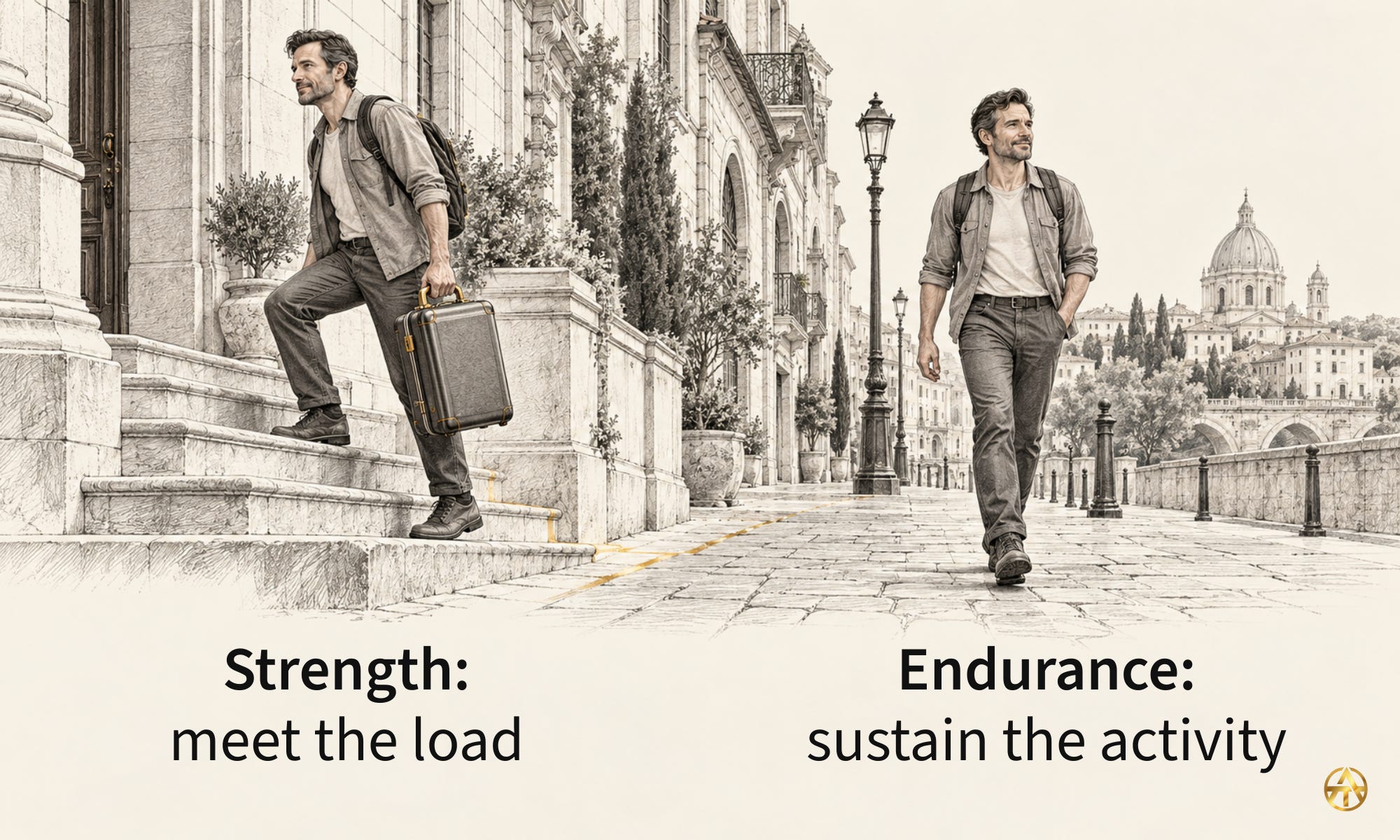
This is why the case for strength should lead us towards a fuller understanding of training. Endurance work develops qualities that matter in their own right. A long walk, a swim or a game that keeps you moving asks something different of you from a heavy lift. Becoming better prepared for one demand does not automatically prepare you equally well for the others.
The evidence gives us good reason to develop both. A 2026 umbrella review found that combined resistance and endurance training produced broadly comparable strength, power and muscle-growth outcomes to resistance training alone, while improving aerobic capacity more. Aerobic improvements were also comparable to endurance training alone. The authors' conclusion was especially relevant to recreationally trained people; evidence in highly trained and elite athletes remained limited.4
That does not mean every combination, at every dose, produces identical results. A 2022 review found that explosive-strength development could be reduced when the two forms of training were combined, particularly in the same session, even though maximal strength and whole-muscle growth were not compromised overall. If explosive performance is a priority, that distinction deserves attention.5
For someone who wants broad physical capability, however, the evidence offers encouragement. There is room to become stronger and fitter together. We do not have to treat every run as a threat to muscle growth.
The molecular language can make this seem more adversarial than it is. Resistance exercise stimulates processes involved in building muscle, including a signalling pathway called mTORC1. Endurance exercise stimulates adaptations that help muscles sustain activity, including changes in their energy-producing machinery. These processes interact, but they do not function as two opposing buttons, one of which simply cancels the other. We need to look at what the person actually develops across weeks of training.6
If you love running, run. The enjoyment, the time outdoors and the companionship may be important reasons to keep it in your life. Give it the place that serves you. Alongside it, ask whether you are also developing the strength and other capacities you will want to draw upon.
Equally, if you enjoy lifting but find sustained activity difficult, take that information seriously. A stronger body can still benefit from a better-developed capacity to keep moving.
Training happens inside a life
Training does not happen inside a laboratory. It happens inside a life.
The person doing the programme may also be raising children, building a business, caring for a parent or trying to finish work that has followed them home. They have to find time to eat, sleep and recover. Those circumstances belong in our thinking about training, because they belong to the person doing it.
It is tempting to separate them. We write down the exercises and assume that the rest will somehow take care of itself. Then, when the programme becomes difficult to sustain, we treat the difficulty as a failure of character.
Sometimes we do need more commitment. Sometimes we need to look more carefully at what we have committed to.
Research on psychological stress makes this relationship tangible. In a study of 31 students who trained with weights, higher stress was associated with poorer recovery of muscular force during the first hour after strenuous resistance exercise. It was a small study of a specific response, but it illustrates why life stress belongs in the training conversation.7
This is the recovery economy: the relationship between the work we ask of ourselves and the conditions that allow us to benefit from it. It is a useful way of thinking, provided we remember that the body is adaptable. We are developing capacity over time, rather than spending from a fixed allowance that can never grow.
The difficulty comes when we increase several demands together and pay attention to only one of them. Imagine adding longer runs and harder lifting while work expands, sleep contracts and meals become an afterthought. Each training session may look reasonable on its own. Together, in that week, they may be asking more than the person can usefully sustain.
Food is particularly easy to misjudge when exercise is treated mainly as a way to burn calories. The IOC's consensus on Relative Energy Deficiency in Sport describes the health and performance consequences that can follow prolonged or severe low energy availability: too little dietary energy relative to exercise expenditure. It concerns athletes, including men and women, and should not be used to diagnose an ordinary tired day. Its relevance here is the need to consider fuelling alongside the work being done.8
Exercise can also raise cortisol temporarily, with the response influenced by intensity. That observation alone tells us neither that the exercise is harmful nor that muscle is being lost. An immediate hormone response cannot settle whether your programme is serving you over months.9
We also need some precision when we talk about the nervous system. Reduced force after hard lifting and a change in heart-rate variability are different observations. Heart-rate variability gives us information about cardiac autonomic regulation; it does not measure the total strain of our lives. A review of that response cannot establish that every run places a greater burden on the nervous system than every lifting session.10
The practical question is more demanding than finding a hormone to blame. Are you developing the capacities you intended to develop? Can you sustain the programme? What has changed in the rest of your life since you decided this was the right amount of work?
We need enough honesty with ourselves to answer all three. An ambitious programme can require adjustment. So can an undemanding one that has become a comfortable ritual. The purpose is to find work that continues to develop us.
Train to success
I think of this as training to success. Begin with what the work is supposed to achieve, and let that guide the effort you put into it.
This matters because exhaustion is immediate and easy to recognise. Adaptation takes longer. You can leave a session feeling that you have given everything, and mistake the feeling for proof that you have trained well.
Resistance training offers a useful example. Reaching muscular failure means you cannot complete another repetition with the required technique. It can have a place in training, but every set does not have to end there to produce a result. The 2026 ACSM review found that training to momentary muscular failure did not consistently improve outcomes.11
A smaller trial makes the distinction concrete. Eighteen trained participants completed eight weeks of leg training. Stopping close to failure produced similar quadriceps growth to reaching failure, while the failure condition produced greater acute neuromuscular fatigue. That does not make an easy set equivalent to a challenging one. It shows why the extra fatigue at the end of a set needs to be considered in relation to what it adds.12
The same judgment extends beyond the final repetition. If the aim of a session is to develop a particular quality, changing it into a test of how much discomfort you can tolerate may change the work itself. There is satisfaction in effort, but we should understand what that effort is for.
Over time, success becomes more observable. You can perform the movement with greater control, handle a greater demand or sustain the activity more comfortably. The relevant measure depends on the purpose. We should also ask whether the improvement is reaching the part of life we hoped it would reach.
One goal, three different decisions
Suppose you want to enjoy a hilly walk on holiday, carrying a small pack. You want to reach the end pleasantly tired, with enough energy to enjoy the evening. This is a hypothetical example, but the way of thinking can be applied to many things you want to do.
Start with the demands of the activity: sustained walking, climbing and descending, carrying the pack, and managing the terrain. Then compare those demands with your preparation.
If you already walk regularly but do no strength work, simply adding more walking may leave an important gap. You might give progressive resistance training a place in the week while continuing your walks. The useful change is to develop a capacity you have been neglecting, using exercises and loads appropriate to your starting point.
Now consider a different starting point. You lift regularly, but rarely walk for long and become uncomfortably breathless on the climbs. Adding another lifting session may make you better at lifting while doing little to address the immediate difficulty. Your preparation needs sustained activity and progressively more relevant walking, including the terrain you expect to encounter.
A third person already does both, but has recently increased the running and lifting while sleeping less and eating poorly. Their usual sessions are getting harder, and performance is slipping. Before adding work, they need to examine the recent increases and the conditions around them. The next useful change may be to reduce a recent addition, restore regular meals and protect sleep. Persistent or unexplained symptoms deserve proper assessment rather than an automatic assumption that training is the cause.
The destination is the same in all three cases. The next decision is different because the starting point is different.
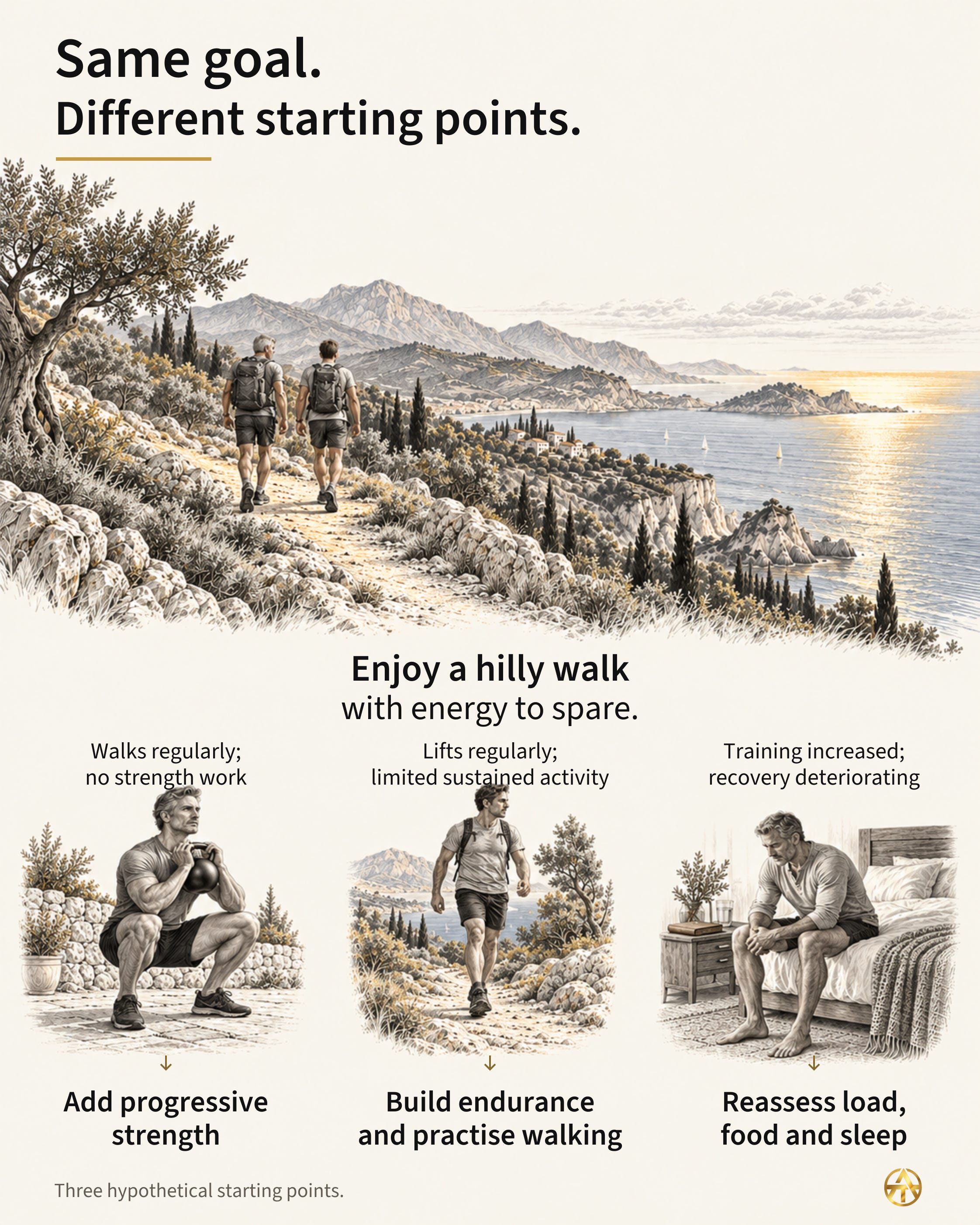
This is where discernment becomes practical. We stop asking which form of exercise deserves our allegiance and begin asking what the person in front of us needs to develop. When that person is ourselves, we also have to notice when our preferred activity is influencing the answer.
Before you add your next session, write down one thing you want your body to let you do. Be specific enough to picture it. “Get fitter” leaves almost every decision open. “Enjoy that hilly walk with a pack and still want to go out afterwards” gives your preparation a direction.
Then identify one gap your current training is leaving, and make one change that addresses it. Give that change a realistic place in the week. Track something relevant in training, and return to the activity itself to see whether it is becoming more manageable. A rising gym number is useful information; the ability to use that strength is part of the reason you wanted it.
A body you can live through
We cultivate our bodies because so much of what we love asks us to take part. There are places to explore, skills to learn, people to help and experiences we have yet to discover. Physical development gives us more capacity to meet them.
It deserves both ambition and judgment. We can want to become considerably stronger, fitter and more capable while thinking carefully about how to get there. We can enjoy demanding work and still expect it to serve a purpose. We can build a programme around the life we have while preparing ourselves for more of the life we want.
The walk on holiday is one expression of that. So is being able to carry something for someone you love, return to a game you have missed, or attempt a new skill with confidence in your preparation.
Build strength you can draw upon. Develop the endurance to keep participating. Give yourself the conditions in which that work can bear fruit.
Then make use of what you have built. Take the walk. Join the game. Enjoy the day you have prepared yourself to enjoy.
For paid subscribers on Monday: How to Get Stronger in the Week You Actually Have. The practical companion will help you arrange strength and endurance into a workable week, adapt it when life interrupts, and decide when to progress. A visual map will bring the complete protocol together so you can return to it quickly when planning your week.
Currier, B.S., D’Souza, A.C., Fiatarone Singh, M.A., Lowisz, C.V., Rawson, E.S., Schoenfeld, B.J., Smith-Ryan, A.E., Steen, J.P., Thomas, G.A., Triplett, N.T., Washington, T.A., Werner, T.J. and Phillips, S.M. (2026) ‘American College of Sports Medicine position stand. Resistance training prescription for muscle function, hypertrophy, and physical performance in healthy adults: An overview of reviews’, Medicine & Science in Sports & Exercise, 58(4), pp. 851–872. https://doi.org/10.1249/MSS.0000000000003897.
Hurst, C., Robinson, S.M., Witham, M.D., Dodds, R.M., Granic, A., Buckland, C., De Biase, S., Finnegan, S., Rochester, L., Skelton, D.A. and Sayer, A.A. (2022) ‘Resistance exercise as a treatment for sarcopenia: Prescription and delivery’, Age and Ageing, 51(2), afac003. https://doi.org/10.1093/ageing/afac003.
Watson, S.L., Weeks, B.K., Weis, L.J., Harding, A.T., Horan, S.A. and Beck, B.R. (2018) ‘High-intensity resistance and impact training improves bone mineral density and physical function in postmenopausal women with osteopenia and osteoporosis: The LIFTMOR randomized controlled trial’, Journal of Bone and Mineral Research, 33(2), pp. 211–220. https://doi.org/10.1002/jbmr.3284.
Held, S., Wolf, L., Rappelt, L., Bloch, W., Donath, L., Micke, F., Geisler, S. and Isenmann, E. (2026) ‘Maximizing adaptations in concurrent training: An umbrella review of meta-analyses’, Sports Medicine, 56(6), pp. 1489–1512. https://doi.org/10.1007/s40279-026-02401-y.
Schumann, M., Feuerbacher, J.F., Sünkeler, M., Freitag, N., Rønnestad, B.R., Doma, K. and Lundberg, T.R. (2022) ‘Compatibility of concurrent aerobic and strength training for skeletal muscle size and function: An updated systematic review and meta-analysis’, Sports Medicine, 52, pp. 601–612. https://doi.org/10.1007/s40279-021-01587-7.
Baar, K. (2014) ‘Using molecular biology to maximize concurrent training’, Sports Medicine, 44(Suppl. 2), pp. S117–S125. https://doi.org/10.1007/s40279-014-0252-0.
Stults-Kolehmainen, M.A. and Bartholomew, J.B. (2012) ‘Psychological stress impairs short-term muscular recovery from resistance exercise’, Medicine & Science in Sports & Exercise, 44(11), pp. 2220–2227. https://doi.org/10.1249/MSS.0b013e31825f67a0.
Mountjoy, M., Ackerman, K.E., Bailey, D.M., Burke, L.M., Constantini, N., Hackney, A.C., Heikura, I.A., Melin, A., Pensgaard, A.M., Stellingwerff, T., Sundgot-Borgen, J.K., Torstveit, M.K., Jacobsen, A.U., Verhagen, E., Budgett, R., Engebretsen, L. and Erdener, U. (2023) ‘2023 International Olympic Committee’s (IOC) consensus statement on Relative Energy Deficiency in Sport (REDs)’, British Journal of Sports Medicine, 57(17), pp. 1073–1097. https://doi.org/10.1136/bjsports-2023-106994. Corrected online in 2024: https://doi.org/10.1136/bjsports-2023-106994corr1.
Hill, E.E., Zack, E., Battaglini, C., Viru, M., Viru, A. and Hackney, A.C. (2008) ‘Exercise and circulating cortisol levels: The intensity threshold effect’, Journal of Endocrinological Investigation, 31(7), pp. 587–591. https://pubmed.ncbi.nlm.nih.gov/18787373/.
Michael, S., Graham, K.S. and Davis, G.M. (2017) ‘Cardiac autonomic responses during exercise and post-exercise recovery using heart rate variability and systolic time intervals: A review’, Frontiers in Physiology, 8, 301. https://doi.org/10.3389/fphys.2017.00301.
Currier, B.S., D’Souza, A.C., Fiatarone Singh, M.A., Lowisz, C.V., Rawson, E.S., Schoenfeld, B.J., Smith-Ryan, A.E., Steen, J.P., Thomas, G.A., Triplett, N.T., Washington, T.A., Werner, T.J. and Phillips, S.M. (2026) ‘American College of Sports Medicine position stand. Resistance training prescription for muscle function, hypertrophy, and physical performance in healthy adults: An overview of reviews’, Medicine & Science in Sports & Exercise, 58(4), pp. 851–872. https://doi.org/10.1249/MSS.0000000000003897.
Refalo, M.C., Helms, E.R., Robinson, Z.P., Hamilton, D.L. and Fyfe, J.J. (2024) ‘Similar muscle hypertrophy following eight weeks of resistance training to momentary muscular failure or with repetitions-in-reserve in resistance-trained individuals’, Journal of Sports Sciences, 42(1), pp. 85–101. https://doi.org/10.1080/02640414.2024.2321021.