

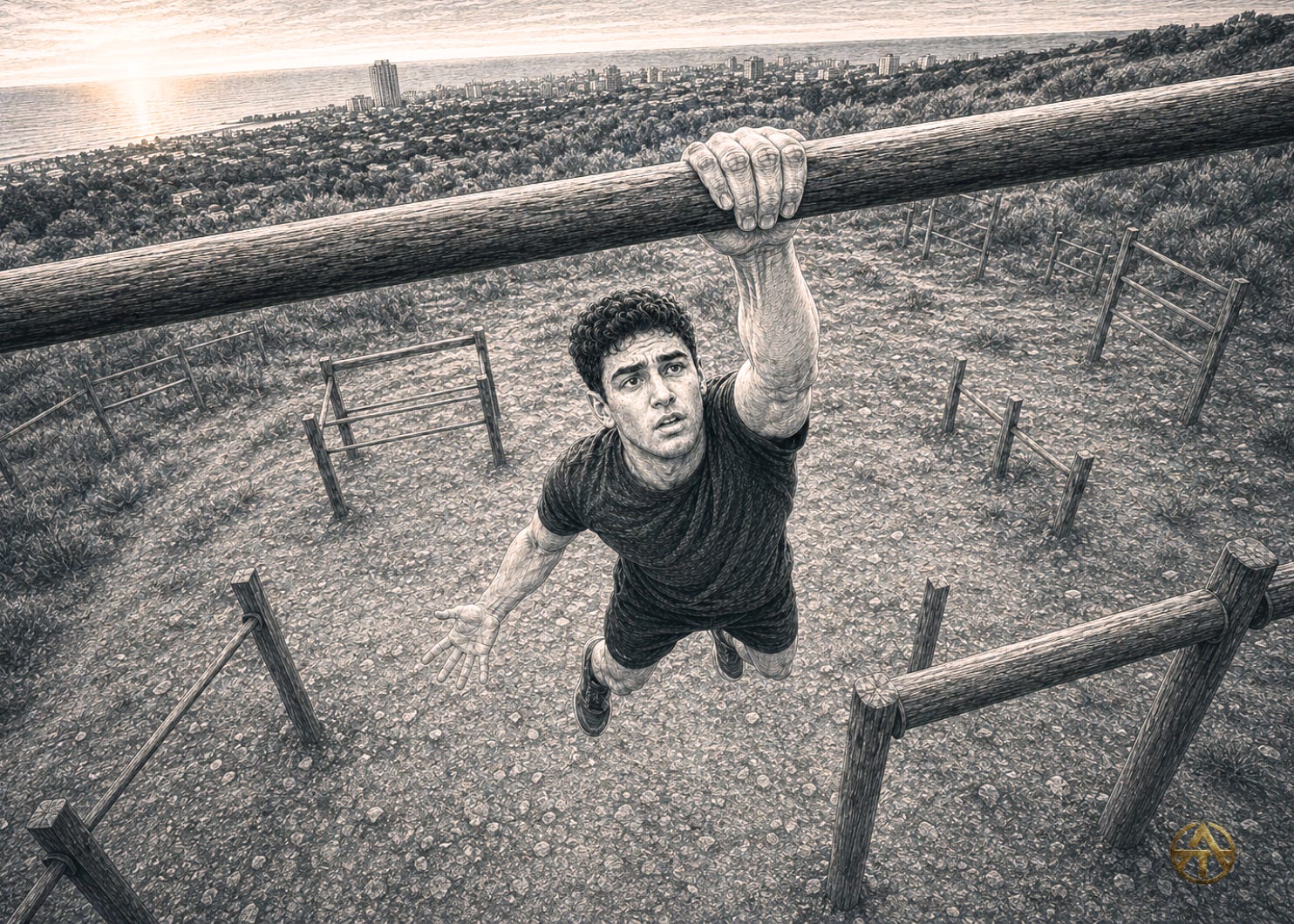
At seventeen, my right hand stopped obeying me.
I was high above the ground on an obstacle during a military assault course in Cyprus. My left hand was holding my entire weight. My right hand would not close.
I could have fallen.
I held on with my left hand and found my way down with whatever strength remained.
But my hand had not failed without warning.
For months, I had been preparing to enter the Cyprus equivalent of Basic Underwater Demolition training. It was the greatest challenge I had ever chosen.
I woke at five in the morning. I ran and swam before school. Afterward, I returned to intervals, strength training, and more intensity. Almost everything was pushed to the limit because I believed that the limit was where the result lived. I repeated this every day for months.
My physical capacity was already far beyond what entry required. I could perform more than fifty pull-ups, two hundred push-ups and swim seventy-five metres underwater on a single breath.
Discipline was not missing.
Neither was pain tolerance.
The pain did not arrive suddenly. It accumulated.
It spread across my joints, but became most disabling in my right elbow and arm. The inflammation and pain grew so widespread that I went from one medical investigation to another.
I had MRIs and underwent an extensive series of tests. Because doctors could not readily explain what was happening throughout my body, they investigated the possibility of rheumatoid arthritis.
The tests ruled it out.
But ruling out one diagnosis did not make the pain disappear.
I went to doctors and physiotherapists. I underwent treatments I remember as ultrasound and light-based therapies. I used anti-inflammatory gels. I received repeated injections intended to support my joints. I was given corticosteroids and non-steroidal anti-inflammatory medication.
I was not refusing to acknowledge that something was wrong.
I was desperately searching for solutions.
But every solution was being asked to serve the same unquestioned objective:
Keep me moving towards the course.
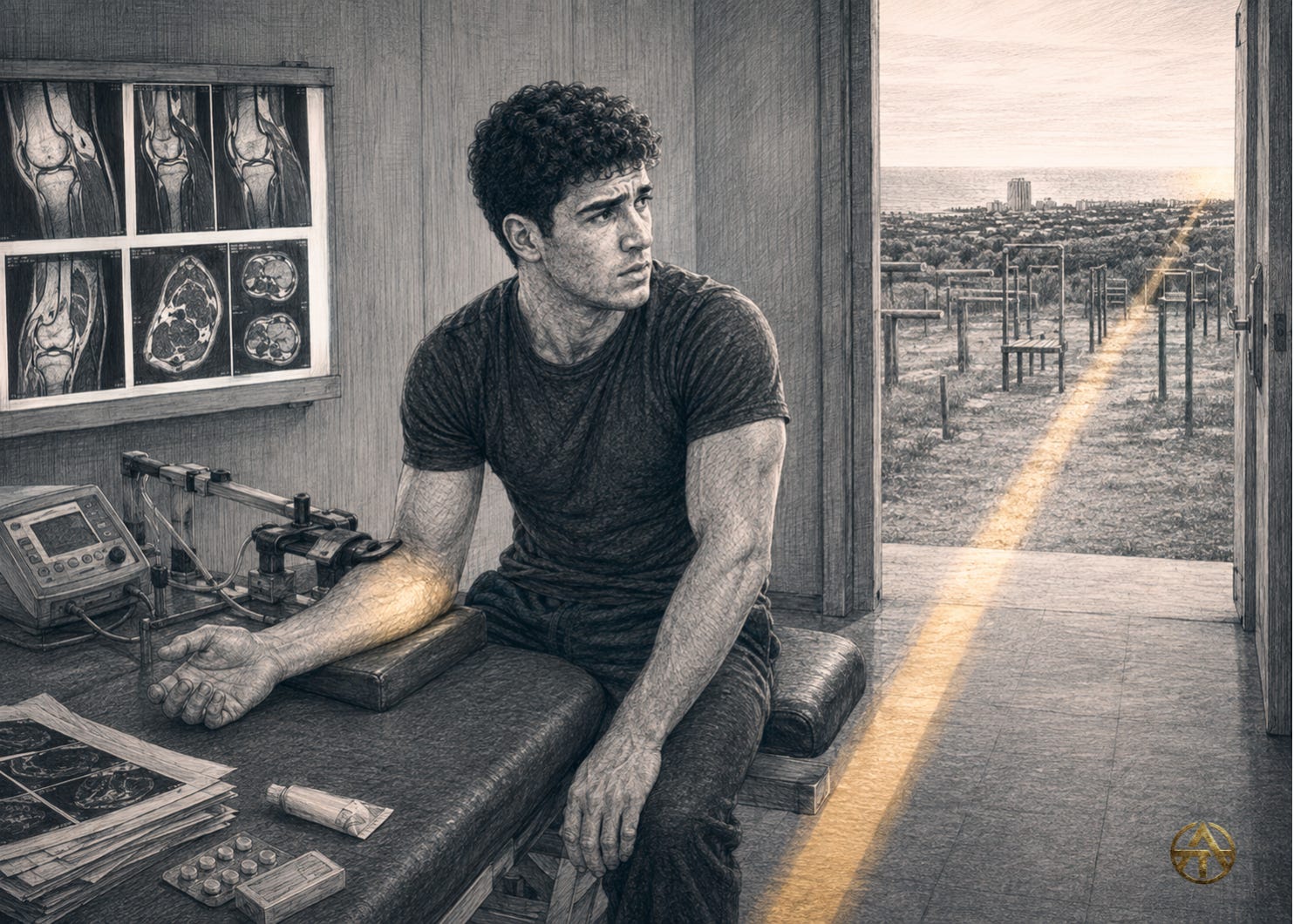
I was not asking whether my direction or preparation needed to change. I was asking how to reduce the pain, increase my tolerance and keep the plan alive.
The interventions helped me remain functional.
They did not make me recovered.
There is one small memory that reveals how much pain I had normalised.
During a school visit to a winery for wine tasting, my friends and I joked around and swallowed the wine instead of spitting it out. That was unusual for me. I was a purist. I would not ordinarily touch alcohol.
What stayed with me was not the feeling of becoming tipsy.
It was the brief respite from the constant pain.
For a few minutes, my body hurt less.
Then I returned to the same cycle of training, treatment, and force.
By the time I entered the military course, I was still relying on anti-inflammatory medication to keep my body operational. Then, high above the ground on that obstacle, my right hand finally stopped obeying me.
When I later told the lead instructor that I wanted to leave, he looked at me and said:
“Go away. We want men like you. You’re not going anywhere.”
Those words were not another demand to destroy myself.
They were recognition.
At a moment when I felt that the greatest dream of my young life was breaking, he saw something in me that he believed belonged there.
His words remain among the most meaningful ever spoken to me. In periods of darkness, I still return to them:
We want men like you.
He did not know what had happened to my hand on that obstacle. I had not explained the full severity of what was happening inside my body.
So I went back.
I returned because his faith in me mattered, because I did not want to show weakness, and because at seventeen I still believed that endurance could answer almost anything.
The error was not his.
It had begun months before I stood in front of him.
I had taken a body already capable of meeting the physical requirement and continued forcing it towards breakdown. Then I used every intervention I could find to preserve the plan instead of reconsidering what the plan required.
That is the danger ambitious people often fail to see.
It is not always that we reject guidance.
Sometimes we do not know that another category of guidance exists.
I understood effort.
I understood discipline.
I understood pain.
So I kept searching for larger quantities of what I already possessed.
The lead instructor’s words gave me something I still carry. But months earlier, my preparation had needed a different form of guidance: the judgement to recognise that the limiting factor had changed.
I had fire in abundance.
What I lacked was a governor for the fire.
That is the idea I want to give you today.
More effort cannot rescue a wrongly chosen target.
The wrong problem can absorb extraordinary strength
This is not an argument against hard work.
I have built too much, carried too much, and broken too much to tell you that difficult work is unnecessary. Hard work is often the price. But before you pay that price, you should know what you are buying.
Hard work applies force to a worthy objective through a method that can change it.
Wasted force increases the cost without changing the condition governing the result.
The difference is not how tired you become.
It is what the effort builds.
At seventeen, I believed I was increasing my capacity. In one sense, I was. I became fitter and better able to endure pain.
But I had already crossed the required physical threshold. What I needed was recovery, periodisation, experienced guidance, greater familiarity with the environment and a different kind of mental preparation.
Sports science describes the distinction clearly: training stress can produce adaptation, but excessive overload without adequate recovery can produce maladaptation (Meeusen et al., 2013).1
I kept improving a strength that was no longer the constraint.
That is how intelligent, ambitious people waste years.
Not because they are lazy.
Because they become extraordinarily good at solving the wrong problem.
There are two people reading this
One person stops whenever the work becomes uncomfortable. He negotiates with every promise, mistakes fear for intuition and keeps changing direction before reality has time to answer.
That person may need a severe message about effort. He may need David Goggins. He may need to learn that discomfort is not always danger and that a meaningful life cannot be built from permanent retreat (Goggins, 2018).2
But there is another person.
He wakes before the alarm. He works through grief. He trains through pain. He turns every warning into a test of character because being the person who never stops has become part of his identity.
Tell that person to push harder and you may not awaken him.
You may help him destroy himself.
Advice is medicine.
Medicine depends on the condition.
Some people need discipline to begin.
Others need discipline to stop.
Grit matters.
But grit is not God.
The question is not whether you are capable of more effort. You probably are.
The question is whether more of the same effort is still the correct answer.
Tactics let us move without deciding
When you do not know what to do next, tactics feel like relief.
You find another training programme. Another productivity system. Another investment. Another marketing format. Another way to explain yourself to the person you love.
Now you are moving again.
But movement can protect you from the more threatening question:
What is making the rest of my life harder?
You can see this everywhere.
In health, you add training, restriction and supplements when the first need may be recovery, a simpler plan or qualified medical assessment.
In work, you extend the day when the real problem is an unclear priority, the wrong position, a missing skill or work that should not exist.
In money, you add income activities when none of them solves a valuable problem deeply enough or stops the structural leak beneath them.
In a relationship, you add more explanation when the first need is attention, repair, steadiness, a boundary or changed behaviour.
Each tactic may be useful. That is what makes the trap difficult to see.
Your list can be full of good actions and still be governed by the wrong first action.
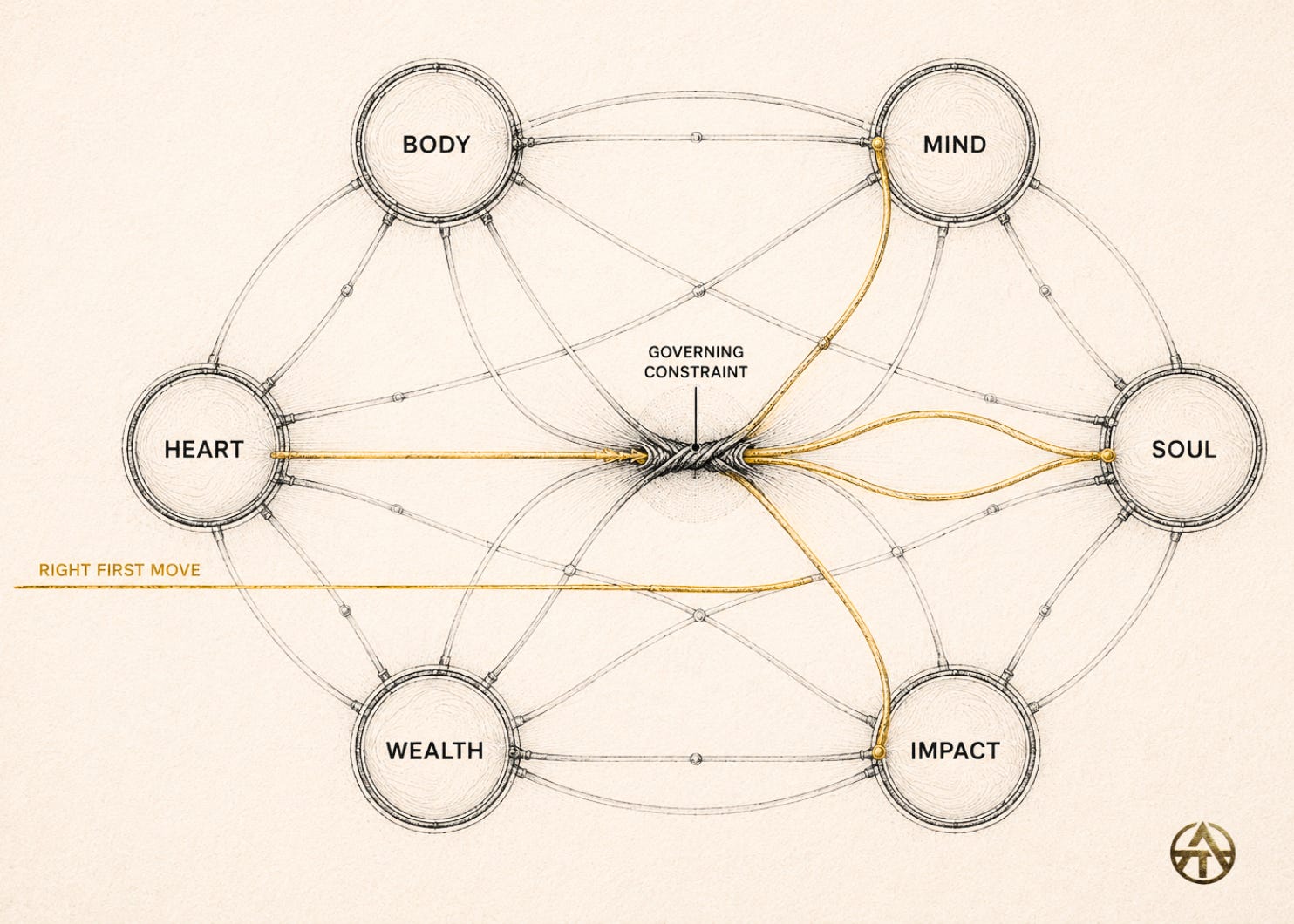
The body affects the mind. The mind affects the work. The work affects the money. The money enters the home. The home returns to the body.
Everything spills into everything else.
So the loudest symptom is not always the correct target. Sometimes it is only the place where another problem has finally become impossible to ignore.
Whole-Life Strategy is not doing everything.
It is knowing what governs what.
When more power tightens the rope
There is a moment at sea when power becomes the danger.
The engine is roaring. The throttle is open. The hull is shaking. Fuel is burning.
But the boat is not moving.
Beneath the surface, a rope has wound itself around the propeller.
The first instinct is to apply more power. The engine sounds stronger. The effort becomes more violent. Everything above the water suggests that the boat is trying harder.
But every turn of the propeller pulls the rope tighter.

More power does not overcome the problem.
It deepens it.
The correct action feels wrong to anyone who has learned to measure seriousness through effort.
Bring the throttle back.
Stop the engine.
Accept the silence.
Then find what is binding the propeller and cut it free.
Only after the obstruction has been removed can the same engine carry the boat forward.
This is what happens when you attack every problem with greater effort. You assume the result is resisting because you have not pushed hard enough.
But sometimes the system is not asking for more force.
It is asking you to remove the condition converting force into damage.
The engine did not need more power.
It needed the obstruction removed.
The right move did not replace the hard work.
It gave the hard work somewhere to go.
Find where your force is being lost
Take ten quiet minutes today. Choose one area where you are working hard but receiving little meaningful movement.
Then answer these three questions in writing:
Where am I spending the most force for the least meaningful movement?
What problem keeps appearing inside other problems?
What single first move could make two or three important things easier at once?
Do not ask which action looks most impressive.
Do not ask which one is easiest to measure.
Do not ask what the most disciplined person on the internet would do.
Ask what your evidence has been trying to show you.
Then choose one behaviour you will stop intensifying until you understand the answer.
That pause is not passivity.
It is the beginning of strategy.
Speed must answer to something higher
There is one final protection.
The fastest route is not automatically the right one.
If a strategy raises income by destroying health, family or conscience, the metric does not redeem it. If greater reach requires dishonesty, the reach is not Impact. If an impressive body is built through a practice that makes the rest of life smaller, appearance has conquered purpose.
No part of a serious life should finance another.
Money can be stored.
Life cannot.
In Christian terms, effectiveness must remain subordinate to faithfulness. “Seek ye first the kingdom of God” is not a productivity technique (The Holy Bible, KJV, Matthew 6:33).3
It is a hierarchy.
The good must govern the useful.
Love must govern force.
The destination must govern the speed.
Success must strengthen the life it is meant to serve.
On Monday, I will show you how to choose
The three questions above can expose wasted force.
They cannot yet tell you how to rank several plausible problems, protect what cannot be replaced, test your explanation or know when the evidence has turned against you.
That is what Monday’s paid essay is for.
I will give you the complete Right Action Plan: a practical method for examining the Six Primes, identifying the likely governing constraint, choosing one action for fourteen days, measuring its direct and wider effects, and deciding when to continue, adapt, stop or diagnose again.
By the end, you will have:
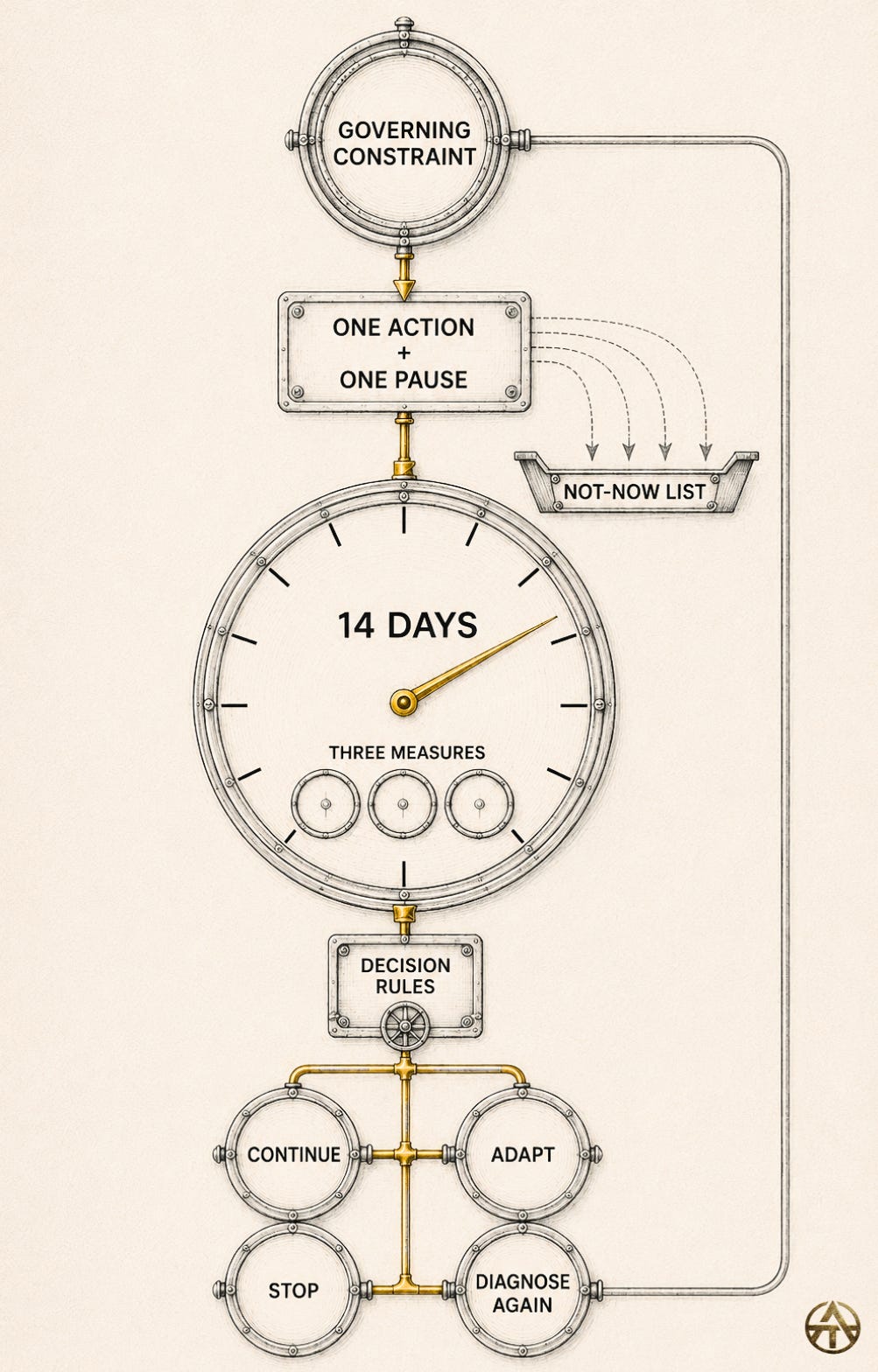
one action that deserves your next fourteen days;
one behaviour to pause;
three measures;
one not-now list; and
decision rules that keep pride from overruling evidence.
If you are tired of solving every problem with more of yourself:
I will walk you through the complete plan on Monday.
At seventeen, I thought the obstacle was the structure beneath me and the test was whether I could hold on.
I understand the scene differently now.
The real obstacle had begun months earlier, when I made more effort the answer before I had learned to ask the right question.
Do not wait until life removes your grip to reconsider what you are gripping.
Goggins, D. (2018) Can’t Hurt Me: Master Your Mind and Defy the Odds. Austin, TX: Lioncrest Publishing.
Meeusen, R. et al. (2013) ‘Prevention, diagnosis and treatment of the overtraining syndrome: Joint consensus statement of the European College of Sport Science and the American College of Sports Medicine’, European Journal of Sport Science, 13(1), pp. 1–24.
The Holy Bible (King James Version) (1611/1769) Matthew 6:33.