


The real loss is not that work makes you tired.
It is that work receives the capable version of you and your life receives what remains.
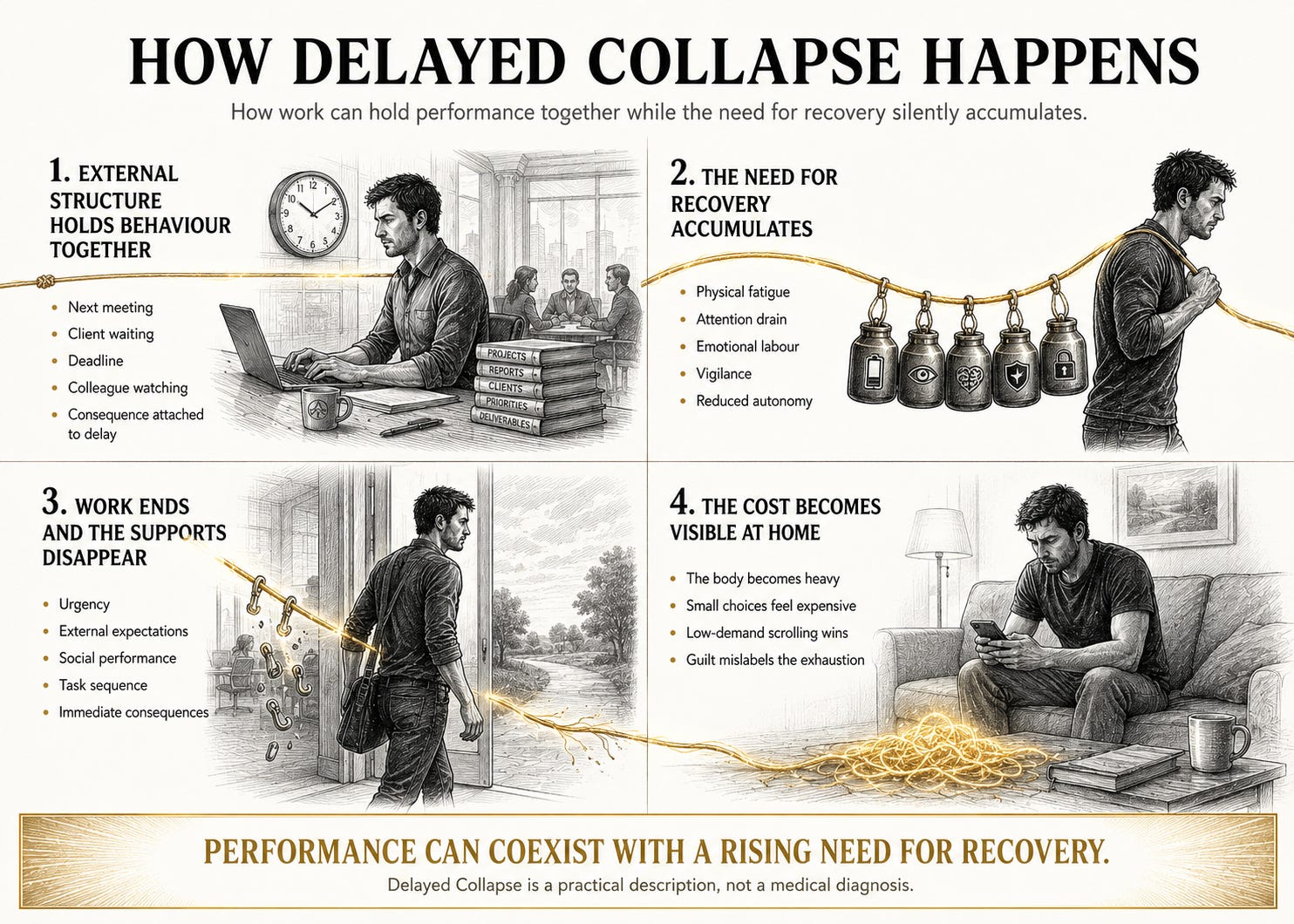
You function through the meetings. You answer the messages. You make the decisions. You remain polite, useful and composed.
Then you get home.
The body becomes heavy. The smallest choice feels irritating. Exercise, reading, conversation and even activities you normally enjoy feel strangely expensive.
So you sit down.
You scroll because scrolling asks less from you than beginning anything that matters.
Then guilt arrives.
You spent the day being competent for everyone else and now interpret your collapse as a personal failure.
The timing makes the exhaustion look voluntary.
It often is not.
After-work exhaustion can reflect work-induced fatigue, insufficient sleep or nourishment, mental saturation, emotional labour, residual activation, poor psychological detachment, or a workload the current system cannot recover from.1
The exhaustion may become most visible only when the immediate demands and external structure of the workday disappear.
I call that pattern Delayed Collapse.
It is not a medical diagnosis.
It is a practical description of something many capable people know intimately:
You remain functional while the role requires you. You discover the cost when the role releases you.
The first task is not to force another productive evening.
It is to understand what the workday actually spent.
Why You Can Function at Work and Collapse at Home
Work provides structure.
There is a next meeting, a client waiting, a deadline, a colleague watching, a consequence attached to delay.
That structure can organise behaviour even when the person carrying it is increasingly tired.
Occupational-health research uses the concept need for recovery to describe the need to recuperate from work-induced fatigue after a working day. It is related to work and health factors but can be distinguished from prolonged fatigue and psychological distress.2
You can therefore be performing and accumulating a need for recovery at the same time.
When work ends, several supports disappear at once:
urgency,
external expectations,
social performance,
task sequence,
immediate consequences.
What remains is not necessarily a sudden new fatigue.
It may be the fatigue that work did not allow you to notice fully.
This is why the person who appeared energetic during a 4 p.m. meeting can feel almost incapable at 6 p.m.
The meeting did not prove that capacity was abundant.
It proved that a demand still existed.
Work Does Not Spend Only One Kind of Energy
Most advice treats tiredness as one state.
It is not.
A workday can spend:
physical energy,
attention,
emotional regulation,
vigilance,
social capacity,
autonomy.
Two people can both say, “I am exhausted,” while needing almost opposite transitions.
One needs food and rest.
One needs to move after sitting and thinking all day.
One needs silence.
One needs to say what happened.
One needs to stop receiving information.
One does not need a better evening routine at all. They need a job or workload that stops consuming more than ordinary recovery can replace.
You cannot match the recovery until you know what the day spent.
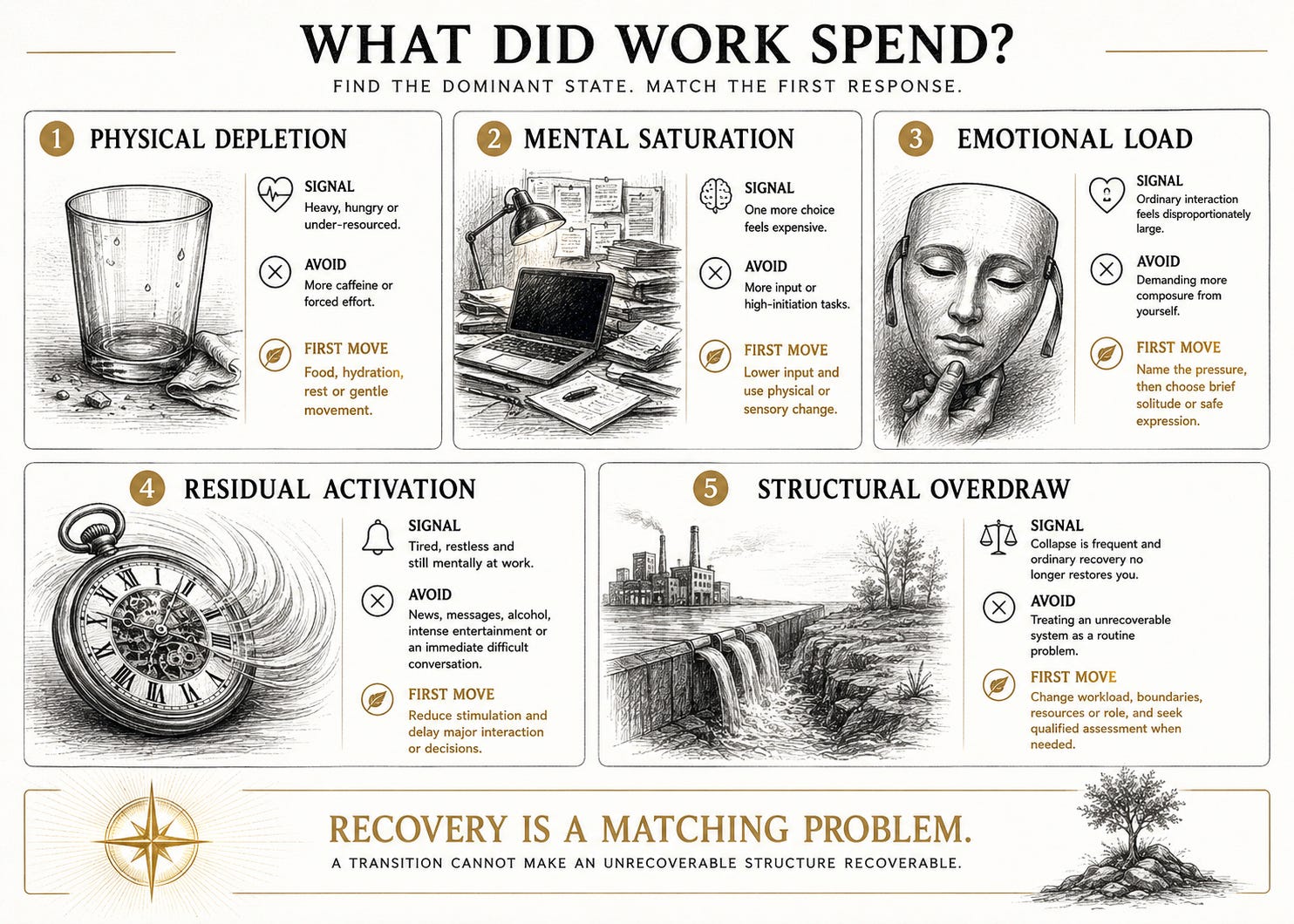
1. You Are Physically Depleted
Sometimes the explanation is direct.
The day involved:
physical work,
prolonged standing,
heat,
a long commute,
missed meals,
insufficient hydration,
poor sleep,
illness,
training layered onto an already demanding schedule.
Work-related fatigue can arise from extended hours, non-standard schedules, stress and physically or mentally demanding tasks.3
The person often makes this form of depletion worse by treating basic physical needs as optional.
They finish work hungry, consume more caffeine instead of food, delay dinner, then wonder why everything feels impossible.
The answer is not always a motivational technique.
Sometimes the system is under-resourced.
This does not mean every tired person needs a supplement, a meal plan or more sleep. Fatigue has many possible causes.
It means physical depletion should be checked before a moral explanation is accepted.
2. You Are Mentally Saturated
You may not be sleepy.
You may have no appetite for another demand.
The workday required you to:
switch repeatedly,
compare options,
absorb information,
answer questions,
remember unfinished tasks,
make small decisions continuously.
At home, the sentence “What do you want for dinner?” can feel absurdly difficult.
Not because dinner is important.
Because one more choice has arrived after the day has consumed the part of you that organises choices.
This is mental saturation.
It often drives the person toward behaviours with:
low initiation cost,
no meaningful standard,
immediate stimulation,
no clear ending.
Scrolling fits perfectly.
It does not require you to decide what matters.
It decides what appears next.
That may explain why the phone feels possible while reading a book, planning a workout or beginning a personal project does not.
The lowest-demand behaviour is not always the most restorative behaviour.
But choosing it does not prove laziness.
It may show that the day left little capacity for another organised act.
3. You Are Emotionally Loaded
Some jobs require more than tasks.
They require a face.
You reassure clients while uncertain.
Remain calm while someone else is angry.
Show interest when depleted.
Suppress irritation.
Carry another person’s fear.
Lead without displaying the full weight of the decision.
This is emotional labour.
A meta-analysis across 95 independent studies found substantial relationships between emotion-rule dissonance or surface acting and impaired well-being.4
The work may look physically easy.
The person can still arrive home with no willingness to absorb another emotional demand.
This is why an ordinary question from a partner or child can feel larger than it is.
The family did not create the pressure.
They encountered the person after the pressure had already spent their flexibility.
The answer is not to make the people at home smaller.
It is to recognise that emotional capacity was used at work and needs a clean transition before the next role begins.
4. You Are Still Activated
Sometimes you are tired and unable to settle.
The body is home.
The workday is still running internally.
You replay a conversation. Check a message. Anticipate tomorrow. Continue protecting yourself from a problem that is no longer in the room.
Psychological detachment means mentally switching off from work during non-work time. A meta-analysis of 86 publications involving more than 38,000 employees found that detachment was associated on average with less exhaustion and fatigue, better sleep and higher well-being, although much of the literature is correlational.5
Daily workload can also make detachment more difficult precisely when it is most needed.6
This state can be mistaken for energy because the person remains restless.
It is not necessarily usable energy.
It may be unfinished activation.
Adding news, messages, alcohol, intense entertainment or a difficult conversation immediately on arrival can keep the system receiving demands when what it needs is a clear reduction in input.
5. The Job Is Structurally Overdrawing You
An after-work ritual is not powerful enough to repair every job.
If you collapse most days, ordinary recovery rarely restores you, and the cost is spreading into sleep, health, mood and relationships, the problem may not be the transition.
The problem may be what you are transitioning from.
Working hours, schedules, mental and emotional demands, autonomy and recovery opportunities all matter to the need for recovery.7
No walk can make chronic understaffing reasonable.
No shower can repair permanent availability.
No breathing exercise can solve repeated humiliation, serious value conflict or a workload built on hidden overtime.
The correct response may include:
workload reduction,
clearer boundaries,
additional resources,
role redesign,
support,
medical or psychological assessment,
an eventual decision about the work itself.
A transition can help you arrive home more cleanly.
It cannot make an unrecoverable structure recoverable.
Recovery Is a Matching Problem
The question most articles ask is:
What is the best thing to do after work?
That question is too broad.
Recovery research distinguishes experiences such as psychological detachment, relaxation, mastery and control.8
Different activities may also restore different resources.
In one experiment after mentally demanding tasks, a relaxation break produced greater detachment and relaxation, while physical activity produced higher energy. The study involved students in a laboratory setting and does not establish a universal prescription, but it illustrates the important principle: the activity that calms one state may not energise another.9
The better question is:
What kind of exhaustion am I carrying, and what does that state need first?
If you are physically depleted, forcing a workout may deepen the cost.
If you are mentally saturated, sitting with more input may not help.
If you are emotionally loaded, another demand for composure may be the wrong medicine.
If you are activated, stimulation may feel like relief while delaying the downshift.
If the job is structurally overdrawing you, no personal ritual is the complete answer.
The After-Work Capacity Audit
Before reaching for the phone, rate six things from 1 to 10.
Physical energy
How capable does the body feel?
Mental saturation
How difficult does another decision or piece of information feel?
Emotional charge
How much unprocessed tension, sadness, irritation or pressure remains?
Hunger
Have basic physical needs been delayed?
Activation
Can you settle, or are you still braced and mentally at work?
Social capacity
Can you listen and respond without treating another person as an intrusion?
Then ask:
Which state is strongest?
Do not answer with the state you prefer to have.
Answer with the state that is actually present.
What to Do in the First Ten Minutes
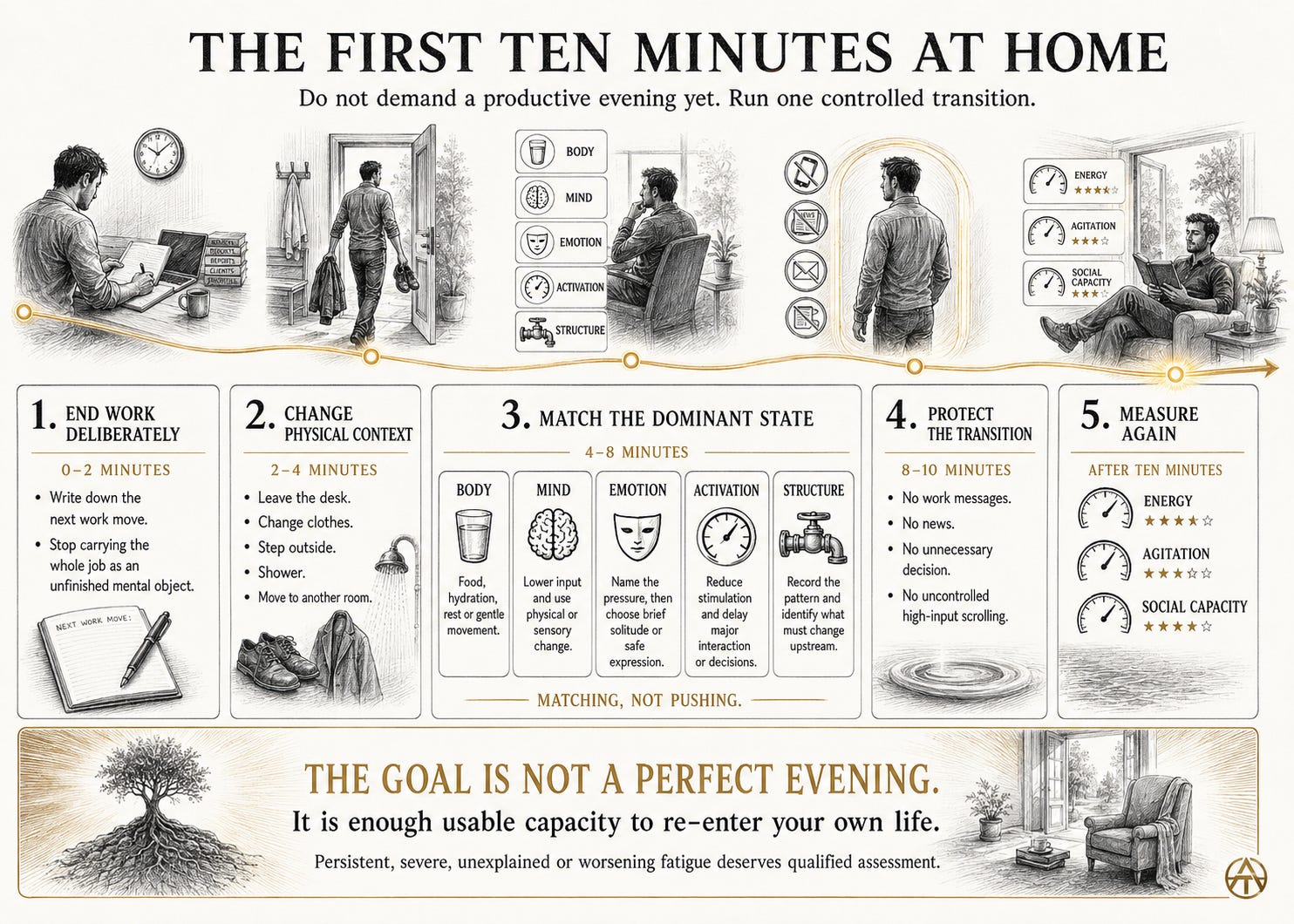
Run one controlled transition.
1. End work deliberately
Record the next work move.
Stop carrying the entire job as an unfinished mental object.
2. Change physical context
Leave the desk, change clothes, step outside, shower or move to a different room.
3. Match one action to the dominant state
Physically depleted: food, hydration, rest or gentle movement.
Mentally saturated: lower input and use physical or sensory change.
Emotionally loaded: name the pressure and choose brief solitude or safe expression.
Still activated: reduce stimulation and delay major interaction or decisions.
Structurally overdrawn: record the pattern and identify what must change upstream.
4. Protect the transition
Do not fill the first available minute with work messages, news, another decision or uncontrolled high-input scrolling.
5. Measure what changed
After ten minutes, rate:
energy,
agitation,
social capacity.
The purpose is not to create a perfect evening.
It is to collect evidence about what helps you re-enter one.
When Fatigue Needs More Than a Better Routine
Fatigue is a symptom with many possible causes.
Persistent, severe, unexplained or worsening fatigue can be related to sleep problems, medical conditions, mental-health difficulties, medication effects or other factors that need appropriate assessment.10
Do not turn a persistent symptom into:
a character verdict,
a productivity problem,
a content framework,
a supplement experiment.
Seek qualified help when the pattern is prolonged, concerning or interfering substantially with ordinary life.
The goal of this essay is narrower.
It is to show that your collapse after work contains information.
Work may be spending a different capacity than the one you are trying to restore.
Or it may be spending too much.
The evening is not merely dead time between shifts.
It is where health is maintained, relationships are felt, children are known, bodies are trained, books are read, ideas are built and life remains more than employment.
Work should not receive the only version of you that can think, care and act.
The evening is not merely what remains after ambition.
It is part of what ambition was meant to protect.
If this brought someone to mind, please forward it to them. It may help them see their exhaustion as information rather than failure.
On Monday: The After-Work Re-Entry Plan
A state-matched system for identifying the exhaustion you are carrying, choosing the correct transition, protecting the first 20 minutes at home and recovering enough usable capacity to re-enter your own life
Subscribe free to receive it.
Important note
This essay is educational and does not diagnose or treat fatigue, burnout or any medical or psychological condition. Persistent or concerning fatigue deserves assessment from an appropriately qualified professional.
Jansen, N.W.H., Kant, I. and van den Brandt, P.A. (2002) ‘Need for recovery in the working population: Description and associations with fatigue and psychological distress’, International Journal of Behavioral Medicine, 9(4), pp. 322–340. https://doi.org/10.1207/S15327558IJBM0904_03; Wendsche, J. and Lohmann-Haislah, A. (2017) ‘A meta-analysis on antecedents and outcomes of detachment from work’, Frontiers in Psychology, 7, article 2072. https://doi.org/10.3389/fpsyg.2016.02072; Hülsheger, U.R. and Schewe, A.F. (2011) ‘On the costs and benefits of emotional labor: A meta-analysis of three decades of research’, Journal of Occupational Health Psychology, 16(3), pp. 361–389. https://doi.org/10.1037/a0022876; National Institute for Occupational Safety and Health (NIOSH) (2026) ‘Fatigue and Work’, Centers for Disease Control and Prevention, 14 July. Available at: https://www.cdc.gov/niosh/fatigue/about/index.html (Accessed: 15 July 2026); MedlinePlus (2025) ‘Fatigue’, MedlinePlus Medical Encyclopedia, U.S. National Library of Medicine, reviewed 19 May. Available at: https://medlineplus.gov/ency/article/003088.htm (Accessed: 11 July 2026).
Jansen, N.W.H., Kant, I. and van den Brandt, P.A. (2002) ‘Need for recovery in the working population: Description and associations with fatigue and psychological distress’, International Journal of Behavioral Medicine, 9(4), pp. 322–340. https://doi.org/10.1207/S15327558IJBM0904_03
National Institute for Occupational Safety and Health (NIOSH) (2026) ‘Fatigue and Work’, Centers for Disease Control and Prevention, 14 July. Available at: https://www.cdc.gov/niosh/fatigue/about/index.html (Accessed: 15 July 2026).
Hülsheger, U.R. and Schewe, A.F. (2011) ‘On the costs and benefits of emotional labor: A meta-analysis of three decades of research’, Journal of Occupational Health Psychology, 16(3), pp. 361–389. https://doi.org/10.1037/a0022876
Wendsche, J. and Lohmann-Haislah, A. (2017) ‘A meta-analysis on antecedents and outcomes of detachment from work’, Frontiers in Psychology, 7, article 2072. https://doi.org/10.3389/fpsyg.2016.02072
Sonnentag, S. and Bayer, U.-V. (2005) ‘Switching off mentally: Predictors and consequences of psychological detachment from work during off-job time’, Journal of Occupational Health Psychology, 10(4), pp. 393–414. https://doi.org/10.1037/1076-8998.10.4.393
Jansen, N.W.H., Kant, I., van Amelsvoort, L.G.P.M., Nijhuis, F.J.N. and van den Brandt, P.A. (2003) ‘Need for recovery from work: Evaluating short-term effects of working hours, patterns and schedules’, Ergonomics, 46(7), pp. 664–680. https://doi.org/10.1080/0014013031000085662; Sluiter, J.K., de Croon, E.M., Meijman, T.F. and Frings-Dresen, M.H.W. (2003) ‘Need for recovery from work related fatigue and its role in the development and prediction of subjective health complaints’, Occupational and Environmental Medicine, 60(Suppl. 1), pp. i62–i70. https://doi.org/10.1136/oem.60.suppl_1.i62
Sonnentag, S. and Fritz, C. (2007) ‘The Recovery Experience Questionnaire: Development and validation of a measure for assessing recuperation and unwinding from work’, Journal of Occupational Health Psychology, 12(3), pp. 204–221. https://doi.org/10.1037/1076-8998.12.3.204
Hoover, C.S., Ragsdale, J.M. and Ayres, T.B. (2022) ‘An experimental test of resource recovery from physical and relaxation work break activities’, Stress and Health, 38(3), pp. 477–489. https://doi.org/10.1002/smi.3108
MedlinePlus (2025) ‘Fatigue’, MedlinePlus Medical Encyclopedia, U.S. National Library of Medicine, reviewed 19 May. Available at: https://medlineplus.gov/ency/article/003088.htm (Accessed: 11 July 2026).