

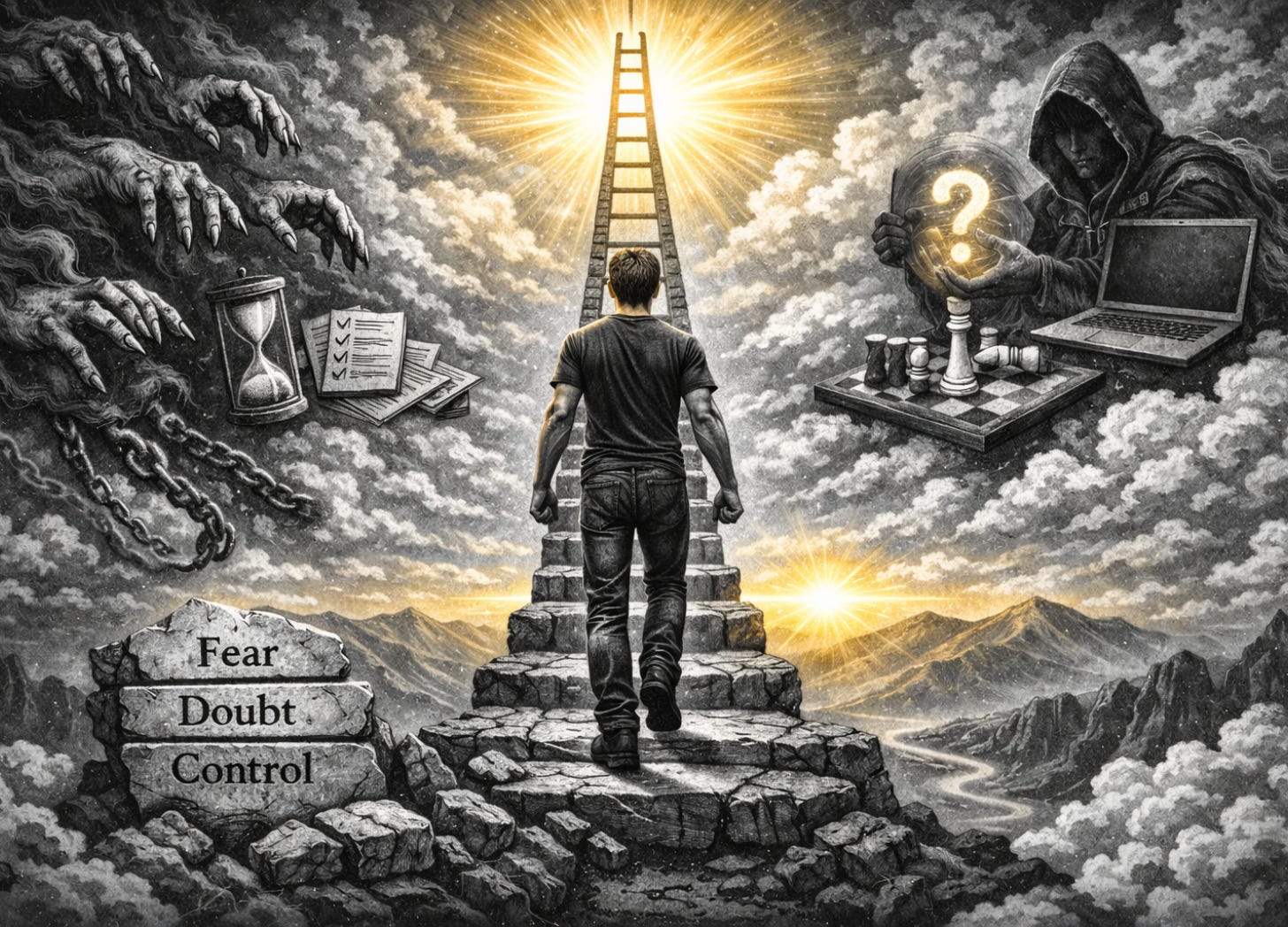
You do not need more reassurance.
You need evidence that you can function before certainty arrives.
Because the problem is not that life is uncertain.
The problem is that you keep paying uncertainty with checking, over-preparing, reassurance, and repeated mental rehearsal, and each payment teaches your nervous system the same lesson:
Not knowing is unsafe.
This manual is built for one outcome:
Less bargaining with the unknown.
Less hidden reassurance.
More function before the answer arrives.
Where this series is going
This essay is part of a wider sequence on chronic worry, unresolved threat, and nervous system load. The Sword Above the Feast named the problem: worry becomes toxic when the threat stays mentally alive. The Threat Ledger turned that into a practical frame, and the Field Manual translated it into rules and drills. The Night Sword showed how the same mechanism sharpens after dark, and The Night Sword Field Manual turned that insight into a reset protocol. Uncertainty Training then moved underneath both daytime worry and nighttime spiralling to the fuel that keeps them alive: intolerance of uncertainty. This manual is the implementation layer for that fuel. The pieces that follow move into perfectionistic threat and the safety behaviours that keep anxiety alive.
What you get in this manual
The Plan or Train gate.
The ten-rung ladder.
The prediction card.
The no-collusion rules for checking, over-preparing, and reassurance.
A seven-day training block that turns uncertainty from a private trial into a deliberate rep.
The mechanism in one page
Anxiety is tightly bound to uncertain future threat. When the future is unclear, the organism prepares before the outcome is known, because uncertainty interferes with prediction, control, and efficient threat management.1
That is not the whole problem.
The deeper trap is that uncertainty itself can become the thing you are reacting to. In intolerance of uncertainty models, worry, checking, reassurance-seeking, and over-preparing are not random habits. They are attempts to neutralize the state of not knowing, even when no further useful action exists.2
This is why uncertainty feels so expensive.
You are not only responding to risk.
You are responding to the absence of a guarantee.
That matters because the treatment logic changes.
If the real issue is uncertainty, then more thought is often not the cure. What changes the system is behavioural learning: making a prediction, entering the uncertain situation, reducing the safety behaviour, and letting new evidence compete with the old belief that uncertainty must be neutralized before you can function.3
So the target is simple:
Less certainty-seeking.
More uncertainty tolerance.
Function before the answer arrives.
The Plan or Train gate
This is how the series locks together.
Do not use the wrong tool for the wrong problem.
Use the Threat Ledger if a real next action meaningfully changes the outcome now.
Use the Night Sword protocol if the case is reopening in bed.
Use the Uncertainty Ladder if responsible action is already done, or if no further action exists right now, but your mind still demands certainty.
That gate matters because many people keep planning when what they really want is a guarantee.
A plan can improve reality.
It cannot abolish uncertainty.
