

You do not have a shortage of good options.
That is the problem.
You could protect your sleep, train more consistently, repair a relationship, increase your income, improve your offer, learn a new skill, change your environment, return to prayer, or finally complete the project that has followed you from one list to another.
Every one of those actions can be defended.
So you keep several alive at once. You make progress on none of them for long enough to learn what really matters, and the question returns every morning:
What should I do next?
This essay gives you my answer.
By the end, you will have a completed Right Action Plan:
● one plausible governing constraint;
● one action for the next fourteen days;
● one behaviour to pause;
● one direct measure and two spillover measures;
● one prediction that can be proved wrong;
● one not-now list; and
● exact rules for continuing, adapting, stopping or diagnosing again.
Not certainty.
Something more useful.
A decision strong enough to meet reality.
What “exactly” means
The word exactly refers to the action, not to omniscience.
It means making the strongest decision the present evidence allows, placing it inside a clear moral hierarchy and defining it precisely enough to test.
What will you do? What will you pause? For how long? What should change first? What else should improve if your explanation is right? What evidence would make you change your mind?
That is exact enough to move.
A sound next action does not remove uncertainty. It turns uncertainty into evidence.
And when I speak about succeeding faster, I do not mean effortless or immediate results. I mean fewer years lost to the wrong problem.
Speed without direction only makes the mistake arrive sooner.
Your goal is not always your correct first action
Eliyahu Goldratt explained constraints through a fictional troop of boys walking through the woods.1
The fastest boys were at the front. The slower boys fell behind. The leader kept trying to make the front move faster, but the line only became longer and less coherent.
Then he noticed Herbie.
Herbie was carrying a heavy pack. The entire troop was moving at his speed. When Herbie was brought to the front and the weight in his pack was redistributed, everybody moved more quickly.
Improving the fastest walkers had not improved the troop.
The correct action changed what governed everybody else.
This is obvious in a hiking story. It is much harder in a life.
Your exhaustion may look like a sleep problem but be created by a job that has colonised the night. Your money problem may look like an income problem but be created by a structural leak. Your declining work may look like a discipline problem but be created by a body that can no longer carry the demand. Your conflict at home may look like a communication problem but be intensified by financial fear, physiological depletion or years without real presence.
Everything spills into everything else.
So separate four things:
● A goal names where you want to go.
● A priority names what you value.
● A symptom names where the system is speaking loudly.
● A governing constraint is the condition currently restricting meaningful movement across the system.
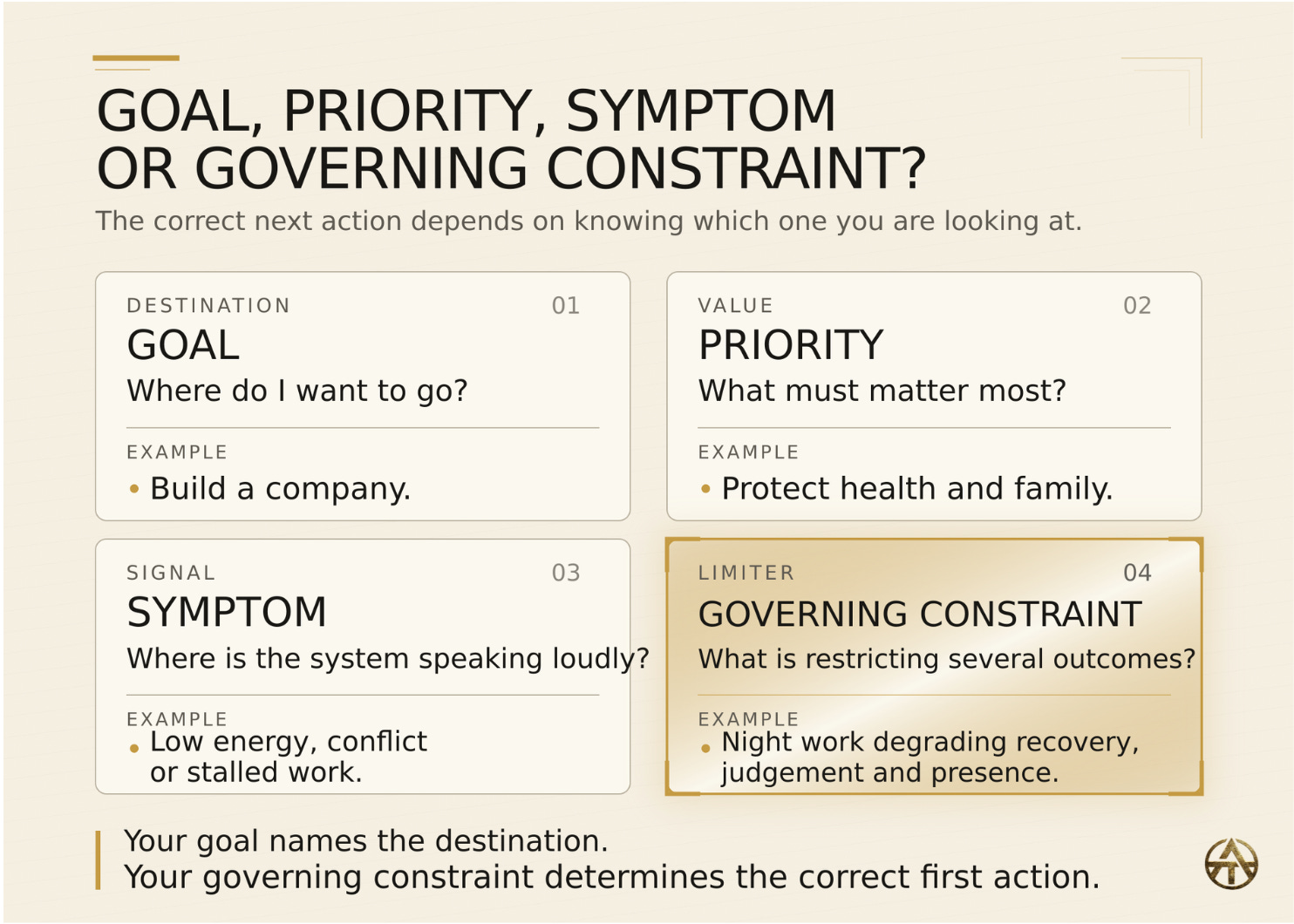
Your greatest goal may be to build a company. Your correct first action may be to restore the physical capacity required to think.
Your greatest concern may be your health. Your correct first action may be to stop the financial emergency keeping your nervous system under siege.
Your deepest desire may be to repair a relationship. Your correct first action may be to end the behaviour that makes every conversation unsafe.
Whole-Life Strategy is not doing everything.
It is knowing what governs what.
A useful correction before the complete plan
Take the problem occupying the most space in your mind.
Do not list actions yet.
Write three sentences instead:
One possible explanation is...
Another explanation is...
A third explanation is...
Then write one observation that would weaken each explanation.
This small act changes the nature of the problem. You are no longer choosing between attractive tactics. You are comparing explanations.
The first plausible story no longer gets to become king.
The complete Right Action Plan begins below. If you are reading the free preview, become a paid subscriber to Rising with Atlas and finish the page with me. By the end, you will know what deserves your next fourteen days and what must wait.
