

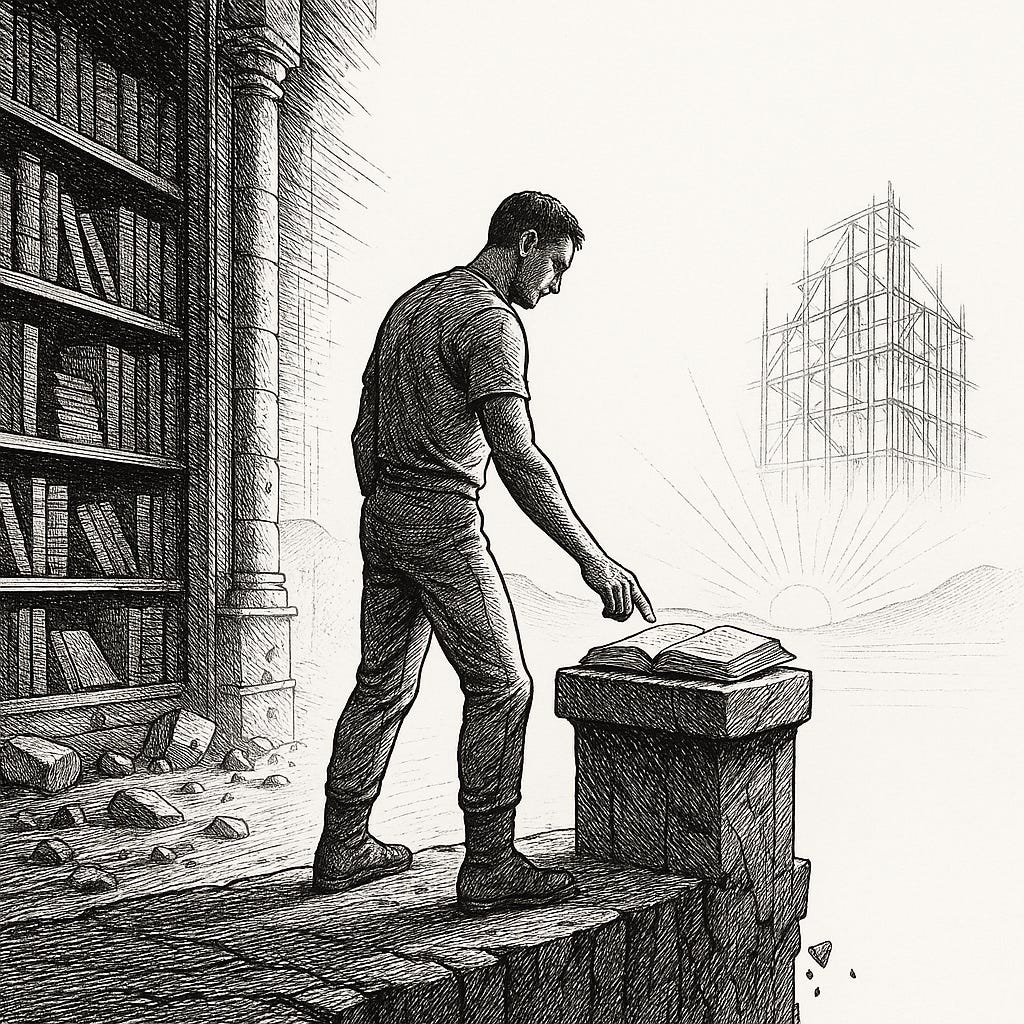
We are told to heal the past and visualize the future. Good. Do both with care. Then return to the only point where the world can be moved, the present. Memory is an archive that stores signal. Imagination is a blueprint that provides direction. Neither grants leverage. Action happens only where thought meets the hand, at the hinge of the present, not in recollection or rehearsal (Tulving, 2002; Schacter, Addis and Buckner, 2008). The older counsel to concern ourselves with what is within our control stays sharp because the hinge is the only place we can act (Aurelius, 2002).
What follows is a brief spine that sets the logic, then a pass through six domains that compound into legacy, and finally a one-page protocol you can run today.
The present is load-bearing
Memory is an archive; it keeps the record. It reminds us of lessons, hurts, and joys, but it cannot act now. Imagination offers a blueprint, conscious or unconscious. It can point the way, yet it cannot touch what has not arrived. Only the present matters. The present is the hinge where reality meets your hands. Every change passes through this hinge. When you treat the present as an opportunity, attention becomes practical, not abstract. Will returns to a reachable object, the step in front of you (James 1890). Nothing matters more.
Excellence Nexus: six primes that compound
We carry the weight of living through six domains. Each with a promise, a contact point, and a practice cue. None asks for spectacle. All ask for a small, honest steps, now.
Body Prime: build the chassis
Promise: Regular movement, nutrient-dense food, and consistent recovery turn the body into a dependable channel for action.
Contact point: Move for two minutes now. Breathe slowly through the nose, four seconds in and six seconds out. Set a neutral posture: feet grounded, ribs over pelvis, shoulders relaxed, chin level. This supports calm attention and effective breathing.
Practice cues:
• Do one brisk 5–10 minute bout within an hour of waking.
• Eat a protein-rich meal by midday, about 25–40 g protein. Examples: eggs, Greek yogurt, cottage cheese, chicken, tofu, or lentils.
• Avoid screens for one hour before sleep.
Why this matters: Regular physical activity improves executive function and learning across the lifespan and supports brain health (Hillman, Erickson and Kramer, 2008). In later adulthood, sustained aerobic training can increase hippocampal volume and improve memory, which shows the system remains trainable (Erickson et al., 2011). Evening exposure to bright screens delays melatonin, disrupts sleep, and reduces next-morning alertness, so one screen-free hour protects next-day cognition and mood (Chang et al., 2015). Higher-protein eating patterns increase satiety and help regulate appetite, which makes a midday protein-rich meal practical rather than faddish (Leidy et al., 2015).
Mind Prime: aim the beam
Promise: Attention chooses the story that drives behavior. What you rehearse now becomes tomorrow’s default.
Contact point: Pick one visible action and give it full attention.
Practice cues:
• Name the single next step in one sentence.
• Remove distractions: silence the phone, close extra tabs, clear the desk.
• Work in a fixed block, for example 25–50 minutes, then take a short break.
Why this matters: Switching tasks costs time and accuracy because the brain must reconfigure the task set, so serial single-tasking beats so-called multitasking for real work (Rubinstein, Meyer and Evans, 2001). Heavy media multitaskers perform worse on tests of attention and cognitive control, which argues for simplifying inputs rather than trying to tolerate overload (Ophir, Nass and Wagner, 2009; Gazzaley and Rosen, 2016).
Heart Prime: build durable connection
Promise: Emotion carries information and builds bonds. Resilience grows in relationship.
Contact point: Speak one honest sentence to one person who matters today.
Practice cues:
• Name one specific gratitude to someone.
• Make one repair, apologize or fix a small harm.
• Do one unglamorous act of service that helps them.
Why this matters: Strong social relationships are associated with lower mortality risk, with an effect size comparable to many biomedical risk factors, placing connection at the center of health and performance (Holt-Lunstad, Smith and Layton, 2010). Social ties shape health across the life course at the population level, showing that care, reciprocity, and belonging are structural supports rather than sentimental extras (Umberson and Montez, 2010).
Soul Prime: align purpose with time
Promise: Purpose becomes real when it fills time, not just thought.
Contact point: Write one clear line of intent in the morning and review it in the evening.
Practice cues:
• Schedule one meaningful act of service today.
• Let it cost a little time or effort, for example 10 to 20 minutes of help, a check-in call, or sharing a needed resource.
• Put it on the calendar and complete it inside a protected work block.
Why this matters: Midlife is defined by generativity, care for and guidance of the next generation, which explains why purposeful work feels like the right kind of weight to carry (Erikson, 1950). Generativity moves from inner desire and belief to cultural demand and commitment, then to concrete actions that leave a mark (McAdams and de St. Aubin, 1992). Purpose in life predicts better health and lower mortality across adulthood, so make purpose visible in the schedule rather than waiting for a feeling (Hill and Turiano, 2014). Deep absorption, often called flow, is more likely when challenge and skill meet in service of a clear goal, which supports placing meaningful work inside protected blocks (Csikszentmihalyi, 1990).
Wealth Prime: turn energy into stewardship
Promise: Systems built today create freedom of action tomorrow.
Contact point: Make one decision once and set it to run automatically.
Practice cues:
• Record one clear line in a ledger—track what matters.
• Remove one unnecessary expense.
• Improve one small process so it saves time next time.
Why this matters: Non-cognitive skills such as self-control, perseverance, and social skill have measurable and lasting returns in education and work, showing that quiet disciplines like record-keeping, planning, and follow-through are engines of freedom, not chores (Heckman and Kautz, 2012). Self-control measured early in life predicts adult health, wealth, and even public safety outcomes, independent of intelligence and social class (Moffitt et al., 2011).
Impact Prime: carve value that outlives you
Promise: Repeated usefulness becomes reputation, then legacy.
Contact point: Teach one thing you learned today or fix one small break in your domain.
Practice cue: Document the step you just took so someone else can repeat it tomorrow. Store it where your team will find it.
Why this matters: A eudaimonic model of well-being emphasizes growth, purpose, and environmental mastery rather than spectacle, which orients the worker toward excellence and service as the durable path (Ryff and Singer, 1998). Repeated usefulness builds trust. Trust sustains institutions. Institutions carry a life beyond the calendar.
The Now Protocol
A simple loop you can run today
1) Placement
Name the single piece of work that deserves light for the next block.
Write one line of intent: “Today I build {one concrete thing} for {one fixed block}.”
Use if–then language to bind the cue to the action, the shortest path from choice to behavior (Gollwitzer, 1999).
2) Constraint
Close what you do not need. Put the phone in another room.
State one boundary in a single sentence, then keep it.
Precision rises when interference falls, which is why inputs are removed before work begins, not after attention has already leaked (Gazzaley and Rosen, 2016; Rubinstein, Meyer and Evans, 2001).
3) Cadence
Set a timer for 25–45 minutes. Work the piece in your hands.
When the mind wanders, notice, return, continue, without commentary.
This trains selection, inhibition, and persistence, the core skills of execution and learning (James, 1890; Hillman, Erickson and Kramer, 2008).
4) Closure
Stop on the bell. Capture open loops in one trusted place.
Title the step you finished so you can begin fast tomorrow.
You update both archive and blueprint with one fact, you did something, and small links become a chain that sets a trajectory.
Daily run card
Morning
• Brisk movement for 10 minutes.
• Write one line of intent: “Today I will {specific task} in {first work block}.”
• Start one focused block; name the next visible action before you begin.
Midday
• Eat a protein-rich meal, about 25–40 g protein.
Examples: eggs, Greek yogurt, cottage cheese, chicken, tofu, lentils.
• Drink water. Take a short walk.
• Name one gratitude and make one small repair, apology, or fix.
• Log one line in your ledger.
• Improve one process by 1 percent, for example a quicker template, a clearer checklist, or a shorter step.
Evening
• One hour without screens before sleep.
• Dusk check-in, answer two one-line questions:
1. What did I move today.
2. What will I touch first tomorrow.
• Lay out the first action for the morning.
Working notes on flow and clarity
The hinge is set, the primes are clear, and the protocol fits on one page. The structure exists to carry weight through time without waste. Memory and imagination now serve the hands, informing what they will do next rather than becoming places to live. Attention is aimed, not scattered. Emotion is heard and harnessed. Purpose sits where a clock can see it. Systems protect energy. Usefulness, repeated, becomes a reputation. Coherence is built not by spectacle but by a pattern of small, repeatable choices that compound day after day.
Closing invocation
You cannot change the past, and you cannot live in plans. You can act only now, where your hands meet the work. Choose one desk or table you will use every day. Clear it. Put only the tools you need on it. Write one line of intent for the day and place it where you can see it. Name the first small step. Do that step. When you finish a block, write one short note about what you did and what comes next. Put loose tasks in one trusted list so your head stays clear. When you are done for the day, clean the surface, set out the first tool for tomorrow, and leave a simple instruction that tells you where to begin. Keep this routine. Use it on good days and on hard days.
If someone else needs help, show them your way. Show them how to set the first step. Share a small checklist or a simple template. The goal is not perfection. The goal is steady, repeatable work. This is how progress turns into momentum. This is how momentum turns into trust. And this is how trust grows into a life that matters more than a single day.
References
Aurelius, M. (2002) Meditations. Translated by G. Hays. New York: Modern Library.
Chang, A.-M., Aeschbach, D., Duffy, J.F. and Czeisler, C.A. (2015) Evening use of light-emitting eReaders negatively affects sleep, circadian timing, and next-morning alertness. Proceedings of the National Academy of Sciences of the United States of America, 112(4), 1232–1237.
Csikszentmihalyi, M. (1990) Flow: The Psychology of Optimal Experience. New York: Harper and Row.
Erickson, K.I., Voss, M.W., Prakash, R.S., Basak, C., Szabo, A., Chaddock, L., Kim, J.S., Heo, S., Alves, H., White, S.M., Wojcicki, T.R., Mailey, E., Vieira, V.J., Martin, S.A., Pence, B.D., Woods, J.A., McAuley, E. and Kramer, A.F. (2011) Exercise training increases size of hippocampus and improves memory. Proceedings of the National Academy of Sciences of the United States of America, 108(7), 3017–3022.
Erikson, E.H. (1950) Childhood and Society. New York: W. W. Norton.
Gazzaley, A. and Rosen, L.D. (2016) The Distracted Mind: Ancient Brains in a High-Tech World. Cambridge, MA: MIT Press.
Gollwitzer, P.M. (1999) Implementation intentions, strong effects of simple plans. American Psychologist, 54(7), 493–503.
Heckman, J.J. and Kautz, T. (2012) Hard evidence on soft skills. Labour Economics, 19(4), 451–464.
Hill, P.L. and Turiano, N.A. (2014) Purpose in life as a predictor of mortality across adulthood. Psychological Science, 25(7), 1482–1486.
Hillman, C.H., Erickson, K.I. and Kramer, A.F. (2008) Be smart, exercise your heart, exercise effects on brain and cognition. Nature Reviews Neuroscience, 9(1), 58–65.
Holt-Lunstad, J., Smith, T.B. and Layton, J.B. (2010) Social relationships and mortality risk, a meta-analytic review. PLoS Medicine, 7(7), e1000316.
James, W. (1890) The Principles of Psychology. New York: Henry Holt.
Leidy, H.J., Clifton, P.M., Astrup, A., Wycherley, T.P., Westerterp-Plantenga, M.S., Luscombe-Marsh, N.D., Woods, S.C. and Mattes, R.D. (2015) The role of protein in weight loss and maintenance. The American Journal of Clinical Nutrition, 101(6), 1320S–1329S.
McAdams, D.P. and de St. Aubin, E. (1992) A theory of generativity and its assessment through self-report, behavioral acts, and narrative themes in autobiography. Journal of Personality and Social Psychology, 62(6), 1003–1015.
Moffitt, T.E., Arseneault, L., Belsky, D., Dickson, N., Hancox, R.J., Harrington, H., Houts, R., Poulton, R., Roberts, B.W., Ross, S., Sears, M.R., Thomson, W.M. and Caspi, A. (2011) A gradient of childhood self-control predicts health, wealth, and public safety. Proceedings of the National Academy of Sciences of the United States of America, 108(7), 2693–2698.
Ophir, E., Nass, C. and Wagner, A.D. (2009) Cognitive control in media multitaskers. Proceedings of the National Academy of Sciences of the United States of America, 106(37), 15583–15587.
Rubinstein, J.S., Meyer, D.E. and Evans, J.E. (2001) Executive control of cognitive processes in task switching. Journal of Experimental Psychology, Human Perception and Performance, 27(4), 763–797.
Ryff, C.D. and Singer, B. (1998) The contours of positive human health. Psychological Inquiry, 9(1), 1–28.
Schacter, D.L., Addis, D.R. and Buckner, R.L. (2008) Episodic simulation of future events, concepts, data, and applications. Annals of the New York Academy of Sciences, 1124, 39–60.
Tulving, E. (2002) Episodic memory, from mind to brain. Annual Review of Psychology, 53, 1–25.
Umberson, D. and Montez, J.K. (2010) Social relationships and health, a flashpoint for health policy. Journal of Health and Social Behavior, 51(S1), S54–S66.
The article is so impactful of how we handle our current actions and direction. I love the guide across 6 primes, it is clear and implementable. I feel this topic is a necessary reminder for everyone.