

“The heart is deceitful above all things,
and desperately sick;
who can understand it?”
Jeremiah 17:9
“Man is the creature who does not know what to desire,
and he turns to others in order to make up his mind.”
René Girard, Deceit, Desire and the Novel (1965)
You feel disconnected, lost, drowning in a life that was never really yours.
Your calendar is full, your devices are charged, your metrics might even look “successful”, yet somewhere underneath the noise, there is a quiet sentence that never goes away:
“I do not recognise the life I am living.”
Most people instinctively turn that accusation inward. They decide the problem must be weakness, lack of discipline, not enough gratitude, or not enough optimisation. They treat their suffering as a personal defect that needs to be repaired so they can return to “functioning” in the very conditions that made them unwell.
But the story often begins much earlier, long before any conscious choice. It starts in the place where the world quietly teaches you what to desire.
From there, everything else follows.
The borrowed life: when suffering does not fit the script
From childhood onward, you are immersed in other people’s definitions of a “good life”. Family, school, media, culture, all carry scripts about what counts as success, worth, and sanity. Over time, these scripts sink below awareness and harden into what feels like simple reality.
Sociologists, psychologists, and philosophers have been saying this for decades: human beings do not come to the world with ready-made values; they inherit and internalise them through the social environment that surrounds them (Fromm 1955; Baumeister and Leary 1995).
At the same time, your nervous system carries a deep, non-negotiable need to belong. Baumeister and Leary argued that the “need to belong” is a fundamental motivation, not a luxury: people are willing to reshape their beliefs and behaviour in order to avoid exclusion (Baumeister and Leary 1995).
Combine those two facts, and something important appears:
You learn what to want from the people and structures around you.
You cling to those wants because belonging depends on them.
Over time, the borrowed script starts to feel like “just the way things are”.
Underneath that, however, there is your own interior witness, the part of you that notices when the life you are living and the life you are built for no longer match.
Erich Fromm warned that whole societies can be sick in ways that become invisible from the inside. A person can be well adapted to an unhealthy culture and still be unwell in a more profound sense (Fromm 1955).
In that light, your exhaustion, your numbness, your quiet despair may not be signs that you are failing; they may be signs that something in you refuses to fully adapt to a world that is fundamentally misaligned with human flourishing.
Your suffering does not fit the script, because the script itself is wrong.
How the world trains your heart: desire as a social project
The older philosophical tradition tended to treat desire as something that springs from within, spontaneous and authentic. A more honest reading of human life suggests something different.
René Girard argued that human desire is profoundly mimetic. We do not simply want things; we learn what to want by imitating the desires of others whom we take as models, rivals, or idols (Girard 1965).
We absorb:
The careers that are worth admiring.
The lifestyles that are worth envying.
The markers of status that are worth chasing.
Advertising, social media, and algorithmic feeds supercharge this process. Your attention is constantly trained toward images of “the good life” that are selected because they drive engagement, not because they correspond to wisdom, virtue, or truth.
Psychologically, the mechanism is straightforward:
You need to belong and be valued (Baumeister and Leary 1995).
You are shown which forms of life are praised, liked, and rewarded.
You gradually reshape your desires to align with what your reference group considers desirable.
Self-determination theory, developed by Deci and Ryan, shows that genuine psychological well-being depends on three basic needs: autonomy, competence, and relatedness (Deci and Ryan 2000). When your desires are heavily scripted by external forces, autonomy is compromised. You find yourself running hard, but toward goals that never really felt like yours in the first place.
At that point, something profound has happened. Scripture describes the heart as “deceitful above all things” (Jeremiah 17:9). Not because the heart is inherently evil in itself, but because it is porous. Whatever the world keeps feeding it, it eventually learns to love. Given enough repetition, illusions start to feel like intuitions. Borrowed desires begin to feel like destiny.
If you spend years staring at distorted stories about what a worthy life looks like, you will eventually attach to those distortions. You will suffer when you cannot reach them. You will suffer just as much when you do.
Not because you are broken, but because your heart has been trained to serve the wrong master.
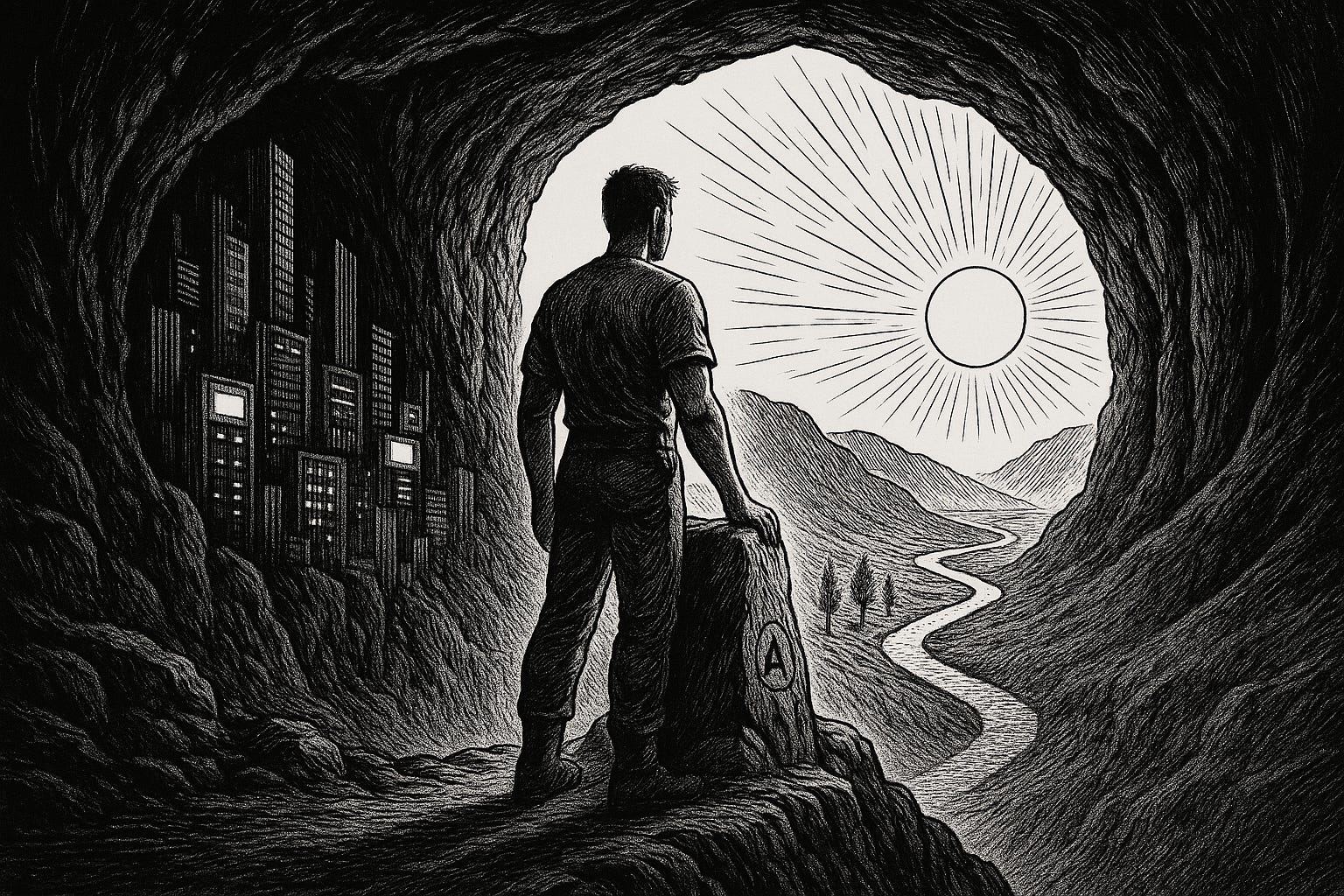
Plato’s cave in the age of feeds and quarterly targets
Plato tried to describe this condition two and a half thousand years ago in the image of prisoners chained inside a cave, facing a wall where shadows flicker in the firelight (Plato, Republic, Book VII). The prisoners take those shadows to be reality itself. They compete over who can interpret them best. If someone is dragged out of the cave into the light, the process is painful. Re-entry is worse: when he returns, half blind, and speaks of a larger world, he is mocked and, if possible, silenced.
That image is disturbingly contemporary.
The shadows on the wall are now financial metrics, notification badges, follower counts, rankings, performance reviews, prestige brands, and socially approved milestones. Inside the cave:
A “good life” is equated with being productive, busy, visible, and optimised.
Worth is measured by numbers displayed on screens.
People learn to monitor their own value in real time by refreshing dashboards.
Philosopher Byung-Chul Han describes our era as a “burnout society” in which the individual is no longer primarily suppressed by external prohibitions, but driven by internalised demands to perform, improve, and self-optimise without limit (Han 2015).
The result is a paradox.
You appear free. You choose your apps, your career path, your goals. Yet those choices are made inside a narrow band of possibilities that were handed to you by the very system that profits from your exhaustion.
You become, in Han’s phrase, an entrepreneur of yourself: the manager, product, and exploited labour of your own life at the same time (Han 2015).
Plato’s prisoner, who begins to question the shadows, is not sick. He is sane enough to feel that something is wrong.
The same is true of you.
Optimisation as compliance: when potential becomes fuel for the machine
In this environment, “optimisation” is usually not about becoming more fully human. It is about becoming more useful to the machine.
Be more productive. Be more efficient. Be more available. Be more responsive. Sleep just enough to keep functioning, not enough to become truly rested. Exercise just enough to keep the body from collapsing, not enough to feel rooted and alive. Learn just enough to remain competitive, not enough to become wise.
On the surface, nothing is forced. Underneath, everything is coerced by invisible structures:
Debt, status anxiety, and job insecurity.
A culture that glamorises busyness and normalises exhaustion.
Institutional expectations that treat human beings as endlessly upgradable resources.
Self-determination theory predicts what happens here. When autonomy is undermined and external pressures dictate your goals, motivation becomes more controlled, brittle, and draining. Over time, this is associated with higher burnout, lower well-being, and more symptoms of anxiety and depression (Deci and Ryan 2000).
Han’s diagnosis lines up from another angle: the pathologies of our time, from burnout to attention collapse, are not random individual failures; they are structural consequences of an achievement culture that demands constant self-exploitation (Han 2015).
If you accept the system’s definitions of success, then any fatigue, doubt, or resistance that stops you from hitting those targets will look like a personal defect.
If you reject those definitions, even secretly, the same fatigue and doubt can be read differently. They become signals that your soul is refusing to be quietly converted into fuel.
You were not born only to become a more efficient component in a sick structure. You were given potential so that your life could bear the weight of meaning, love, and service, not just productivity.
Suffering as protest, not pathology
Viktor Frankl, writing after surviving Nazi concentration camps, argued that the deepest drive in human beings is not the will to pleasure or power, but the will to meaning, the need to feel that one’s life is oriented toward a purpose that justifies suffering rather than erasing it (Frankl 2006).
From that perspective, some forms of distress are not signs of failure; they are signs of honesty.
You feel suffocated by a life of constant performance because something in you still remembers that you were meant for more than performance. You feel disconnected, not because you have failed to adjust, but because you are correctly registering that a life of shallow metrics and hollow prestige does not answer the question your existence is actually asking.
There is, of course, real clinical suffering that deserves care: depression, trauma, anxiety disorders, and biological vulnerabilities. None of this romanticises pain.
What it does say is this:
Not every discomfort is a symptom to be suppressed.
Sometimes the ache is a form of protest, your interior life refusing to sign a contract it never agreed to.
Sometimes the emptiness is a doorway, not a defect.
Frankl notes that a person can endure extraordinary hardship if they can orient it within a meaningful story. When meaning is absent, even comfort becomes unbearable in its emptiness (Frankl 2006).
If your life “looks fine on paper” yet feels hollow, that dissonance is precious data. It tells you that your current story does not have space for your actual soul.
Your suffering is not proof that you are failing. It is evidence that some deeper part of you is awake enough to notice that you are still in the cave.
Awakening: the moment you see the cave for what it is
Plato is explicit about what happens when a prisoner begins to turn toward the light. It hurts. Their eyes burn. They long to turn back to the familiar shadows. When they finally see the world outside, they pity those who remain in the cave. If they descend again and speak about what they have seen, they are ridiculed and may be attacked (Plato, Republic, Book VII).
Awakening is not a romantic moment of instant clarity. It is often a slow, disorienting unravelling of assumptions.
You notice that the work you were told would fulfil you leaves you strangely anaesthetised.
You realise that the status you chased does not protect you from loneliness.
You see that the “normal” pace of life around you produces symptoms that, if they appeared in any other context, would be called warning signs.
Then a dangerous thought arises:
“What if the problem is not that I am behind, but that I am running in the wrong race?”
This is the point at which many people double down on optimisation. They think: if I improve my routines, upgrade my productivity system, and install the right array of habits, it will start to feel right.
Sometimes it does, briefly. But if the underlying story has not changed, the relief never lasts.
True awakening begins when you are willing to entertain a more radical possibility:
“My suffering is telling the truth about the world I am in. I am not meant to adjust to this perfectly. I am meant to become the kind of person who can walk out of it and help others walk out too.”
At that point, optimisation is no longer about compliance. It becomes preparation for the exit.
Practical lines of escape: beginning to reclaim your life
You cannot leave the cave in a single heroic leap. You leave through a series of stubborn, practical decisions that gradually make your life incompatible with the machine’s logic.
Here are starting points.
1. Name the borrowed scripts
Take a page and draw two columns.
On the left, write, “I was taught that a successful life means…”. List everything that comes up. Income, titles, bodies, social markers, timelines.
On the right, write, “When I am most honest before God, my soul, and reality, a worthy life feels more like…”. Let yourself describe qualities, not metrics: courage, truthfulness, depth, faithfulness, service, craft, presence.
You are not trying to be clever. You are trying to make explicit the clash between the cave’s definitions and the voice that will not leave you alone.
That contrast is the map of your disconnection.
2. Fast from distorted mirrors
If desire is mimetic, then your reference group is destiny.
For a defined period, reduce exposure to sources that aggressively script your desires: algorithmic feeds designed to produce envy and speed, media that glamorise burnout, spaces that relentlessly frame worth in terms of visibility and success.
Replace at least part of that input with voices that call you toward depth rather than performance: serious spiritual writing, philosophy, biographies of people who chose meaning over status, relationships with those who care about who you are becoming rather than what you are achieving.
You are retraining the eyes of your heart.
3. Recover interior authority
You cannot hear your own life amid constant noise.
Establish a daily pocket of silence that is non-negotiable. It might be:
Sitting quietly in prayer or contemplation.
Walking without headphones.
Journaling, not about productivity, but about truth.
The aim here is not mindfulness as a productivity hack. The objective is to re-establish contact with the part of you that can say, “Yes, this is my path” or “No, this is not worth my one life”, before any external incentive weighs in.
This is where Jeremiah’s warning becomes hope. The same heart that can be deceived can also be searched, healed, and strengthened when it is brought into the light honestly (Jeremiah 17:9–10).
4. Make incompatible moves
Begin to make small choices that do not make sense inside the logic of the cave but make deep sense to your soul.
That might mean:
Protecting time for deep craft or study that has no immediate market value.
Saying no to a promotion that requires betraying your health or integrity.
Structuring your day around prayer, learning, or family rather than around emails.
Choosing a simpler lifestyle that buys back time and presence.
Each such move is a declaration: “My life does not exist to maximise my usefulness to an unhealthy system. It exists to become an instrument of something truer.”
These choices are risky. They may cost status and approval. They also begin to build a life that you can eventually recognise as your own.
5. Expect friction and misunderstanding
Plato notes that when the freed prisoner returns to the cave, the others laugh at his disorientation and regard his journey as madness (Plato, Republic, Book VII).
When you begin to prioritise wholeness over performance, some people will interpret your choices as laziness, naivety, or even betrayal. The possibility of alternatives may genuinely threaten them.
None of that is proof that you are wrong.
It is evidence that you are starting to live by a different centre of gravity.
6. Redefine optimisation
You do not have to abandon excellence. You have to change what excellence is serving.
Frankl’s logotherapy is built on the conviction that meaning is found by committing oneself to tasks, people, or truths that transcend the self, and by facing unavoidable suffering with dignity for the sake of that commitment (Frankl 2006).
Apply that here.
Optimise your body, not to squeeze more productivity out of it, but so it can carry the weight of your calling.
Optimise your mind, not to win every competition, but so you can perceive truth clearly and serve others well.
Optimise your systems, not to keep up with the machine, but to free time and energy for what actually matters.
You are no longer trying to become a high-performing slave. You are training to become a free person who can carry responsibility without being owned by it.
You were not born for shadows
If you feel disconnected, suffocated, or quietly horrified at the thought of living the next forty years in the same pattern, it is doubtful that you are weak.
It is more likely that some deep, sane part of you has begun to wake up.
You were not built for cages, for cubicles, for a life measured purely by quarterly targets and socially sanctioned exhaustion. You were not born to excel in a sick world. You were born to see it clearly enough that you cannot be fully tamed by it, and to become the sort of person whose very existence points to another way.
Once you see the cave for what it is, you cannot honestly go back.
You can distract yourself. You can numb yourself. You can try to forget. But the knowledge remains: the life you were handed is not the only life available. The desires you were taught are not the only desires possible. The system that names you “successful” may be unworthy of your obedience.
Your suffering is not the end of the story. It is the beginning of the turning.
Out of the shadows. Toward the light. Into a life that, for the first time, feels like it could actually be yours.
References
Baumeister, R.F. and Leary, M.R. (1995) ‘The need to belong: Desire for interpersonal attachments as a fundamental human motivation’, Psychological Bulletin, 117(3), pp. 497–529.
Deci, E.L. and Ryan, R.M. (2000) ‘The “what” and “why” of goal pursuits: Human needs and the self determination of behavior’, Psychological Inquiry, 11(4), pp. 227–268.
Frankl, V.E. (2006) Man’s Search for Meaning: An Introduction to Logotherapy. Boston, MA: Beacon Press.
Fromm, E. (1955) The Sane Society. New York: Rinehart.
Girard, R. (1965) Deceit, Desire and the Novel: Self and Other in Literary Structure. Baltimore, MD: Johns Hopkins University Press.
Han, B.-C. (2015) The Burnout Society. Stanford, CA: Stanford University Press.
Jeremiah. 17:9–10. The Holy Bible (New Revised Standard Version).
Plato. (2003) Republic. Translated by C.D.C. Reeve. Indianapolis, IN: Hackett Publishing.
Very few people are awake and it is a sad state of affairs. This is insightful and liberating.🙏