


Imagine finishing a report an hour earlier than usual. The work is good, the figures have been checked, and there is nothing left to repair. You could use that hour to get home, train, or make progress on the project that matters more than the report.
Then the next assignment arrives.
The time saving was real. So was the expectation that you would remain available. Unless something changes in the agreement around the work, both can be true and your day can end exactly when it always did.
If you work for yourself, you may recognise the same sequence without needing anyone to send the assignment. You see what is now possible and begin it. An hour that might have changed your afternoon becomes the beginning of another commitment.
I want us to take the new possibilities seriously. Earn more. Build something substantial. Become capable of serving people in ways that were previously beyond your reach. There is nothing admirable about preserving drudgery when a better method is available. But if part of the promise is greater freedom, we ought to follow the gain far enough to find out whether we receive it.
Saving time changes what is possible. Deciding what happens next is how we begin to make it ours.
This is where I would begin with AI: establish the real gain, identify who can decide how it is used, and make a specific arrangement for the benefit you want. That benefit may be better work, more income or an evening in which you are actually available to the people you love. The tool creates an opportunity. There is still a human decision to make.
Goethe gave us a memorable picture of capability without command in The Sorcerer’s Apprentice. A young pupil, left alone by his master, puts a spell on a broom and sends it to carry water for the bath. At first, he gets what he wanted. He is relieved of the chore. Then the bath fills and the broom keeps working. He has forgotten the word that would stop it. He takes an axe to it, only to find that he now has two servants carrying water, and the flood rises faster.1
The work is getting done. The room is flooding.
His original desire was reasonable. His difficulty was governing what he had set in motion. We do not need to wait for a flood to ask where additional capability should lead.
A better tool gives you a choice to make
In an experiment published in Science, Shakked Noy and Whitney Zhang gave college-educated professionals writing assignments such as reports and press releases. Access to ChatGPT reduced average completion time by 40% and increased assessed quality by 18%. These were bounded writing tasks, not complete jobs, and they did not require precise factual research or detailed knowledge of an organisation.2
That is a substantial improvement within the work tested. It is also a reason to be precise about what has improved. The study tells us about completing particular assignments. It does not tell us that the participants gained 40% more life outside work.
There is evidence that some gains do reach the working day. A six-month experiment involving 7,137 workers across 66 firms found that access to Microsoft 365 Copilot reduced time spent on email. Those assigned access spent about 1.4 fewer hours a week in Outlook during the later study period. Their measured digital work outside regular hours also fell, by about 15 minutes a week. The researchers could not account for the whole working day, but some of the gain appeared to return to workers.3
We should welcome that. A tool that helps people finish useful work and reduces what follows them into the evening has done something worth doing.
But consider the decisions that lie behind such a result. After a task becomes faster, someone still has to decide whether to improve it further, do more of it, undertake different work or finish earlier. An employer may make that decision. A team may negotiate it. If you work for yourself, you may make it without noticing that you have made it at all.
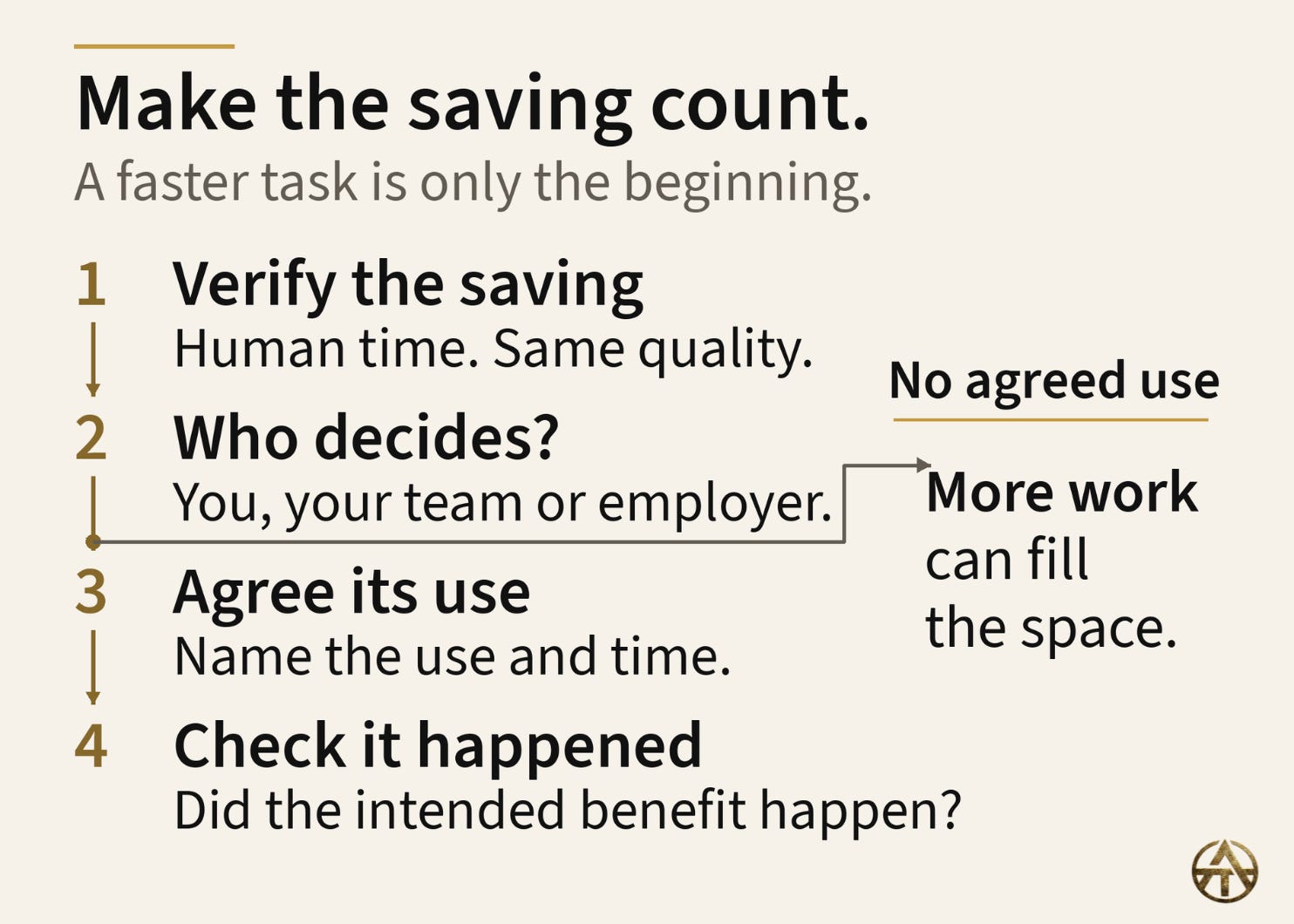
That is why I would separate four questions before declaring success: Is the work faster? Is it good enough, or better? Who can decide how the gain is used? Does that decision actually change the day?
Those questions belong together. A quick draft can still be wrong. A better result may be worth the same amount of time. Leaving the desk earlier may achieve very little if the work continues to occupy your attention throughout dinner. We should be able to recognise each outcome without pretending they are interchangeable.
The demands we are pleased to accept
Researchers at Berkeley Haas followed work at one 200-person technology company for eight months. They observed employees extending the range of tasks they attempted, slipping prompts into former pauses and keeping several streams of work running at once. Much of this expansion was voluntary. People felt capable of more, so they took on more. This was an in-progress qualitative study of one company, not a finding about every worker who uses AI.4
The voluntary part deserves our attention. It is easy to discuss overwork as something imposed upon us. It becomes more interesting when the additional work arrives as an opportunity we are delighted to accept.
Imagine a small business owner preparing a proposal. This is a hypothetical example. She knows her field and has something useful to offer. AI helps her complete the first version before lunch, leaving time to speak with the prospective customer and understand a concern that has not yet been resolved.
She could have that conversation, improve the proposal where it matters and send it. Or she could remain at her desk, producing six further versions, redesigning the presentation and adding a service she had not previously intended to offer. By evening, she might have a far more elaborate document and still be no closer to understanding what the customer needs.
Before she asks what else she can produce, she needs to understand what is preventing the useful result. An unanswered customer question calls for an answer. An offer she cannot yet deliver calls for work on delivery. Further versions may help, but she should know what they are meant to resolve.
That is where I would direct the new capacity: toward the obstacle between the business and the result it needs. Better presentation has a place, as do another conversation, a stronger offer and work on delivery. Choose what matters at this stage and decide how you will recognise when that part is ready. Otherwise, a possibility for improvement can keep the useful work from ever reaching the person it was meant to serve.
This matters because the ease of creating a possibility tells us very little about the cost of carrying it. The new service will need delivering. Its promises will need keeping. Other people may have to coordinate around it. What began as an interesting afternoon can become an obligation that occupies months.
I do not want to discourage that owner’s ambition. I want her ambition to reach the person it is supposed to serve, and to build a business she is glad to own. She needs the freedom to consider more possibilities and the judgment to leave some of them unchosen.
AI can help examine the options. It cannot assume responsibility for the life that follows the choice.
In How to Stop Trading Time for Money Without Quitting Your Job, I explored what our work leaves us able to own and choose. The same question now belongs inside a single afternoon. Finishing the proposal sooner is useful. Whether it brings the owner more income, a stronger business or time with her family depends on what happens after the draft appears.
Establish what you can honestly claim
Before trying to reclaim anything, find out whether there is a real saving. Choose one recurring task with a recognisable finish and a result you can assess. It could be a weekly update. It should be work you are permitted to carry out with the tool and with the information involved.
Even here, the first question is whether the task should continue to exist. If nobody needs the update, producing it faster preserves an obligation you could have removed. If people do need it, understand what they need from it before deciding that a longer or more polished version is an improvement.
You then need a fair comparison. Record how long a comparable update takes without AI, at the standard it needs to meet. Use a recent record or time the next occurrence. Comparing an easy assisted task with your memory of the worst unassisted afternoon will tell you what you hoped to hear.
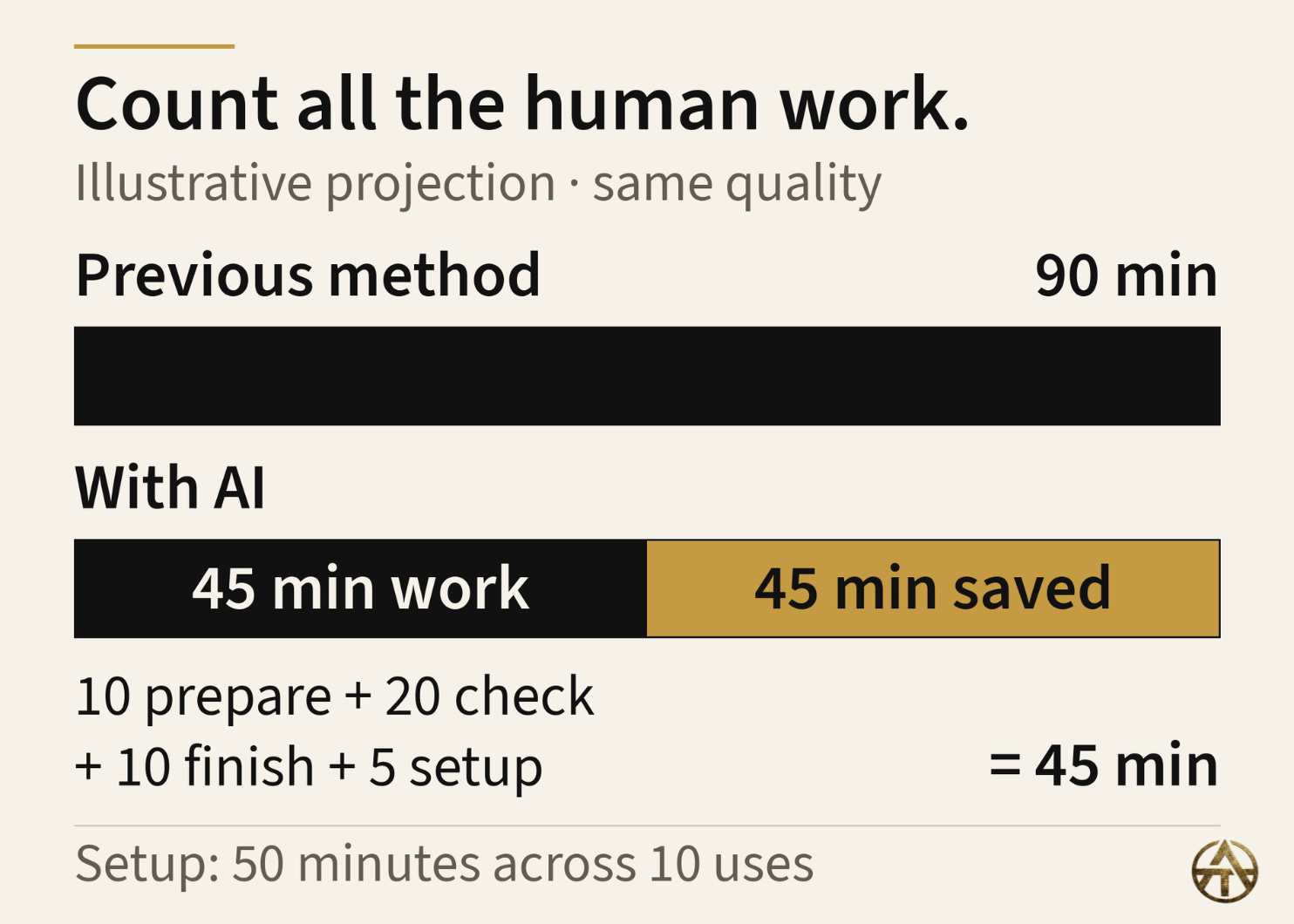
The assisted method has its own costs. You prepare the material, give instructions, handle the response, check the facts and omissions, and correct what needs correcting. If a colleague must repair the result, their work belongs in the calculation too. The appearance of a finished document on your screen does not mean the human work is finished.
Here is a worked illustration, not a reported client result:
The same weekly update: Human time
Previous method, at the required quality: 90 minutes
Prepare the material and instruct AI: 10 minutes
Check facts, omissions and usefulness: 20 minutes
Correct and finish: 10 minutes
Share of initial setup: 50 minutes across 10 uses: 5 minutes
Total assisted time per use: 45 minutes
Net saving per use: 45 minutes
On these figures, the saving is 45 minutes per use across ten uses. That is different from counting only the few moments it took the machine to respond. It is also a projection until those ten uses have actually occurred. If you use the process only twice, the setup allowance becomes 25 minutes per use and the saving falls to 25. Keep that one-time work visible instead of quietly forgetting it once the process begins to feel convenient.
Count active human time consistently. If the machine works unattended, that is different from sitting in front of it, monitoring every response. Waiting may still delay delivery, so record it separately where a deadline makes that important.
Then look at the actual update. Are its facts correct? Does it include what matters? Can the intended reader use it? You remain responsible for work you put your name to. Check it accordingly, and keep sensitive information within the permissions and systems appropriate to your work.
If quality has fallen below the required standard, you have not demonstrated a comparable saving. If total human time has stayed the same or increased, there is no time saving to allocate. You may still have achieved better work, and that can be valuable. Call the gain what it is. Where neither the time nor the result justifies the method, repair the process or stop using it for that task.
An hour needs more than an empty space
Now you have evidence with which to make a decision.
If you are employed, the work you have agreed to do does not disappear because you have found a quicker way to do part of it. Your manager may need more output, a better result or help with a problem elsewhere in the team. Bring the observed saving and the quality check into that conversation, together with a specific proposal for using the capacity.
Perhaps the proposal is to tackle work that has been waiting for proper attention. Perhaps it is to reduce the demands that repeatedly spill into the evening. Make the proposed change specific: which result will still be delivered, what part of the day will change, and when you will review whether the arrangement works. A general agreement that AI should help everyone leaves the next afternoon unresolved.
If your proposal is refused, ask what would have to change for the benefit to become possible. The obstacle may be a delivery commitment, the way work is handed over, or an expectation of constant availability. You cannot remove every constraint by writing a better prompt. Until the arrangement changes, record the gain honestly as capacity available for work; do not count it as time you can personally use.
If you lead people, you can make the other side of that agreement possible. Decide which result the team needs and which work can cease once that result is delivered. Before turning new capability into a higher minimum, consider where the additional output would help. A longer report may only transfer effort to its reader. Removing unnecessary work might produce a greater benefit than distributing another assignment.
A saving can be shared. The organisation can receive better work or help with a bottleneck while the person gains a more dependable finishing time. Whether that arrangement is feasible depends on the work and its commitments. It deserves an explicit decision, instead of allowing every gain to become another demand by default.
The owner working alone has more direct authority over the decision, but no automatic protection from making a poor one. There may be nobody insisting that the afternoon be filled. The demand may come from the owner’s own excitement, fear of falling behind or unwillingness to leave a possible improvement alone.
Return to our calculation. Suppose you and the people affected agree to give 25 of the saved minutes to a valuable piece of work and protect 20 for a walk before going home. All 45 minutes have been deliberately directed, and both uses can be worthwhile. Only 20, however, have been released from work. Choosing to invest the other 25 in something you value can be an exercise of freedom too. Having them filled by a demand you could not influence would be a different outcome.
There is a further practical difficulty. Six five-minute gaps do not necessarily let you leave half an hour earlier. The saving may be real while the interval you want remains unavailable. You may need to change when the task is done, how it fits with other work or which interruptions are allowed to fill the space.
Give the intended use a place in the day:
When this task is finished to the required standard, I will use the time released for ________, at ________.
Then check whether it happens. Did the valuable work advance? Did you take the walk? If both disappeared into further revisions, the workflow improved but the arrangement did not yet deliver what you wanted.

You are allowed to choose more work. Choose it deliberately when it serves something worthy. An hour spent learning, earning or creating an asset can enlarge your future choices. There are seasons when building asks a great deal of us.
The trouble begins when that season has no declared purpose, no completion condition and no moment of reassessment. The people we love can be asked to share a sacrifice. They should not be asked to live indefinitely on the promise that, after the next thing, we will finally become available.
The life the gain is meant to reach
I want the power to create useful work, earn well and build something substantial. I also want to sit with my wife and children, eat, joke, laugh and actually be there. Those desires belong to the same life. I will not accept a definition of progress that requires one to disappear so that the other can keep expanding.
In The Doorway Data Cannot See, I wrote about honouring what can be measured while recognising what stands above measurement. We need that order here. Count the time accurately, but do not expect the calculation to tell you what deserves it.
Your child experiences your presence, your attention, the chance to begin a game before you reach for the phone again. A friend needs the conversation you keep intending to have. Your body needs to be lived through, cared for and given the conditions in which it can meet your ambitions. There is also work of great value that requires sustained thought, patience and attention. Its importance is not reduced because it cannot be hurried through a prompt.
For me, this includes prayer and attentiveness to God. Greater capability carries responsibility for how it is used. It should help me become more available to what is worthy, including the people whose needs make a claim on me.
That is the connection to Being of Service. Our lives matter in the lives of others. You may use what AI releases to build an excellent business, reach more people with something useful or solve a problem that deserves your full attention. You may use it to restore your strength, care for someone or enjoy the company of the people you love.
Learn the tool well. Let it expand what you can do. Then follow the gain all the way into the life it is meant to serve.
The apprentice could see that the bath was full. He could not stop the broom. When we discover a way to do more, we should make sure we can still decide what comes next.
You get one life. Build all of it.
On Monday, the paid companion, How to Turn AI Into Time You Actually Own, will help you put this into practice over 14 days. You will have a task-selection card, a worked example that keeps setup and checking costs visible, a scorecard for your own results and an agreement you can adapt for the people affected. We will also work through what to change when the saving is real but the benefit keeps disappearing, so you can decide what to keep, change or stop. Become a paid subscriber for the complete implementation.
Goethe, J.W. von (1797) ‘Der Zauberlehrling’ [‘The Pupil in Magic’], translated by E.A. Bowring, in The Poems of Goethe, second-edition text (1874). Project Gutenberg, eBook 1287. https://www.gutenberg.org/cache/epub/1287/pg1287.html (Accessed: 24 September 2026).
Noy, S. and Zhang, W. (2023) ‘Experimental evidence on the productivity effects of generative artificial intelligence’, Science, 381(6654), pp. 187–192. https://doi.org/10.1126/science.adh2586. Author manuscript: https://shakkednoy.com/Noy%20Zhang%20NBER%20SI.pdf.
Dillon, E.W., Jaffe, S., Immorlica, N. and Stanton, C.T. (2026) ‘Shifting Work Patterns with Generative AI’, revised manuscript dated 24 August 2026, arXiv:2504.11436v4. https://arxiv.org/html/2504.11436v4 (Accessed: 24 September 2026).
Counts, L. (2026) ‘AI promised to free up workers’ time. UC Berkeley Haas researchers found the opposite’, Haas News, 18 February. Interview with Xingqi Maggie Ye on research with Aruna Ranganathan. https://newsroom.haas.berkeley.edu/ai-promised-to-free-up-workers-time-uc-berkeley-haas-researchers-found-the-opposite/ (Accessed: 24 September 2026).