


A room can keep asking you to stay shallow.
Not with force.
Not with noise loud enough to blame.
Not with some obvious disaster.
More quietly.
A phone in view.
A tab left open.
A pile that belongs to another life.
A light that makes the work feel dead.
A sound your nervous system keeps trying to interpret.
A chair that makes the body keep negotiating.
A desk where the right action is harder to reach than the wrong one.
Then people sit down in that field and call the next hour a focus problem.
That diagnosis is too late.
The Thursday essay argued that the room is not decoration. It is part of the sensory field of thought. Environmental flow research now points in the same direction: flow is not only shaped by the task and the person, but also by natural and built environments, aesthetics, person-environment fit, and relationship to place.1
This manual is the operational version of that claim.
It is not a desk setup article.
It is not a shopping list.
It is not ambience culture.
It is not a promise that the right lamp will save a badly designed life.
It is a way of building a field that makes absorption less expensive.
Where this series is going
This season explores the hidden architecture of flow, not as hacks but as a field theory of entry, coherence, and peak mental states.
Today: Build a Room That Makes Absorption Easier
This manual gives you: the Environmental Audit, the Threat-Leak Map, the Visual Subtraction Checklist, the Sound Field Selector, the Light and Air Baseline, the Scent Anchor Guide, the Tool-Path Layout, and the Depth Configuration.
Already live:

Next: Group Flow Begins With Trust.
Most people fail here because they think the environment has to be beautiful.
That is the wrong standard.
A beautiful room can still fragment you.
A plain room can still hold you.
A minimalist desk can still feel sterile and dead.
A full room can still feel ordered and alive.
The deeper question is not:
Does this room look good?
The deeper question is:
What does this room make easier?
Indoor environmental quality research decomposes the field into variables such as air quality, thermal conditions, lighting, noise, and non-light visual factors, and links these conditions to attention, perception, memory, language, and higher-order cognitive skills, while also showing that the evidence varies by factor and cognitive function.2 That is the right level of seriousness. The room matters, but not simplistically.
Before the paywall, do this first.
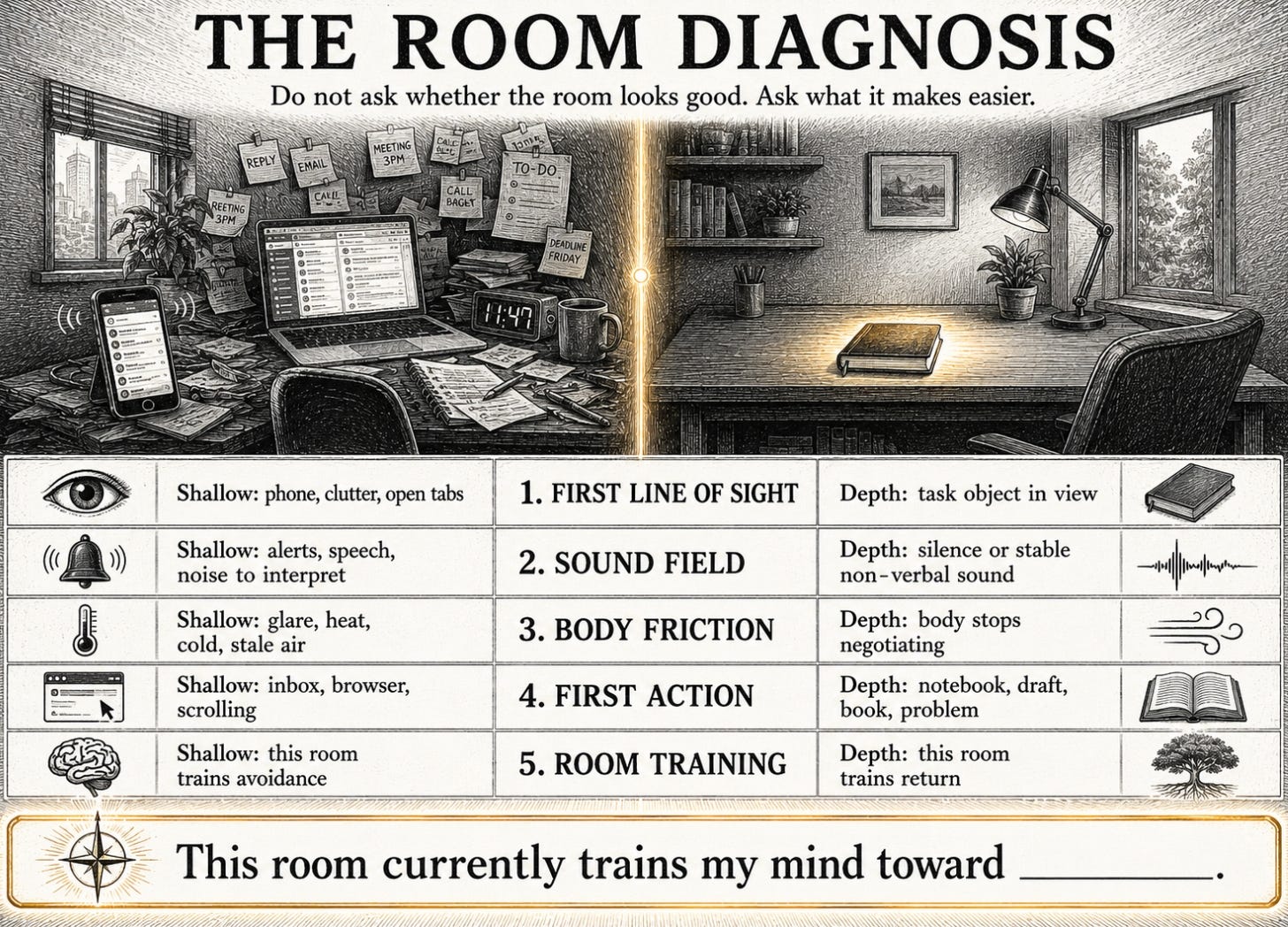
The Room Diagnosis
Choose one room or work position where you regularly ask for depth.
Then answer five lines.
1. What does this room keep inviting me to do?
Work, scroll, answer, compare, snack, collapse, rehearse, tidy, avoid, think, pray, create?
2. What does the first line of sight show me?
The work?
The phone?
Clutter?
Another task?
An unresolved demand?
3. What sound keeps asking to be interpreted?
Speech, notifications, movement, office noise, silence that feels exposed, or background audio that pulls language processing?
4. What does the body keep solving?
Light, glare, heat, cold, stale air, chair friction, posture, discomfort?
5. Is the first right action easier than the first wrong action?
Is the notebook easier than the phone?
Is the draft easier than the inbox?
Is the book easier than the browser?
Then write one sentence:
This room currently trains my mind toward ________.
That sentence is the hinge.
Because below the paywall, the work becomes exact.
You will identify whether the room is leaking threat, creating friction, deadening the task, or inviting the wrong action.
You will subtract from the visual field instead of decorating it.
You will set sound according to task demand, not mood.
You will use light, air, temperature, and scent as state cues without turning them into superstition.
You will arrange tools so the room begins to carry part of the task.
And you will build one recognizable Depth Configuration that can be re-entered.
