

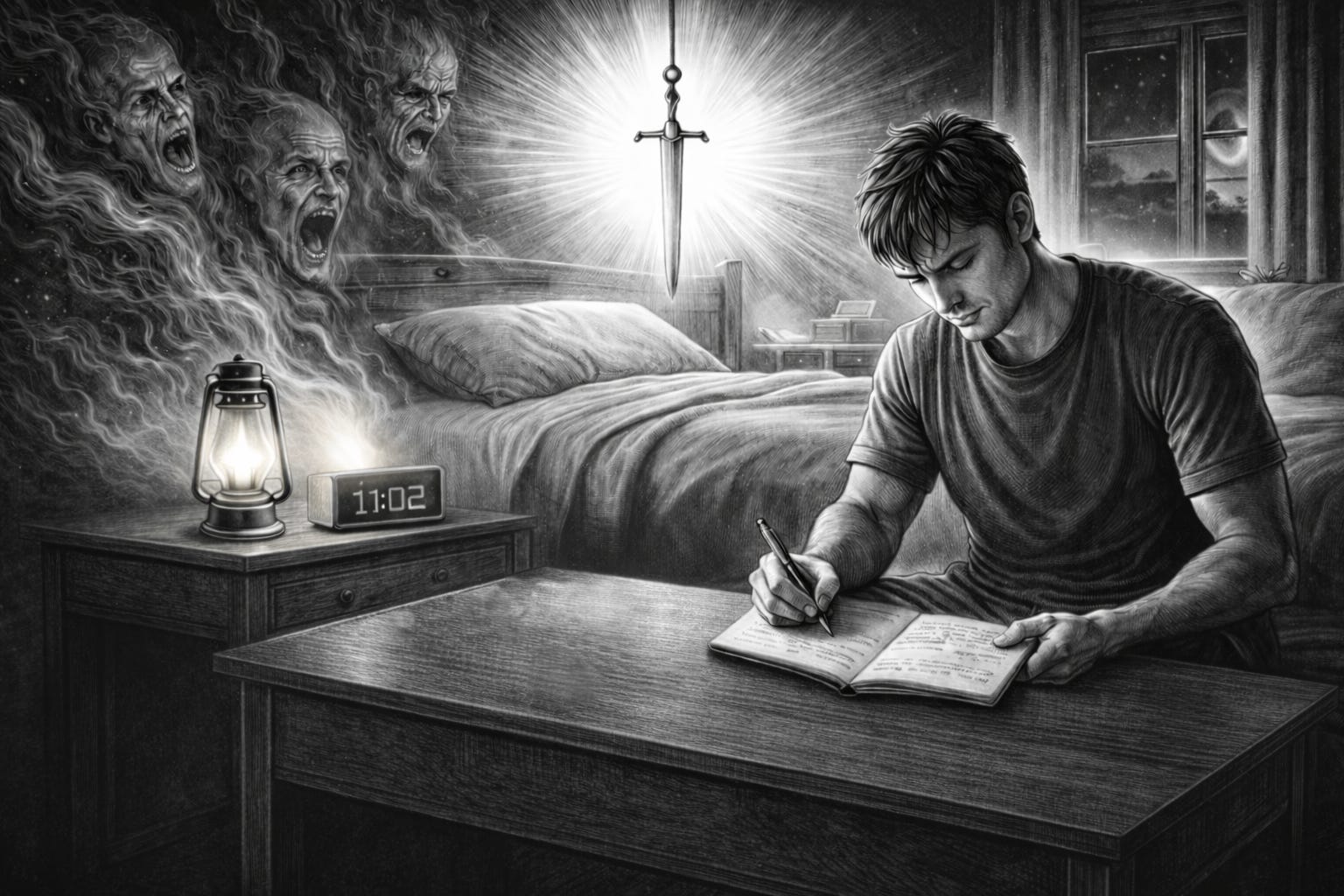
If your mind only attacks you at night, it is not because you are broken. It is because the day finally stopped distracting you.
Many people can work, speak, answer messages, even look composed, then lie down and feel the whole weight of their life arrive at once.
The room is quiet.
The body is tired.
The mind begins its audit.
This is the night sword.
By the end of this essay, you will understand why threat gets louder after dark, why most sleep advice misses the real problem, and what to do tonight so your bed stops becoming a place of negotiation.
Where this series is going
This essay is part of a wider sequence on chronic worry, threat, and nervous system load. The Sword Above the Feast named the problem: why worry becomes toxic when threat stays mentally alive. The Threat Ledger turned that insight into a practical frame, and the Field Manual translated it into rules and drills. This piece moves into one of the main fronts where the same mechanism keeps working: the night, when distraction falls away, and unresolved threat becomes louder. The essays that follow will move through uncertainty, perfectionistic threat, and the safety behaviours that keep anxiety alive. Some pieces will clarify the mechanism. Others will provide the protocols.
Already live
· The Sword Above the Feast: Why Worry Becomes Toxic, 26 February 2026, Open essay
· The Threat Ledger: Stop Paying for Tomorrow in Advance, 5 March 2026, Open essay
· The Threat Ledger Field Manual: Rules, Drills, Failure Modes, 9 March 2026, Subscriber protocol
Coming next
· 16 March 2026, Subscriber protocol: The Night Sword Field Manual: A 7-Night Reset for Racing Thoughts, Bed Cues, and 3 A.M. Wake-Ups
· 19 March 2026, Open essay: Uncertainty Training: Why Your Mind Keeps Rehearsing What Has Not Happened Yet
· 23 March 2026, Subscriber protocol: The Uncertainty Ladder: A 7-Day Protocol for Tolerating Uncertainty Without Reassurance
· 26 March 2026, Open essay: The Inner Tyrant: When High Standards Become a Chronic Threat System
· 30 March 2026, Subscriber protocol: The Tyrant Audit: A 7-Day Reset for High Standards Without Self-Punishment
· 2 April 2026, Open essay: The Safety Behaviours That Keep Anxiety Alive: Reassurance, Over-Preparing, and False Relief
· 6 April 2026, Subscriber protocol: The Anti-Collusion Protocol: A 7-Day Plan to Stop Reassurance Loops, Over-Preparing, and Doomscrolling
New public essays publish on Thursdays. Subscriber protocols follow on Mondays.
Why the sword gets louder at night
The first mistake is to think the night creates the problem.
Usually, it reveals it.
During the day, life gives you friction. Tasks. Noise. Movement. Conversations. Deadlines. Stimulation. Even when you are strained, the outside world keeps pulling your attention outward.
At night, that outward pull weakens.
What was held back by motion now has space to rise.
This matters because stress is not only driven by events. It is driven by what the mind keeps representing as unresolved threat. Brosschot and colleagues called this perseverative cognition: worry and rumination that prolong stress-related activation before and after the event itself, not only during it.1
In plain language, the problem is not only what happened today.
It is what your mind refuses to let end.
That is why the same person can feel “fine” at 3 p.m. and suddenly mentally flooded at 11 p.m. The threat did not arrive at night. The day simply stopped covering it.
There is another layer.
Night also strips away false control.
In daylight, you can mistake motion for progress. You can answer one more message, open one more tab, make one more list, check one more number. These actions often feel like management. At night, many of those actions are no longer available, or no longer socially justified, so the mind is left with the one thing it fears most: uncertainty.
And uncertainty is gasoline for anticipatory arousal. When the future is unclear, the mind biases toward vigilance, prediction, and rehearsing possible harm, as if dark imagination might purchase safety in advance.2
It does not.
It only keeps the sword suspended.
Why most sleep advice misses the point
A lot of sleep advice treats racing thoughts as background noise.
That is too shallow.
Your mind is not generating random static. It is usually trying to prevent surprise.
That does not make the process wise. It makes it intelligible.
Harvey’s cognitive model of insomnia helps here. Insomnia is not only a problem of insufficient tiredness. It is often maintained by cognitive arousal, threat monitoring, effortful attempts to sleep, and safety behaviours that make sleep more difficult rather than less.3
This is why telling an activated person to “just relax” is often useless.
It mistakes the symptom for the mechanism.
If the mind believes something is unresolved, dangerous, or uncertain, it does not respond to vague instructions to calm down. It responds to containment, clarity, and a visible reduction in open loops.
There is a second mistake.
People turn the bed into a place of effort.
They lie there trying harder. Forcing sleep. Negotiating with thoughts. Checking the time. Measuring how damaged tomorrow will be. That effort matters, because it can train the bed to become associated with wakefulness, frustration, and performance pressure rather than sleep itself. Stimulus control principles in CBT-I are built partly to reverse that learning process.4
So the night sword usually has two edges:
First, unresolved threat.
Second, the pressure to sleep.
Once both are active, the bed stops feeling like refuge and starts feeling like a test.
The real move is not “calm down”
The real move is to relocate the threat.
Most people try to solve night worry inside the night itself.
That is too late.
If you want the mind to stop processing threat in bed, you need to move that processing earlier, into a container, while you still have cognitive control and distance. This is the logic behind constructive worry in CBT-I. You do not wait until you are under the sword. You sit down earlier, name the worries, define the next step where one exists, and reduce the need for the mind to keep returning to them in bed.5
That is the shift.
Not suppression.
Not sedation.
Containment.
Your mind does not need to become innocent before sleep.
It needs to stop holding the case open.
The Night Sword has three common forms
It helps to see what usually arrives after dark.
1. The unfinished future
This is the classic one.
Money. Work. Reputation. Health. A difficult conversation. A decision you have postponed. Something with consequences that are still unfolding.
The mind keeps returning because nothing feels sealed.
2. The ambiguous signal
A message not answered.
A symptom not explained.
A relationship that feels uncertain.
A business outcome you cannot yet read.
These are hard because ambiguity tempts the mind into story-building. And story-building in the dark almost always bends toward threat.
3. The pressure to perform sleep
This is the hidden one.
You stop worrying only about the original problem and start worrying about sleep itself.
Now the mind says:
You need to sleep.
You are still awake.
Tomorrow will be ruined.
Why are you still thinking.
What is wrong with you.
At that point the night has become self-feeding.
The original sword is still there, but now you are also frightened of your own state.
What to do tonight
This is not the full protocol. That comes next.
This is the minimum effective move for tonight.
The Tonight Plan
1. Move the worry out of bed.
Roughly two hours before sleep, sit somewhere that is not your bed. Paper is better than a screen.
2. Write no more than three swords.
Not ten. Not everything. Three.
Use one sentence for each.
“I am afraid revenue will dip next month.”
“I am afraid this symptom means something serious.”
“I am afraid their silence means rejection.”
3. For each sword, choose one of two outcomes.
Either:
one next action for tomorrow, scheduled, or
one release sentence if no action exists tonight
Examples:
“Tomorrow at 11:00, I will review cash flow for 20 minutes.”
“I have already booked the appointment. I am not allowed to diagnose myself in bed.”
“I sent the message. No more checking tonight.”
4. Close the page.
Use a single closing line:
“I have named the sword. I have chosen the next step or the release. I will not carry this into bed as an open case.”
5. If you are awake in bed and activated, stop trying harder.
Do not keep wrestling there. Leave the bed. Low light. Quiet chair. No phone. No new information. Return only when you feel sleepy again. This protects the bed from becoming a place of mental combat, which is a central concern in CBT-I stimulus control work.6
That is enough for tonight.
Not perfect sleep.
Not instant peace.
Just a cleaner handoff between mind and body.
What not to do tonight
This matters as much as the plan.
Do not open a new information loop
No symptom searching. No late-night bank-account spirals. No checking whether they replied. No doomscrolling under the excuse of staying informed.
If the mind is already activated, more input rarely resolves it. It usually widens the field of threat.
Do not use the bed as a courtroom
The bed is not where you prosecute your life.
It is not where you assess your worth, audit your future, or cross-examine your mistakes.
Do not chase the feeling of perfect calm
That becomes another form of effort.
Your job is not to produce a magical state. Your job is to reduce open loops and stop reinforcing the association between bed and threat.
Do not confuse exhaustion with resolution
Many people fall asleep only when worry burns them out.
That is not recovery. That is collapse.
The aim is cleaner closure, not mere depletion.
Why this works
Because the mind is often less interested in peace than in unfinished business.
If threat remains cognitively active, the system stays mobilised. If threat is named, classified, converted, and contained, the need for night-time rehearsal drops. That does not mean one evening solves every case. It means the mechanism is no longer being fed in the same way.7
The bed also matters.
If you repeatedly pair bed with striving, clock-watching, threat rehearsal, and frustration, you train wakefulness there. If you protect the bed from that sequence, you begin to restore the older association: sleep, not struggle.8
That is the larger principle beneath the technique.
The night is not your enemy.
Uncontained threat is.
A necessary boundary
Not every sleep problem is the same.
If your sleeplessness is severe, persistent, or accompanied by panic, trauma symptoms, major mood shifts, substance effects, or thoughts that feel dangerous or uncontrollable, do not reduce this to a self-help issue. Seek professional support.
This essay is about mechanism and practice. It is not a replacement for care.
The standard to keep
You do not need to solve your whole life before sleep.
You need to stop asking the dark to do what daylight failed to contain.
Tonight, do one clean rep.
Move the worry out of bed.
Name three swords.
Choose one next step or one release line for each.
Close the page.
Protect the bed.
That is the standard.
Not endless analysis.
Not midnight courage.
Containment.
For the full sequence
If this essay named something real for you, subscribe.
The open essays explain the mechanism. The subscriber protocols turn it into practice: worksheets, scripts, decision rules, troubleshooting, and full implementation plans designed to be used under pressure, not merely admired in theory.
Next Monday’s subscriber edition is The Night Sword Field Manual, a 7-night reset for racing thoughts, bed cues, and 3 A.M. wake-ups.
Brosschot, J.F., Gerin, W. and Thayer, J.F. (2006) ‘The perseverative cognition hypothesis: a review of worry, prolonged stress-related physiological activation, and health’, Journal of Psychosomatic Research, 60(2), pp. 113–124. doi:10.1016/j.jpsychores.2005.06.074.
Brosschot, J.F. (2010) ‘Markers of chronic stress: prolonged physiological activation and (un)conscious perseverative cognition’, Neuroscience & Biobehavioral Reviews, 35(1), pp. 46–50. doi:10.1016/j.neubiorev.2010.01.004.
Grupe, D.W. and Nitschke, J.B. (2013) ‘Uncertainty and anticipation in anxiety: an integrated neurobiological and psychological perspective’, Nature Reviews Neuroscience, 14(7), pp. 488–501. doi:10.1038/nrn3524.
Harvey, A.G. (2002) ‘A cognitive model of insomnia’, Behaviour Research and Therapy, 40(8), pp. 869–893. doi:10.1016/S0005-7967(01)00061-4.
Edinger, J.D. and Carney, C.E. (2008) Overcoming Insomnia: Workbook: A Cognitive-Behavioral Therapy Approach. New York: Oxford University Press. doi:10.1093/med:psych/9780195365900.001.0001.
Edinger, J.D. and Carney, C.E. (2008) Overcoming Insomnia: Workbook: A Cognitive-Behavioral Therapy Approach. New York: Oxford University Press. doi:10.1093/med:psych/9780195365900.001.0001.
Edinger, J.D. and Carney, C.E. (2008) Overcoming Insomnia: Workbook: A Cognitive-Behavioral Therapy Approach. New York: Oxford University Press. doi:10.1093/med:psych/9780195365900.001.0001.
Brosschot, J.F., Gerin, W. and Thayer, J.F. (2006) ‘The perseverative cognition hypothesis: a review of worry, prolonged stress-related physiological activation, and health’, Journal of Psychosomatic Research, 60(2), pp. 113–124. doi:10.1016/j.jpsychores.2005.06.074.
Brosschot, J.F. (2010) ‘Markers of chronic stress: prolonged physiological activation and (un)conscious perseverative cognition’, Neuroscience & Biobehavioral Reviews, 35(1), pp. 46–50. doi:10.1016/j.neubiorev.2010.01.004.
Chrousos, G.P. (2009) ‘Stress and disorders of the stress system’, Nature Reviews Endocrinology, 5(7), pp. 374–381. doi:10.1038/nrendo.2009.106.
Edinger, J.D. and Carney, C.E. (2008) Overcoming Insomnia: Workbook: A Cognitive-Behavioral Therapy Approach. New York: Oxford University Press. doi:10.1093/med:psych/9780195365900.001.0001.
Harvey, A.G. (2002) ‘A cognitive model of insomnia’, Behaviour Research and Therapy, 40(8), pp. 869–893. doi:10.1016/S0005-7967(01)00061-4.
This article explains something I’ve struggled to put into words.
When the world goes quiet, my mind gets loud.
Not because something is wrong, because the day’s distractions are gone and whatever I’ve been carrying finally has space to surface.
What I appreciated is you don’t do the usual “just stop worrying” advice. You actually respect what it feels like when the mind races at night, then you explain the science of why it happens, and then you give a solution that’s practical.
If nights are when your worry shows up most, read this. It will make you feel understood and give you a way through it.