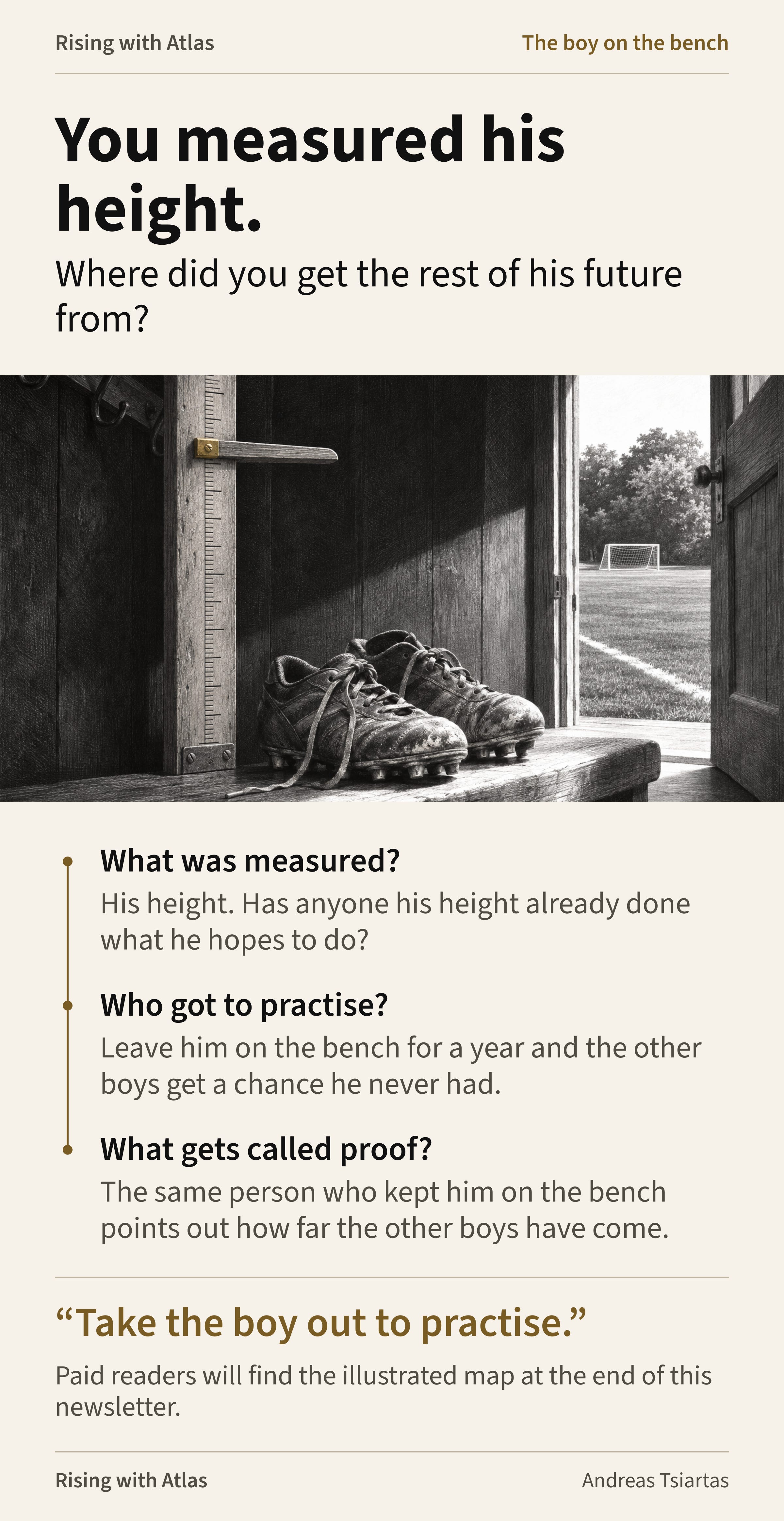
Someone tells a teenager he is too short to achieve his ambition. But he fails to ask if anyone of the same height has achieved what the teenager aims to achieve. This person is revealing a bias; and he is revealing that he does not mean the teenager well.
“I’m only being objective,” the person says.
You measured his height. Where did you get the rest of his future from? Of all the things you could have taken an interest in about that boy, you chose the one thing he can do nothing about. And you want credit for your objectivity.
Someone who insists on pointing out your weaknesses and refuses to see your greatness does not mean you well. Give that person a say in who gets picked, or taught, or given a second chance, and they can do real harm. They can leave the boy on the bench for a year and then have the nerve to point out how far the other boys have come.
Would you have left that boy on the bench if someone you trusted had told you he had a gift? In The Pygmalion and Rosenthal Effect, I look at what happened when teachers were told to expect remarkable progress from children whose names had been picked at random.
Everyone great had people who saw the greatness in them long before it manifested. And everyone great had great people around them who gave serious thought to how they could draw that greatness out. This point cannot be emphasised enough. Man is not a fixed thing. Man is a becoming.
Consider what it means for a child to grow up with a father who always tells him he has genius in him. He fails at sport. He fails at something at school. What does he do with those failures? He keeps looking for that greatness his father is certain exists. I want you to appreciate what the boy has been given here. He can bring home the worst report in his class and still have somebody to sit down with who is genuinely interested in finding out what he could do well. Viktor Frankl, the author of Man’s Search for Meaning, spoke about what it means to see a man in terms of what he could become.1 He pointed out that this draws out latent power, hidden powers, possibilities!
That father brings me back to Olympias, the mother of Alexander the Great. In Thursday’s newsletter, Is Anyone Self-Made?, I asked how much of Alexander’s belief in himself could be separated from his mother’s belief in him.2 Her family traced its descent to Achilles. And when the boy went to his lessons, what did his tutor Lysimachus call him? Achilles.3 Think what it meant to hear the name of the hero you grew up hearing about at home spoken to you as your own. Now think of the boy we left on the bench. What words will he take home with him?
Roy Disney had his own way of letting his younger brother know what he saw in him. When Walt was struggling in Kansas City, Roy sent him cheques. Sam Walton needed the barbershop next door to make his new store big enough. The owners wouldn’t budge. His father-in-law went to Kansas City and negotiated the lease without telling him. The work Walt and Sam went on to do was their own.4 But what could each man do the morning after somebody had acted on his behalf that he couldn’t do the morning before?
I want you to bring one ambition of your own to that question. Think of the person you usually tell first when you’ve made some progress. What happened the last time you told them? By the time you finish reading, I want you to have a name in mind and a request worth making. It may surprise you whom you choose.