

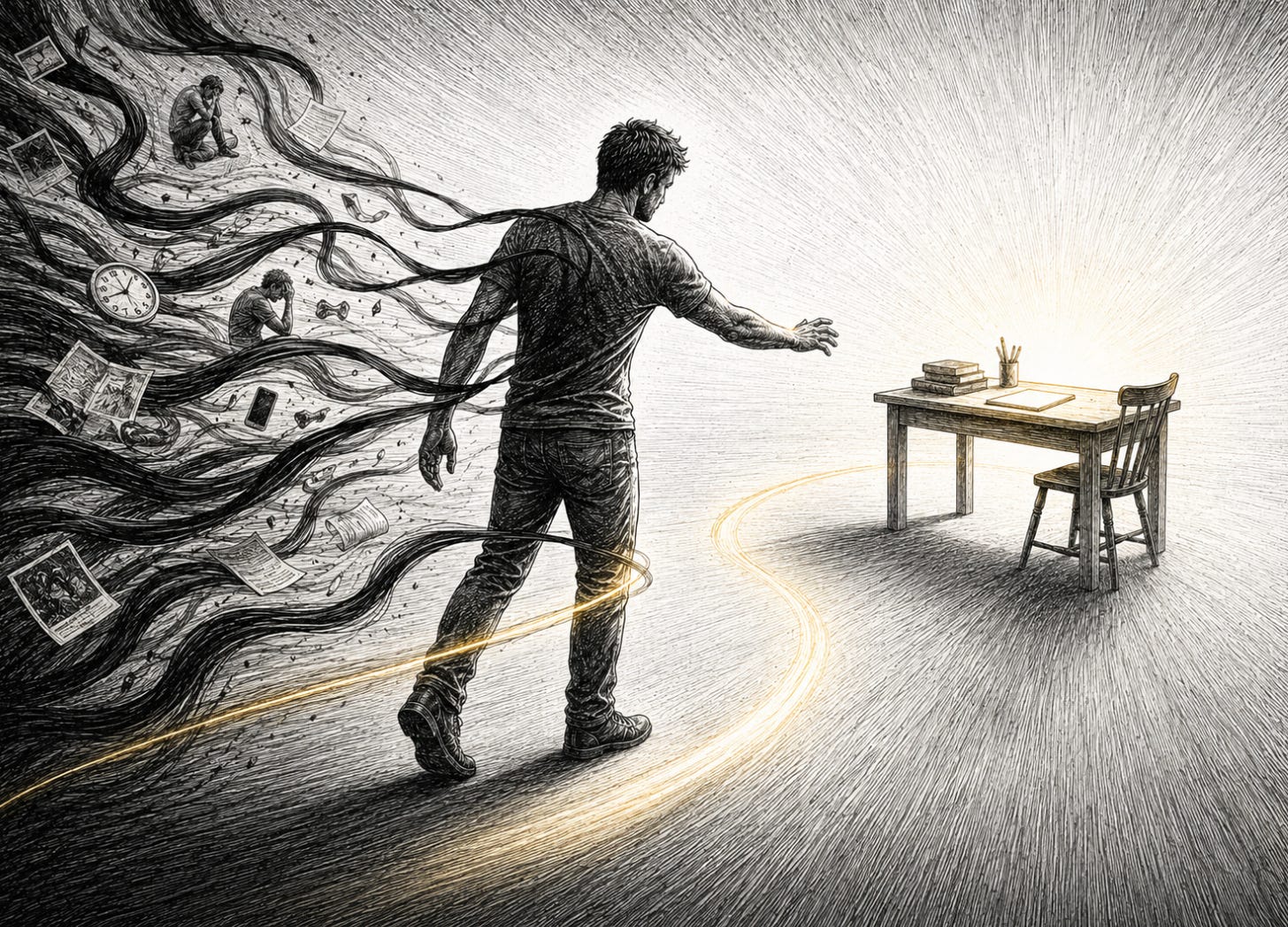
A task can matter deeply and still fail to hold the whole of you.
You can know why it matters.
You can choose it freely.
You can believe you can begin.
You can even feel the weight of service, craft, duty, or truth behind it.
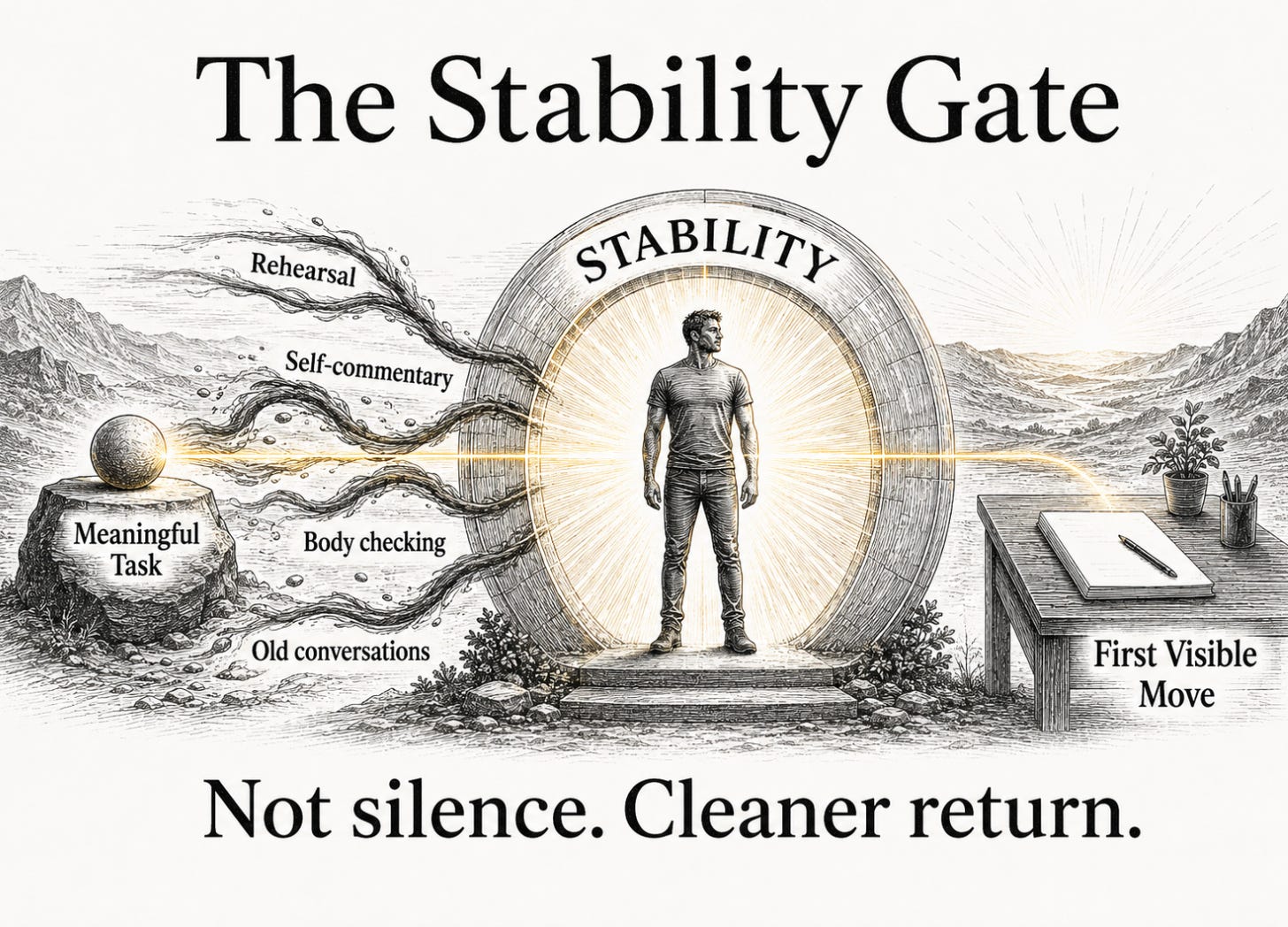
And still your attention leaks.
Into rehearsal.
Into self-commentary.
Into old conversations.
Into imagined judgment.
Into body sensations.
Into tiny impulses to check, shift, fix, escape, or narrate.
That is the problem this manual is built to solve.
The previous essay argued that meaning changes the depth of attention. A task that feels genuinely significant often draws more of the system toward it. But meaning does not automatically stabilize perception. You can bring a meaningful task to the threshold and still fracture every few seconds because the perceiving system is too noisy to stay.
That is the gate Pair 7 names.
Not motivation.
Not consent.
Not meaning.
Stability.
Flow research continues to describe the state through deep absorption, intense concentration, reduced self-consciousness, and tight action-awareness coupling. Mindfulness research, by contrast, centers present-moment awareness, attention regulation, and a changed relationship to thoughts, feelings, and sensations. These are not identical states, but the relationship matters. Mindfulness may help prepare the mind for deeper work by reducing internal leakage, improving attentional recovery, and changing how experience is held before the task begins.1
This manual is the operational version of that claim.
It is not a meditation sermon.
It is not wellness branding.
It is not an attempt to empty the mind.
It is a way of making the perceiving system steadier before you ask it to disappear into the work.
Where this series is going
This season explores the hidden architecture of flow, not as hacks but as a field theory of entry, coherence, and peak mental states.
Today: Reduce Internal Noise Before the Work Begins
This manual gives you:
The Internal Leakage Audit
The Noise Map
The Anchor Selector
The Three-Minute Stability Sequence
The Open-or-Narrow Monitoring Guide
The Transition Phrase
The Mid-Block Weather Reset.
Already live:

Next: Movement Changes the Conditions of Thought.
Upgrade for the full sequence of field manuals, templates, and troubleshooting.
Most people fail here because they ask the wrong question.
They ask:
How do I stop thinking?
That question creates another fight.
A thought appears, and now the person has two problems: the thought itself, and the effort to not be having it. A sensation appears, and now the body becomes the enemy. A memory appears, and now the person argues with the memory. An impulse appears, and now attention divides into manager and rebel.
That is not stability.
That is internal war disguised as discipline.
The sharper question is different:
How do I become less governable by internal noise when the work begins?
That question is closer to the real mechanism.
Mind wandering is not rare. Conscious experience is naturally fluid, and attention often shifts from the current task toward unrelated thoughts, images, plans, feelings, or self-generated material.2 The issue is not that the mind ever moves. The issue is whether every movement becomes a command.
This is where mindfulness becomes useful for serious work. Bishop and colleagues describe mindfulness through attention regulation and an open orientation toward present experience, while Hadash and colleagues argue that mindfulness training appears to primarily target internal attention processes, meaning processes that operate on internally generated or stored material rather than only early-stage external attention.3
That is exactly the missing piece in many deep work failures.
The room is not always the problem.
The task is not always the problem.
The meaning is not always the problem.
Sometimes the inner field is simply too unstable.
Before the paywall, do this first.
The Internal Leakage Audit
Take one meaningful task that should have gone deeper than it did.
Then answer five lines.
1. What kept leaking into the block?
Rumination, rehearsal, commentary, body sensations, fantasy, self-evaluation, future planning, old conversations, checking impulses, emotional residue?
2. Did the leakage pull me backward, forward, sideways, or inward?
Backward into replay.
Forward into rehearsal.
Sideways into distraction.
Inward into body monitoring or self-consciousness.
3. What did I do when I noticed it?
Obey it, fight it, judge it, follow it, suppress it, or return?
4. What secondary noise did I add?
Frustration, shame, self-attack, urgency, impatience, fear that the block was ruined?
5. What would a cleaner return have looked like?
Then write one sentence:
The internal noise that governs me most before deep work is ________.
That sentence is the hinge.
Because below the paywall, the manual becomes exact.
You will learn how to map internal noise without feeding it.
You will choose the right anchor for the state you are actually in.
You will decide when to use narrow attention and when to use open monitoring.
You will run a three-minute stability sequence before the block.
You will use a transition phrase so awareness becomes action rather than another place to hover.
And you will have a reset for the first surge of internal weather instead of treating it as failure.
