


A task can be meaningful, chosen, and worth doing, and still fail to take the whole of you.
You can know why it matters.
You can freely endorse it.
You can believe you are capable of it.
You can even feel a real pull toward it.
And still your attention leaks.
Into commentary.
Into rehearsal.
Into bodily noise.
Into self-monitoring.
Into drifting thought.
Into the subtle restlessness of a mind that never quite settles enough to disappear properly into the work.
That is the subject of this essay.
By the end of it, you will understand why meaning and autonomy are still not enough if perception remains unstable, why mindfulness is not a decorative wellness layer but a serious attentional training, why mindfulness and flow are related without being identical, why I use the phrase perceptual stability, and why one of the hidden conditions of deep work is the ability to notice internal noise without being repeatedly carried away by it. A 2024 workplace study found that mindfulness built up over an 8-week MBSR program tracked with decreasing stress and increasing flow over time, especially in emotionally exhausted individuals, while a major 2026 review argued that mindfulness training primarily targets internal-attention processes such as mind wandering, meta-awareness, and attention to internal experience.1
Where this series is going
Flow Begins Before the Work Begins laid the ground. It defined flow, argued for its importance in human performance, and introduced the threshold thesis: peak states do not begin at the visible moment of work, but in the conditions that precede it.
The Body Is the Ignition Key moved to physiology: sleep, circadian timing, metabolic steadiness, inflammation, and optimized activation as preconditions of deep states.
Vigilance Kills Absorption moved to guarding: how threat-monitoring, self-surveillance, and unresolved uncertainty make clean descent difficult.
How boredom can be your secret weapon for success moved to pull: why boredom often signals badly designed engagement, and why curiosity and live questions help attention descend rather than merely stay put.
The Mind Rarely Goes Deep Under Coercion moved to consent: why autonomy, competence, and self-efficacy matter because a coerced mind can comply while still failing to descend cleanly.
Meaning Changes the Depth of Attention moved to significance: why the mind gives more of itself to work it judges worthy of that expenditure.
This essay moves to the next gate.
Stability.
Because a task can be meaningful, chosen, and significant, yet still remain hard to enter if the perceiving system is too noisy, too reactive, too scattered, or too easily captured by its own internal weather.
The essays that follow will move through exercise, environment, relationships, group flow, compounds, salience, and the difference between clean elevation and distorted intensity.
Some pieces will clarify the mechanism.
Others will provide the protocols.
Already live


Coming next
· Reduce Internal Noise Before the Work Begins, 1 June 2026, Subscriber protocol
The Stability Protocol for breath, awareness, and perceptual grounding
· Movement Changes the Conditions of Thought, 4 June 2026, Open essay
Exercise and the state transition problem
· Use Exercise to Enter Work, Not Escape It, 8 June 2026, Subscriber protocol
The Pre-Flow Exercise Protocol for activation without overshoot
New public essays publish on Thursdays. Subscriber protocols follow on Mondays.
Meaning can deepen attention. Noise can still scatter it
The previous essay argued that the mind gives more of itself to work it judges worthy of that expenditure.
That was necessary.
It was not sufficient.
Because value does not stabilize perception by itself.
A task can be deeply significant and still fail to hold the mind if the perceiving system keeps getting pulled off course by rumination, rehearsal, bodily preoccupation, emotional reactivity, self-evaluation, or intrusive streams of internally generated material.
This is one reason highly motivated people can still fail to enter cleanly.
They do not lack meaning.
They lack stability.
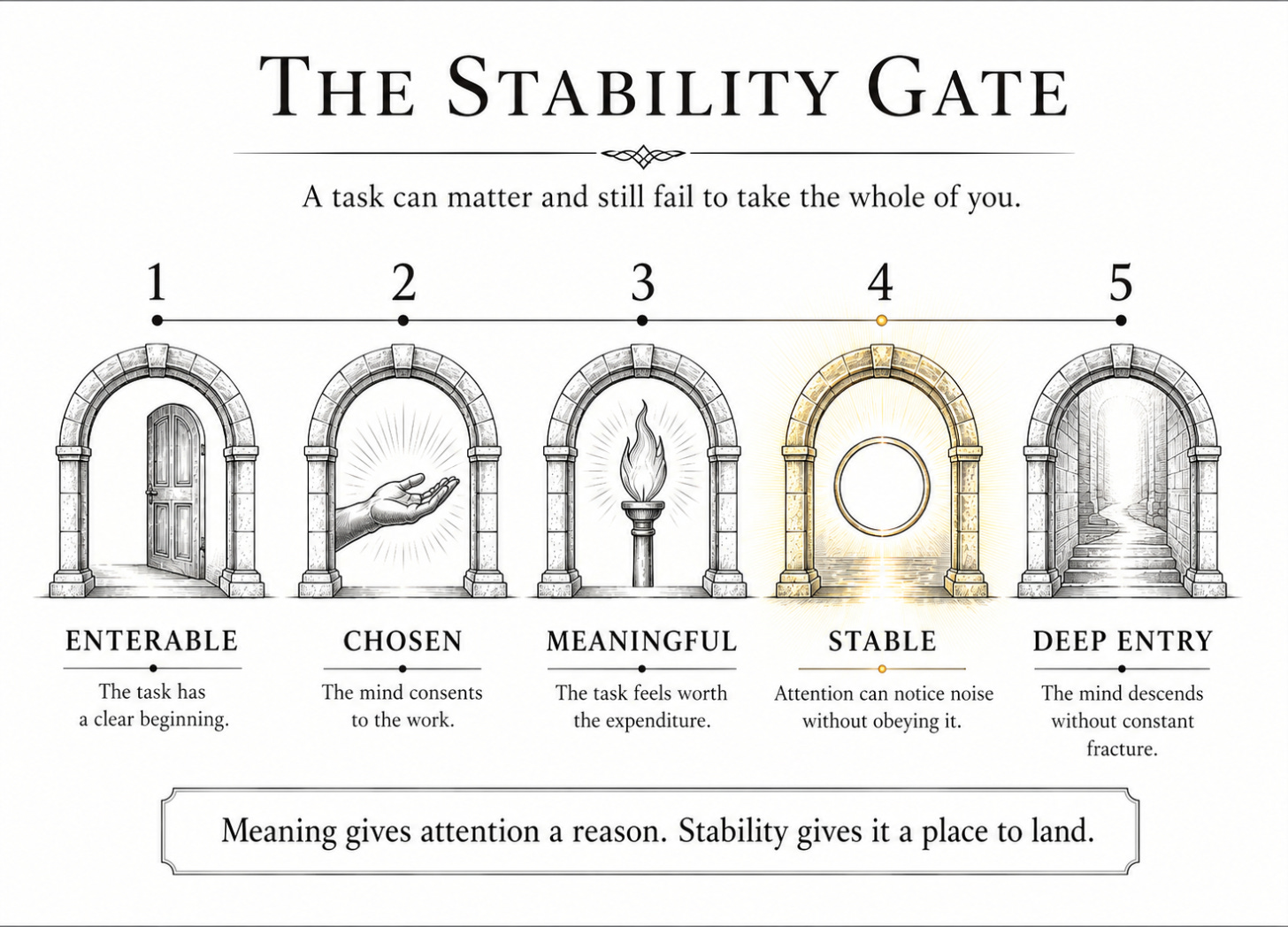
That distinction matters because flow is not just effort directed toward something valuable. It is a state of coherent absorption, and coherence becomes difficult when attention is repeatedly hijacked by internally generated noise rather than remaining available to the task. Flow reviews continue to define the state through deep absorption, intense concentration, reduced self-consciousness, and coupled action and awareness.2
What mindfulness actually is
Mindfulness is often flattened in both directions.
Some people mystify it.
Others trivialize it.
Neither helps.
A useful working description is simple: mindfulness involves present-moment, non-judgmental attention, typically cultivated through practices of focused attention or open awareness. A 2022 network-neuroscience study describes mindfulness as the ability or tendency to consciously engage in a state of non-judgmental, present-moment attendance, cultivated through meditation practices that employ focused attention or open awareness toward sensations and experience.3
That matters because mindfulness is not just “calming down.”
It is also not mere passivity.
It is a disciplined way of relating to experience so that thoughts, sensations, feelings, and impulses are noticed more clearly and followed less helplessly.
That is why I use the phrase perceptual stability in this essay.
I do not mean the elimination of thought.
I do not mean emotional numbness.
I do not mean some permanently serene state.
I mean something narrower and more useful:
a steadier relation to experience, in which attention is less repeatedly yanked away by internal noise, and more able to recover when it drifts.
That is closer to the point.
Mindfulness and flow are not the same state
This distinction is crucial.
I do not want to collapse mindfulness and flow into one thing.
They are related, but not identical.
In fact, one of the more interesting tensions in the literature is that mindful perception and total absorption may not be fully simultaneous in the exact same moment. The 2024 MBSR-flow paper explicitly notes this paradox, citing prior work suggesting that mindful perception of the situation and the absorption of flow may not be experienced simultaneously. Yet the same paper found that, over time, a build-up of mindfulness during training predicted increasing flow and decreasing stress, suggesting mindfulness may function less as the state itself and more as a cultivation of conditions that make flow easier to enter.4
That is a subtle but powerful point.
Mindfulness may not be identical to peak absorption in the moment of total descent.
But it may help prepare the system for cleaner entry by reducing noise, clarifying perception, improving resource allocation, and lowering stress.
That is exactly why it belongs in this season.
Not as a spiritual side route.
As part of the threshold architecture.
Internal attention is one of the missing pieces
This is where the recent literature becomes especially useful.
The 2026 Mindfulness Internal Attention (MIA) Framework argues that attention has always been assumed to matter in mindfulness, but that the evidence looked inconsistent partly because researchers were not distinguishing clearly enough between different kinds of attention. Hadash and colleagues propose that mindfulness training primarily targets internal attention processes, involving internally generated or stored information and experience, rather than all forms of early-stage external attention equally. They also argue that mindfulness training appears to affect executive functions and working-memory processes shared between internal attention and later-stage external attention.5
This is one of the most important conceptual tools for our series.
Because it explains why a person can have a good environment, decent sleep, and a meaningful task, yet still fail to go deep if the internal field is too turbulent.
Thoughts rehearse.
Predictions multiply.
Old scenes replay.
Sensations intrude.
Tiny worries branch out.
Attention is not only dealing with the work. It is also dealing with its own weather.
If mindfulness mainly helps at the level of internal attention, then it makes sense that it would matter for flow.
Flow is fragile to internal leakage.
Mindfulness trains the management of that leakage.
A noisy mind is not only distracted. It is expensive
This is another important distinction.
When people talk about internal noise, they often frame it only as distraction.
That is too weak.
Internal noise is not just annoying.
It is expensive.
A mind caught in rumination, rehearsal, evaluative commentary, and repeated involuntary drift is spending attentional force somewhere other than the task.
That cost matters because deep states require not only directed effort, but a certain freedom from needless internal expenditure.
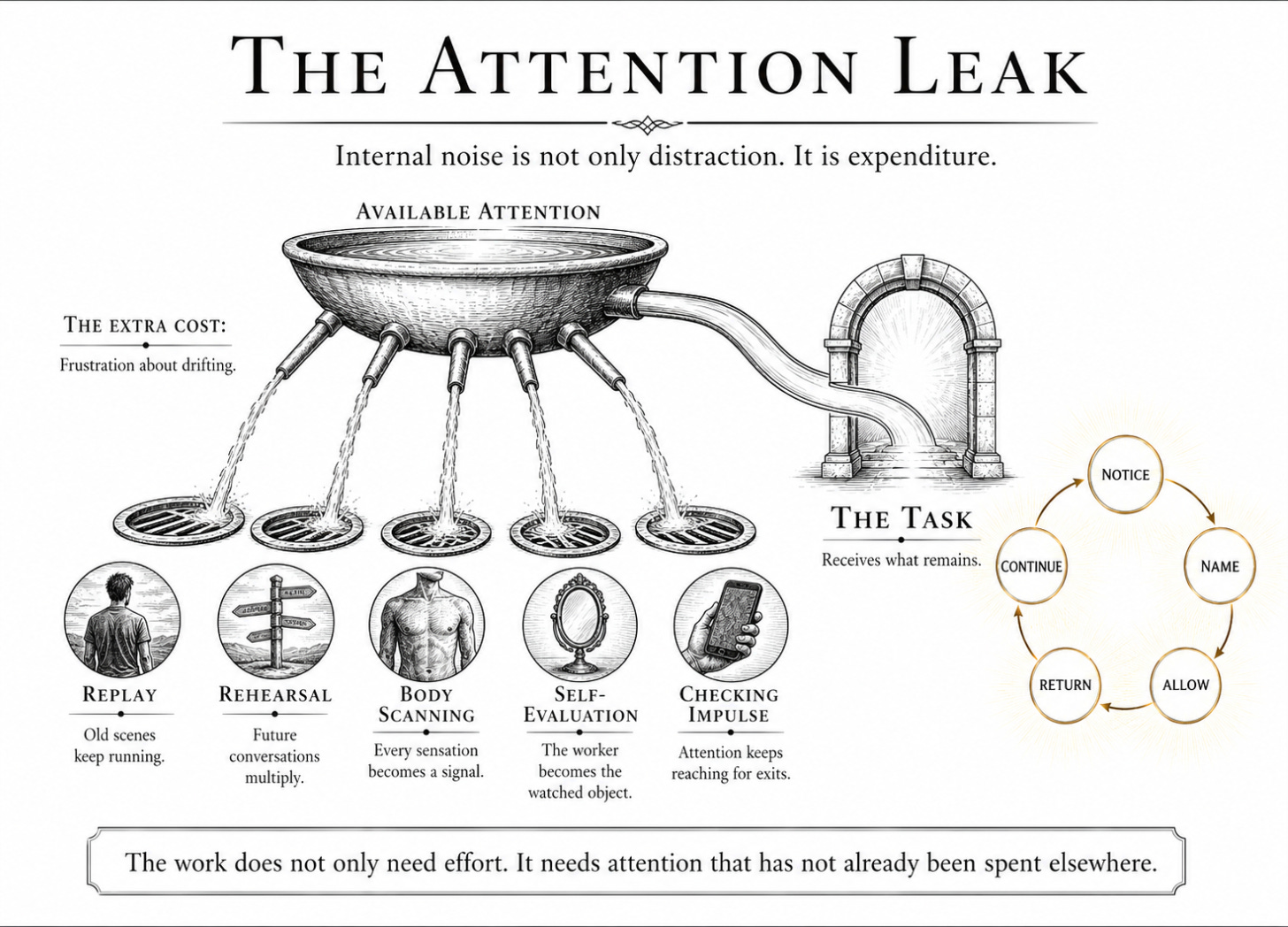
The 2024 workplace MBSR study is useful here again. The authors argue that mindfulness training may lead to clearer and more accepting perception of demanding situations along with more efficient resource allocation, thereby promoting flow and reducing stress. Their results showed linear increases in both mindfulness and flow over eight weeks, with stronger gains among emotionally exhausted individuals.6
That is a serious finding.
Because it suggests mindfulness is not only “good for calm.”
It may help reduce the internal waste that competes with depth.
What mindfulness seems to change in the brain
We should be careful here.
This literature is still developing, and I do not want to oversell it.
But several findings point in a coherent direction.
The 2022 Scientific Reports study on meditation-naïve adults found that one month of mindfulness meditation training increased functional connectivity between parts of the default mode, salience, and central executive networks. The authors interpret these results as potentially allowing the salience network to modulate more effectively between default-mode dominance and executive re-engagement, helping practitioners regain attention more efficiently. They also note that DMN abnormalities are linked to rumination, and that prior research found key DMN regions relatively less active in experienced meditators.7
Again, the point is not to make inflated neuro-claims.
The point is simpler.
Mindfulness may help the system notice drift and recover task-positive control with less friction.
That is exactly the kind of function a flow architecture would care about.
Because the quality of a deep work block depends not only on how little attention drifts, but on how well it can be recovered once it does.
The evidence on attention is no longer trivial
This is not only theory.
The intervention literature is no longer thin enough to ignore.
A 2024 study of brief mindfulness meditation training in young adult males found improved dispositional mindfulness, enhanced attention allocation to light stimulation, prolonged individual attention, and marginally significant improvement in executive control after four weeks, although it did not improve alerting or orienting networks equally. Meanwhile, a 2024 meta-analysis of 111 randomized controlled trials concluded that mindfulness-based interventions showed small-to-moderate effects on global cognition, executive attention, working-memory accuracy, inhibition accuracy, shifting accuracy, sustained attention, and subjective cognitive functioning.8
That does not mean mindfulness solves all attentional problems.
It does mean the evidence base is now strong enough to treat mindfulness as a serious cognitive-performance variable rather than a purely therapeutic or spiritual one.
That matters for this season.
Because if we are building a field theory of flow and peak mental states, then attentional recovery, internal stability, and the management of mind wandering are not optional side topics.
They are central.
Why this belongs after meaning
The sequence matters.
This essay comes after meaning on purpose.
Because a task can become more meaningful and still remain hard to enter if the perceiving system has poor stability.
You can care deeply and still keep drifting.
You can value the work and still keep reacting to every internal ripple.
You can know exactly what is at stake and still find that your own mind keeps placing little taxes on the act of entry.
That is why we had to move in this order:
first the task must become enterable,
then willingly chosen,
then meaningful,
and only then can we fully face the problem of internal noise.
The mind may now have enough reason to go deep.
The next question is whether it can stay with the task long enough, and recover itself gently enough, for depth to consolidate rather than constantly fracture.
That is the transition.
Mindfulness is not withdrawal from performance
This is another misunderstanding worth cutting off early.
Some people still assume mindfulness is fundamentally anti-performance, too quiet, too passive, too slow, too inward, too detached from demanding action.
That is confused.
Mindfulness is not the refusal of performance.
It is training in how to relate to experience without being repeatedly owned by every passing movement inside the system.
That can serve wellbeing.
It can also serve performance.
The Hohnemann study is important precisely because it framed mindfulness not only as a stress-reduction tool, but as a possible route to optimal functioning at work, with flow used as one marker of that optimal functioning. The authors explicitly argue that workplace mindfulness research should move beyond stress reduction alone toward the promotion of flow and functioning.9
That aligns perfectly with this season.
Mindfulness belongs here not because it is fashionable.
It belongs here because a noisy mind struggles to go deep.
The rep for today
Do not try to “clear your mind” today.
Audit the noise.
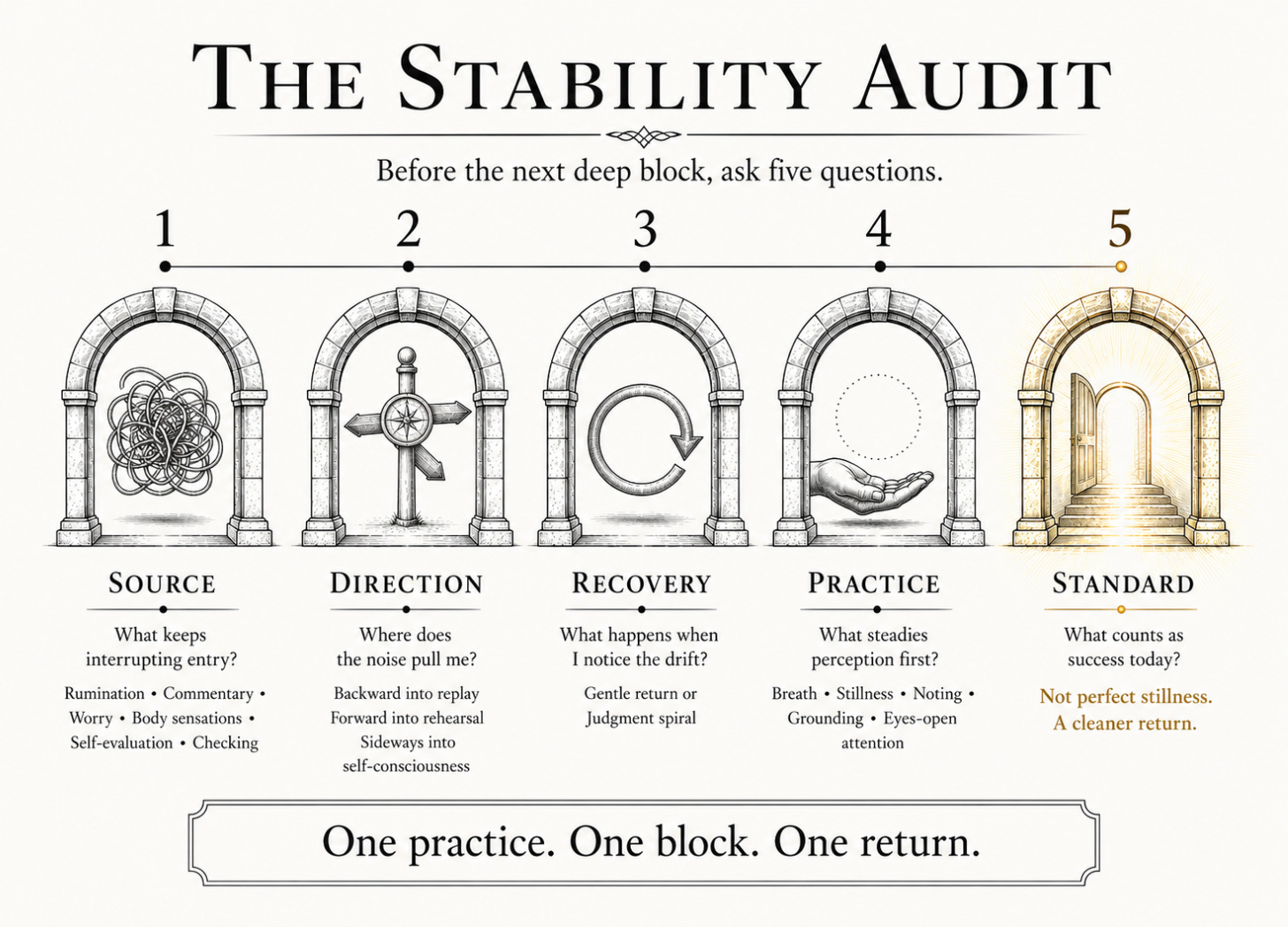
The Stability Audit
Take one task that matters, that is meaningful, chosen, and still failing to deepen.
Then ask five questions.
1. What internal noise keeps interrupting entry?
Rumination?
Commentary?
Worry?
Body sensations?
Self-evaluation?
Impulses to check or shift?
2. Does the noise mainly pull me backward, forward, or sideways?
Backward into replay?
Forward into rehearsal?
Sideways into self-consciousness and distraction?
3. What happens when I notice the drift?
Do I recover attention gently?
Or do I add a second layer of frustration, judgment, and struggle?
4. What one practice would improve perceptual stability before the work begins?
Breath awareness?
A minute of stillness?
Noting?
Body grounding?
Eyes-open attention training?
A rule against immediate reaction to internal chatter?
5. What would a successful return look like today?
Not perfect stillness.
A cleaner return.
Then do one thing before the next deep block.
One.
Not ten.
Maybe it is:
two minutes of breath attention before opening the laptop
naming the dominant internal noise before beginning
a rule that the first drift is noticed, not obeyed
one gentle return instead of ten angry self-corrections
treating internal chatter as weather rather than command
Do not ask, “How do I stop having thoughts?”
Ask, “How do I become less governable by them when the work begins?”
That is the sharper question.
The standard to keep
A meaningful task still needs a stable perceiver.
That is the standard.
Flow does not require the total absence of thought.
It requires enough stability that thought, sensation, and self-commentary stop fragmenting the act every few seconds.
Mindfulness is not flow.
But it can help build some of the conditions under which flow becomes more likely: less stress, clearer perception, better recovery of attention, and less helpless capture by internal noise.
That is why a noisy mind struggles to go deep.
And that is why perceptual stability belongs in a serious theory of human performance.
If this series speaks to you, subscribe.
The Thursday essays clarify the architecture.
The Monday manuals turn it into practice: stability audits, breath-based entry, attentional recovery, perceptual grounding, and field-tested protocols built to be used under pressure, not merely admired in theory.
Next Monday’s subscriber edition is Reduce Internal Noise Before the Work Begins: The Stability Protocol for breath, awareness, and perceptual grounding.
Charlotte Hohnemann, Florian Engel, Corinna Peifer and Stefan Diestel, ‘Trajectories of Mindfulness, Flow Experience, and Stress during an Online-Based MBSR Program: The Moderating Role of Emotional Exhaustion’, Frontiers in Psychology, 15 (2024), Article 1385372, doi: 10.3389/fpsyg.2024.1385372; Yuval Hadash, Omer Dar, Iftach Amir, Todd S. Braver and Amit Bernstein, ‘The Mindfulness Internal Attention (MIA) Framework: Uncovering the Attentional Mechanisms of Mindfulness Training’, Annual Review of Psychology, 77(1) (2026), pp. 255–283, doi: 10.1146/annurev-psych-012925-030843.
Sami Abuhamdeh, ‘Investigating the “Flow” Experience: Key Conceptual and Operational Issues’, Frontiers in Psychology, 11 (2020), Article 158, doi: 10.3389/fpsyg.2020.00158; Corinna Peifer, Gina Wolters, László Harmat, Jean Heutte, Jasmine Tan, Teresa Freire, Dionísia Tavares, Carla Fonte, Frans Ørsted Andersen, Jef van den Hout, Milija Šimleša, Linda Pola, Lucia Ceja and Stefano Triberti, ‘A Scoping Review of Flow Research’, Frontiers in Psychology, 13 (2022), Article 815665, doi: 10.3389/fpsyg.2022.815665.
Benno Bremer, Qiong Wu, María Guadalupe Mora Álvarez, Britta Karen Hölzel, Maximilian Wilhelm, Elena Hell, Ebru Ecem Tavacioglu, Alyssa Torske and Kathrin Koch, ‘Mindfulness Meditation Increases Default Mode, Salience, and Central Executive Network Connectivity’, Scientific Reports, 12 (2022), Article 13219, doi: 10.1038/s41598-022-17325-6.
Charlotte Hohnemann, Florian Engel, Corinna Peifer and Stefan Diestel, ‘Trajectories of Mindfulness, Flow Experience, and Stress during an Online-Based MBSR Program: The Moderating Role of Emotional Exhaustion’, Frontiers in Psychology, 15 (2024), Article 1385372, doi: 10.3389/fpsyg.2024.1385372.
Yuval Hadash, Omer Dar, Iftach Amir, Todd S. Braver and Amit Bernstein, ‘The Mindfulness Internal Attention (MIA) Framework: Uncovering the Attentional Mechanisms of Mindfulness Training’, Annual Review of Psychology, 77(1) (2026), pp. 255–283, doi: 10.1146/annurev-psych-012925-030843.
Charlotte Hohnemann, Florian Engel, Corinna Peifer and Stefan Diestel, ‘Trajectories of Mindfulness, Flow Experience, and Stress during an Online-Based MBSR Program: The Moderating Role of Emotional Exhaustion’, Frontiers in Psychology, 15 (2024), Article 1385372, doi: 10.3389/fpsyg.2024.1385372.
Benno Bremer, Qiong Wu, María Guadalupe Mora Álvarez, Britta Karen Hölzel, Maximilian Wilhelm, Elena Hell, Ebru Ecem Tavacioglu, Alyssa Torske and Kathrin Koch, ‘Mindfulness Meditation Increases Default Mode, Salience, and Central Executive Network Connectivity’, Scientific Reports, 12 (2022), Article 13219, doi: 10.1038/s41598-022-17325-6.
Shi-Yang Zhong, Jia-Hui Guo, Xiao-Na Zhou, Jun-Lan Liu and Chun-Lei Jiang, ‘Effects of Brief Mindfulness Meditation Training on Attention and Dispositional Mindfulness in Young Adult Males’, Acta Psychologica, 246 (2024), Article 104277, doi: 10.1016/j.actpsy.2024.104277; Nur Hani Zainal and Michelle G. Newman, ‘Mindfulness Enhances Cognitive Functioning: A Meta-Analysis of 111 Randomized Controlled Trials’, Health Psychology Review, 18(2) (2024), pp. 369–395, doi: 10.1080/17437199.2023.2248222.
Charlotte Hohnemann, Florian Engel, Corinna Peifer and Stefan Diestel, ‘Trajectories of Mindfulness, Flow Experience, and Stress during an Online-Based MBSR Program: The Moderating Role of Emotional Exhaustion’, Frontiers in Psychology, 15 (2024), Article 1385372, doi: 10.3389/fpsyg.2024.1385372.