

You do not need to notice more.
You need the right things to win the gate.
That is the problem.
The phone wins.
The unfinished task wins.
The body sensation wins.
The possible criticism wins.
The metric wins.
The open tab wins.
The old conversation wins.
The reward cue wins.
The threat cue wins.
Then the work sits there, quietly important, but not bright enough to command the system.
That is not always a discipline problem.
Very often, it is a salience problem.
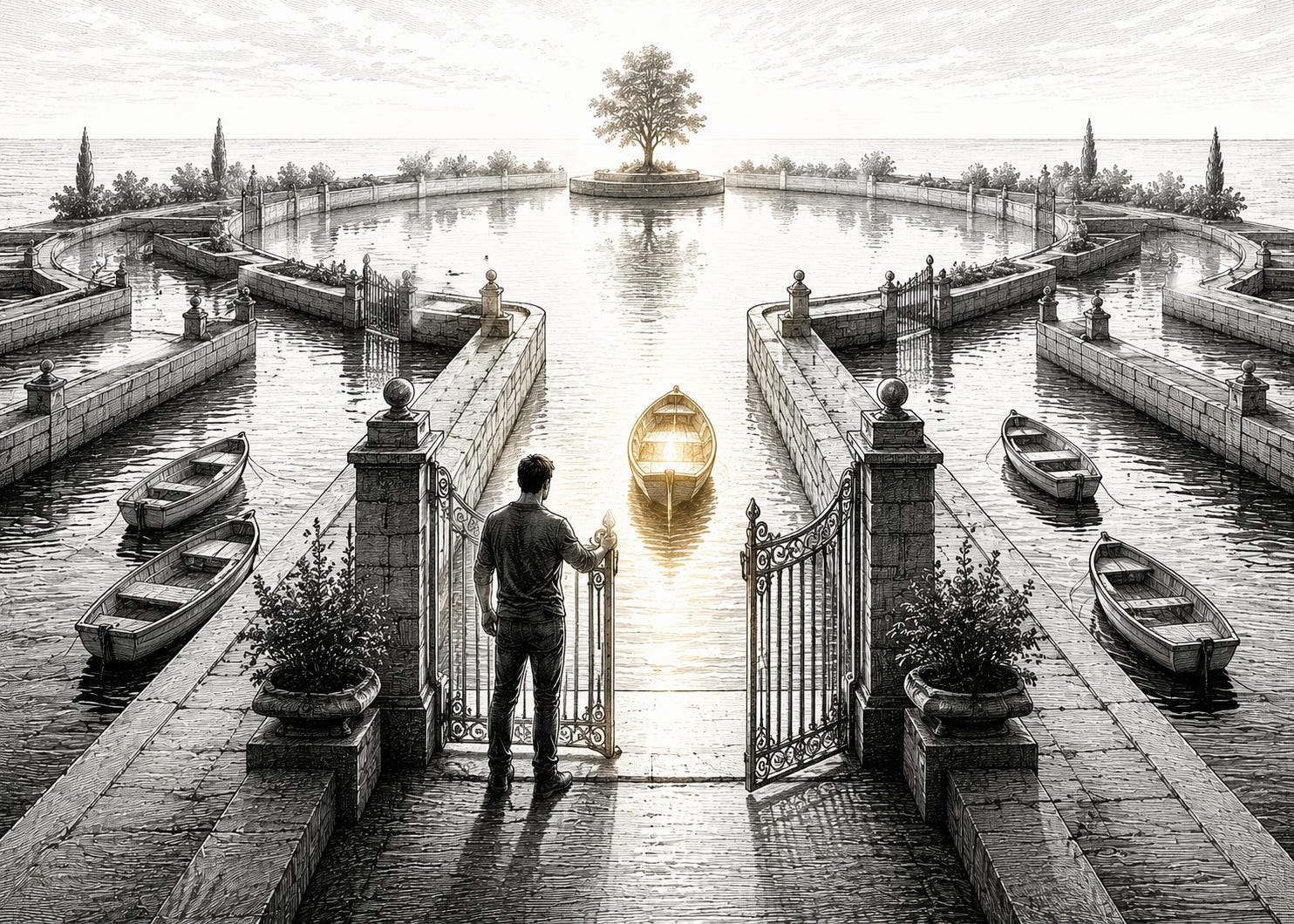
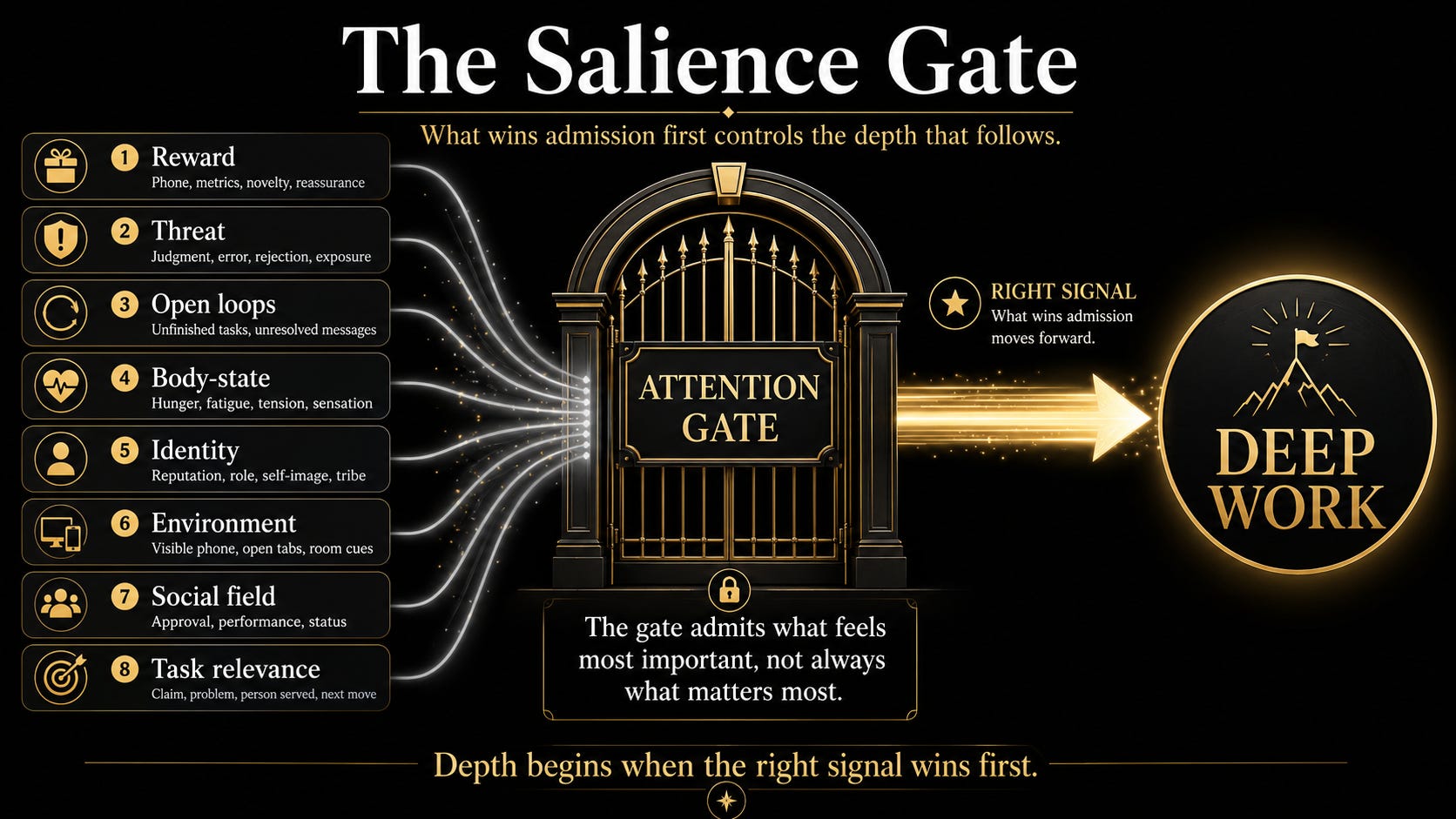
The previous essay argued that attention is not a blank spotlight held obediently by will. It is shaped by goal, threat, reward, novelty, body-state, identity, environment, memory, and unfinished business. Attention is not merely directed. It is gated.1
This manual is the operational version of that law.
It is not manifestation.
It is not RAS mythology.
It is not a trick for making the universe bring you what you want.
It is a way of training your own system to admit the right signal first.
Where this series is going
This season explores the hidden architecture of flow, not as hacks but as a field theory of entry, coherence, and peak mental states.
Today: Train the Mind to Notice the Right Things
This manual gives you:
The Salience Audit
The Signal Hierarchy
The False-Salience Removal Map
The Unresolved-Loop Clearance Sheet
The Cue Design Worksheet
Implementation-intention templates
Identity-linked prompts
Five-Minute Gate Rehearsal
Already live:

Next: Not Every Intense State Is Flow.
Upgrade for the full sequence of field manuals, templates, and troubleshooting.
Most people fail here because they try to focus while everything else in the field is still more entitled than the work.
The task is open, but the phone is closer.
The paragraph matters, but the metric is brighter.
The prayer matters, but the body sensation feels more urgent.
The study block matters, but the unfinished message keeps asking for entry.
The decision matters, but the imagined judgment of the group has become louder than the question itself.
That is why “focus harder” is too late.
The gate is already trained.
Selection history matters. Awh, Belopolsky and Theeuwes (2012) argued that the old top-down versus bottom-up distinction is incomplete because attention is also shaped by what has been selected and rewarded before. Anderson, Laurent and Yantis (2011) showed that reward-associated stimuli can later capture attention even when they are no longer task-relevant. Masicampo and Baumeister (2011) showed that unfulfilled goals can intrude on unrelated tasks, while plan-making can reduce those effects.2
That means the question is sharper than most people realize:
What has my system learned to admit before the work?
Before the paywall, do this first.
The Salience Audit
Think of one deep block that fractured recently.
Then answer six lines.
1. What kept winning admission?
Phone, inbox, metric, body sensation, old conversation, social judgment, open loop, reward cue, threat cue, urgent thought, fantasy, tab, hunger, noise?
2. What kind of salience was it?
Threat, reward, novelty, unfinished business, identity, body, environment, social field, or task relevance?
3. Why did it feel more important than the work?
Was it trained, feared, rewarded, visible, unresolved, embodied, identity-linked, or simply closer?
4. What signal should have won?
The first sentence, the client, the text, the problem, the decision, the person served, the standard, the next rep?
5. What would make the right signal easier to admit next time?
A visible cue, a written question, a closed loop, a stronger meaning sentence, a different room, a blocked false cue, a clearer first move?
6. What would make the wrong signal less entitled?
Distance, silence, no notification, hidden metric, written plan, delayed checking, physical removal, or one boundary?
Then write one sentence:
My attention is currently trained to admit ________ before ________.
That sentence is the hinge.
Because below the paywall, the manual becomes exact.
You will create a signal hierarchy for the block.
You will remove false salience instead of trying to out-will it.
You will close or contain unfinished loops before they keep intruding.
You will design cues that point the mind toward the right signal.
You will use if-then plans so cue and action become linked.
You will tie the signal to identity without turning it into ego.
And you will rehearse the gate so the right thing becomes easier to notice first.
