


Some states should not be repeated just because they worked.
That is the danger.
You delivered.
You finished.
You made the deadline.
You survived the sprint.
You pushed through the night.
You entered the tunnel and came out with something in your hands.
So the mind makes a dangerous conclusion:
This must be the way.
Not always.
Sometimes the state gave you access.
Sometimes it gave you output.
Sometimes it gave you survival.
But it also left you agitated, depleted, compulsive, numb, brittle, sleepless, or strangely hungry to recreate the same emergency.
That is not mastery.
That is a recovery problem.
The previous essay argued that not every intense state is flow. Flow is coherent absorption. Clutch is controlled performance under pressure. Hyperfocus can be useful but sticky. Stress can distort time. Dissociation can look quiet without being clean regulation. Arousal can drive output while degrading coherence.1
This manual is the operational version of that warning.
It is not a plan for becoming less intense.
It is not an argument against pressure.
It is not softness dressed up as recovery.
It is a way of recognizing distorted intensity, interrupting it when necessary, recovering from it cleanly, and re-entering serious work without building your identity around overdrive.
This is the final manual of the season.
And it may be the one many high performers need most.
Where this series closes
This season has explored the hidden architecture of flow: thresholds, body-state, vigilance, curiosity, consent, meaning, perceptual stability, movement, environment, group flow, state support, salience, and the distinction between coherent elevation and distorted intensity.
Today: Recover Cleanly When Intensity Distorts the System
This manual gives you: the State Discrimination Checklist, the Distorted Intensity Triage, the Acute Downshift Routine, the Recovery Decision Tree, the Next-Day Re-Entry Plan, the Coherence Journal, and the Repeatability Test.
Already live:

Most people fail here because they judge the state only by the output.
Did I finish?
Did I win?
Did I publish?
Did I perform?
Did I survive?
Did I get praised?
Those questions matter.
But they are incomplete.
A state must also be judged by what it costs, what it trains, and what it makes you more likely to repeat.
Effort-recovery theory argues that effort creates load reactions that need time and recovery conditions to reverse; when recovery is insufficient, load can accumulate into longer-term strain.2 Recovery research also distinguishes psychological detachment, relaxation, mastery, and control as important recovery experiences outside work.3
That means the end of a work bout is not a neutral moment.
It is a fork.
You either recover the system, or you teach it that distortion is the price of excellence.
Before the paywall, do this first.
The State Aftermath Audit
Think of one recent period where you were intensely locked in.
Then answer seven lines.
1. What created the state?
Flow, challenge, meaning, deadline, fear, caffeine, conflict, stimulant support, social exposure, threat, sleep loss, unfinished business, or panic?
2. What did the state feel like inside?
Clean, urgent, fluent, frantic, narrow, compulsive, powerful, brittle, numb, sharp, harsh, or unreal?
3. What happened to the body?
Steady, mobilized, hot, tight, shaky, numb, breathless, hungry, exhausted, over-caffeinated, or wired?
4. What happened to time?
Gone, fast, slow, fragmented, pressured, irrelevant, distorted, or strangely unreal?
5. What happened to judgment?
Sharper, narrower, harsher, impulsive, rigid, flexible, clean, or absent?
6. What happened after?
Recovery, satisfaction, agitation, collapse, insomnia, irritability, craving, shame, pride in damage, or emptiness?
7. Would I want to train this state as a repeatable path?
Then write one sentence:
This state was powerful, but it trained ________.
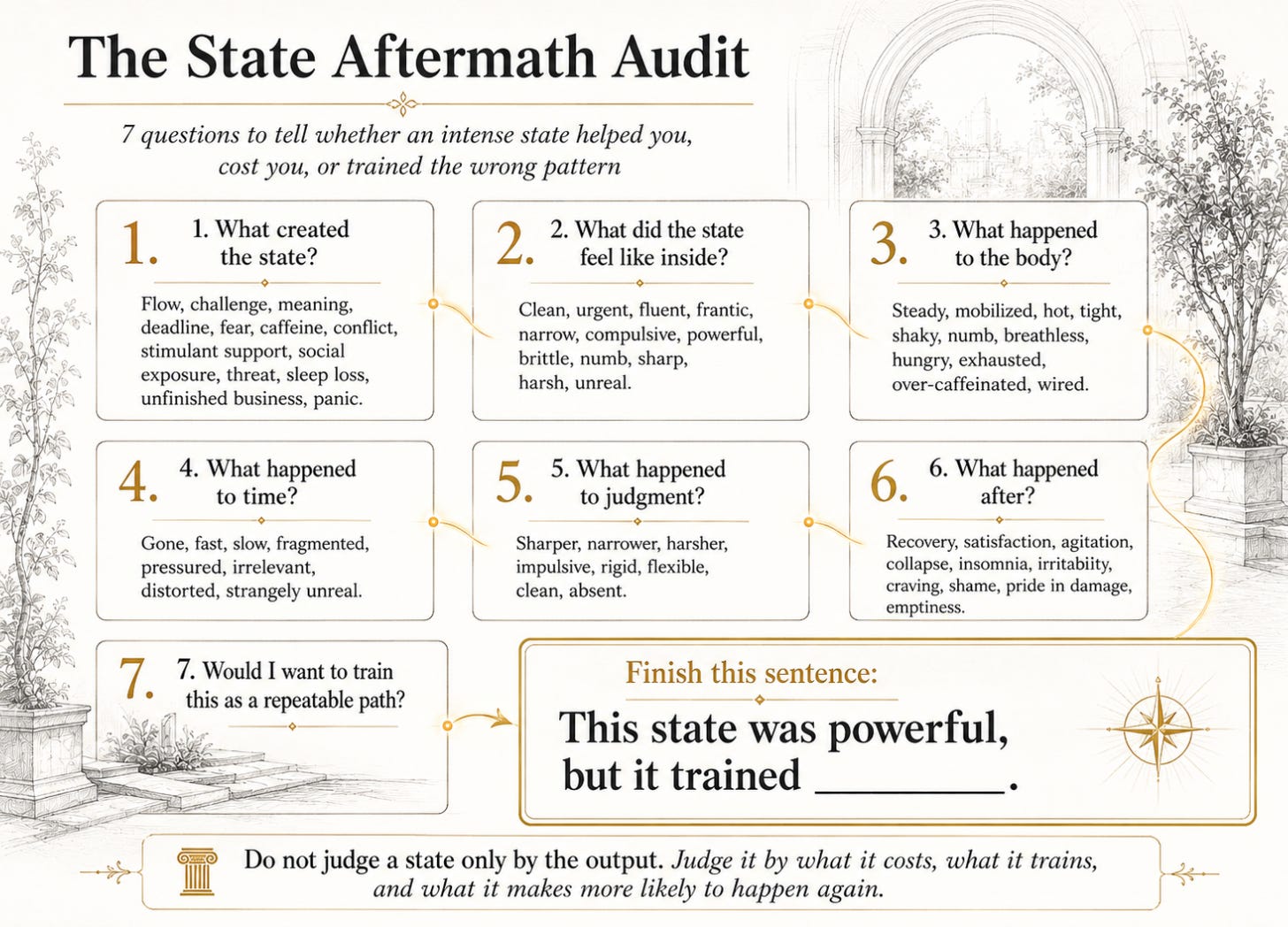
That sentence is the hinge.
Because below the paywall, the manual becomes exact.
You will distinguish coherent elevation from distorted intensity.
You will learn when to keep going, when to downshift, and when to stop.
You will use an acute recovery routine after overdrive.
You will decide whether the next day requires re-entry, repair, or rest.
You will journal the state without glorifying it.
And you will test whether a powerful state is worthy of repetition.
