

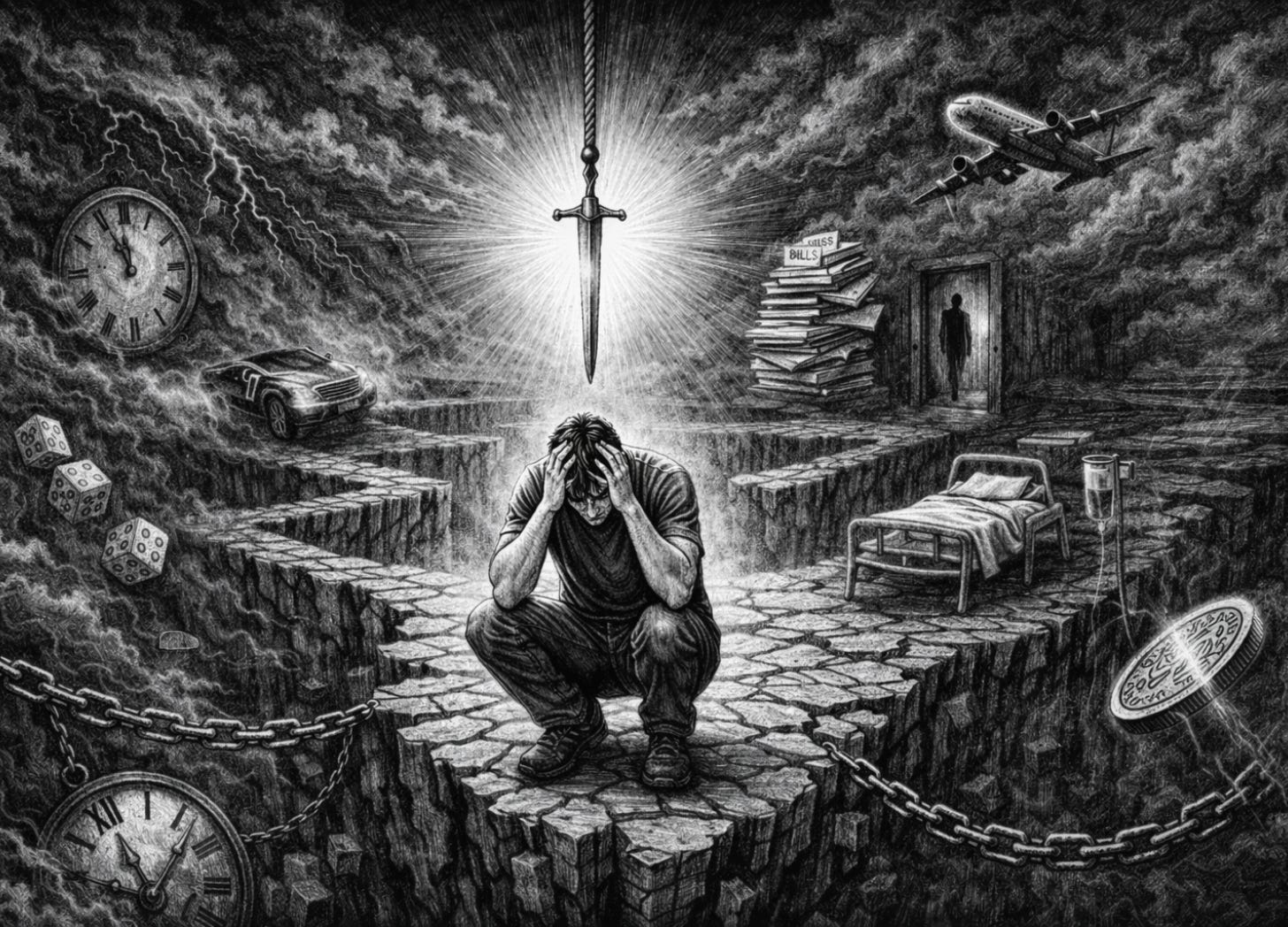
What exhausts you is not only threat.
It is the absence of a guarantee.
Nothing has happened.
No disaster has landed.
Yet your mind keeps opening possible futures and demanding an answer from each of them.
This is uncertainty training, whether you chose it or not.
By the end of this essay, you will understand why uncertainty produces anticipatory arousal, why checking and over-preparing keep the loop alive, and what rep to do today so you stop confusing certainty with safety.
Where this series is going
This essay is part of a wider sequence on chronic worry, unresolved threat, and nervous system load. The Sword Above the Feast named the problem: worry becomes toxic when threat stays mentally alive. The Threat Ledger turned that into a practical frame, and the Field Manual translated it into rules and drills. The Night Sword showed how the same mechanism sharpens after dark, and The Night Sword Field Manual turned that insight into a reset protocol. This piece moves underneath both daytime worry and night-time spiralling to one of the main fuels that keeps them alive: intolerance of uncertainty. The essays that follow move into perfectionistic threat and the safety behaviours that keep anxiety alive.
Already live
· The Sword Above the Feast: Why Worry Becomes Toxic, 26 February 2026, Open essay
· The Threat Ledger: Stop Paying for Tomorrow in Advance, 5 March 2026, Open essay
· The Threat Ledger Field Manual: Rules, Drills, Failure Modes, 9 March 2026, Subscriber protocol
· The Night Sword: Why Your Mind Races When the World Goes Quiet, 12 March 2026, Open essay
· The Night Sword Field Manual: A 7-Night Reset for Racing Thoughts, Bed Cues, and 3 A.M. Wake-Ups, 16 March 2026, Subscriber protocol
Coming next
· 23 March 2026, Subscriber protocol: The Uncertainty Ladder: A 7-Day Protocol for Tolerating Uncertainty Without Reassurance
· 26 March 2026, Open essay: The Inner Tyrant: When High Standards Become a Chronic Threat System
· 30 March 2026, Subscriber protocol: The Tyrant Audit: A 7-Day Reset for High Standards Without Self-Punishment
· 2 April 2026, Open essay: The Safety Behaviours That Keep Anxiety Alive: Reassurance, Over-Preparing, and False Relief
· 6 April 2026, Subscriber protocol: The Anti-Collusion Protocol: A 7-Day Plan to Stop Reassurance Loops, Over-Preparing, and Doomscrolling
New public essays publish on Thursdays. Subscriber protocols follow on Mondays.
The first essay named the sword.
The second gave you a ledger.
The fourth and fifth took you into the night.
This piece names the fuel.
Why uncertainty feels like danger
Anxiety is built for possible futures.
That is what makes it adaptive.
It prepares before impact.
But uncertainty changes the calculation. When the future contains possible threat but no clear answer, the mind loses the clean ability to classify, predict, and stand down. In the anxiety literature, uncertainty is not a side issue. It is one of the central conditions that make anticipatory arousal so potent.1
This becomes more corrosive when uncertainty itself feels intolerable. Intolerance of uncertainty is commonly described as a tendency to respond negatively, emotionally, cognitively, and behaviourally, to uncertain situations and their implications, and to treat the possibility of a negative event as unacceptable even when the probability is low.2
That is why you can be objectively safe and still feel unable to settle.
The problem is not only the possible loss.
It is the fact that the outcome has not signed its name.
Worry is often the manoeuvre, not the root
By now the pattern in this series should be familiar.
The nervous system does not only react to events.
It reacts to what remains cognitively alive.
This essay adds one step beneath that truth.
Often, worry is what the mind does when uncertainty feels unbearable.
In the classic cognitive-behavioural model of generalized anxiety disorder, intolerance of uncertainty sits near the center of the cycle, alongside beliefs about worry, poor problem orientation, and cognitive avoidance. In that model, the person does not merely fear bad outcomes. They struggle with the fact that outcomes cannot yet be known, and worry becomes an attempt to mentally plan, prepare, and reduce the unknown.3
So worry is not always the root problem.
Sometimes it is the tactic.
The deeper demand is this:
Tell me now.
Make it certain.
Let me stop scanning.
Life refuses.
And the mind keeps negotiating.
The behaviours you call responsible
This is where high-functioning people get trapped.
Because the uncertainty behaviours do not look irrational at first.
They look responsible.
You check again.
You prepare one more angle.
You reread the message thread.
You ask one more person what they think.
You model one more scenario.
You do not call it avoidance.
You call it diligence.
But the mechanism is usually the same: a short-term attempt to lower uncertainty by performing one more act of control. The problem is that the act rarely ends the loop. It may soothe you briefly, but it also teaches the nervous system that uncertainty is intolerable and must be neutralized before you can return to baseline. Models and treatment protocols targeting intolerance of uncertainty are built around exactly this logic, identifying safety behaviours and testing the beliefs that keep them alive.4
This is why the loop grows while life shrinks.
The behaviours look active.
The nervous system learns helplessness anyway.
What intolerance of uncertainty does to the system
When uncertainty is appraised as threatening, the body does not wait calmly for more data.
It prepares.
Research syntheses suggest that intolerance of uncertainty is not just a philosophical discomfort with ambiguity. It is associated with anxiety and depression symptoms across forms of psychopathology, and with altered responses to uncertain threat, reward, and safety learning. Reviews of the neural and psychophysiological literature link higher intolerance of uncertainty to greater anterior insula and amygdala reactivity to uncertainty, and to deficiencies in safety learning signals such as skin conductance responding.5
That matters because it explains why uncertainty feels so physical.
The restless jaw.
The compulsive thought loops.
The need to check.
The urge to settle the case before there is a case to settle.
The body is not waiting for the outcome.
It is rehearsing the gap before the outcome.
The false goal is certainty
You cannot build a stable life around guarantees.
There are too few of them.
The aim is not to become casual about risk.
The aim is to become less dependent on certainty as a condition for function.
That is the shift.
From certainty-seeking to uncertainty tolerance.
From mental rehearsal to behavioural training.
From endless prediction to cleaner contact with reality.
If you miss this, you will keep using intelligence against yourself.
You will think more, model more, prepare more, ask more.
And call the whole thing responsibility.
The Uncertainty Ladder
The paid protocol next Monday will give you the full printable ladder, the rules, the scoring, and the seven-day progression.
For now, you need the concept.
The Uncertainty Ladder is a graded exposure system for the unknown.
You choose uncertain situations you normally neutralize through checking, reassurance, over-preparing, overthinking, or premature control.
Then you rank them.
Then you practise them deliberately, one rung at a time, without using the safety behaviour that normally rescues you.
This is not recklessness.
It is learning.
Behavioral experiments targeting intolerance of uncertainty are built on this principle: make a prediction, enter the uncertain situation, reduce the safety behaviour, and let new information compete with the old fear structure. Work directly targeting intolerance of uncertainty suggests that such change processes can reduce both intolerance of uncertainty and worry, rather than merely comforting the person around them.6
In plain language:
You stop asking the mind to feel certain.
You start teaching the body that uncertainty is survivable.
The one-rung rep for today
This is the minimum effective rep.
Not the full protocol.
Just one rung.
1. Choose one uncertainty you usually neutralize.
Keep it small and real.
Examples:
A message you usually reread six times.
Analytics you usually check every hour.
A symptom you usually search repeatedly.
An email you feel compelled to answer perfectly.
2. Name the safety behaviour.
Be honest.
Checking.
Reassurance.
Over-preparing.
Over-researching.
Compulsive rereading.
Premature decision-making.
3. Write your prediction.
What do you think will happen if you do not neutralize the uncertainty right away?
Write it cleanly.
“If I do not check, I will miss something important.”
“If I do not reread this, I will look foolish.”
“If I do not search this symptom again, I will be irresponsible.”
4. Delay or drop the safety behaviour once.
Make the dose small enough to complete.
Ten minutes.
Thirty minutes.
One send, no reread.
One message, no follow-up spiral.
One planned check later, not now.
5. Record what actually happened.
What happened externally.
What happened internally.
What changed after the first wave.
That is the rep.
Not bravery theatre.
Not self-punishment.
Training.
Founder and creator examples
Because your audience is not abstract, the reps should not be abstract either.
A founder rep:
“I will check cash flow at the scheduled review, not three extra times tonight.”
A creator rep:
“I will publish this after two clean edits, not nine fear edits.”
A relationship rep:
“I will send one clear message and allow silence to remain silence for a while, not instantly make it a verdict.”
A health rep:
“I will follow the appropriate medical action already chosen, and I will not keep trying to obtain certainty through repeated searching.”
You are not exposing yourself to negligence.
You are exposing yourself to the residue that remains after responsible action is already complete.
That distinction matters.
The Plan or Release gate
This is where the sequence locks together.
Use the Threat Ledger for problems that have a genuine next action.
Use the Night Sword protocol when the case is reopening in bed.
Use uncertainty training when the action has already been taken, or when no further action exists right now, but the mind keeps demanding certainty anyway.
That is the gate:
If action changes the outcome meaningfully, plan.
If no further action exists right now, stop rehearsing and train tolerance.
Do not keep planning when the real hunger is certainty.
That only turns strategy into compulsion.
What people get wrong
1. They use the ladder to punish themselves
That is not training.
That is ego.
Choose a rung you can actually complete.
You are building tolerance, not proving toughness.
2. They choose real danger and call it exposure
Do not use this method to ignore urgent symptoms, legal deadlines, acute safety issues, or other situations that genuinely require timely action.
Exposure is for uncertainty you are compulsively neutralizing, not for real emergencies.
3. They secretly swap one safety behaviour for another
You stopped checking the app.
Now you ask three friends what they think.
Same loop.
Different costume.
4. They expect instant calm
Sometimes anxiety falls quickly.
Sometimes it does not.
The win is not immediate serenity.
The win is that you stayed inside uncertainty without buying relief through the old ritual.
5. They call repeated thinking “processing”
Often it is only rehearsal.
If the thought does not produce a new action, a new fact, or a clean release, it is usually just re-consumption of uncertainty.
A necessary boundary
If your worry is severe, persistent, or impairing, especially if it is accompanied by panic, severe insomnia, compulsive checking that is difficult to interrupt, trauma symptoms, depressive collapse, or thoughts that feel dangerous or uncontrollable, do not reduce this to a self-help issue. Seek appropriate professional care. Public guidance is clear that anxiety can require support when it is affecting your life in a sustained way.7
This essay is about mechanism and training.
It is not a replacement for care.
The standard to keep
You do not need a guarantee to function.
You need a higher tolerance for the moment before the answer arrives.
Today, do one clean rep.
Choose one uncertainty.
Name the safety behaviour.
Delay or drop it once.
Record what actually happened.
That is the standard.
Not endless forecasting.
Not one more check.
Not a private trial in the mind.
Training.
For the full sequence
If this essay resonated with something real for you, become a paid subscriber.
The open essays explain the mechanism. The subscriber protocols turn it into practice: worksheets, ladders, rules, scoring, troubleshooting, and implementation plans designed to be used under pressure, not merely admired in theory.
Next Monday’s subscriber edition is The Uncertainty Ladder: A 7-Day Protocol for Tolerating Uncertainty Without Reassurance.
D.W. Grupe and J.B. Nitschke, “Uncertainty and anticipation in anxiety: an integrated neurobiological and psychological perspective,” Nature Reviews Neuroscience 14, no. 7 (2013): 488–501, doi:10.1038/nrn3524.
K. Buhr and M.J. Dugas, “The intolerance of uncertainty scale: psychometric properties of the English version,” Behaviour Research and Therapy 40, no. 8 (2002): 931–945, doi:10.1016/S0005-7967(01)00092-4; R.N. Carleton, P.J. Norton, and G.J.G. Asmundson, “Fearing the unknown: a short version of the Intolerance of Uncertainty Scale,” Journal of Anxiety Disorders 21, no. 1 (2007): 105–117, doi:10.1016/j.janxdis.2006.03.014.
M.J. Dugas, F. Gagnon, R. Ladouceur, and M.H. Freeston, “Generalized anxiety disorder: a preliminary test of a conceptual model,” Behaviour Research and Therapy 36, no. 2 (1998): 215–226, doi:10.1016/S0005-7967(97)00070-3.
E.A. Hebert and M.J. Dugas, “Behavioral experiments for intolerance of uncertainty: challenging the unknown in the treatment of generalized anxiety disorder,” Cognitive and Behavioral Practice 26, no. 2 (2019): 421–436, doi:10.1016/j.cbpra.2018.07.007.
R.N. Carleton, “Into the unknown: a review and synthesis of contemporary models involving uncertainty,” Journal of Anxiety Disorders 39 (2016): 30–43, doi:10.1016/j.janxdis.2016.02.007; E. Tanovic, D.G. Gee, and J. Joormann, “Intolerance of uncertainty: neural and psychophysiological correlates of the perception of uncertainty as threatening,” Clinical Psychology Review 60 (2018): 87–99, doi:10.1016/j.cpr.2018.01.001.
J. Bomyea, H. Ramsawh, T.M. Ball, C.T. Taylor, M.P. Paulus, A.J. Lang, and M.B. Stein, “Intolerance of uncertainty as a mediator of reductions in worry in a cognitive behavioral treatment program for generalized anxiety disorder,” Journal of Anxiety Disorders 33 (2015): 90–94, doi:10.1016/j.janxdis.2015.05.004; E.A. Hebert and M.J. Dugas, “Behavioral experiments for intolerance of uncertainty: challenging the unknown in the treatment of generalized anxiety disorder,” Cognitive and Behavioral Practice 26, no. 2 (2019): 421–436, doi:10.1016/j.cbpra.2018.07.007.
NHS, “Anxiety, fear and panic,” NHS, page last reviewed 17 January 2023, accessed 19 March 2026; NHS, “Generalised anxiety disorder (GAD),” NHS, page last reviewed 22 October 2024, accessed 19 March 2026.