


Decide what you want, and why.
Before we work out how you are going to get there, I want you to spend some time on this. What amount of money could give you everything you desire?
It might be ten million or a hundred million, but it must connect to what your personal desires are, what you want for your time, your relationships and your work. This is truly the key, because it differs for everyone. We can agree that we want to prosper and still want to live very different lives. I want you to be quite specific about yours.
Jim Rohn gives goals first place in 7 Strategies for Wealth & Happiness. What interests me is his connection between the goal and the person you become in achieving it.1 We will spend part of our lives becoming that person. We should know why we want to.
One life, six connected plans
In my mind, you need to have a plan for each of the Six Primes of the Excellence Nexus: Body, Mind, Heart, Soul, Wealth, and Impact and Legacy (fillable PDF at the end of the essay). But of course, these six primes are not disconnected.
They are connected by one underlying purpose, which is your life goal: to live happy, healthy and prosperous. This passes through relationships, purpose and, of course, reverence for the grander scheme of things, remembrance of our mortality and what is after.
Being of service, loving people, leaving the world a little better, even if just through a garden patch: this is part of what it means to have succeeded. And forgetting God detracts from all of this.
The garden patch is from the verse about success often attributed, incorrectly, to Emerson.2 I have linked the full text below. It belongs here because success must include what we give to life. However much we acquire, there is still the question of what good we did while we were here.
I also find something useful in ikigai, especially the attention Mogi gives to small pleasures and to the present.3 We need a reason to get up and do things. A reason to develop our abilities. People to love and something worthwhile to offer them. Earning money can be part of that, of course, but the meaning of a life extends beyond its earning capacity. In my own philosophy, purpose includes our relationship with God and what we do for others, including the things that nobody pays us for.
There is room here for great ambition. There is also room for the garden patch. I would like us to remember both when we decide what we want.
Money is a great servant but a bad master
I often say this. And I mention that the LOVE OF MONEY is the root of all evil. Not money itself. The LOVE of money.
The familiar King James wording is: “For the love of money is the root of all evil”.4 Later in the chapter, the wealthy are called to do good and to be generous. There is work for money to do in a good life.
We must love God, love people and use money. Never use people and love money. Reversing this is at the root of great disaster and evil in the world.

Also, we must touch on the New Testament image of a camel passing through the eye of a needle, and the difficulty of a rich man entering the kingdom of God. Not because a rich person can never enter heaven, but because of attachment. Attachment is the problem.
In Mark’s account, the man asks Christ about eternal life. Jesus looks at him and loves him. The invitation is to sell what he has, give to the poor and follow Him. The man goes away grieving, because he has many possessions. The disciples then ask who can be saved; Christ speaks of what is possible with God.5
That encounter ought to give us pause. Here is a man who knows what he wants, and who has gone to ask for it, yet his attachment prevents him from accepting what he is offered. He cannot let go. Money becomes an idol we inadvertently worship, and that is how it moves from servant to master.
Socrates in Dan Millman’s Way of the Peaceful Warrior is relevant here too. This is Millman’s literary teacher; his later teaching distinguishes the effort we make from our attachment to an outcome.6 We can give everything to the work without making the result the only thing in our lives that matters. Remember that when we come to the numbers. They have a purpose to serve.
The right move in the right way at the right time
This is where I want to bring in my personal philosophy of the highest-leverage move.
In my experience, life moves ahead forcefully, powerfully, and fast when you focus your efforts on the highest-leverage move. Do this repeatedly, and your life will progress faster than you thought possible. More than that, progress and momentum will compound. This is what I call leverage: making the right move in the right way at the right time.
But we need to have decided what we want and why, or how will we know which move is right? That is why I have spent time on the purpose before the plan. Your reasons will affect what you build and how you build it.
Consider time. If what you want includes more time for the people you love, then it makes sense to build assets that give time back. They need to be built once and then require less time for maintenance. DeMarco asks whether the business can function without you.7 That matters to me because the point was to get time back. If somebody else has to be paid to keep it running, we must include that in the calculation. Monday’s numbers will include the maintenance too.
And this brings us back to humility. Housel writes about how our past financial experience shapes our thinking.8 Past knowledge makes us think we know, but we don’t really know, because every situation changes and must be thought of anew. We need to address the situation in front of us and focus on the process, instead of assuming that we know because we have seen something like it before.
I wrote a whole essay on this, I Know, and Therefore I Fail. “You move forward with force, but you hold your beliefs with open hands. You lead, but you remain teachable”.9
For today, take one page. Describe the life you want across all Six Primes, why you want it, whom it will allow you to serve, and the money and time you think it will require. Some of this will need further thought and some will need research. Put down what you have in mind, and identify the questions you still have to answer.
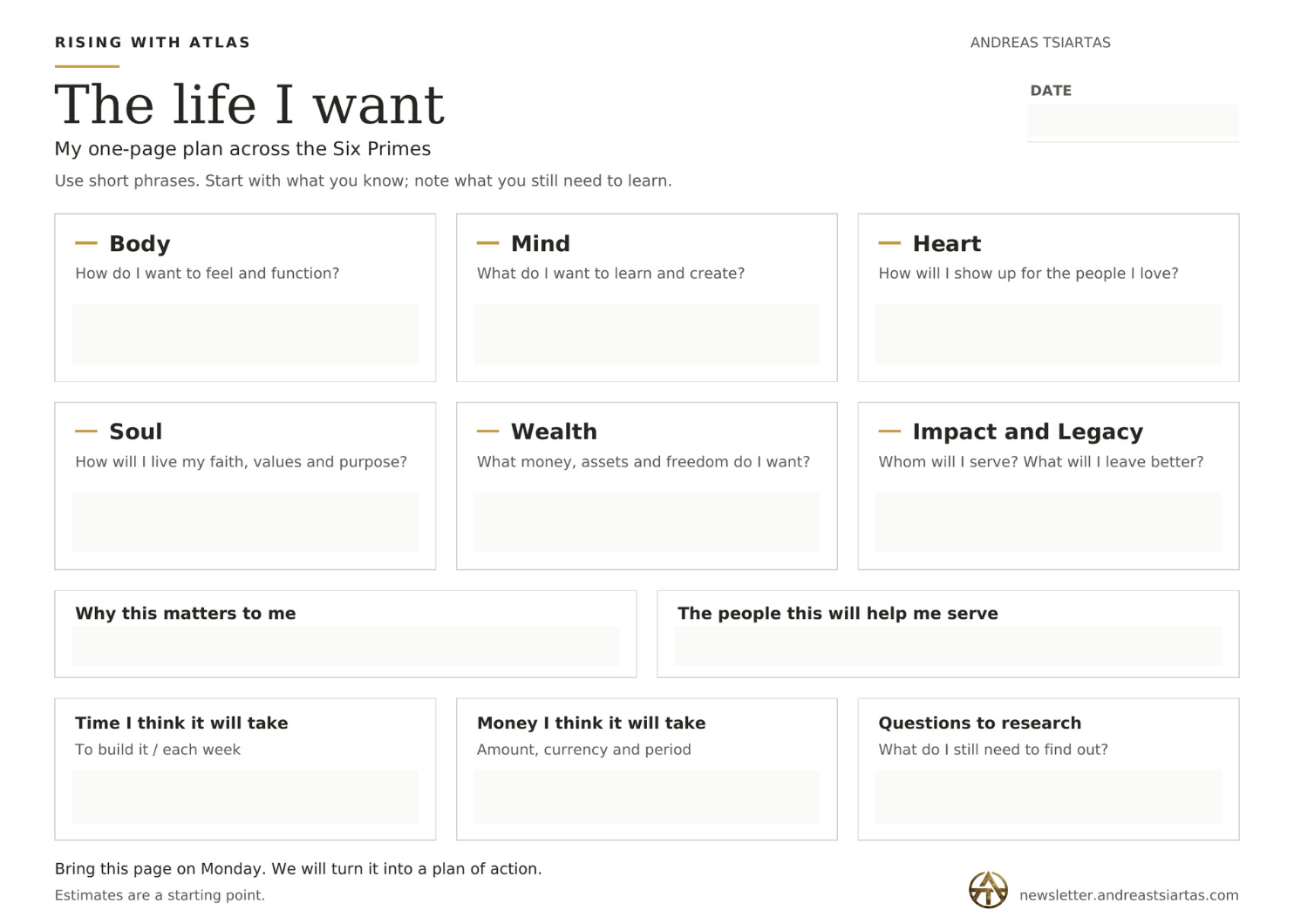

On Monday, we will work backwards from five years to two, to one, to six months, one month, one week and the present moment. We will put numbers to the work and choose a cycle in which to act and review. Today, decide what you want and why. Bring that page with you.
Rohn, J. (1996) 7 Strategies for Wealth & Happiness. New York: Harmony.
‘In Search of Success’ (2004). Ralph Waldo Emerson website, maintained by Dirk H. Kelder and hosted by Chebucto Community Net. Last revised 22 December. Reproduces the popular ‘Success’ verse and discusses its misattribution to Emerson and its relationship to Bessie A. Stanley’s earlier text. Accessed 17 September 2026.
Mogi, K. (2018) Awakening Your Ikigai: How the Japanese Wake Up to Joy and Purpose Every Day. New York: The Experiment.
The Holy Bible, King James Version (first published 1611), 1 Timothy 6:10, 17–19. Bible Gateway, digital edition. Read the passage. Accessed 17 September 2026.
The Holy Bible, King James Version (first published 1611), Mark 10:17–27. Bible Gateway, digital edition. Read the passage. Accessed 17 September 2026.
Millman, D. (2021) ‘Preface: Peaceful Heart, Warrior Spirit’. The Peaceful Warrior’s Way, autumn. Accessed 17 September 2026; Kearns, B. (n.d.) ‘Dan Millman: Way of the Peaceful Warrior’. Interview with Dan Millman and accompanying show notes, particularly 21:06. Accessed 17 September 2026.
DeMarco, M.J. (2011) The Millionaire Fastlane: Crack the Code to Wealth and Live Rich for a Lifetime. Phoenix, AZ: Viperion Publishing Corporation, chapter 34, ‘The Commandment of Time’.
Housel, M. (2018) ‘The Psychology of Money’. Collaborative Fund, 1 June, sections 5–6. Accessed 17 September 2026.
Tsiartas, A. (2026) ‘I Know, and Therefore I Fail’. Rising with Atlas, 8 January. Accessed 17 September 2026.