


Imagine waking up with something you cannot wait to begin. To want to get on with your work, to enjoy the strength you are developing in your body, to look forward to being with the person you have already spent years of your life with. How much of your life could you approach with that kind of desire?
We talk about wanting these things, but they require us to become capable of doing things we may not yet enjoy. How do we come to desire the practice, the effort, the learning involved in creating the life we say we want? I believe we can participate in developing that desire, and the implications go a very long way beyond how we feel about our work.
How we learn to want
We often say that you can give people the tools, but you cannot give them the desire. I would argue that the desire itself is built by experience. That was the thought I kept coming back to while considering something as ordinary as our preference for food.
Why is it that people from a particular country so often like particular kinds of food? Even the smell that rises with the steam from a pot can give you an appetite. And another person can smell exactly what you smell and wonder how anyone would want to eat it. We have learned to like different things.
Even experiences before we can remember contribute to our tastes. Infants whose mothers consumed carrot juice during pregnancy or breastfeeding showed fewer negative facial expressions when eating carrot-flavoured cereal than plain cereal.1
It is familiarity, experience and learning together. We can see it with food, but how many more intricate parts of desire are interwoven with experience and the things that people live? This raises a much broader question about desire, and it brings me back to Alexander.
The story beneath his pillow
In Is Anyone Self-Made?, we explored the people, education and circumstances that contributed to his greatness.2 I want to add another layer to that discussion. Why did he desire the particular greatness he went on to pursue?
As Plutarch recounts, one of his tutors called him Achilles, and Aristotle became his teacher. His attachment to the Iliad was such that he kept it beneath his pillow, alongside his dagger. Plutarch also records the tradition of Olympias encouraging her son to pursue ambitions worthy of his divine birth.3
How was this young child’s mind being formed by such an education? How was his mother’s belief in his divine origin to affect his belief in himself, and how was that belief to affect what he desired? We also have to consider the ambitions of the world around him. Philip had made Macedon a dominant military and political power. Can his desire to achieve greatness be separated from the greatness he was being taught to imagine?
The story beneath his pillow was entering the story he wanted to live.

So the nature of desire becomes interwoven with the beliefs we have about ourselves, the beliefs we have about the world, and the ambitions our environment has more broadly and for us.
The pleasure of being able to play
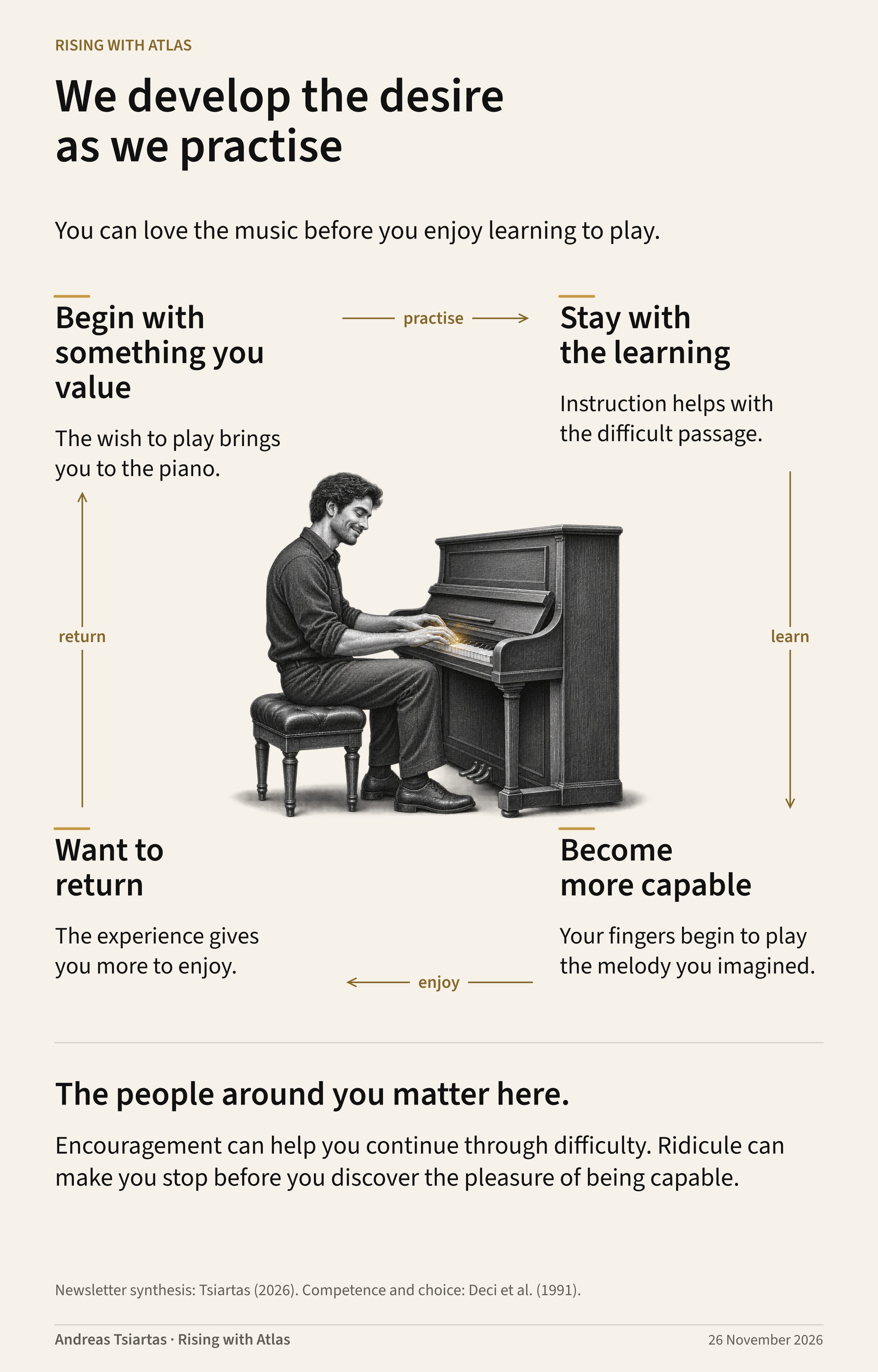
Our experience of trying is another part of this. At a piano, you can love the music and find the experience of learning to play it frustrating. You know how you want it to sound, but there is a great deal to learn before your fingers can produce it. And then you reach a point where they do, where the melody you have been hearing in your mind is coming out of the instrument. Until then, you had not experienced the pleasure of being able to play it. But you can give up long before you reach that pleasure if you decide that your frustration means you do not enjoy playing.
People start to love the thing they do when they become good at it. But they cannot become good at it without enduring the difficulty of gaining that ability. They are doing it while they do not necessarily like it, and as they become capable, their experience changes. This is also consistent with the role of competence and a sense of choice in intrinsic motivation.4 We are developing the very desire we thought we needed before we began.
Encouragement and ridicule
And here we come back to the influence of other people, which I explored in The People Who Draw Out Your Greatness.5 We have discussed this through the Pygmalion and Rosenthal effect, and its counterpart, the Golem effect.
In Eden and Shani’s (1982) military training experiment, the trainees whose instructors had been led to expect more of them did better in the tests and reported more positive attitudes.6 Low expectations working against performance are the subject of the Golem effect.7
I am interested here in how this becomes connected to wanting. If a child is ridiculed every time he makes a mistake, how much will he want to continue? And if he stops, how will he become good at it? How can we understand the child’s desire without considering how he is being taught, when that teaching can help him reach the experience of being capable, or prevent him from ever getting there?
This is also why I so often come back to the Peaceful Warrior. In Dan Millman’s stories, Socrates says, “The peaceful warrior practices everything”.8
Everything important to you is worth the time, passion, creativity, effort and persistence of becoming good at it. The person who is very good at creating wealth became good at it by seeking solutions, trying, failing and trying again. They keep going because they consider it valuable. What I have argued for years is that we need to apply what we know equally in all realms of life. The same is true for health, and the same is true for relationships.
In a relationship, that includes learning to listen to the person sitting across from you and understanding something of the life behind those eyes. We bring passion and creativity to learning things we consider valuable. How much of that do we bring to understanding the person we say we love? I would say this deserves every bit as much of our effort.
The meaning of what we want
And I would argue one step further: the body reacts to these things too.
Consider a person who wants to become wealthy but has been brought up to consider the desire for wealth shameful. He begins to explain what he wants to achieve and finds himself apologising for wanting it. But if he comes to view the desire as good, because of what his success would allow him to do for his family, that changes the meaning of the pursuit. I am interested in the bodily response to that change. Can we separate it from the beliefs he holds about what he is trying to achieve?
This is what brings me to placebo and nocebo effects. Bingel and colleagues (2011) examined the effect of expectations on pain relief with remifentanil. At a constant drug concentration, positive expectations doubled the pain-relieving benefit, and negative expectations abolished it in the experiment.9
If we have placebo and nocebo effects in response to a medicine, what about ideas and desires? How does the body react if a desire is considered to be good, and how does it react if that desire is considered to be bad? My contention is that this response can enhance us in doing what we desire or undermine us in doing it.
Give yourself more to fall in love with
So take something you want to develop in your own life and consider what has gone into your relationship with it. What experiences have you had? What were you taught about people who want what you want? Are these beliefs you actually agree with?
I suggest trying this with one thing you want to become good at. Write down why you want to do it and what you need to learn. Then arrange a lesson or find instruction that addresses the difficulty you are having. Give yourself time to practise what you have learned.
As you do this, keep a few notes about what is happening to your interest in the activity. Is the activity still something you have to make yourself do, or are you beginning to want to return to it? Consider what has contributed to that, and what it tells you about the experience you want to create when you practise again.
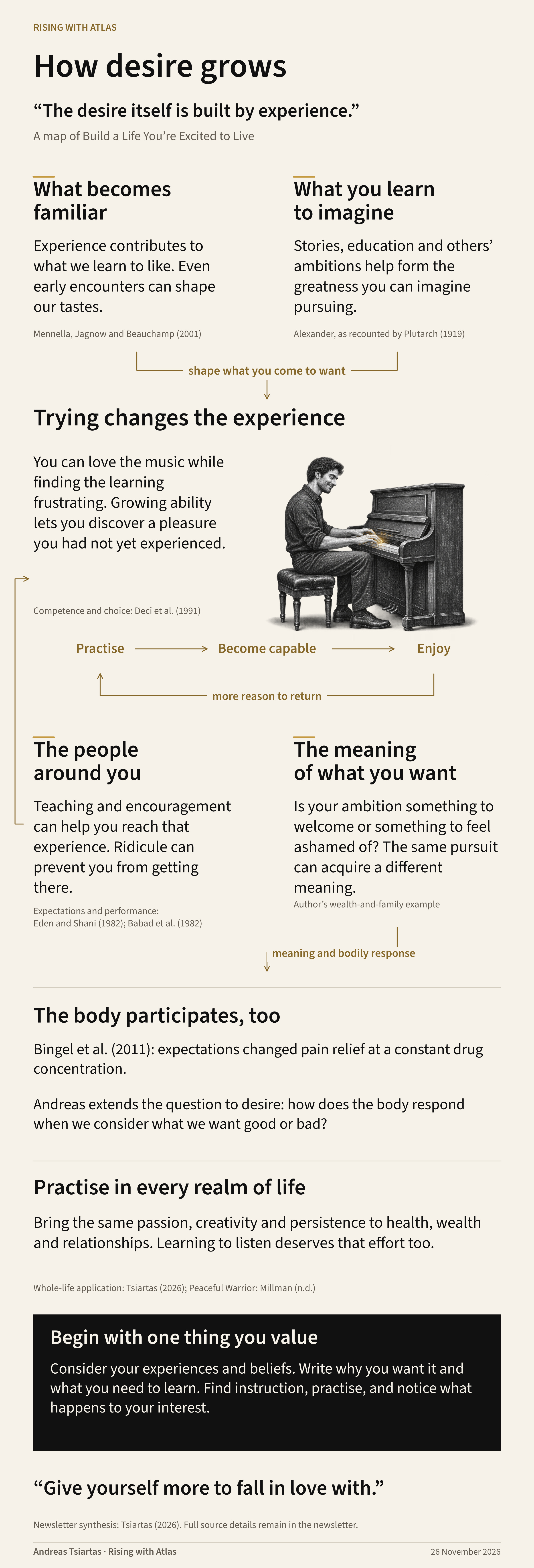
There is so much of life we have yet to learn to love. Everything important to you is worth pursuing with passion and persistence. That includes the parts of life you have barely begun to explore. This is how I think about creating a life of miracles, and it requires us to change. The change in what we are capable of doing becomes a change in what we are capable of enjoying, and that is a profound possibility to bring into our lives.
Begin today. Give yourself more to fall in love with.
Monday’s paid newsletter will take this into practice in more detail. We will work through an example of developing desire, and you will have a plan to complete for an ambition of your own. I want you to be able to apply what we have discussed here to something you consider worth pursuing.
Mennella, J.A., Jagnow, C.P. and Beauchamp, G.K. (2001) ‘Prenatal and postnatal flavor learning by human infants’, Pediatrics, 107(6), e88. https://doi.org/10.1542/peds.107.6.e88.
Tsiartas, A. (2026a) ‘Is Anyone Self-Made?’, 5 November. Available at: newsletter.andreastsiartas.com/p/is-anyone-self-made.
Plutarch (1919) ‘Alexander’, in Lives, vol. VII. Translated by B. Perrin. Cambridge, MA: Harvard University Press, chapters 2–3, 5, 7–8. Available at: Life of Alexander.
Deci, E.L., Vallerand, R.J., Pelletier, L.G. and Ryan, R.M. (1991) ‘Motivation and education: The self-determination perspective’, Educational Psychologist, 26(3–4), pp. 325–346. https://doi.org/10.1080/00461520.1991.9653137.
Tsiartas, A. (2026b) ‘The People Who Draw Out Your Greatness’, 9 November. Available at: newsletter.andreastsiartas.com/p/people-who-help-you-grow.
Eden, D. and Shani, A.B. (1982) ‘Pygmalion goes to boot camp: Expectancy, leadership, and trainee performance’, Journal of Applied Psychology, 67(2), pp. 194–199. https://doi.org/10.1037/0021-9010.67.2.194.
Babad, E.Y., Inbar, J. and Rosenthal, R. (1982) ‘Pygmalion, Galatea, and the Golem: Investigations of biased and unbiased teachers’, Journal of Educational Psychology, 74(4), pp. 459–474. https://doi.org/10.1037/0022-0663.74.4.459.
Millman, D. (n.d.) ‘Preface: No Ordinary Moments: A Peaceful Warrior’s Guide to Daily Life’, The Peaceful Warrior’s Way. Available at: peacefulwarrior.com/preface-noordinarymoments/ (Accessed: 26 November 2026).
Bingel, U., Wanigasekera, V., Wiech, K., Ni Mhuircheartaigh, R., Lee, M.C., Ploner, M. and Tracey, I. (2011) ‘The effect of treatment expectation on drug efficacy: imaging the analgesic benefit of the opioid remifentanil’, Science Translational Medicine, 3(70), 70ra14. https://doi.org/10.1126/scitranslmed.3001244.