


A great many people do not fail at deep work because they lack understanding.
They fail because they cannot cross the state boundary.
They know what matters.
They know the task.
They know the plan.
They even want to begin.
And still they remain on the wrong side of the threshold.
Too flat to engage.
Too braced to settle.
Too mentally noisy to descend.
Too physiologically static to gather force.
That is the state transition problem.
It is one of the most under-discussed problems in human performance.
By the end of this essay, you will understand why exercise belongs inside a serious theory of flow, why movement is not only a health behavior but a state-transition tool, why acute exercise can change cognition, rumination, and executive control in ways that matter for entry into demanding work, why more intensity is not always better, and why one of the hidden arts of peak performance is learning how to use movement to cross from one state into another instead of trying to think your way across every threshold. Acute physical activity has been shown to produce small but credible improvements in cognition overall, with particular benefits for working memory, inhibition, and reaction time in some contexts, while broader reviews now conclude that exercise benefits cognition, memory, and executive function across populations.1
Where this series is going
Flow Begins Before the Work Begins laid the ground. It defined flow, argued for its importance in human performance, and introduced the threshold thesis: peak states do not begin at the visible moment of work, but in the conditions that precede it.
The Body Is the Ignition Key moved to physiology: sleep, circadian timing, metabolic steadiness, inflammation, and optimized activation as preconditions of deep states.
Vigilance Kills Absorption moved to guarding: how threat-monitoring, self-surveillance, and unresolved uncertainty make clean descent difficult.
How boredom can be your secret weapon for success moved to pull: why boredom often signals badly designed engagement, and why curiosity and live questions help attention descend rather than merely stay put.
The Mind Rarely Goes Deep Under Coercion moved to consent: why autonomy, competence, and self-efficacy matter because a coerced mind can comply while still failing to descend cleanly.
Meaning Changes the Depth of Attention moved to significance: why the mind gives more of itself to work it judges worthy of that expenditure.
A Noisy Mind Struggles to Go Deep moved to perceptual stability: why mindfulness matters because internal noise can keep fracturing the act even when the task is meaningful and chosen.
This essay moves to the next gate.
Transition.
Because sometimes the system does not need more meaning, more insight, or more will.
It needs a different physiological state.
The essays that follow will move through environment, relationships, group flow, compounds, salience, and the difference between clean elevation and distorted intensity. Some pieces will clarify the mechanism. Others will provide the protocols.
Coming next
· Use Exercise to Enter Work, Not Escape It, 8 June 2026, Subscriber protocol
The Pre-Flow Exercise Protocol for activation without overshoot
· The Room Is Part of the Mind, 11 June 2026, Open essay
The sensory field of thought
· Build a Room That Makes Absorption Easier, 15 June 2026, Subscriber protocol
The Environment Protocol for light, sound, scent, order, and friction
New public essays publish on Thursdays. Subscriber protocols follow on Mondays.
The problem is not always motivation. It is transition
A lot of high performers keep trying to solve a transition problem with motivational language.
Push harder.
Discipline yourself.
Stop procrastinating.
Focus.
Try.
Sometimes that works.
Often it is the wrong tool.
Because the state you are in when you approach the task matters. This entire season has been building toward that point from different angles: bodily readiness, reduced vigilance, cleaner task pull, internal consent, significance, and perceptual stability. Exercise enters here because it is one of the fastest lawful ways to change the condition of the organism before asking it for higher-order work. The acute exercise literature repeatedly frames single-bout exercise as capable of transiently modulating cognition, arousal, and mental functioning rather than only long-term fitness outcomes.2
That is why I call this the state transition problem.
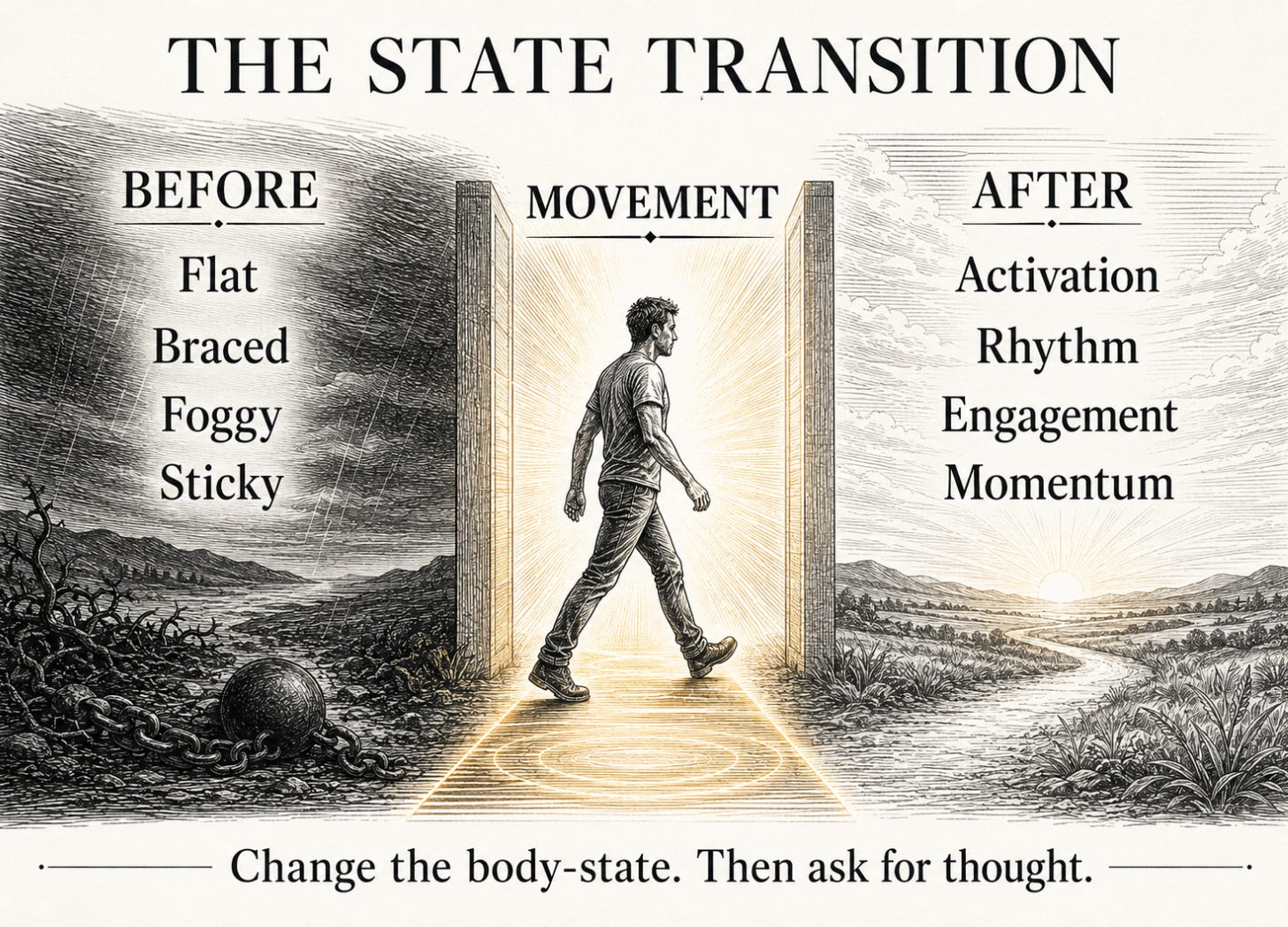
It is the problem of moving from one whole-organism condition to another:
from flatness to usable activation,
from rumination to outward engagement,
from bracing to rhythm,
from static mental pressure to embodied momentum.
You do not always need more thought.
Sometimes you need a different body-state from which thought becomes possible.
Why exercise belongs in a serious theory of flow
At first glance, exercise can look like a neighboring topic rather than a central one.
That is too narrow.
Flow is an optimal state of absorption. A growing body of theory now argues that it should be understood not only as something “inside the head,” but as emerging from multiscale performer-environment systems. A recent ecological-dynamics theory of flow in sport explicitly argues for a broader account grounded in experience, intention, skill, attention, information, and temporality rather than in a thin internal-state model alone.3
That matters because exercise is not only something that can happen alongside flow.
Physical activity and sport are among the most natural laboratories of flow we have. A 2021 systematic review of flow in youth sport, physical activity, and physical education found widespread interest in flow across movement settings and highlighted links with confidence, task-involving climates, and motivational structures, while also noting that interventions to induce flow have been difficult and complex.4
So exercise belongs here for two reasons.
First, because movement contexts are among the clearest places where flow has been observed and studied.
Second, because exercise can change the preconditions of cognition itself.
That second reason is the focus of this essay.
Movement changes more than fitness
When people say “exercise helps the brain,” they often say it too vaguely.
The better claim is more specific.
Acute exercise appears capable of changing cognitive function in the short term, especially aspects of executive function. Garrett and colleagues’ 2024 Bayesian meta-analysis found a small beneficial effect of acute physical activity on cognition in healthy young adults, with improved reaction time and benefits for executive-function tasks, especially working memory and inhibition. A 2025 umbrella review and meta-meta-analysis then concluded that exercise, even light intensity, benefits general cognition, memory, and executive function across populations.5
That is already enough to force a correction in how many people think about movement.
Exercise is not just for the body you have later.
It also changes the mind you bring to the next hour.
And that matters for flow, because flow is fragile to the state from which you begin.
Exercise can sharpen executive control in the short window that matters
This is where the practical value becomes clear.
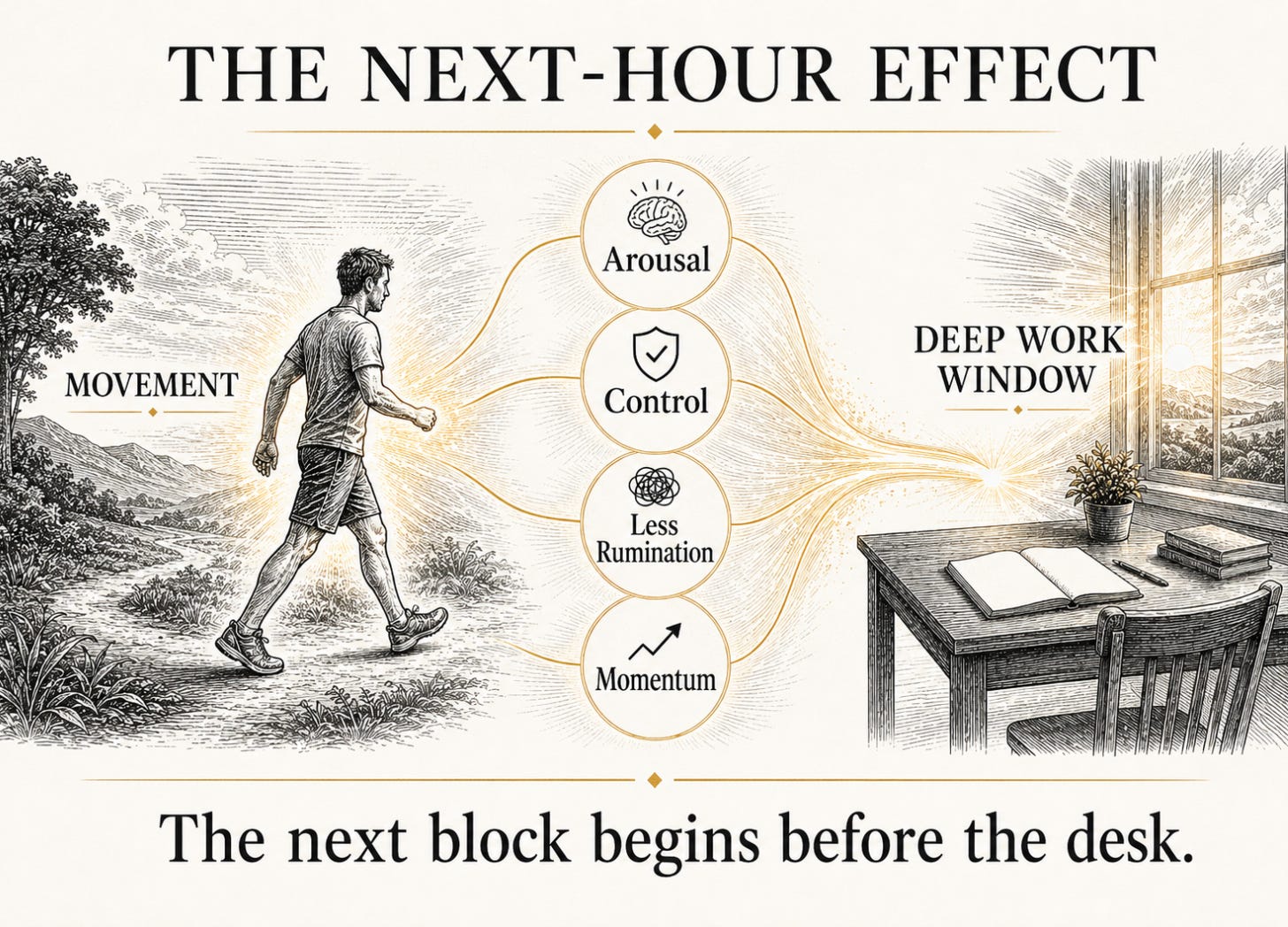
A 2025 scoping review of acute exercise effects on executive function using event-related potentials concluded that acute exercise positively impacts executive function and suggested that the enhancement may last for roughly 30–40 minutes, while also emphasizing that timing after exercise matters and that the mechanism likely involves changes in physiological arousal. A 2026 study then found that a 20-minute bout of moderate-intensity aerobic exercise modulated brain activity and enhanced cognitive performance in both younger and older men, with the authors describing a dual-phase neural mechanism supporting inhibitory control.6
This is exactly why I want to place exercise here in the season.
Because the cognitive gains are not just a chronic, abstract, “be healthier over time” story.
They can be immediate enough to matter for the next block of thinking.
Which means exercise is not only maintenance.
It can be preparation.
Movement can reduce mental stickiness
This is another reason movement matters for the threshold.
A lot of people do not fail to enter work because they are merely sleepy or under-stimulated.
They fail because the mind is sticky.
Caught in rumination.
Caught in loops.
Caught in replay.
Caught in a self-referential mode that keeps using cognitive resources without moving toward task engagement.
A recent study in people with major depression found that a single bout of moderate exercise reduced self-reported rumination more strongly than a sedentary condition and also reduced decoded rumination in favor of distraction in an EEG subsample.7 That does not prove the same effect will look identical in every healthy knowledge worker, but it is strong proof of principle that movement can shift the mind out of one internal mode and into another.
That is the state transition problem again.
Exercise is not always about making you “smarter.”
Sometimes it is about making you less stuck.
And a less stuck mind is much easier to gather.
This is why mindfulness and exercise are not rivals
The previous essay argued that a noisy mind struggles to go deep, and that mindfulness helps build perceptual stability.
That remains true.
But mindfulness and exercise do not solve exactly the same problem.
Mindfulness primarily changes the relation to experience.
Exercise more often changes the state of the system itself.
Mindfulness may help you notice drift with less helpless capture.
Exercise may help make the drift itself less sticky by changing arousal, mood, rumination, and embodied readiness.
These are not competing claims.
They are complementary routes into the threshold.
Some people need stillness before work.
Some people need movement before stillness is even available.
That is why a serious series on peak mental states has to include both.
Not all exercise helps in the same way
This is where the internet usually gets childish.
It hears that exercise helps cognition and concludes:
harder is better,
more is better,
faster is better,
sweat is the point.
The literature does not support that simplification.
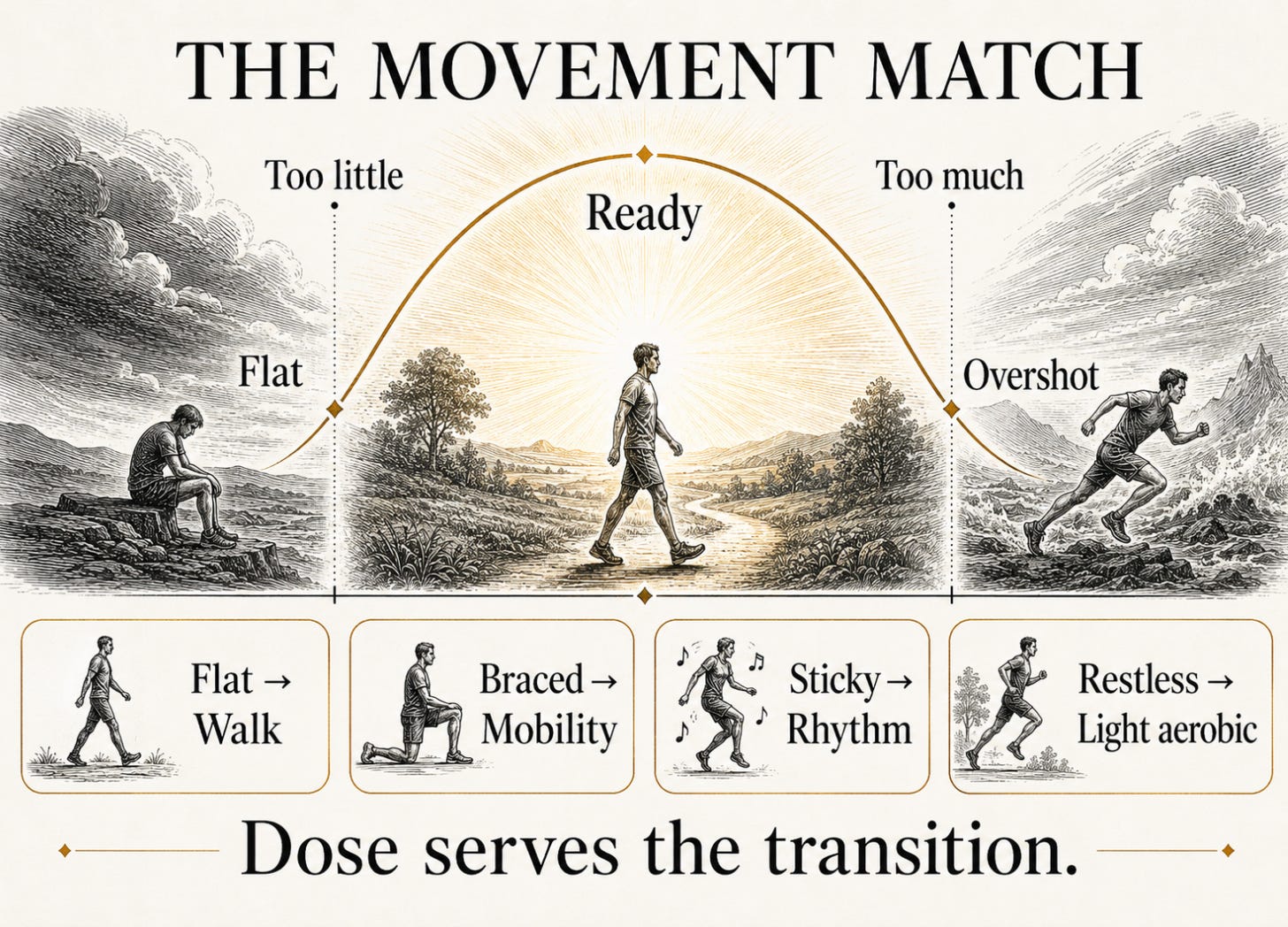
The same 2025 scoping review on acute exercise and executive function emphasizes timing and arousal as key variables, and explicitly invokes the Yerkes-Dodson inverted-U principle: too little or too much arousal can both be counterproductive. A 2025 systematic review of moderate-intensity aerobic exercise in older adults concluded that acute moderate-intensity exercise can improve core executive functions, while also noting the need for better mechanistic clarity. Meanwhile, earlier intensity-dependent work continues to show that moderate intensity is often more favorable than higher intensity for executive-function demands, especially when the task requires clean prefrontal control rather than sheer effort.8
That means the wrong exercise at the wrong time can work against the very thing you want.
Too intense, and you may overshoot into agitation, fatigue, or transient executive disruption.
Too long, and you may deplete instead of prepare.
Too complex, and you may spend the transition budget on the exercise itself rather than on the work that follows.
The point is not “exercise helps.”
The point is:
exercise must fit the state transition you are trying to create.
Exercise is not only activation, it is reorganization
This is the deeper reason it matters.
People often think exercise simply turns the volume up.
That is incomplete.
Movement reorganizes the system.
It changes breathing.
It changes circulation.
It changes muscular tone.
It changes attentional orientation.
It changes how trapped you are in internal narration.
It changes your relationship to inertia.
A 2026 Frontiers review on exercise-induced executive-function changes in older adults summarizes this more mechanistically, describing acute exercise as expanding the “resource pool,” increasing neural-resource recruitment, and enhancing prefrontal cortical activity in ways that can temporarily improve executive function.9
Whether one accepts that exact phrasing or not, the practical implication is obvious:
movement can alter the whole readiness profile of the organism.
That is why it is so often useful before demanding work.
Not because it is virtuous.
Because it is functional.
Why sedentary knowledge work makes this problem worse
Modern knowledge work intensifies the state transition problem.
You wake into screens.
You sit before moving.
You ask for precision from a system that has barely changed state.
You try to descend into abstract work from an organism that has received very few embodied signals of entry.
Then you wonder why the threshold feels stubborn.
This is not a moral problem.
It is a design problem.
If the organism has not yet crossed into a more usable pattern of activation, rhythm, and engagement, then asking for high-grade cognition may be like trying to start a cold engine by lecturing it.
That is why so many people find that a short walk, a moderate bike ride, a few minutes of mobility, or even a brief burst of light movement changes the next hour more than another block of internal argument ever does.
The movement did not merely “burn off energy.”
It changed the entry conditions.
Exercise can itself become a flow context
There is another reason this essay matters.
Movement is not only a preparatory tool for other forms of work.
It can itself be a setting where flow is naturally available.
Sport and exercise contexts are rich in immediate feedback, embodied challenge, clear goals, and tightly coupled action-perception loops, which is one reason they remain so important in the broader study of flow. Recent theoretical work in sport explicitly treats flow as something emerging within performer-environment dynamics rather than as a purely internal feeling detached from action.10
That helps explain why movement can be such a powerful bridge.
In the right dose and form, it does not merely “wake you up.”
It can move you closer to a state in which attention and action have already begun to cooperate.
That cooperation sometimes carries forward.
Not mechanically.
But often enough to matter.
Why this belongs exactly here in the season
The order is deliberate.
We began with thresholds.
Then physiology.
Then guarding.
Then curiosity.
Then consent.
Then meaning.
Then perceptual stability.
Now movement.
Because once you have enough reason to go deep, enough willingness to go deep, and enough stability not to be constantly dragged off course, another question appears:
What if the organism still has not crossed the state boundary?
That is where exercise enters.
Not as another wellness obligation.
As a lawful way of changing the whole starting position.
And that is why the title of this essay matters.
Movement changes the conditions of thought.
Not metaphorically.
Operationally.
The rep for today
Do not ask, “Should I exercise more?”
Ask a better question.
The State Transition Audit
Think of one work block in the last week that should have gone deeper than it did.
Then write five lines.
1. What state was I in before the block began?
Flat?
Braced?
Foggy?
Sticky?
Restless?
Mentally overactive but physically inert?
2. Would movement likely have helped this state?
Not in theory. In practice.
3. What kind of movement would have matched the state transition I needed?
Walk?
Cycle?
Mobility?
Short aerobic work?
Resistance work?
Something rhythmic?
Something light?
4. What would have been too much?
Too intense?
Too long?
Too close to the task?
Too draining?
Too cognitively noisy?
5. What is one pre-work movement rule I can test in the next 24 hours?
Then test one thing.
One.
Not ten.
Maybe it is:
a 10-minute walk before writing
light movement before morning screens
moderate cycling before the most cognitively demanding block
mobility and breathing before a task that usually begins with bracing
a rule that no important desk block starts from total physical stillness
Do not ask only, “How do I think better?”
Ask, “What state is my body in when I ask it to think?”
That is the sharper question.
The standard to keep
You do not always need more motivation.
Sometimes you need a cleaner transition.
That is the standard.
Exercise is not just a health habit in this series.
It is one of the practical levers by which the organism can cross from flatness, rumination, or static bracing into a more usable state for thought.
Not every movement session will help.
Not every intensity will fit.
Not every timing will serve.
But the larger law remains:
the mind often enters work differently when the body has already begun to move.
That is why movement changes the conditions of thought.
If this series speaks to you
The Thursday essays clarify the architecture.
The Monday manuals turn it into practice: state-transition audits, movement matching, timing, dose, intensity control, and field-tested protocols built to be used under pressure, not merely admired in theory.
Next Monday’s subscriber edition is Use Exercise to Enter Work, Not Escape It: The Pre-Flow Exercise Protocol for activation without overshoot.
Garrett, J., Chak, C., Bullock, T. and Giesbrecht, B. (2024) ‘A systematic review and Bayesian meta-analysis provide evidence for an effect of acute physical activity on cognition in young adults’, Communications Psychology, 2, Article 82. doi: 10.1038/s44271-024-00124-2; Singh, B., Bennett, H., Miatke, A., Dumuid, D., Curtis, R., Ferguson, T., Brinsley, J., Szeto, K., Petersen, J.M., Gough, C., Eglitis, E., Simpson, C.E.M., Ekegren, C.L., Smith, A.E., Erickson, K.I. and Maher, C. (2025) ‘Effectiveness of exercise for improving cognition, memory and executive function: a systematic umbrella review and meta-meta-analysis’, British Journal of Sports Medicine, 59(12), pp. 866–876. doi: 10.1136/bjsports-2024-108589.
Garrett, J., Chak, C., Bullock, T. and Giesbrecht, B. (2024) ‘A systematic review and Bayesian meta-analysis provide evidence for an effect of acute physical activity on cognition in young adults’, Communications Psychology, 2, Article 82. doi: 10.1038/s44271-024-00124-2; Cai, Z., Shi, L., Wu, W., Meng, L., Ru, Y. and Wu, M. (2025) ‘A scoping review of effects of acute exercise on executive function: evidence from event-related potentials’, Frontiers in Psychology, 16, Article 1599861. doi: 10.3389/fpsyg.2025.1599861; Wang, K.-P., Chen, L.-J., Yu, C.-L., Chen, D.-T., Hung, T.-M. and Hsieh, S.-S. (2026) ‘Moving the body or watching the screen: 20-minute exercise modulates brain activity and enhances cognitive performance in younger and older male adults’, Mental Health and Physical Activity, 30, Article 100760. doi: 10.1016/j.mhpa.2026.100760.
Farrokh, D., Davids, K., Araújo, D., Strafford, B.W., Rumbold, J.L. and Stone, J.A. (2025) ‘Towards an ecological dynamics theory of flow in sport’, Acta Psychologica, 253, Article 104765. doi: 10.1016/j.actpsy.2025.104765.
Jackman, P.C., Dargue, E.J., Johnston, J.P. and Hawkins, R.M. (2021) ‘Flow in youth sport, physical activity, and physical education: a systematic review’, Psychology of Sport and Exercise, 53, Article 101852. doi: 10.1016/j.psychsport.2020.101852.
Garrett, J., Chak, C., Bullock, T. and Giesbrecht, B. (2024) ‘A systematic review and Bayesian meta-analysis provide evidence for an effect of acute physical activity on cognition in young adults’, Communications Psychology, 2, Article 82. doi: 10.1038/s44271-024-00124-2; Singh, B., Bennett, H., Miatke, A., Dumuid, D., Curtis, R., Ferguson, T., Brinsley, J., Szeto, K., Petersen, J.M., Gough, C., Eglitis, E., Simpson, C.E.M., Ekegren, C.L., Smith, A.E., Erickson, K.I. and Maher, C. (2025) ‘Effectiveness of exercise for improving cognition, memory and executive function: a systematic umbrella review and meta-meta-analysis’, British Journal of Sports Medicine, 59(12), pp. 866–876. doi: 10.1136/bjsports-2024-108589.
Cai, Z., Shi, L., Wu, W., Meng, L., Ru, Y. and Wu, M. (2025) ‘A scoping review of effects of acute exercise on executive function: evidence from event-related potentials’, Frontiers in Psychology, 16, Article 1599861. doi: 10.3389/fpsyg.2025.1599861; Wang, K.-P., Chen, L.-J., Yu, C.-L., Chen, D.-T., Hung, T.-M. and Hsieh, S.-S. (2026) ‘Moving the body or watching the screen: 20-minute exercise modulates brain activity and enhances cognitive performance in younger and older male adults’, Mental Health and Physical Activity, 30, Article 100760. doi: 10.1016/j.mhpa.2026.100760.
Welkerling, J., Niess, A., Schneeweiss, P., Sudeck, G., Rohe, T. and Wolf, S. (2026) ‘Single bout of exercise reduces self-reported and decoded rumination in favor of distraction in patients with major depression’, Journal of Affective Disorders, 397, Article 120829. doi: 10.1016/j.jad.2025.120829.
Cai, Z., Shi, L., Wu, W., Meng, L., Ru, Y. and Wu, M. (2025) ‘A scoping review of effects of acute exercise on executive function: evidence from event-related potentials’, Frontiers in Psychology, 16, Article 1599861. doi: 10.3389/fpsyg.2025.1599861; Çakaloğlu, E., Yüksel, H.S., Şahin, F.N., Güler, Ö., Arslanoğlu, E., Yamak, B., Aydoğmuş, M., Yaşar, O.M., Gürkan, A.C., Söyler, M., Ceylan, L. and Küçük, H. (2025) ‘The acute effects of moderate-intensity aerobic exercise on core executive functions in healthy older adults: a systematic review’, Life, 15(2), Article 230. doi: 10.3390/life15020230.
Cai, Z. and Li, S. (2026) ‘Research progress on exercise-induced executive function improvements in older adults: insights from functional near-infrared spectroscopy’, Frontiers in Psychology, 17, Article 1675737. doi: 10.3389/fpsyg.2026.1675737.
Farrokh, D., Davids, K., Araújo, D., Strafford, B.W., Rumbold, J.L. and Stone, J.A. (2025) ‘Towards an ecological dynamics theory of flow in sport’, Acta Psychologica, 253, Article 104765. doi: 10.1016/j.actpsy.2025.104765.